Chalice of darkness, p.1
Chalice of Darkness, page 1


Contents
Cover
Also by Sarah Rayne from Severn House
Title Page
Copyright
Chapter One
Chapter Two
Chapter Three
Chapter Four
Chapter Five
Chapter Six
Chapter Seven
Chapter Eight
Chapter Nine
Chapter Ten
Chapter Eleven
Chapter Twelve
Chapter Thirteen
Chapter Fourteen
Chapter Fifteen
Chapter Sixteen
Chapter Seventeen
Chapter Eighteen
Chapter Nineteen
Chapter Twenty
Chapter Twenty-One
Chapter Twenty-Two
Chapter Twenty-Three
Chapter Twenty-Four
Chapter Twenty-Five
Chapter Twenty-Six
Author’s Note
Also by Sarah Rayne from Severn House
The Phineas Fox mysteries
DEATH NOTES
CHORD OF EVIL
SONG OF THE DAMNED
MUSIC MACABRE
THE DEVIL’S HARMONY
THE MURDER DANCE
The Nell West and Michael Flint series
PROPERTY OF A LADY
THE SIN EATER
THE SILENCE
THE WHISPERING
DEADLIGHT HALL
THE BELL TOWER
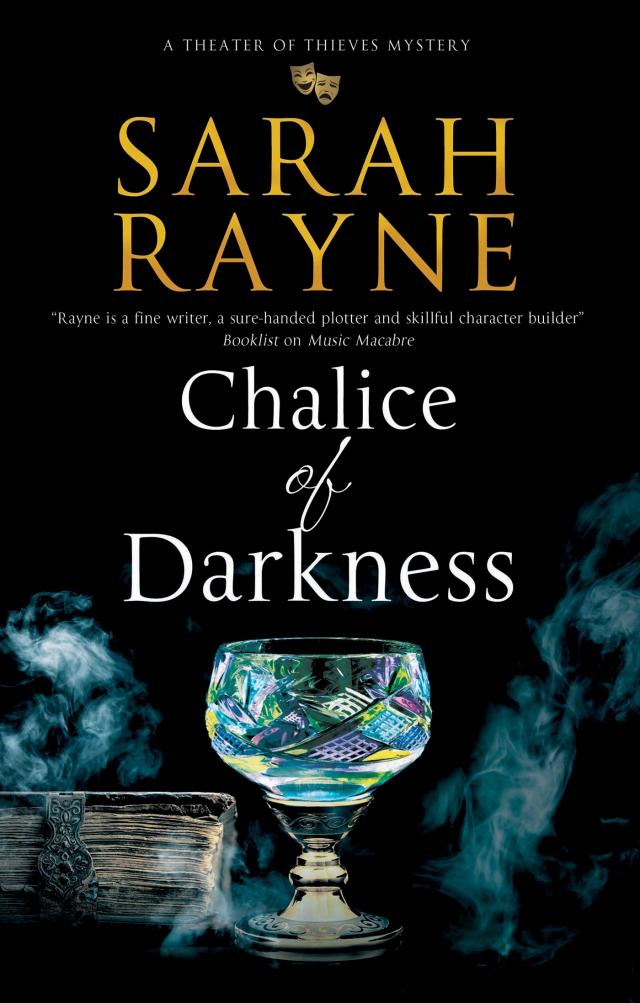
CHALICE OF DARKNESS
Sarah Rayne
This ebook is copyright material and must not be copied, reproduced, transferred, distributed, leased, licensed or publicly performed or used in any way except as specifically permitted in writing by the publishers, as allowed under the terms and conditions under which it was purchased or as strictly permitted by applicable copyright law. Any unauthorised distribution or use of this text may be a direct infringement of the author’s and publisher’s rights and those responsible may be liable in law accordingly.
First world edition published in Great Britain and the USA in 2023
by Severn House, an imprint of Canongate Books Ltd,
14 High Street, Edinburgh EH1 1TE.
Trade paperback edition first published in Great Britain and the USA in 2023
by Severn House, an imprint of Canongate Books Ltd.
This eBook edition first published in 2023 by Severn House,
an imprint of Canongate Books Ltd.
severnhouse.com
Copyright © Sarah Rayne, 2023
All rights reserved including the right of reproduction in whole or in part in any form. The right of Sarah Rayne to be identified as the author of this work has been asserted in accordance with the Copyright, Designs & Patents Act 1988.
British Library Cataloguing-in-Publication Data
A CIP catalogue record for this title is available from the British Library.
ISBN-13: 978-1-4483-0640-4 (cased)
ISBN-13: 978-1-4483-0644-2 (trade paper)
ISBN-13: 978-1-4483-0643-5 (e-book)
This is a work of fiction. Names, characters, places and incidents are either the product of the author’s imagination or are used fictitiously. Except where actual historical events and characters are being described for the storyline of this novel, all situations in this publication are fictitious and any resemblance to actual persons, living or dead, business establishments, events or locales is purely coincidental.
This eBook produced by
Palimpsest Book Production Limited,
Falkirk, Stirlingshire, Scotland
ONE
Augustus Pocket sat in a corner of the bare stage and hoped that this was not going to be the day when the Fitzglens in general, and Mr Jack Fitzglen in particular, embarked on a course of action that would end in their downfall. After his years as dresser to Mr Jack, Gus supposed he ought to be accustomed to the family’s ways, but he was not. Every time one of them came up with a new scheme, Gus imagined them all being locked up in some bleak cell, in company with half the old lags in London.
‘They’re society burglars, the Fitzglens,’ old Todworthy Inkling had said to Gus when Gus first went to work for the family. ‘They might bound around the stage, declaiming Shakespeare, and put on lavish concerts for the King, and dine with the wealthy, but they’re criminals, every last one of them. Burglars – thieves, robbers, filchers, screwsmen. They’re very good at what they do, though – and,’ he said, with one of his sly winks, ‘they only steal from the rich. And even though they’re criminals, they’re extremely charming.’
Mr Jack was being extremely charming now. He was standing at the centre of the stage, his eyes alight with enthusiasm.
‘I’ve asked you here tonight because I’ve worked out our next filch,’ he was saying. ‘And it’s going to involve something so famous and so priceless that it’ll be the talk of London for years to come.’
A sharp voice said, ‘I hope you aren’t about to announce that we’re going to lift something like the Star of India, because it would be an impossibility, and I’ll have nothing to do with it.’
This was Miss Daphnis, of course – the majestic Daphnis Fitzglen who in her youth had been admired by the King when he was Prince of Wales, and who, even now, could sweep on to a stage and inspect the front row of the stalls through a lorgnette, with a stare that silenced even the most chattersome of audiences.
‘Don’t talk rot, Daphnis,’ said Mr Rudraige, who would never be left out of any argument that was brewing. ‘Jack won’t be planning anything so outrageous.’
‘And so risky,’ murmured Mr Byron Fitzglen, who had draped himself on a chaise longue that had been left on the stage after the week’s performance. ‘But I’m all agog to hear Jack’s plan.’
‘Never mind agog, get to the point, Jack, because it’s Sunday night, let’s remember – the one night we’re usually free to go about our lawful occasions—’
‘Or unlawful,’ murmured a sardonic voice from the chaise longue.
‘—and when I had your note I was about to set off for the Thespis Club, and they’ve just had a consignment of Tuke Holdsworth,’ said Mr Rudraige, glaring at Byron.
Mr Jack abandoned his centre-stage stance and sat down at the table. ‘Aunt Daphnis,’ he said, ‘of course I haven’t got the Star of India in mind, and Rudraige, I’ll be brief so you can go along to drink your port at the Thespis.’ He leaned forward. His hair, which ladies said was like amber silk or honey with the sun on it, had tumbled over his forehead. ‘We’re going to mount a marvellous, lavish production,’ he said. ‘It will be so extravagant and splendid it will be anticipated for weeks ahead of its opening, and we’ll be booked up for months. But on opening night …’
‘Yes?’ said several voices.
‘On opening night, making a surprising and dramatic appearance of its own, will be something immeasurably rare and famous. Something about which there’s always been a great deal of rumour and speculation – about which legends have been spun. When the Amaranth’s curtain rises, there it will be.’
‘Is it something you want us to filch beforehand, Jack, because we can hardly do that, then display it to half of London on our own stage,’ said a dubious voice from the other end of the table.
‘Well said, Ambrose,’ nodded Miss Daphnis. ‘Jack?’
‘We won’t be filching anything,’ said Mr Jack. ‘At least – we won’t be seen to be filching anything. We’re going to reclaim something that vanished fifteen years ago.’
‘What? What are we going to reclaim?’
The smile that was both mischievous and beckoning showed briefly, then Mr Jack said, ‘The Talisman Chalice.’
Jack Fitzglen thought there were times when an audience’s reaction disappointed you. Times when you worked and rehearsed until you were drained, and when you almost sweated blood to get a response from your audience – only to find that they sat in stony silence, not laughing or crying or displaying any trace of emotion, so that you wondered why on earth you were in the theatre at all.
But this was not one of those times. The shocked silence that descended on the little group of people on the Amaranth’s stage was all he could have wished.
He thought it would be either his Uncle Rudraige or Daphnis who would speak first, and in the end it was Rudraige. Of course it would be, thought Jack, with an inward and affectionate smile.
Rudraige said, ‘That sounds like an extremely far-fetched scheme.’
‘It sounds like an impossibility,’ put in Byron. ‘Apart from anything else, nobody’s ever known what happened to the Talisman Chalice, have they?’
‘It was supposed to have been stolen,’ said Daphnis, ‘although nobody ever found out who had stolen it – or if anyone did find out, it was all kept very secret. Fifteen years ago, wasn’t it, Rudraige?’
‘It was. You and Jack were too young to be really aware of it at the time, Byron, but I remember it very well.’
‘It was going to be part of a display the Victoria & Albert Museum were mounting—’
‘To celebrate Edward VII’s fiftieth birthday,’ said Rudraige, eagerly. ‘The museum had arranged a special glass case for it, and then, when it came to it, the chalice was nowhere to be found. The V&A were horrified and all kinds of wild accusations flew around. All the newspapers reported it. “Royal treasure stolen”, that was what they wrote. And, “One of the oldest items in the monarch’s possession”. The whole thing caught people’s imaginations.’
‘And sold a lot of newspapers in the process,’ remarked Daphnis, tartly.
‘Well, yes.’
‘I always thought the chalice didn’t really exist,’ said a rather worried voice that had not spoken yet. ‘My mother said the stories about it were just twopence-coloured tales cooked up by the newspapers.’
‘It does exist, Cecily,’ said Jack, turning to her.
‘Yes, and weren’t ballads even written about it?’ asked Byron.
‘They were.’ Rudraige frowned in an effort of memory. ‘Daphnis, wasn’t there one supposed to be about its history – what was it called—?’
‘“The Lament of the Luck-filled Vessel”,’ said Daphnis. ‘I remember it very well. “There’s a fortune’s gone a-begging/And the luck’s gone out the door—” I don’t recall any more of the words, though.’
‘Nor do I, but it was a good song,’ said Rudraige, rumty-tumming a tune on the table top with his fingertips.
Jack said, ‘It’s true that nobody ever knew what happened to the chalice.’ He looked round at them. ‘Until now,’ he said.
There was another of the abrupt silences, then Ambrose said, ‘You’ve never found it, Jack? Or found out who pilfered it?’
‘Of course he hasn’t. He’s teasing us.’
‘I’m not teasing you, and I haven’t found it yet, and I have no idea who might have pilfered it. But I think I might have discovered where it is,’ said Jack. By this time even Byron had forgotten about being a languid poet and was sitting up straight so as not to miss anything.
Jack reached into a pocket, and produced a large envelope. ‘This is a letter to my father,’ he said, pleased that his voice sounded perfectly normal, because he did not want to show any emotion about this. ‘I found it in the old costume room – I was looking for ideas for something dazzling and unusual that we might use as a focus for our next piece.’
‘Or that we might profitably filch,’ murmured Ambrose.
‘Well, that, too. And I found this.’
Before anyone could ask questions, he read the letter out.
‘“My dear Aiden – and I hope I may call you that.
“I send you with this letter two photographs which show me with both the items you arranged to be brought to me last month. You may be sure they will be kept safely.
“The photographs have been taken discreetly and in secrecy, and, of course, are not known about here. However, I think they are excellent reproductions, and I am sending them partly as a mark of my gratitude, but also because it will mean that somewhere beyond this house proof of my ownership will exist. Perhaps one day I will be glad of that. If it is ever possible for the sender to be told how much I treasure his gift and how much it meant to me, I would be most grateful.
“Thank you so very much for what you have done. It pains me to now write this, but I know you will understand when I say that on no account must you come to Vallow and certainly never to Vallow Hall. I wish it could be otherwise, but you and I both know it can not.
“With my very warmest good wishes, Maude.”’
‘It’s dated December 1891,’ said Jack. ‘With it were these photographs.’
He placed them on the table, and they all leaned forward. Byron abandoned the chaise longue and came over to the table. Jack sat back, watching them, curious to know if the photographs affected them in the way they had affected him. At first glance the images were not so very remarkable; two of them showed a young lady with dark hair coiled smoothly into the nape of her neck, wearing a gown that Jack thought was the style of the Nineties. In one photograph she was holding some kind of document – it was impossible to read the writing on it, but there was the impression of ornate script and of ribbon sewn down the left-hand side, as in a legal document. In the other photograph more of the room was visible, as if the photographer had moved his equipment back a little way. It might be any drawing room in any large house, although it looked more like a study, or even a library.
But the third photograph was different. It showed a piecrust table, and on it was a large, stemmed bowl, elaborately shaped, almost with folds, suggesting the petals of a rose. Even in the black and white and grey image it was obvious that the bowl was glass, and that it was tinted. Tiny figures were discernible, as if several scenes were depicted, and it was as if an illuminated medieval manuscript had been cast in glass, or as if a stained-glass window had been re-shaped. Jack again regretted the absence of colour, because in reality the chalice would glow with richness – crimson and violet and jade …
He said, ‘I’m taking it that the lady in those two photographs is the writer of the letter.’
‘Maude,’ said Byron, softly.
‘Yes. And that,’ said Jack, touching the third photograph with a fingertip, ‘is the lost Talisman Chalice.’
‘The curious thing,’ said Rudraige, after the photographs had been passed round and studied, and the letter read by everyone, ‘is that on the night of the fire in this theatre, your father went back inside, Jack. None of us ever knew why.’
‘But now you think it might have been to get this letter and the photographs?’ Why his father had gone back into the burning Amaranth that day was a question that had always lain uncomfortably at the deepest part of Jack’s mind. It was not a question he had ever asked until now, because he had never dared allow the memory of his father’s death into the light.
But Rudraige said, ‘I don’t know. But I do think he tried to get up to the costume room.’
‘Have any of you heard of Vallow?’ asked Jack. ‘Or Maude?’ As they shook their heads, he said, ‘Well, no matter. Because what we’re going to do is find the chalice, take it back, and make it the centrepiece of a play here at the Amaranth.’ He grinned. ‘Can’t you just visualize the interest that will create? Most of London will be queuing up for seats.’
‘It’d solve the problem of the dry rot,’ observed Rudraige, sepulchrally.
‘Has the Amaranth got dry rot? My father always said you could never get rid of dry rot. Not once it had got hold of a building.’
‘Cecily, the Amaranth’s had dry rot ever since anyone can remember. It’s positively rampant, but of course it can be got rid of.’
‘Always supposing you can afford to do so,’ said Ambrose, who had been jotting down figures and apparently trying to add them up.
‘Jack, what do you know about the Talisman Chalice?’ demanded Daphnis.
‘Not very much,’ said Jack. ‘But I think Byron might know more. Byron?’
‘Well, I do know a little,’ said Byron, clearly pleased at being deferred to. ‘And one of the things I do recall is a superstition that it carries good fortune with it – almost as if it’s contained inside the chalice itself.’
‘Like a soup tureen,’ murmured Cecily.
‘But there’s a dark side,’ Byron went on. ‘The legend is that the good fortune is only for the rightful owners, and that if it’s taken from them, the luck is poured away, and very ill luck indeed fills it up instead, and spills out on to the – well, the wrongful owner. I think that’s what the words of that ballad meant, Rudraige. That line about “A fortune’s gone a-begging” was actually “Fortune’s gone a-begging”.’
‘Gone a-begging, because the chalice had been stolen from the rightful owners,’ said Jack, thoughtfully.
‘But who are the rightful owners?’ asked Cecily.
Byron glanced at Jack, who nodded, as if to say: go on. ‘They’ve had several names over the centuries,’ said Byron. ‘But when they first acquired the chalice, they were called—’
‘Yes?’ said several voices, as Byron, who knew, as all the Fitzglens did, the effect of a well-judged pause, broke off. Then he said, ‘At the start of the chalice’s history they were called Plantagenet.’ He looked across at Jack, as if handing the conversation back to him.
Jack said, ‘And now, of course, we know them by the name of Saxe-Coburg-Gotha.’
For a moment he thought he had miscalculated. I’ve over-reached, he thought. Gus always said I would, one day. He glanced at Gus, who was sitting quietly in his chair, and saw him give a small nod of encouragement. This was reassuring, because Gus’s instinct was seldom wrong.
Daphnis said, very sharply, ‘You’re talking about the British royal family? Our own royal family?’