Chalice of darkness, p.2
Chalice of Darkness, page 2
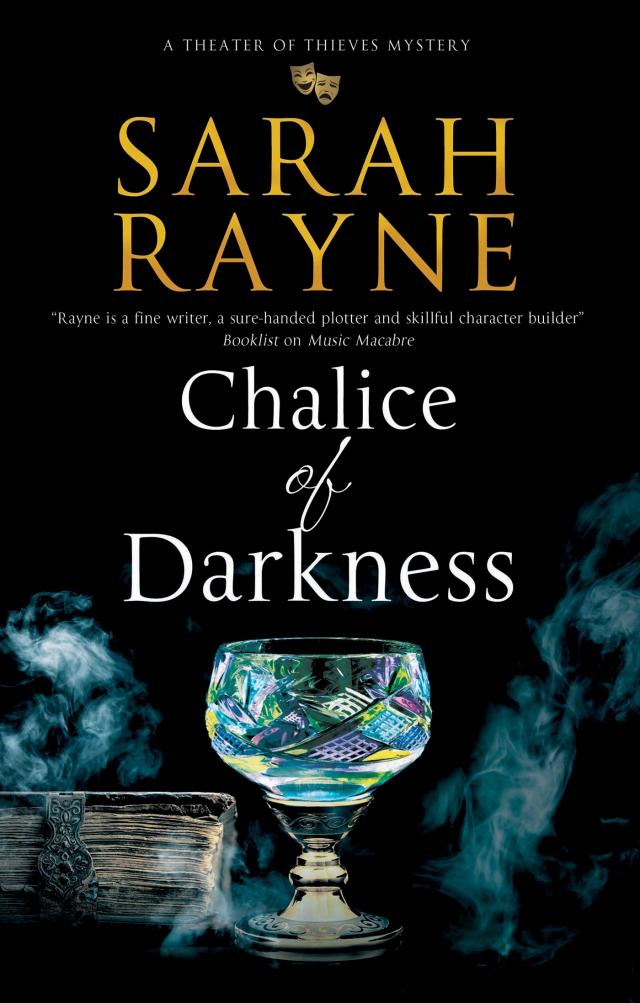


‘Yes, he is,’ said Byron. ‘They’re supposed to have acquired the chalice somewhere in the thirteen hundreds. I don’t know how or from where, although I should be able to find out. As for the superstition – I wouldn’t think the present incumbents of the throne give it much credence. They’re far too down to earth.’
‘I agree. But,’ said Jack, ‘around fifteen years ago—’
‘In 1891,’ murmured Byron, glancing at Maude’s letter.
‘Perhaps. Around that time, somebody in that family either lost the chalice, or it was stolen.’
‘And the theft covered up.’ This was Daphnis.
‘You know, I wouldn’t be surprised if old Edward didn’t quietly lift it to bestow on one of his lady friends,’ observed Rudraige. ‘“A little mark of affectionate gratitude, my dear”,’ he said, and such was his stagecraft that for a moment it was the now-ageing Edward VII who sat there. ‘In fact now I think back, I believe that old ballad about fortune going a-begging was supposed to have been written after Edward got drunk one night in company with a crowd of actors and actresses, and related the legend to them.’
‘And somebody took notes and wrote the song?’ asked Cecily.
‘I shouldn’t be surprised. I even have a feeling that one of the Gilfillan lot was among the company that night.’
‘Oh, they get everywhere, those Gilfillans,’ said Ambrose. ‘I wouldn’t put anything past them. They’re always spying on us and trying to get in with their own version of a play ahead of us.’ He glanced over his shoulder, as if he expected to see Gilfillans lurking in the wings.
‘But,’ said Cecily, ‘the chalice might simply have been broken by a housemaid who never admitted it – and they simply put out the theft theory to cover it up. I remember we used to have a Sèvres dish and a housemaid was dusting it one day, and—’
‘Cecily, if this photograph can be believed, the chalice wasn’t smashed by a housemaid brandishing a feather duster,’ said Daphnis.
‘But look here, Jack, supposing you can find the chalice,’ said Rudraige, ‘how will you explain it turning up on our stage?’ He fixed Jack with the brow-frowning expression that caused audiences to shiver with fearful delight and theatre critics to write how Rudraige Fitzglen could convey villainous menace better than anyone in the English theatre.
‘Yes, have you got a plan for that?’ demanded Daphnis.
‘Of course he’ll have a plan,’ said Byron.
‘The plan is that one of us has an admirer,’ said Jack. ‘But it’s someone who has never let his name be known, but who has nurtured his – or, of course, her – passion for years in utter secrecy. But who’s now sent a gift hinting that it has a mysterious history—’
‘And expressing the hope it can be used in a play?’ asked Byron. ‘Oh, I like that.’
‘And the gift is the Talisman Chalice,’ said Ambrose, thoughtfully.
‘Who’s going to have the admirer?’ demanded Daphnis. ‘I wouldn’t mind it being me. Someone from my past, we could make it. I was not unsought in my youth,’ she added.
‘I could write the letter from him,’ offered Byron.
‘Yes, it’s very much your province, Byron.’ Jack had hoped Byron would offer, and he was pleased.
‘It’d have to prove we hadn’t stolen the chalice, but that shouldn’t be difficult.’ Byron sat up enthusiastically, then remembered about being a poet, and relapsed into semi-languor. ‘Of course, I’m quite busy at the moment with the family history and my epic poem, and you can’t just switch off the muse—’
‘Oh God,’ said several voices.
‘You’ll be very glad when that history’s finished, and bound in vellum,’ said Byron, indignantly. ‘I’ve already dealt with that uncle on Aunt Daphnis’s side who was involved in the disappearance of the Fabergé egg from the Russian imperial court. And,’ he said, ‘I’m on the track of the founder of this family – Highwayman Harry who romped around holding up carriages in the seventeen hundreds.’
‘Angels and ministers of grace defend me,’ said Rudraige. ‘Jack, if Byron ever finishes his opus, for pity’s sake make sure it doesn’t see the light of day until we’re all safely dead. Otherwise we’ll all be hailed off to the clink.’
‘Yes, but Byron will make a good job of creating a letter to go with the chalice,’ said Jack. ‘He’s forged much more difficult things in his time.’
‘Such as when we spruced up that silver coffee pot, and Byron wrote a letter making it seem as if it was a gift from David Garrick to Peg Woffington.’ Ambrose nodded. ‘He wrote how Garrick was looking forward to drinking coffee out of it with her.’
‘Todworthy Inkling got an excellent price for us on the strength of that,’ said Jack.
‘We had new curtains for the royal box out of it,’ put in Cecily.
‘I suppose,’ said Ambrose, suddenly, ‘that it is the real thing, is it, that chalice in the photograph? It isn’t a copy?’
‘You can’t tell from a photograph,’ said Byron. ‘But I should think it’d be quite difficult to fake convincingly.’
‘Then assuming we’re agreed that it’s the genuine article,’ said Rudraige, ‘and that its whereabouts can be tracked down, who is going to be the one to actually carry out the filch?’
They glanced at one another. It’s that story about the luck going a-begging and ill luck spilling out if the chalice falls into wrongful hands, thought Jack, watching them. They don’t like that. If I’m honest, I don’t like it, either.
But he smiled round the table, and said, lightly, ‘Since this is my idea, I suppose I’d better be the one to carry it out.’ And felt, as if it was tangible, the relief go through them.
After everyone had left, Jack looked again at the photograph and re-read Maude’s letter. Why had she warned his father never to go to Vallow? Had Aiden been engaged on some filch of his own, and narrowly escaped being caught and had to flee? But that explanation did not seem to fit with the contents of Maude’s letter.
If Jack went to this unknown place called Vallow all these years later, what would he find? The Talisman Chalice itself? Maude? But Maude might have left the country long since, married, gone on safari, died …
He stared at the photograph. Maude, whoever you are – or were – I don’t think you could be called beautiful and certainly not pretty, he thought. But I suspect most people would take a second look at you and probably a third.
For a fleeting moment he touched in his mind the memory of his mother, who had died when he was born, but who was still spoken of with affection by the family. But the woman in these photographs bore no resemblance to the figure in the silver-framed images that were all he had of his mother. And although he would not have ruled out his father having had one or two lovers since his wife’s death, Maude’s letter was not couched in lover’s terms.
And it was important to remember that it was only in novels or rather pretentious plays that valuable objects were discovered in dusty corners, with mysterious letters from enigmatic ladies folded alongside them …
He already knew that he was going to Vallow Hall. He had no idea yet where it was, and he had certainly never heard of Vallow. But he would find it. Even if it turned out to be at the ends of the earth – if it was in some far-flung corner of the Empire, or buried in the undergrowth of the Amazon rainforests or in a remote Tibetan valley – he would go there.
TWO
Vallow Hall was not in a far-flung corner of the Empire or an Amazonian rainforest or a lost valley in Tibet. It was in Northumberland, and it was close to the Scottish border.
‘The village is called Vallow as well,’ said Jack, studying various maps with Byron after that evening’s performance. ‘It looks like the tiniest of places. But it’s a fair journey from London to Northumberland.’
‘Perfectly reachable by rail, though. And once you’re there,’ said Byron, ‘I think you should appear as a gentleman of some substance. Unless you’re thinking of using the tramp ploy, but I hope you aren’t, because it doesn’t really suit you, the tramp ploy. What do you think, Gus?’
‘You can play any role there is, Mr Jack,’ said Gus, who was ironing shirts in a corner of Jack’s dressing room. ‘But I’d have to say that being a tramp doesn’t come naturally to you.’
‘Gus is right. I thought,’ said Byron, ‘that you could recently have come into an inheritance, and be searching for a country residence to purchase. A great-uncle can have died and left you a modest fortune. That’ll mean you can wander around looking at houses and no one will find it peculiar. Actually, of course, you’ll be looking for the chalice and investigating Vallow Hall.’
‘And Maude,’ said Jack.
‘And Maude. I thought you might call yourself Joseph Glennon – what do you think? It’s near enough to your own name not to feel too strange, but sufficiently unlike it for anyone to guess who you really are.’
Jack tried it out with several different emphases. ‘I like it,’ he said at last. ‘And I think Joseph Glennon is quiet and somewhat diffident and a bit naïve.’
‘Academic and slightly overwhelmed by his sudden good fortune,’ agreed Byron.
‘I’ll wear rimless spectacles,’ said Jack. ‘There’s bound to be some in the costume store. They’d look very professorial. And if we don’t travel up there until next week I can probably grow a scholarly looking beard. In fact it had better be a week from now anyway, because Ambrose needs rehearsal if he’s taking over my part in this current piece. Will the two of you keep an eye on things while I’m away? Some of those younger cousins – Rudraige’s side of the family – get a bit unruly at times.’
‘Not to mention Rudraige himself,’ murmured Byron. ‘Now look, I’ve made notes of a couple of properties in the area that don’t seem to be occupied. You could enquire about them. Ambrose has made a sketch map as well, so you can see what’s where. This is starting to turn into a quest, isn’t it?’ he said, hopefully.
‘No, it isn’t,’ said Jack at once. ‘It’s not a quest, it’s a filch. Don’t get carried away with quests and parfit gentil knights and journeys to find holy grails.’
‘All journeys should be regarded as adventures,’ said Byron. ‘Think of the great romantic journeys of history – Marco Polo and Christopher Columbus. And all those marvellous journeys in fiction. Would Anna Karenina have had such an extraordinary relationship with Vronsky if they hadn’t been shut into a railway carriage for several chapters of the book? Tolstoy knew what he was about, didn’t he? And those ancient maps – travellers on the brink of unexplored lands, writing, “Here be dragons” on the maps for the uncharted areas.’
‘Byron, I’m only going as far as Northumberland.’
‘Your trouble, Jack, is that you’ve got no romance in your soul,’ said Byron, severely. ‘Vallow Hall will be your main target of course – just here on the map, d’you see? And then across a field and a bit of woodland is Chauntry School – it sounds as if it’ll have an emphasis on music for the pupils. There seems to be a schoolhouse in its grounds that’s empty.’
‘It looks a bit close to the school,’ said Jack, studying Ambrose’s sketch. ‘Joseph Glennon mightn’t want noise from rugby matches or cartloads of visitors on parents’ days. What was the other house you found?’
‘It’s called Bastle House. I don’t know what a bastle is, but it’s even nearer to the Scottish border than Vallow Hall.’
‘It looks very remote,’ said Jack, studying Ambrose’s map and the strangely named Bastle House. ‘I think Mr Glennon might prefer the schoolhouse. I’d better see what’s in the war chest if I’m to look prosperous enough to buy country houses. Gus, d’you happen to know what we’ve got in there?’
‘There’re still a few things from that last filch in St John’s Wood,’ said Gus.
‘Good. I’ll take them along to Tod Inkling tomorrow.’
Gus spent most of the day packing for the journey to Vallow, and wondering what kind of people they would be meeting. Still, Mr Jack was as much at ease with the lowliest match seller in Sloat Alley outside the Amaranth’s stage door, or the barmaids in The Punchbowl near the theatre, as he was with the grand ladies and gentlemen who came to watch the plays and who often invited Mr Jack to supper or to posh luncheons in their houses in Belgravia or Fitzroy Square. The fact that Mr Jack – often accompanied by Mr Byron or Mr Ambrose – then visited some of those houses a few nights later with a very different purpose was neither here nor there, and in Mr Jack’s favour it had to be said that he only ever took from the rich. Also, he was very generous. Not many people knew that there was a certain soup kitchen near St Martins Lane or a hostel in Spitalfields that received substantial donations.
But Gus did not like the sound of this chalice, even though he did not really believe in superstitions and hoary old stories. People in Pedlar’s Yard, where he grew up, had not paid much attention to such things, not unless it might form a useful part of a story to spin when you were on the flimp. Gus’s pa had been able to spin a very good story if it looked like being profitable.
Mr Byron was going to find out as much as he could about the chalice, which probably meant he would be browsing in the British Museum and also the Victoria & Albert. Gus could not help with that at all – he would not have known what to do in such places – but there might be one thing he could help with. Mr Rudraige and Miss Daphnis had mentioned a song supposed to be about the chalice. They had even sung the first line – about fortune going a-begging, and a luck-filled bowl. The words had stuck in Gus’s mind, and considering them now he thought: supposing that song tells more about this chalice and its history? A lot of those old music hall songs told far more than people realized. They were about the strivings and the struggles of ordinary folk such as Gus had grown up with. They were about poverty and being thrown out of your house because you couldn’t pay the rent, or about going up to the workhouse after you had been together for forty years. Sometimes there were even clues inside them about crimes.
Clues.
Gus reached for his cap and the woollen scarf knitted by Miss Cecily as a Christmas gift last year – she had made quite a ceremony of presenting it, even winding it around his neck to make sure it fitted. Then he made his way across Covent Garden, and into the maze of side streets and alleys, until he reached the cobbled alley with the stone arch overhead, and the jutting bow windows of eight or ten shops beyond it.
Mr Todworthy Inkling’s premises were at the far end. It was a very wide-reaching trade that Mr Inkling followed; as well as dealing in jewellery and silverware (it was usually better not to enquire too deeply into the histories of some of those items), he carried on a perfectly respectable business in old, and often rare and valuable, books. Within this section was a collection of what Gus had learned to call theatrical memorabilia, and it was this he wanted to investigate.
Mr Inkling, enjoying a glass of malmsey by way of an appetizer to his supper – which he would take in any one of the several taverns on his doorstep – was pleased to see Gus. He was, he said, always very happy to welcome anyone associated with the Fitzglens.
‘Mr Jack, of course, brings me the best quality items – he was here only yesterday as a matter of fact, as I daresay you know. Several very nice pieces he brought. A real gentleman, Mr Jack, but then all the family are quality. Miss Daphnis can be a bit of a tartar, and Mr Rudraige has the way of rampaging around the shop and cursing – my word, he knows some splendid Shakespearean curses, Mr Rudraige, I could make your ears curl. But we generally reach an amicable compromise.’
He rearranged the crimson velvet smoking cap, without which he was never seen, poured Gus a glass of malmsey, and, in answer to Gus’s question, said certainly he had a collection of theatrical odds and ends. Something of a mishmash it was, but you picked up what you could.
He topped up his own wine glass, then took Gus along to a small section near the back of the shop, where there were shelves on which were stacked a variety of books, papers, old theatre programmes, and posters.
‘A lot is from the music halls,’ he said, waving a hand towards the shelves. ‘Those cellar places – the Coal Hole, and the Cyder Cellars. My word, they saw some life. You could get away with just about anything on those stages – well, I’m saying stages, but often they weren’t much more than platforms, or a bit of a dais at one end of the room. What exactly are you looking for?’
‘Street ballads,’ said Gus, draining the malmsey, and seeing with slight alarm that it was promptly refilled to the brim because Mr Inkling did not believe in being miserly with his drink.
He was wary about providing any more details on his search, because if Tod thought there might be money to be made he would pounce. So he just said that one of the family had mentioned an old song recently, and he had thought it would be nice if he could find a copy of it. The title, he thought, was ‘The Lament of the Luck-filled Vessel’.
‘And I think it’d be about fifteen years old. The early Nineties. But if it was a street song, it mightn’t have been written down at all.’
‘You can but look. The shelves over here will be the likeliest.’
He reached down a stack of tattered playbills and programmes and deposited them on Gus’s lap. Fortunately, he then went off to another part of the shop, which meant Gus was able to pour most of the malmsey into a handy plant pot. If he had drunk any more of it, he thought he would not have been able to make much sense of anything useful.
Many of the faded playbills and posters bore names that would have been recognizable twenty and thirty years ago, but which nobody today was likely to recognize. Gus found it sad to know that so many hopeful performers and entertainers had had just those brief days of their small fame, then vanished. But it was interesting to delve into this fragment of the theatre world’s past, and he went carefully through everything. And then suddenly there it was. Little more than a fragment – tattered and brown with age, and looking as if the edges might have been chewed by rodents. Most of the page had been torn away, but at the top was the title: ‘The Lament of the Luck-filled Vessel’. And there was the line that Mr Rudraige and Miss Daphnis had chanted.