Chalice of darkness, p.4
Chalice of Darkness, page 4


Maude smiled, then before he could stop her, she went to his study to find notepaper and pen, and wrote a polite acceptance for them both. Before Saul could find out, she gave the note to Lily to post.
‘And it’s important, so I’d like it to be taken to the post office right away, please.’
Lily, scenting intrigue, which she loved, and always ready to take the opportunity to further her erratic romance with the poulterer’s boy in the village anyway, went off at once, concealing the note in her shawl as if it contained State secrets.
When, later in the day, Saul asked if Maude had written to Lady Hymbre, she said she was afraid she must have misunderstood him, because she had sent an acceptance for both of them. His eyes snapped with annoyance, but then he shrugged and said, ‘Very well, but you had better remain at my side all the time, so I can guide you through it – particularly the formal dinner.’
‘Thank you,’ said Maude, in an expressionless voice, and went off to her bedroom to look through her wardrobe, because spending a weekend with important people, one of whom had a brother in court circles – never mind how minor – was a very big event in her life, in fact it would probably be a very big event in anybody’s life.
She could wear the green, velvet-trimmed travelling two-piece for the train journey, and for the formal dinner at which Saul thought she would not know how to behave (did he think she would drink from the finger bowls, for goodness’ sake!), the champagne lace gown with the wide, décolleté neckline, and the ivory silk roses. There was a hair ornament shaped like a silk rose to go with it. She had never worn the gown, but it had been part of her trousseau, because Aunt Hilda had said she must have one or two gowns for formal evening gatherings; she was not sending Maude into marriage without the proper clothes. Perhaps there might be events to which Hilda herself might be invited, she had said.
So far there had not been any events to which Maude had wanted to invite her aunt, in fact there had not been any events at Vallow Hall at all, formal or otherwise, and the gown had hung in a dust sheet in her wardrobe. But it was elegant and dignified and Maude hoped it was not vain to believe it was also becoming.
The elegant and dignified champagne lace seemed as if it was very becoming indeed. Lady Hymbre complimented Maude on how well she looked, and several of the gentlemen cast what Maude thought could be admiring glances her way. This was gratifying, because she was not used to being looked at admiringly.
At dinner that night she sat next to a young man who looked at her with more admiration than any of the others. Maude thought there had been introductions earlier, but Saul had been droning on to her about Hymbre House and its history, and she had not heard the introductions properly. There were place cards at the table, but there was an elaborate table centre partly masking the one at the young man’s place, and she could hardly lean over to read it. So she said that she hoped it was not impolite, but she had not caught the introduction, and that she was Maude Vallow.
He smiled – he had rather a slow smile, as if his mind had to make itself up as to whether smiling was the correct thing to do – then he said, very nicely, ‘I think as it’s you, and as you are very beautiful indeed, you should call me Eddy.’ He looked at her, almost as if to see how she received this, and when she smiled, he said, ‘You know, there are going to be parlour games after dinner, and I’m very bad at parlour games.’
‘Oh, so am I,’ said Maude, never having actually participated in a parlour game.
‘Then shall we go into the conservatory, just the two of us, and I can get to know you a little better?’ he said.
‘Will Lady Hymbre mind?’ said Maude, casting a doubtful glance at their hostess, who was seated imposingly at the foot of the table, and who seemed to be watching Maude and the young man called Eddy very fixedly.
‘I’m sure she won’t,’ he said. ‘But to put your mind at rest, my dear, I’ll have a word with her.’
It seemed that Lady Hymbre did not in the least mind two of her guests taking themselves off to the conservatory while everyone else tried to guess the book titles that were being acted out in Charades, or making up wild stories in Consequences, some of which were making the younger female guests shriek with mirth.
As she slipped out of the room Maude had a moment of nervousness, but there was surely no reason not to talk for a while with another guest, and the young man was courteous and gentlemanly. Saul was deep in earnest discussion with two of the older men and he did not even look round. Lady Hymbre did, though, and she smiled and gave a half-nod, and looked at Maude very approvingly.
The conservatory was warm and shadowy, and there was a heavy, heady scent of flowers. Eddy indicated a small silver tray bearing a decanter of wine and two tall-stemmed glasses set on a low table.
‘I thought we deserved a glass of champagne. To go with your gown, Maude.’
This was entirely charming, and Maude, who was not very used to champagne – who was not really used to it at all – sipped with enjoyment, and then drank a second glass, because it seemed impolite to refuse. Her companion’s fingers brushed hers when he handed her the glass, and she wondered if she might be partaking in a flirtation – she had read about flirtations in conservatories. If so, it was all very polite and well-mannered, and providing she did not stay here too long – and certainly providing she did not have any more champagne – there was nothing wrong about it.
He was very easy to talk to; he listened to everything she said, and smiled and nodded and asked her questions about her life and where she lived. He did not say much about himself, other than that he had recently come back from travelling, and had seen some interesting sights in other countries. He was not what Maude would have called handsome precisely, having a rather heavy jaw so that you might describe him as a bit jowly, but he had nice dark hair, and eyes which somehow had a sleepy look. Slumbrous might be the word.
But when she got up to go back to the drawing room, the room tilted slightly and she gasped and put out a hand to steady herself.
Eddy had stood up at the same time, and he put out a hand to her. ‘Have I made you a bit squiffy, Maude?’ he said. ‘I’m sorry. Perhaps you oughtn’t to go back to the drawing room. Perhaps I had better help you up to your bedroom.’
‘I could go up on my own.’
‘Oh, no,’ he said, very gently, smiling down at her. ‘I’m coming with you, Maude.’
Lady Hymbre had allotted to Maude and Saul two adjoining bedrooms. The inter-connecting door was closed, and the room where Maude’s things had been laid out was warm and comfortable. Her nightgown was on the bed, ready for her, and there was a fire in the hearth. Somebody – presumably one of the maids – had lit the gas jets earlier, turning them very low, so that the room was filled with a soft light.
But the bedroom was as unsteady as the conservatory had been, and Maude was relieved to be helped to the bed, where she could sit down.
The young man hesitated then, and looked down at her. ‘Would you like me to fetch your husband?’ he said, and for some really strange reason Maude had the impression he was not asking that exact question, but that his words had a different meaning altogether, which he expected her to understand.
But she said, at once, ‘Oh, no, you mustn’t fetch Saul,’ and he seemed to relax, and came to sit by her on the bed, taking her hand, and then putting up his other hand to her hair.
Maude had no idea how to respond, but it was nice to have something to cling on to while she was still feeling so peculiar, and it was surprisingly comfortable to feel him stroking her hair, and then unclipping the hair ornament so that her hair fell from its pinnings and tumbled about her shoulders.
‘Oh, beautiful,’ he said in a different voice, and began to twine her loose hair between his fingers. ‘I’m so very pleased we met tonight, Maude.’
His hands were still caressing her hair, and now they were on her shoulders as well and her shoulders were bare because of the gown being low-cut. And then somehow – Maude had no idea how it had happened – the fastenings of her gown were being loosened, and it was being slipped down, so that her silk chemise was visible.
He said, in a whisper close to her ear, ‘This is all right, isn’t it, Maude? This is what we meant?’
‘Oh, yes,’ said Maude, not knowing what else to say.
His hands were sliding under her gown, and he was breathing fast as if he had been running. ‘And – you’ll forgive me asking – but you are quite prepared, are you?’
‘Oh, yes,’ said Maude again, having no idea what he meant, but not wanting to appear stupid or ignorant or naïve.
He thrust his hands deeper under her gown, and began to move against her, and it was a little like the way Saul moved on those Saturday nights, but in a curious way it was nothing like that at all, because Eddy was doing so with more assurance. There was a moment when he seemed to draw back from her slightly, and Maude drew in a shaky breath of relief, because clearly he was now going back to his own room or perhaps back to the drawing room, and it was over.
But it was not over. There was the sense of him fumbling at something low down, and then the sound of a belt being unclasped – and buttons unfastening? But Maude was still unsteady from the champagne, and she could not be sure she was entirely understanding what was happening.
And then, shockingly, there was the feel of his bare skin against her legs – his thighs, a brush of hair – and the blurred sensation cleared slightly, because it was suddenly obvious that he was going to do to her what Saul did, and it would be horrible and embarrassing, and she would have to see him tomorrow morning at the breakfast table knowing this had happened between them … And Saul might come in at any moment and catch them …
Here came the prodding now, just as she had known it would. Dreadful. Maude thought about shouting for help, but it was not very likely that anyone would hear her, and if anyone did hear and come running it would be even more embarrassing. So she shut her eyes and waited for it to stop, because it would only last for a few minutes, it only ever did …
It did not, though. And it was starting to be very different from what Saul did. This was stronger, somehow more assured and – this was the really surprising thing – it was as if he was enjoying it and wanting to take her into the enjoyment with him. For a remarkable moment Maude felt as if the two of them were sharing something private and special and good.
And then suddenly he was pushing at her with more force, and something hard and very insistent was being forced upwards and right inside her body. Maude gasped and her eyes flew open and met those of the man above her. He was smiling down at her, and she thought he said something about was this all right, because for him this was marvellous. She had no idea how to reply, but it did not seem to matter, because he was moving faster and faster, and this was not like anything she had ever had done to her before, and then without warning there was a deep secret pain, and she cried out with it. And then – the most astonishing thing of all – there was a brief extraordinary moment of soaring pleasure. Like a firework exploding against a night sky – like a shooting star. Then Eddy gasped and cried out, and slumped half on to his side, one arm still about her.
After a few moments Maude managed to half sit up, and to push aside her gown which was crumpled. In doing so she became aware of a sticky wetness between her legs, and when she looked down, there was blood on the sheet beneath her.
It was the most embarrassing situation she had ever known. Eddy sat up and looked at her, and then looked at the blood, and in a voice of shock, said, ‘My dear girl, I had no idea you were a virgin … Your husband— My God, if I had known, I would never have …’
Maude was crying. She said, ‘I don’t understand – I don’t know what to do—’
He was pulling his clothes together; Maude did not want to watch as he buttoned his trousers and tucked in his shirt, so she went on staring at the bloodied sheet. But he said, ‘I think you should ring for one of the maids – can you tell some story about …’ He frowned, then said, ‘About this being the week for your head to ache?’
It took a moment to realize what he meant, then Maude understood, and the colour flamed in her cheeks, because you did not, ever, refer to that uncomfortable week you had once a month. You might have to mention it to a maid in your house, but never ever to anyone else and above all never to a man.
So, not looking at him, she said in a mumble, ‘Yes, I’ll do that. Please will you go now?’
‘I will. But I shall make sure you’re all right, Maude,’ he said. ‘I shall make it my business to know. And if there’s any trouble …’ A pause, then he said, ‘I should want to know.’
‘How could I be in touch with you?’ Maude had no idea what he meant by trouble, but she asked the question anyway.
He said, slowly, ‘A message could be got to me through one of two gentlemen. Connor O’Kane, who was here with me tonight – you didn’t meet him – no? He helped arrange the music entertainment after luncheon. I can give you an address for him.’ He reached into his jacket for a small pocket book, scribbled a few lines on it and gave the page to her. ‘Or there’s a man called Aiden Fitzglen at the Amaranth Theatre in London,’ he said. ‘His theatre has held concerts, recitals for …’ He broke off, frowning, as if he had said more than he had intended, then leaned over, dropped a kiss on the top of her head and went quietly out of the room.
In the end it was quite easy. Maude had an awkward conversation with the housemaid, who whisked the sheet away and brought a fresh one, and Saul, when he finally came upstairs, went into the adjoining room and clambered into bed without even coming in to say goodnight.
And it turned out that ladies staying at Hymbre House were always served breakfast in bed, and by the time Maude got downstairs there was no sign of Eddy and people were leaving. It meant there was a bustle of departures, and farewells and thanks, and Maude and Saul were swept up in it, and they were on the train back to Vallow almost before Maude had time to think.
‘A pleasant enough weekend,’ Saul said, sitting in the corner seat in their railway carriage, and unfolding a newspaper. ‘But not an experience I want to repeat.’
Maude did not answer, partly because he would not expect it, but mainly because she could not think what to say. She had no idea how she felt, but she could not stop remembering what the man called Eddy had said before he left the bedroom.
‘If there’s any trouble,’ he had said, and then he had given her the names of two gentlemen. Connor O’Kane with a London address, and Aiden Fitzglen who was somehow part of a big London theatre. She would not, of course, ever be in touch with either of them, and it would not be necessary anyway, but if she needed to do so, she thought she would rather it was Mr O’Kane than the other man. A London theatre sounded very grand and imposing.
FOUR
One of the things that fascinated Gus about Mr Jack was the way in which he could immerse himself in any part he was playing. It did not matter if he was not on a stage with an audience to watch, either. This morning, for instance, on the platform at King’s Cross, he was playing the part of the hesitant, scholarly Mr Joseph Glennon. The small neat beard he had grown over the last week gave him the appearance of having just come from one of the universities, and his general air was one of bewilderment at having to cope with the noisy bustle of the platforms. The beard made him look older, too – mid or even late thirties – and he had drawn his shoulders forward slightly in what he said was a scholar’s stoop. Gus watched him hesitantly summon a couple of porters and hold an anxious conversation with them about the stowing of his luggage. Could it be put in the guard’s van? Oh, it could. He was most grateful to them, and here was a coin or two for their trouble.
They travelled first class – Mr Jack said he was not having Gus sent off to third.
‘Wooden benches, the windows glued shut, and very likely folk being sick on the floor from the jolting of the carriages,’ he said, as they got on board and found seats.
When the train finally pulled out of the station, Mr Jack reached for the notes Mr Byron had brought last evening.
‘Can you listen to these, Gus? Byron did say it’s only a rough draft, but reading it will give me a better sense of it. Also, between us we might spot some idea for the actual filch.’
‘I’d like to hear it,’ said Gus, at once.
‘Good man. We’ve got the carriage to ourselves – I don’t think there are many stops, so no one’s likely to come in. And we don’t change trains for at least three hours, if not longer.’
As he picked up the first page, Gus saw that he was already so deeply inside the character of Mr Joseph Glennon he was even patting his pockets for his spectacles, which were plain glass. He smiled slightly, then sat back in the comfortable first-class seat, and listened.
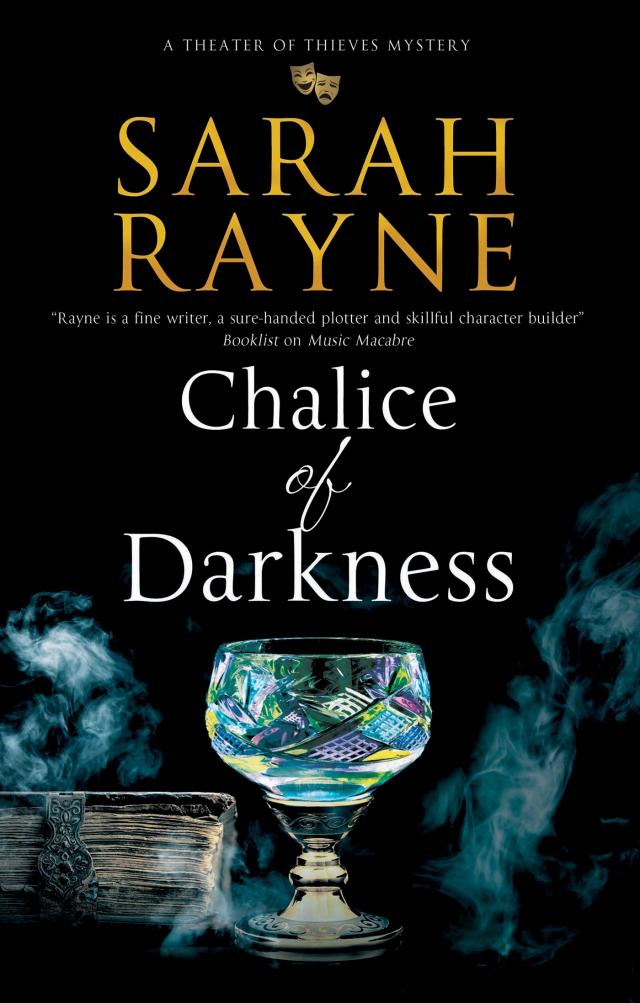
‘The chalice’s legend,’ Byron wrote, ‘really does seem to go all the way back to the Plantagenets – in fact it seems to have begun with no less a person than Richard II. It was made for the founders of an Essex monastery, and there are plenty of descriptions. The colours of the glass are described as violet and magenta, lapis lazuli blue and gentian, as well as amethyst, and – take particular note of this one, Jack – amaranthine purple, “so that the chalice should echo the Greek term for unfading or immortal”. It’s as if this is meant, isn’t it?’
‘It’s why my great-great-grandfather called our theatre the Amaranth,’ said Mr Jack, glancing across to Gus. ‘That’s what Byron means, of course. The name was meant to indicate that the family’s place in theatrical history would be everlasting – would never fade.’
‘I remember Mr Rudraige telling me that.’ Gus was pleased that he could proffer this knowledge.
‘According to the legend,’ wrote Byron, ‘the monks handed down a somewhat discreditable story about Richard II – that during a royal progress and a visit to the monastery, he stole the chalice. I don’t know why a King of England would steal something like that – I haven’t been able to find any suggestion of a motive – but I’d imagine that Richard simply saw the thing, liked it, and decided it would look better in a royal apartment than in a backwater monastery. You can’t say they weren’t acquisitive, never mind arrogant, those Plantagenets.