Gold rush, p.1
Gold Rush, page 1


Gold Rush
Copyright
Copyright © 2025. All rights reserved. The right of Peter Cawdron to be identified as the author of this work has been asserted in accordance with the Copyright, Designs and Patents Act 1988. All the characters in this book are fictitious, and any resemblance to actual persons, living or dead, is purely coincidental. No part of this book may be reproduced or used in any other manner without the written permission of the copyright owner, except for the use of quotations.
Disclaimer: No artificial intelligence (AI) was used in the creation of this story. Some would argue that no intelligence was used at all. I’ll leave that for you to decide. No AI training—the author does not permit the use of this book for training artificial intelligence or large-language models.
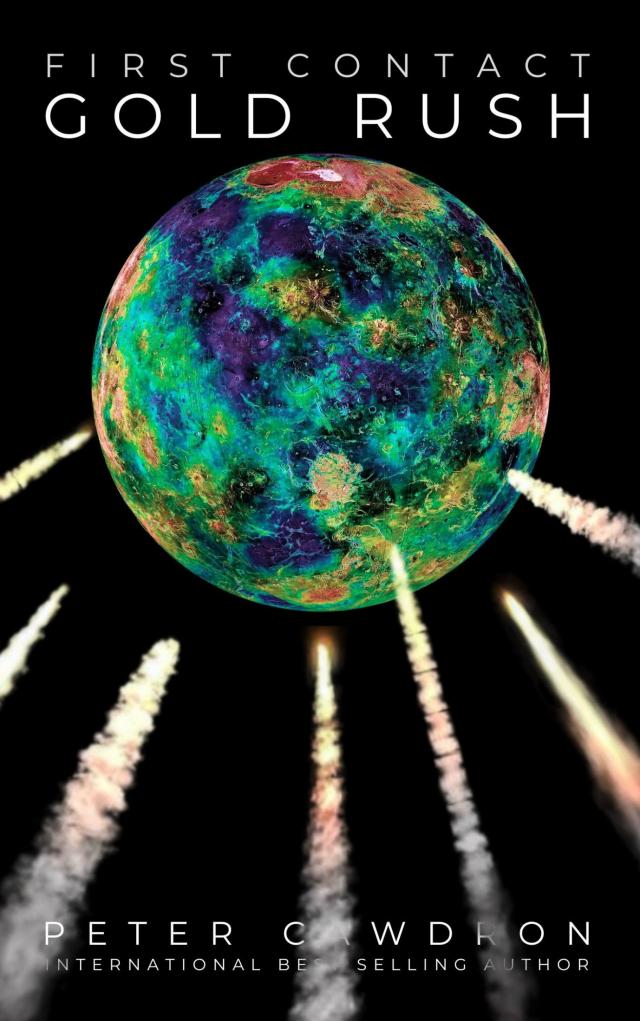
Cover Art: Topographic image of Venus from Encyclopedia Britannica and rocket trails from iStockPhotos.
Subscribe to my email newsletter to learn more about my writing, special deals and upcoming releases. Thank you for supporting independent science fiction.
Dedication
Gold Rush is dedicated to my beta-readers, some of whom have been with me for the best part of a decade. Their enthusiasm, passion, keen intellect and penetrating insights have helped polish this novel into a gemstone. In alphabetical order, they are: Phil Bailey, CPL Gabe Ets-Hokin USMC, Chris Fox, Gerald Greenwood, Terry Grindstaff, Per Hansen, David Jaffe, Dr. Didi Kanjahn, LCDR Mike Morrissey USN RET, Jay Palermo, Dr. Randy Petersen, Melinda Robino and John Stephens. To them and everyone else who has beta-read any of my other novels over the years, thank you.
The Rush
“It was not the gold, but the gold fever that made men mad…
Gold gave birth to cities and cemeteries alike.”
—John David Borthwick, California (1854)
Comet 57P-Yakov
“So, tell me about Yakov,” Professor Hans Schmidt of the University of Zurich in Switzerland asks. “What makes this comet so special?”
Professor Schmidt is sitting behind a desk with a black, broadcast-quality microphone on a stand in front of him, picking up the subtle inflections in his voice. Behind him, outside the floor-to-ceiling windows in the boardroom, snow covers the hills. It’s a beautiful day. The azure blue of the sky is radiant. Sunlight glistens off a distant glacier. At the base of the mountain range, there’s a forest and a lake. The still water rivals the sky for the depth of its iridescent blue.
Dr. Jill Yakov is sitting opposite Professor Schmidt, feeling like an impostor. She has a PhD in astrophysics and has spent the best part of a decade working on Pan-STARRS, the University of Hawaii's Panoramic Survey Telescope and Rapid Response System, but she doubts herself. She shouldn’t, but she does, and it shows in the way she fidgets with her fingers, picking at the cuticles around the edge of her nails. The professor notices, and Jill notices his attention shift to her hands, so she hides them beneath the table. He tries to put her at ease.
“You detected this comet as part of ATLAS?”
“Yes, I did.”
The professor chuckles. “Tell our listeners what ATLAS stands for.”
“Oh, yes,” Jill replies, realizing the acronym sounds bland. “ATLAS is the Asteroid Terrestrial-impact Last Alert System.”
“When you say it like that, it’s a little more interesting, huh?”
“It certainly is.”
“You must track a lot of asteroids and comets in your role at the observatory. What makes this one so interesting?”
Professor Schmidt is good at interviewing guests on his podcast, and that puts her at ease. Jill thinks about where she should start.
As part of ATLAS, Pan-STARRS specializes in detecting near-Earth objects, focusing on asteroids. Comets are not her specialty, or they weren’t until Jill spotted this particular comet off the plane of the ecliptic three months ago, hidden by the glare of the Sun.
Having a comet named after her is a rare honor. All Jill remembers of the discovery is seeing a faint smudge moving slightly against the background stars. After checking various astronomical catalogs, she was delighted to realize she’d found something new. It wasn’t until a spectrographic analysis was conducted that she knew for sure that the object was a comet and not an asteroid.
Jill sweeps her long, dead-straight, brunette hair behind one ear.
“Well, most comets and asteroids orbit the Sun along the ecliptic—the plane of the solar system. Think of the solar system like an old vinyl record. The Sun is the spindle in the center, the nob sticking out of the middle of the turntable. The orbits of the planets would be akin to the various music tracks running around the record. On this scale, comets and asteroids would be smaller than the finest grains of dust.”
“That’s a good analogy,” the professor says. “I like that.”
“And it isn’t just a handy analogy. It’s a really good comparison. A vinyl record has a ratio of 1 to 100 when comparing a record’s thickness to its diameter. Ignoring outliers like Pluto, that ratio is roughly the same for all the planets orbiting the Sun, including most of the asteroids. The solar system really is similar in shape to an old black vinyl record.”
“And Comet Yakov?” the professor asks, already knowing the answer to his question. He’s hosting an astronomy podcast that will stream on multiple platforms, including Spotify and Overcast, with the video being made available on YouTube. With two million subscribers and over a hundred million views across his series of podcasts, Professor Schmidt is ranked among the top 50 podcasters on the planet.
Jill could have participated in the podcast via video link from Hawaii, but the university’s media team told her that listener engagement increases by 33% for in-person interviews. Whether that’s because she’s more at ease in person or he’s more open, she’s unsure. Perhaps it’s a bit of both. Either way, she didn’t argue about the need to travel to Switzerland. This is the third of eight stops on her academic junket, and she still gets nervous. It’s not that she worries about saying the wrong thing. It’s more that she wants to find the right balance between saying too much and boring her audience, and too little, leaving them confused. She knows she has to stop overthinking interviews.
“Most comets orbit slightly off the ecliptic, but Yakov is curling overhead. It’s traveling in an arc. Comet Yakov has come up from beneath the solar system, curled over the top of the Sun, and is now turning back down from the north.”
“And?” the professor asks, angling for more information—information he already knows, additional details that will be new to the majority of listeners.
“Its speed tells us it is interstellar in origin,” Jill says, getting to the heart of the controversy that has seen the university send her on a global publicity tour to combat the rampant spread of misinformation around the comet.
“And that puts Comet Yakov in the history books,” the professor says.
“It does.”
It’s taken Jill a couple of weeks to get used to referring to the comet by her surname. Each time she hears Yakov, she’s reminded of her years in high school, where Yakov was used as a term of derision by jealous girls. The crazy thing about jealousy is that it’s shortsighted. Jill wasn’t pretty or busty or gregarious, just smart. Truth be told, she was jealous of the girls who turned heads as they strutted down the hallway as though it were a fashion runway in Paris, but Jill wasn’t going to be mean in response. Now, Yakov evokes a sense of mystery. It’s a name spoken with uncertainty—but not by her.
Jill was born in St. Petersburg. At the age of seven, her parents fled Russia for the United States during the Russo-Ukrainian War. Being academics and critics of the Putin regime left them exposed and under surveillance by the Russian secret police, the FSB. All Jill remembers is being woken by her mother in the dead of night and carried away from their apartment wearing nothing more than her pajamas under a thick coat. Later, she learned that the Russian mercenary leader, Yevgeny Prigozhin, was marching on Moscow. Her parents didn’t think his coup attempt would succeed, but they saw an opportunity to escape in the confusion.
That night, they drove north to Vyartsilya, a small town on the border with Finland. The next day, they trudged through foot-deep snow in a dense forest until they reached the river Jänisjoki running along the border.
Jill can still remember the sound of ice breaking beneath her father’s boots as they walked across the frozen surface. The cracks sounded like gunfire. They were exposed. Vulnerable. If any of the border guards had seen them, they would have been captured or shot. Water rushed beneath the ice. Every few minutes, there would be another resounding crack running through the thick ice, and her father would stand still for a moment, watching as a jagged line ran through the frozen surface. Her mother carried rope to rescue them if either of them fell into the frigid water. When they got to the other side, that rope and their passports were all they had to claim political asylum. To this day, her parents still have that rope coiled up over the mantlepiece in their Ann Arbor, Michigan home. This is the first time Jill has been back to Europe.
“It’s alien, right?” the professor says. There’s a twinkle in his eye and a wry smile on his lips. He doesn’t believe what he’s saying. He’s leaning into the controversy for clicks. A bit of sensationalism sells. He’s thinking about an advertising soundbite. Jill understands his motive. If he can drum up interest in his podcast, he can use that to combat the disinformation being spread by others. Knowledge or fear—it’s a tug-of-war that has raged for millennia.
“Yes. It’s alien, but only because it has come from well outside our solar system,” Jill says like a Shakespearean actor on stage reciting lines spoken dozens of times in rehearsal while still giving them enough passion to seem new and invigorating. She follows up with, “But there are no aliens.”
“So you don’t think there’s an alien spacecraft following in the comet's wake? Hiding in its tail?”
“No.”
Jill hates this part of the various interviews she’s given over the past few weeks, but she understands it’s important. Misinformation has to be countered. Lies can’t be left unchallenged. When Comet Hale-Bopp visited the inner solar system back in 1997, almost forty members of the Heaven’s Gate religious cult committed mass suicide. To Jill, that level of delusion is unthinkable, and yet it happened. They were convinced an alien spacecraft was following along behind the comet, hidden in its tail. And they took their own lives, believing they were going to be transformed into immortal beings. As logical as most people like to think they are, everyone’s driven by emotion, and if someone exploits that, the consequences can be disastrous. Jill is determined to ensure that the public is well-informed about Comet Yakov.
She sips water from a glass, letting her one-word response linger for a moment, knowing seconds pass like decades on a podcast. People need certainty. Saying no gives them that. She puts down her glass before continuing.
“Yakov is an interstellar interloper, but it’s not harboring aliens. It’s not part of some wild conspiracy.”
“Why do you think we jump to aliens as an explanation for something we don’t understand in the night sky?”
“We’re drawn to the sensational like a moth to a flame. Being mundane is boring. We want excitement—but what we want is irrelevant when it comes to science.”
The professor says, “Now, I know you have some exciting scientific news to share with us a little later, but first, what would you say to people who are sitting on the fence? To those who are naturally curious? To those who think—well, maybe it is alien?”
“It’s natural to be curious,” she says. “It’s natural to imagine what might be. And would I like it to be aliens? Sure. How cool would that be? As a scientist, it would be astonishing to have confirmation of life elsewhere in the universe.”
“So it is possible?”
“Oh, when it comes to science, anything’s possible. I mean, people look at us from the outside and see scientists as killjoys. We’re the bad guys, right? Always shooting down talk of UFOs, but the truth is far different.”
“What is the truth?” the professor asks, clearly enjoying her line of reasoning.
“The truth is that scientists will believe anything—if there’s evidence. And I mean, seriously. Anything. Literally anything.”
“Anything?”
“Anything at all. Back in the 1940s, Fred Hoyle came up with the term Big Bang as a way of ridiculing an utterly absurd theory about the entire universe expanding from a single point smaller than the tip of a pin. He was poking fun at the idea, but the phrase stuck. And he’s not laughing now.”
“Well, he is dead.”
“Haha, yes. He is. But the point stands: scientists will believe anything—if—it is supported by evidence. Back in the 1970s, Stephen Hawking placed a bet with Kip Thorne that astronomers would never—ever—find a black hole. Today, we have photographs of them.”
“So if there are aliens in the tail of comet 57P-Yakov, you’d believe it?”
“Yes, I would, but it’s important to realize that science isn’t about beliefs—it’s about acceptance. Science accepts evidence. So, yes, absolutely, if we detect little green men, I will accept that finding. But—and this is the really important point—I’m not going to jump to conclusions. Remember, science isn’t about what you or I want. It’s about what’s real. It’s about what can be decisively demonstrated and proven.”
“So, if they’re there…”
“If they’re there, we’ll see them. We’ll have front-row seats. Every telescope on Earth will be watching the approach of Comet Yakov.”
The professor shifts in his seat. Before the meeting, Jill told him he’d have an exclusive, and it seems he can sense the moment coming.
“And what exactly will we be watching? What will we see?”
“This morning, I received confirmation from the monitoring team in Hawaii about our tracking data. And I can offer the listeners of SpaceTalk an exclusive. We’ve been sitting on this idea for a while, but now it’s time to tell the world. And the evidence is overwhelming.”
“Oh, I love overwhelming evidence,” the professor says, playing along with her. “Tell me, what is it we have to accept?”
“That there are going to be fireworks.”
“Why?”
“Comet 57P-Yakov is going to hit something.”
“What??? What is it going to hit?”
Jill turns in her seat toward the camera, addressing it as she points at the professor, saying, “Those of you watching on YouTube can see Professor Schmidt’s face. Look at him. He’s like a kid at Christmas. For those of you on the podcast, you’ll have to imagine his jaw hitting the floor.”
The professor laughs as Jill continues, stringing him along.
“Orbital dynamics are tricky. Yakov is coming up from beneath the solar system, approaching from the south. It’s going wide of the Sun, swerving around it as it comes over the top. This is what made its motion so difficult to determine. We didn’t see it until it was already in our northern hemisphere. Originally, we thought it came from the north because that’s where it is now, but we’ve gone back through our deep space scans, and we’ve been able to get a glimpse of its approach over the past few years.”
“Years! Oh, wow! Ohhh-kay,” a curious professor says.
“And when we plug those details into our models, it shows Yakov turning back toward the plane of the ecliptic, coming down from the north and crossing it for a second time, but this time…”
“This time…”
“It’s not simply going to fly back into deep space. It’s going to hit Venus.”
“What??? Really?”
“We’re looking at a 78% probability of an impact.”
“And the remaining 22%?”
“Would be a deflection, sending the comet flying off into the outer solar system.”
“Is it a danger to Earth?” the professor asks.
“No. Venus will be well ahead of us in its orbit by that time. And any deflection would be away from the ecliptic, going either above or below it.”
“And this is confirmed?” the professor asks.
“We’ve been running the numbers for over a week now. And with each new measurement, the margin for error narrows.”
“Do you have a date?”
“I do.”
“Well?”
Jill tries not to laugh. The professor looks like he’s waiting for Santa to come down the chimney with a bag full of presents.
“February 11 at 5:20 am Eastern Standard Time.”
“Oh, so close to Valentine’s Day.”
“I know, right?” Jill laughs. “It could have been like Cupid’s arrow hitting Venus on Valentine’s Day, but it will strike a few days earlier.”
“And we’ll see it?”
“Yes. It’ll be visible to the naked eye.”
The professor leans forward on his elbows. “What will it look like?”
“At the moment, Yakov is little more than a smudge in the sky. Over the next two months, it will develop a brilliant tail. By the time it approaches Venus, it’ll appear longer than the moon.”
“So it’ll be clearly visible to the naked eye.”
“Yes. And if you have binoculars, it’ll look spectacular.”
“And at the point it hits?” the professor asks.
“If it hits.”
“If it hits.”
Jill says, “There will be a flash of light—a flicker, really. And then it’ll simply disappear. Over a period of a few hours, the tail will appear to be sucked into the brilliance of Venus itself.”
“And if it misses?”
“Oh, if it misses, the tail will swing around the planet, swirling as the comet changes direction. We may even see Yakov break up, with five or six smaller comets appearing on slightly different headings as it moves away from Venus.”