Gold rush, p.8
Gold Rush, page 8
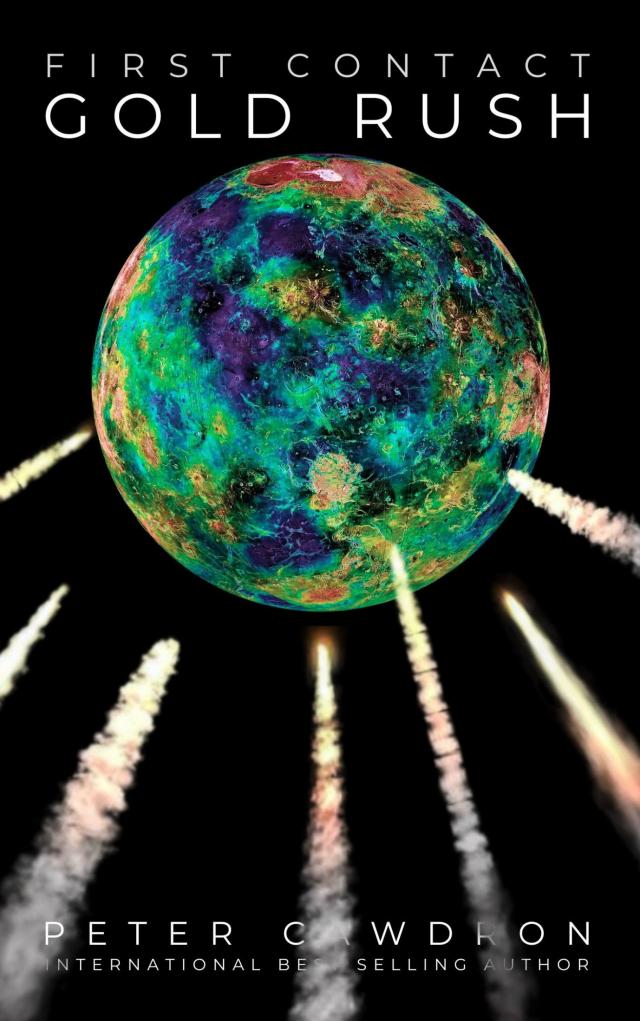


“Ah, these impacts,” she continues. “They represent no danger to Earth whatsoever. For that matter, they won’t hurt Venus either. They’ll look big to us. They’ll be spectacular to watch. They’re going to throw off a lot of the atmosphere and probably kick up a lot of rocks, but most of that will fall back to the planet within a few hours, if not a couple of days. Planets are big. They’re much bigger than most people realize. Even having two of these comets strike Venus isn’t going to do much beyond scorch the surface. Given the hellish temperature and extreme pressure, not much is going to change down there. And given how dense the atmosphere is, the comet may not even reach the surface. If it doesn’t, there won’t be any crater at all, let alone debris. As these comets are going to hit near the equator, we may get some minor change in rotation, but even a double-whammy isn’t going to alter the orbit.”
“So why would they do it?” a woman in a blue uniform asks. As best as Jill understands the military, this woman is a general in the US Air Force, but she could equally be part of the US Space Force.
“Sorry, they?” Jill says in reply. “They who?”
“The aliens.”
“What aliens?”
“The aliens throwing comets at Venus.”
Jill frowns. “Alex, have I missed something? Are there additional observations to support this idea?”
“No,” Alex says. Once again, his economy of words tells Jill precisely what she needs to know. He’s had this discussion with them prior to her joining the call. And he’s made it clear he doesn’t agree with jumping to conclusions.
Jill says, “We can’t assume any of this is due to the presence of extraterrestrials.”
Jill refuses to use the common vernacular term alien. To her, that’s far too vulgar and coarse. It raises images of latex monsters in low-budget science fiction movies following predictable tropes with cheesy actors, poor special effects and a lack of any real imagination.
Like most scientists, Jill wonders about the possibility of extraterrestrial life. There’s no physical reason that both life and intelligence can’t arise elsewhere, but she doubts humanity will ever make contact with another sapient species. The universe is just too vast. And it’s expanding. Out of the roughly two trillion galaxies that can be observed from Earth, 95% of them are already beyond reach. Humanity can see them, but humans will never be able to travel to them, even if they could one day travel at the speed of light. Like a passenger running through an airport toward a plane already pulling away from the gate, an astonishing 95% of all the galaxies in the universe have already departed the terminal, so to speak. Astronomers may be able to see them, but that’s because light takes time to travel across the vast void of space, and in that time, these galaxies have already moved out of reach.
Jill doesn’t want to be a naysayer, but there have been too many people crying wolf at UFOs and UAPs and interdimensional boogeymen for her to entertain the idea. Science is speculative in that it will consider anything if—and only if—there’s hard, tangible, repeatable evidence to support the idea. For now, aliens are in the unproven basket alongside unicorns, fairies and angels.
No one responds to her comment, which is curious, given how vigorous the discussion was when she first joined. It seems no one wants to challenge her.
The helicopter she’s sitting in banks to one side, giving her an astonishing view of an azure blue glacial lake surrounded by thick forest. For Jill, it’s a good reality check.
“Look, I know there’s a temptation to jump to the sensational, but we need to stick to the facts.”
One of the generals says, “The facts are—this is the conclusion the public will reach.”
The general looks angry, but that’s probably a default setting, from what Jill can tell, given the harsh lines on his face. He scratches a note on a pad of paper in front of him, but given that he was the last one to speak, Jill’s not sure what he’s writing down. He’s wearing an olive drab uniform with gold stars on his epaulettes.
“And chaos equals conflict,” another general says. “Both here and abroad.”
As much as Jill hates that conclusion, she can’t argue with him on that. It’s becoming more apparent why senior politicians have pushed her and Alex in front of the military. They’re clearly hoping the scientists can give these particular military planners something positive and constructive to work with.
Everyone starts talking at once. For the sake of clarity—and for her own sanity—Jill mentally assigns them nicknames so she can keep track of each of them.
Daffy Duck, who talks with a slight speech impediment, says, “We need to think about embassy staff, especially in hot spots. There’s going to be a run on visas and the repatriation of US civilians. If violence breaks out, I’m going to need a commitment from the Air Force on evacuation flights.”
“Where?” Vin Diesel asks. He’s another grumpy-looking, older bald guy, but he’s a civilian. He’s loosened his tie. As he’s sitting near the head of the table, Jill figures he’s probably in charge of the meeting. He’s got a pen in his hand, but it’s digital. He jots down notes on a computer tablet.
“India, Bangladesh, Pakistan—hell, all of the ‘stans.”
“And the likelihood?” Vin Diesel asks.
“Anti-American sentiment is already running high among Sunni Muslims following the drone strikes in Tehran last summer. They’re going to jump straight on any conspiracies.”
“And active conflicts?”
“We have hot zones in Gaza, Ethiopia and Eritrea. They’re a mess. They’re always a mess, but I can’t see any escalation.”
“I wouldn’t ignore the Spratly Islands,” one of the admirals says. “We’ve already got intel signaling the Philippines wants to push in on the area. If China’s distracted, they’ll make a play for them.”
“And Korea,” someone in a blue uniform says. “I don’t think either side will breach the DMZ, but we can expect incursions from the north on the outlying islands, interference with shipping, niggling stuff like that. Basically, a step before war.”
“And what about Europe?” Vin Diesel asks. “England? Germany? France? Russia?”
One of the other suits answers. “They’re suspicious of the US at the best of times. Public unrest is unlikely in mainland Europe, but conspiracies on social media could shift the dial. I’d expect protests outside our embassies but no breaches.”
Vin Diesel asks, “Can we rely on local law enforcement?”
“In Western Europe, yes. The further East you go, though, the more corruption comes into play.”
“Noted.”
To Jill, the guy in the sharp suit addressing Vin Diesel looks like Ryan Gosling. He’s too damn good-looking to be in politics. At a guess, he’s one of the directors, as the others defer to him.
“And at home?” Daffy Duck asks.
“The President has already said he’s willing to declare a national emergency in advance of the impact.”
“Why?”
“It will allow him to move the National Guard under the Department of Defense. If needed, the President can then mobilize the Guard in major US cities to prevent civil unrest.”
“It’s Venus,” a frustrated Jill says, struggling to be heard. “We’re talking about Venus, not Earth.”
“It might be Venus,” Vin Diesel replies. “But don’t forget about Earth.”
“But it’s not—”
“It doesn’t matter what it’s not,” the smart-dressed Ryan Gosling says, cutting her off. “Today, it’s not aliens. But what about tomorrow?”
“What do you mean?” she asks, genuinely curious about his point.
“Yesterday, it was a one-in-a-billion collision of a single comet with Venus. Today, it’s two collisions. What about tomorrow? What happens then? What happens if it’s three? Or if there really are little green men in flying saucers?”
“I can’t talk about what we might discover tomorrow, but—”
“No, you can’t. And neither can I, but I can tell you how people are going to react—how they’re going to overreact. Venus might be a million miles from here or a billion or whatever, but the controversy is here! The conspiracy theories are here! The nutjobs are here!”
He points at the door, gesturing beyond the room, saying, “You might not think it’s aliens. I might not think it’s aliens. And we’re probably right. It’s probably not aliens. But, honestly, it doesn’t matter what you or I think. What matters is what they think. We’ve got three hundred and fifty million civilians about to panic. And we have adversaries. We’ve got hostile actors who will exploit this—make no mistake about it. If the nutjobs with the tinfoil hats don’t jump to this conclusion, you can bet your ass that the Russians will, the North Koreans will, the Iranians will. And they’ll jump on social media as Billy Bob from Alabama or Suzy Homemaker from Chicago. And they’ll start lighting spot fires. They’ll fan the flames until there’s an inferno raging out of control.”
Jill swallows the lump in her throat.
“Look, Doc,” he says. “I know you’re good at what you do. I need—we need you to do what you do—fast. We can keep a lid on this for a while, but it won’t be long before someone else figures out what we all know, that there are two of these damn things inbound. And then the fun begins. That’s when the public will start to unravel.”
Jill nods. As much as she wants to speak, now is the time to listen.
“You’re all science this and science that—and that’s cool. I respect that. I need that. I need that energy. I need people like you to turn on a firehose and help us put out the flames. You understand?”
“Yes.”
“We’ll get you back here stateside and set you up with anything you want, but I need you to be the public face of this. I need you to go loud. We’re about to be hit with a tsunami of misinformation. We’ve got to be ready for that. And we need to have a game plan, a narrative of our own. We have to be able to counter the panic.”
Jill nods.
“All right,” fake Ryan Gosling says, gathering together a handful of papers and straightening them in his hand as he gets to his feet. “I want threat assessments on our most vulnerable embassies by the close of the day. Start drawing up plans for evacuations. If our embassy walls are breached, we need plans to deal with civil unrest. Our first response should avoid the use of lethal force. Put out a general recall of non-essential staff. And I want clear rules of engagement so our security teams know when force is warranted. Think about contingencies. Make sure your plans have adequate resources behind them. Lives are at stake. We don’t want to be caught flatfooted on this. Understood?”
There’s a grumble of consent as everyone gets up. Chairs scrape on the linoleum floor. Like the others, Alex stands up, but he walks away from the door, pushing through those leaving the meeting. He gets near the camera and holds up his hand, making as though he’s holding a phone and gestures, mouthing the words, “I’ll call you.”
The meeting ends, leaving Jill looking out the window of the military helicopter at the rolling hills of southern Germany.
The Mirror
Aaron Swagger looks at himself in the mirror. It’s 5:30 am. Being lazy in winter, the sun won’t rise for another hour, but Aaron’s already splashing water on his face. He brushes his teeth in front of a circular, backlit mirror. His marble bathroom is bigger than most bedrooms, and therein lies the problem. There’s a certain level of egotism and narcissism demanded of and by billionaires. Everything has to be larger. Bigger is better, apparently. Aaron’s not selfish, and yet he is. He likes to think of himself as generous, and he is to an extent, paying his employees 15% above market rates and including extra benefits, and yet being generous is strictly defined. Generous means investing in anyone and anything that will help him earn more money. He’s a billionaire, not a saint. He’s not funding climate change initiatives or ending world hunger.
Billionaires are the crown princes and princesses of the modern age, ruling over bank vaults instead of land, but peasants still work the fields. No one earns a billion dollars—they take it. There is an expectation. Defiance is demanded. Arrogance is the norm. Accountability is a joke. Accountability is what others must provide him. And then there’s the mirror.
Looking in the mirror, Aaron sees himself in a way no one else ever does. Others see the myth. He sees reality. He sees a fake.
Mirrors reverse the image of the beholder. The effect is subtle, but it’s the reason why Aaron’s never liked photographs of himself—no one ever does. Looking in a mirror, everyone’s fooled into seeing themselves, only they’re not. No one sees themselves as they really are. They’re seeing the reverse. Like him, they’re seeing an imitation—they’re admiring an impostor. For Aaron, it’s the part of his hair flopping to the other side. His nose is crooked. When he sees himself in an interview or in photos on social media, his nose leans the other way, and he never quite looks right—only he does. That’s how he appears to others. It’s the mirror that lies to him.
Narcissus fell in love with himself. Only he didn’t. As he sat beside a still spring in ancient Greece, he saw his reflection in the water and believed a lie—that he was seeing himself. But the beauty he beheld was an illusion, the reverse of the truth. Others saw something different in him, something real, but he was obsessed with the illusion of his reflection. His ego wouldn’t allow him to see reality, and so he died beside that pond, and flowers sprang up from his corpse. The Narcissi is a species of daffodil, a lush green plant with brilliant flowers. Six white petals surround a narrow, yellow cone containing a delicate stigma and stamen. It’s fragile, which is appropriate.
Aaron’s always found the legend of Narcissus pleasing rather than tragic. Life springs from death. Life continues on regardless. And for him, that’s the real lesson of Narcissus, that no matter how much he and others like him crave the limelight, yearning for relevance and ever more attention, something beautiful will rise from their ashes. No one lives forever. Like Narcissus, billionaires act as though they’re immortal, but they’re not—they will die. And when they do, regardless of the damage they’ve caused, flowers will spring forth.
Aaron wonders about Narcissus. Everyone’s narcissistic to some degree. And that’s natural. There’s nothing wrong with being concerned about yourself. But, like everything in life, the extreme is poisonous.
Somewhat tragically, Narcissus is not remembered for his supposed beauty but for his vanity and an extreme form of self-centered personality. His name gave rise to the Greek word narkō, which means to make numb and led to the English term narcotics. Given that there is a yellow plastic bottle containing ketamine and a small plastic bag of white cocaine lying beside the bathroom sink, Aaron suspects the term is all too appropriate.
The irony of the imposter staring back at Aaron in the mirror isn’t lost on him. He’s too intelligent to miss the implications. What he sees as real—as him—is a distortion. He never sees himself as others see him, as he really is. Interviews and photographs give him a glimpse of his life through the eyes of others, but even those are limited. They’re truncated. Abridged. They’re the glossy text on the dust jacket of a book, hiding the actual grimy reality laid bare on page 79 or the footnotes on page 184. No one will ever read Aaron as clearly as he can read himself, but it takes a deliberate effort. He’s been trained, conditioned by his parents and his business partners, not to read himself, but rather to ignore himself, to become so caught up in the mythos of the billionaire that he never examines himself. And for the most part, he doesn’t. Except now. Except at 5:30 in the morning. Except with water dripping from his face. Except in the rare quiet before the hustle of the day begins.
The mirror lies, and yet it doesn’t. He peers deep into his eyes, fascinated by the three pounds of grey matter hidden behind skin and bone that form his mind. That’s him. That’s the real him. And it’s something he’ll never see. Something no one will ever see other than the doctor performing an autopsy on him after he dies. Fourteen hundred grams of grey mush gives him consciousness. His existence is defined by a mere one and a half kilos he could never build, never buy, never own through mergers or acquisitions. A billion dollars—a trillion—would never be enough.
His consciousness is beyond a king’s ransom. And what is he conscious of? He’s a billionaire. Others bow before him. Courts are swayed by his influence. Politicians serve as though they were personal butlers. But reality isn’t fooled. Microbes defy him. The toothbrush in his hand, the roll of toilet paper on the chrome holder behind him, the towels hanging on the rails. Aren’t these the same everywhere? Aaron is humbled only by the reality that no one can escape the banal aspects of human existence—thirst, hunger, the bathroom and something as simple as a goddamn toothbrush. No amount of money will ever free him of the chains of mortality.
Aaron looks at his reflection. He knows his day is about to begin. Like a rollercoaster clacking up a track reaching high into the sky, he’s about to be launched down the rails into alternating tight curves and loops and banked corners, racing along with the wind in his hair, barely able to concentrate on anything other than what’s immediately before him. But at this particular moment, he’s still at the top of the ride. He’s looking out over the amusement park. He can see for miles instead of only seeing the blur of the track screaming beneath his white knuckles gripping the safety rail at the front of the car. The calm of the early morning speaks to him. The mirror reminds him that there’s more to life than the ride. The face staring back at him tells him he can step off the rollercoaster any time he likes, but once the ride begins, once he plunges down the first slope, he’s locked in. Already, his phone is pinging with incoming messages. The rollercoaster carriage is curling over the top of the track, starting to pick up speed, threatening to race away.