

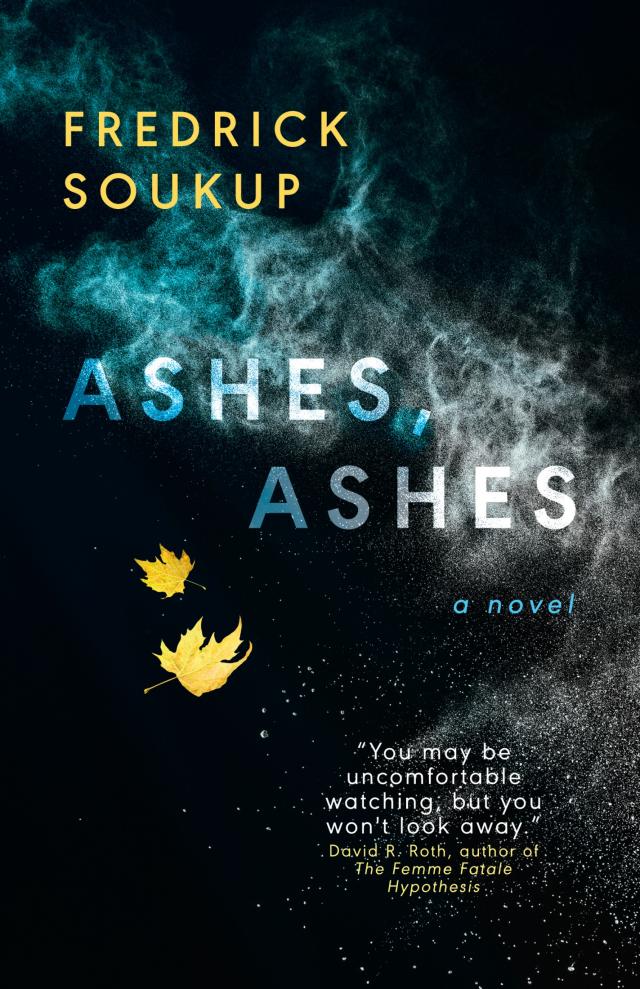
Ashes ashes, p.21
Ashes, Ashes, page 21


Eventually, I gave up these self-imposed torments. Or they quit me. Maybe it was the lack of nutrition in prison. Maybe it was a biological factor, a natural dip in testosterone levels. Maybe it was the shame, which for many years nullified all other psychic activity. I prefer to believe it was God’s grace. Whatever that means, grace. Still, I bet a good number of atheists would accept that there are miracles whose mysteries are their own verification.
I regretted not hearing first-hand how much we children frightened her because she worried she could never do enough for us, how much she feared she frightened us. The little ones, with her perpetually flushed complexion, her crooked nose, her imposing figure. The older ones, with her warmth, her embraces and patience, by showing us the part of her we harmed each time we harmed ourselves. But I was too narcissistic to concern myself with others in this way, at least instinctively. For me, it needed to be premeditated, almost rehearsed, before it became second nature. This was the gift of Murphy’s visits. Dorian’s too, to a lesser extent, how guarded and loath to imposition he is.
One time Murphy mentioned his son. Accidentally, it seemed.
“I sorta understand what she meant,” he said. “Carter is the only person who ever scared me.”
“Carter?” I asked.
He blushed.
Carter is thirteen. He lives with his mother, Courtney, Murphy’s ex-wife, in Montana. When he was eighteen months old, he tried to swallow an acorn whole. “I’d never known anything like that, pulling a damn acorn out of your boy’s mouth. If that isn’t bullying, what a child will do to you, shit …”
After that apparent slip of the tongue, something happened between us. I asked things and he answered, though he often came off abashed, too quick to laughter. Imagine that, Murphy cowed. He had an awful lot to tell me. Say, how all these years later he still wasn’t sure why he had Courtney, his fiancée at the time, call up Miss Bonnie and tell her he’d died. She went along with it because he spun some yarn about owing an old lady cash. To this day Courtney has no idea who Miss Bonnie was. Initially, he thought it was a good prank, no different than how he tricked everyone into thinking he was in Afghanistan. Then he figured that by the time he stopped getting a laugh out it, it might well be the truth. “Or I suppose I just didn’t want her fretting about me anymore.”
He’d “saved up some coin” in Santa Fe, working as a bellhop at a swanky, old-fashioned hotel. About the time he and Courtney were set to be married he got fired for stealing from the guests. They postponed the wedding and moved to Illinois, a compromise—she was pissed about the postponement, so he agreed to their living in her parent’s guestroom in Champaign for a while. Unfortunately, as their new wedding date approached, he got the urge to track his father down in Montana.
“I’m sure you’re sensing the pattern here,” he said. “It wasn’t her, I’ll tell you that much. Wasn’t her.”
Last Murphy had seen his old man, Mr. Murphy was managing a grocery store in some trailer park community just outside of Billings, and though only a boy at the time, Murphy could still recall the smell of his father’s trailer, Swisher Sweets cigarillos and dank sawdust, as despite the rain they’d taken up repairs on the porch. He remembered drinking Coca Cola through a Twizzlers straw.
Some locals pointed him in the right direction. “An impressive accomplishment, really,” he said of Mr. Murphy, who in only a few years had gone from disgruntled grocery store manager to disgruntled cashier to trailer-park-shut-in to bum-in-front-of-grocery-store to bum-behind-trailer-park. Murphy found him sitting by a creek, his pants rolled up and his feet in the water, drunk to the point of delirium, salty about “some bitch,” who might’ve been Murphy and Dorian’s mother, whereabouts yet unknown. The man had soiled himself.
“He didn’t even notice me. Me and him, two ships passing in the night.” At one point Mr. Murphy tapped himself on the cheek, a little slap. Murphy supposed he did this to keep his head from quivering so much. “Something I’d done from time to time when I needed a drink. Seeing that made me wanna cut my hand off.”
Something about the image—some all-too-typical “I’ll show you, pops” impulse, maybe—pushed him back home to Courtney, with whom he eloped when he returned to Illinois, having charmed her into forgiving his procrastination. They had a son and for several years “a normal, middle-class go at it.” The Champaign Police Department issued him a badge and a gun he claimed to have never fired, never drawn, never even wanted to. Regardless of his priors, he didn’t abuse his power. He got off in other ways, aggravating the chief by intentionally misfiling paperwork, driving his partners insane. With one, he spat tobacco in his coffee. With another, he constantly sang “The Battle Hymn of the Republic.” “Always hated cops,” he told me.
The career outstripped the marriage. Courtney, he said, ate more than anyone he’d ever met, yet never seemed to gain weight. She was too anxious, he reasoned, anxious about Carter, anxious about her husband’s moodiness, evasiveness, secrecy, compulsive fibbing, “the list goes on.” Her eyes were light blue, “the most beautiful shade, like aqua, when she teared up.” They were paradoxically magnetic, drew him closer the wetter they were, all the wetter on account of his genius for estrangement.
Ever sense, he’s been a yo-yo, with ever a reason to make himself scarce. “There’s a year or two here and there. I’m out making a lot of women smile and a lot of men jealous.” Not that Courtney hasn’t had her share of flings herself. It seems neither takes the other’s trysts too seriously. Then he and Courtney make up and he’s the father Carter needs, “the boy’s hero.”
“He’s a good kid. Gets good grades, says please and thank you, eats his veggies, doesn’t curse, no temper, all that. She raised him well.”
By his own admission his problem is his need to embark on adventures to demonstrate to himself he’s worthy of them. Only after coming back from them does he realize he’s failed. Hence the yo-yoing.
“Is that what I am to you,” I asked. “An adventure?”
“Sure.”
I’m not sure what made me do it. I only wanted to help. Maybe I should’ve waited a little longer to mention Dorian, or been more tactful about it. Maybe he was bound to run from me eventually, just as he had from Miss Bonnie, from Dorian, from Courtney and Carter, and all the others too numerous to recount.
“You still have one in the chamber,” I said.
“What do you mean?” he asked though in an instant that old deviance, that old malice, emerged in his glare, as poignant and stark and hostile as ever, and he seemed to coil up as if suddenly aware that the manacles binding him to that prison, to me, were illusory.
There seemed no point in playing coy. “Dorian,” I said.
“What about him?”
“I haven’t told him about you.”
“You’d better not.”
“But he’d sure wish to see you again. And Juliette—”
“That’s enough, kid.”
He said some hurtful things after that, things I remember only because they have merit and maybe even needed to be said. It wasn’t my place. I am, in my worst moments, pathetic and wicked. So I didn’t protest.
After he left, I returned to my cell and feigned sleep so my cellmate couldn’t see the tears draining from my eyes, spreading down my face, slow as cracks in a windshield. Had I known this would be the last time we’d speak—for the time being, at least—could I slow time, reverse it, say the things I ought to have said, I might confess to merely emulating his tactics, engaging in the very emotional jujitsu he employed against the universe. I myself was pushing him away, keeping the spotlight on his life because in recent visits he’d steered me toward considerations I wasn’t ready to entertain—in essence, that Christ has “already washed away” my sins, that the rest of my life needn’t be lived so near the gravitational pull of my crimes, that that pull would weaken if only I began to forgive myself.
Springtime next year, my parole ends. I could leave Minnesota. Lately I’ve had the thought often. It may just be the winter, which always gets me dreaming, antsy for flight. Suppose I stayed. Suppose I bought a guitar, acoustic, used, good for picking. Suppose I let my fingers bleed until callouses formed. Suppose I sang. So few who said only God can judge them meant it. If ever I said it, I sure didn’t mean it. Judgment is an early lesson, as inborn and vital as breath. It hones the soul, only you hope not so sharply that another can never touch it.
Some morning, I have to imagine—for the sake of my soul, I must—I’ll get ready for work and head down to my car and the wind will feel different on my hands, my neck, my face. Someday these pines lording over my drive to the site will be greener and prouder, the dawn nobler, and I’ll work a full day without remembering my sins. Dorian will invite me to dinner and Murphy will be there. Emma and her children, too. He’ll meet his niece. He’ll hug his brother. We’ll reminisce. We’ll laugh. And missing them on the way home after, I’ll crack the window to feel the air, hear once more that uncanny exhale of wind whispering, “Hush, my son.”
Acknowledgements
I’m forever indebted:
To my wife, Ashley, my biggest fan, the love of my life.
To my baby girls, Clare and Nora, who inspire me every day.
To my parents, who encouraged me to chase my aspirations as a novelist and whose decision to shelter foster kids during my childhood in northern Minnesota made my siblings and me more compassionate and curious people.
To the foster kids with whom I shared a home as a child, imparting to me many lessons, not the least of which was the importance of community.
To the extraordinary team at Vine Leaves Press: Jessica Bell, publisher; Amie McCracken, publishing director; and Melanie Faith, my developmental editor.
To my readers: Aaron Sinner, Robin Soukup, Cord Jennings, Scott Richardson, Joe Dammel, Rachel Haase, Angela Sinner, Emily Schuster, Mikael Carlson, and Karol Lagodzki.
To Mona Power and The Loft Literary Center.
About the Author
Fredrick Soukup’s works include Bliss (2020) and Blood Up North (2022). He’s been named an IPPY Bronze Medalist, a semifinalist for the American Short Fiction Prize, and a finalist for both the Erik Hoffer Book Award and the Minnesota Book Award. Blood Up North won the NYC Big Book Award for Literary Fiction and Ashes, Ashes was long-listed for the Petrichor Prize.
He lives in Saint Paul with his brilliant wife, Ashley, and daughters/muses, Clare and Nora.
fredrick-soukup.com
Vine Leaves Press
Enjoyed this book?
Go to vineleavespress.com to find more.
Subscribe to our newsletter:
Ashes, Ashes
Copyright © 2024 Fredrick Soukup
All rights reserved.
Ebook Edition
ISBN: 978-3-98832-056-8
Published by Vine Leaves Press 2024
No parts of this publication may be reproduced, stored in a retrieval system, or transmitted in any form or by any means, electronic, mechanical, photocopying, recording, or otherwise, without the prior written permission of the copyright owner.
This book is sold subject to the condition that it shall not, by way of trade or otherwise, be lent, resold, hired out, or otherwise circulated without the publisher’s prior consent in any form of binding or cover other than that in which it is published and without a similar condition including this condition being imposed on the subsequent purchaser. Under no circumstances may any part of this book be photocopied for resale.
This is a work of fiction. Any similarity between the characters and situations within its pages and places or persons, living or dead, is unintentional and coincidental.
Cover design by Jessica Bell
Interior design by Amie McCracken
Ring around the Rosie Heath
Dorian
Pocket Full of Posies Emma
Gavin
Monica
Ashes, Ashes Heath
We All Fall Down Dorian
Juliette
Heath
Acknowledgements
About the Author
Fredrick Soukup, Ashes, Ashes






