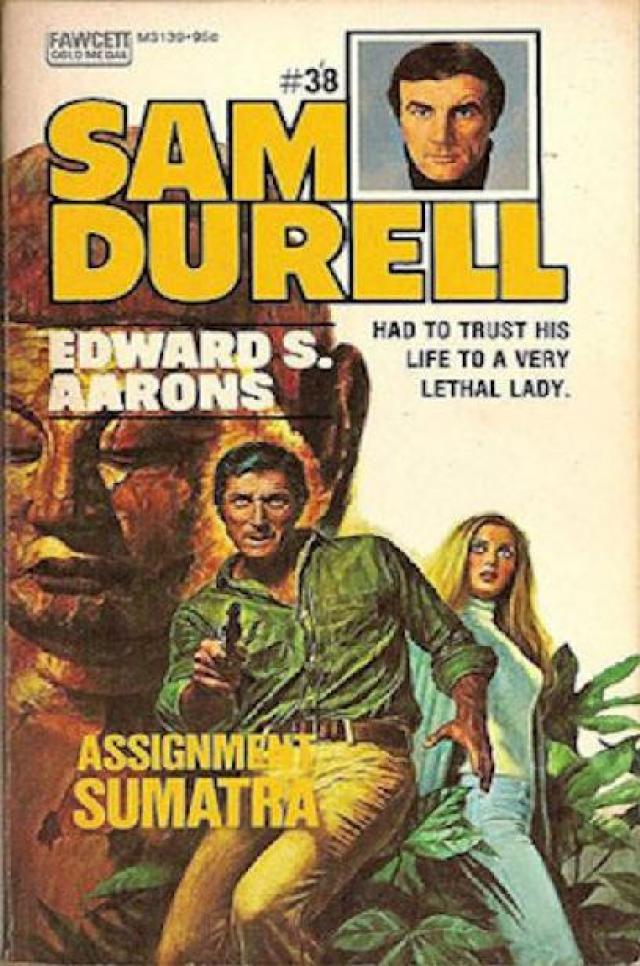
Assignment sumatra, p.17
Assignment Sumatra, page 17
part #38 of Sam Durell Series


He died.
Durell picked up his gun.
K’ang’s followers suddenly yelled and dived off the path, vanishing down the dark hillside.
Lydia turned toward Durell. Her smile was sweet and warm.
“Was that a help? Am I not really very good?”
“Very, very good. Do you have your gun?”
“I lost it. Is he dead?”
“He’s dead. Let’s have the stiletto.”
She stopped smiling. “Why?”
“Just give it to me.”
She hesitated fractionally, then handed it forward, hilt first. It dripped with K’ang’s blood, and some of it got on her palm and ran down from her fingertips. She did not seem to mind.
“All right, Sam, darling.” She trembled.
“Not now,” he said. “It’s been a long night.”
“Now,” she said. Her eyes shone with urgency.
“I want to see about His Excellency, Mr. Hueng.” Durell turned away.
He hoped she didn’t have another weapon hidden somewhere.
2.
The SEACROP conference opened promptly at nine o’clock in the morning. There was much fanfare, large crowds of beribboned and bemedaled notables, heavy traffic of dark diplomatic limousines, bands and orchestras competing for attention in the sunny, sparkling air. There were the usual delays to adjust microphones, to seat the heads of government, or their ministers who were in attendance. There were the usual cliques and hasty conferences held head to head, the buttonholing of delegates, the hand-waving and the urgent, last-minute alignments and decisions. There was a large gallery that formed an upper U-shaped tier of seats for spectators. The hall buzzed and echoed. The amplifiers were tested again. The orchestra played a variety of national anthems. It was not too unlike an American political convention.
There were rumors on the floor that his Excellency, Premier Hueng of Salangap, would not appear. There were rumors that he was ill. That he would be delayed. That Deputy K’ang, head of Security, would take Hueng’s place as chairman. Elation among some of the delegates showed in their broad, excited smiles and loud talk. There was fear in others, sliding sinuously like a snake from group to group. More than one minister wondered what was happening in his home country while he was absent. There was much talk of oil, of potential wealth for impoverished and struggling nations. There was a tidal surging between the Communist-dominated satellites of Hanoi and the more democratic nations who seemed defensive, unsure, while lacking the leadership of Premier Hueng.
Durell watched it all from a diplomatic seat in the gallery. He smoked one of his rare cigarettes, didn’t like it, and crushed it out. The glitter of Asian costumes dazzled his gritty eyes. The floor of the hall seemed like a carpet of moving jewelry. He needed sleep. He watched the security guards, posted at every entrance and in the wings of the stage and in the aisles.
There was a spatter of applause.
A murmuring lifted to a heavy roar of acclaim.
“His Excellency, Premier Hueng, of the People’s Democratic Republic of Salangap!”
The amplified voice echoed back and forth. The hall grew quiet. On the stage, a small, unimportant-looking man walked easily across the dais and stood before the microphones and the TV cameras.
His smile was gentle. He accepted the applause with a soft hand-clapping of his own, a tribute to his listeners.
Durell sat back in his chair.
He wished he had a drink.
He’d have one at Alyce’s, he decided. He would have to wait a short time, though. There were a few things he still had to do.
He listened to Hueng’s modest speech, his appeal for reason, for consultation, for the renunciation of all the wild and irresponsible rumors of violent action that had preceded SEACROP. He condemned such programs. He spoke of the need for aid, for guidance from both worlds. He was unassuming, but strength and force came from his words, and he could not be denied.
It was plain that his suggestions would be followed.
Before Hueng was finished, Durell got up and quietly left the hall.
He looked for a taxi beyond the row of diplomatic cars in the bright sunshine on the plaza outside the building.
People went about their business on the boulevard as if nothing very important was happening inside the impressive new hall. Street vendors called their wares. Bicycle bells tinkled. A few motorcycles violated the quiet of the streets.
“Durell!”
He turned at the sound of the cultivated voice that called his name. George Llewellyn Tolliver III leaned from a limousine that had small American flags attached to the front bumpers. The man’s sleek, narrow head was bent interrogatively toward him.
“Come along. I’ll give you a lift.”
“Thank you.”
“My place?”
“All right, George.”
“I’ve had a signal from K Section. You’re all set to leave now, aren’t you? Mission accomplished?”
“Not quite,” said Durell.
He got into the limousine. The soft rear seat tempted him to relax and close his eyes. He was not relaxed. He would not be able to sleep yet. He looked at the back of the Malay driver’s head and slid the glass partition shut between them. Tolliver’s after-shave lotion filled the back compartment of the limousine with rich opulence. The driver turned left, downhill toward the lake front and the official residence of the American observer to SEACROP. The car was pleasantly air-conditioned.
“So unfortunate about Major Sanu,” Tolliver murmured. “I suppose you’ve heard?”
“What now?” Durell asked.
“He killed himself. Blew his brains out. There really was no place else for him to go, nothing for him to do. He was exposed as an underground PKI, so his life was fore-feit here in Indonesia. And his secret plan for a military coup in Salangap was shot full of holes, of course. Thanks to you, Durell.”
“That’s another one on your conscience,” Durell said. “I beg your pardon?”
“I’d like a drink,” Durell said.
“I have bourbon at the house.”
“Where did he do it?”
“At my place, unfortunately,” Tolliver said. He might have been discussing a poorly played hand of bridge. “I’ve taken care of it, of course. Most discreetly. It won’t be in the press. His disappearance will go unnoticed.”
“Not by Washington,” Durell said.
“No?”
“It will be in my report.”
Tolliver smiled. His lean, aristocratic face was mildly curious. “Of course. When you are debriefed. But that’s the second insinuation you’ve made, Cajun. Do you blame Sanu’s death on me?”
“And all the others. Doesn’t it bother you?”
“I don’t know what you mean.”
“You do know,” Durell said. He disliked sitting this close to the man, and was grateful when the chauffeur smoothly brought the limousine to a halt at the lakeside villa occupied by Tolliver. “I’d like the drink first.”
“I’d like an explanation,” Tolliver said.
“You’ll get it.”
Tolliver looked impressive in a near-beige, drip-dry suit with wide lapels. His sleekly groomed head was cocked a bit to one side, as if he were listening to something; his eyes had a distant appearance, as if watching the activity on his prep school playing fields, far in the past. His lips were quirked. It might have been a smile.
The bourbon was in a cut-glass decanter. Discreet servants in mess-jackets moved about the house. Durell wondered what sort of trust funds George Tolliver enjoyed, aside from his relatively meager Foreign Service pay. The house was cool, and the view out over the lake was serene and peaceful. Durell tried to guess where Major Sanu’s body had been disposed of. Probably chained, weighted, and dropped into the blue, sparkling depths of the lake.
Tolliver crossed his elegantly creased trouser-legs. His head was still slightly cocked to one side.
“Now, then, Mr. Durell. I should think you would be quite satisfied with yourself, considering how matters have turned out. It seems to have cost you a bit, physically. You’re rather banged up, aren’t you? So many visible cuts and bruises. You look as if you’ve been in a grueling ten-rounder. Perhaps a doctor might be helpful—I know an excellent one—English chap—who lives here the year round. Shall I call him?”
“I’ll take care of myself.” Durell waved it aside and poured the bourbon. He thought of asking for the bottle itself, rather than using the decanter, but decided to hell with it. The liquor was mellow and smooth, a sour mash; it made him feel a bit better. He asked, “Aren’t you concerned about my report, George?”
Tolliver looked amused. “Why should I be?”
“You were backing Major Sanu’s projected military coup in Salangap. Not officially, I’m sure. On your own, perhaps? A bit of adventurous independence from your guidelines? You didn’t want Premier Hueng to appear here to make his conciliatory speech. It went over well, by the way. But I suppose you heard it, yourself.” Durell paused. Tolliver nodded. The man’s eyes had turned watchful. “You and Major Sanu planned to overthrow Hueng’s Communist government and install Sanu as head of a military regime, right?”
“A remarkable accusation, Durell. Should one object, however, to one less Red government in this part of the world?”
“Not really. But Hueng is better than another little military dictator out to fatten his Swiss bank accounts.”
“That is a matter of opinion.”
“Do you deny you were backing Sanu?”
“I am not alone in my political philosophies. Certainly elements in Congress and other departments of the government in Washington were pleased to advance unmarked funds for Sanu’s people. But you can prove nothing.”
“Plowman will talk,” Durell said.
“Plowman was not in it.”
“There are other witnesses.”
“None you can produce.”
“But you are the one who sabotaged my job to protect Premier Hueng, all along. You wanted K’ang to hit him and get Hueng easily out of your way. Then Sanu could move in and replace K’ang, I suppose.”
“Nonsense,” Tolliver said.
Durell decided not to drink any more of the man’s bourbon. He put aside his glass and stood up. “I want one 170 thing taken care of. It’s the matter of Tu Fu. He’s been used and abused. I know he’s a convicted murderer, but he was drugged into his original violence. I can’t prove it was you, or maybe Plowman, who originally picked him out and planned to use him as a decoy and an impersonator of Hueng, so that Major Sanu could control him like a puppet on a string until he made his move and seized military control of the country. But I think Tu Fu is one of the world’s innocents. He deserves a chance to live.”
“It has been given to him,” Tolliver said mildly. “He is already on a plane for Singapore, with enough American dollars to set him up for life there; he has new papers, a new identification, and a chance to open a small shop.”
“You’re not afraid he’ll talk some day?”
“Not at all. He never knew anything.”
Durell felt impatient and frustrated. He knew that what he had run up against in George Tolliver, and certain other factions in Washington, was not unusual. Power and fear went hand in hand to instigate wild and improbable plots even worse than the Bay of Pigs—poorly planned, poorly engineered, mostly presumptuous and bound to fail. It was not the way to peace, he thought. Not all the enemies of peace were on the other side of the wire. There would always be Tollivers. And they would always try again. Sometimes, as now, there seemed to be no way to punish and end their schemes. He held an empty hand, and Tolliver knew it, and Tolliver showed he knew it with his complacency.
“Now, then, Durell,” he said, leaning slightly forward. “I think we have had about enough of our little controversy. Things didn’t work out as I might have wished, but you’ve done quite well, all things considered. It’s too bad that Premier Hueng can’t publicly pin a Red Star medal on your chest for saving his life. He’ll appoint a new deputy premier out of his tin-pot Politburo, one he’ll be able to control, and play the Tito of Southeast Asia. I hear that he’s already ordered a shakeup in the Salangap Security Police, who were under K’ang’s control. You see, I assume you took care of Deputy K’ang, too.”
“Yes.”
“Good riddance. I think we both agree on that.”
“Yes.”
Tolliver looked at his gold Rolex. “Your plane leaves in forty minutes. Your papers and expense cash are on the desk over there.”
Durell turned and picked up his passport, air tickets, and an envelope of currency. He put them in his pocket without checking any of it.
“I’m not leaving just yet.”
Tolliver looked mildly surprised again. “Indeed? The orders come directly from Washington. Incidentally, General McFee, your boss, cabled congratulations to you. He, at least, is pleased with what you have done here. I really don’t see what can keep you in Sumatra any longer.”
“It’s unfinished business.”
“Ah?”
“Personal business.”
Tolliver smiled suddenly. “The girl, of course.”
“Yes. The girl.”
“You know where she is?”
“She’s waiting for me,” Durell said.
He turned away again. His legs ached. He felt as if he could sleep for a week.
“When you decide to leave,” Tolliver said, “let me know. I can expedite your plane reservations.”
“Thanks for nothing,” Durell said.
Chapter 12
THERE were few times in Durell's business when everything was wrapped up in a neat, tidy package. There were few truths that were absolute. He knew nothing for certain, except that Hueng was alive, and that he had delivered his speech to the SEACROP conference. The militant firebrand, K’ang, was dead. There was a good chance that in the following days, here at Lake Toba, Hueng’s speech would set the moderate trend for Southeast Asia that Washington hoped for. Among the policymakers back home, of course, there were inevitable divisions and differences. George Tolliver, influential and powerful, a career man who was more than just a functionary, belonged to one set whose political beliefs, in a sense, were just as bad as Deputy K’ang’s—depending on what was “bad” and what was “good” and who defined the terms. The rightness or wrongness of a policy depended on the ultimate outcome of too many factors to make it clear and simple. Peace was the ultimate goal that any man of reason and good faith could work for. In theory, the risks taken against the awesome alternative of nuclear war demanded a minimum of gambling and guesswork. Men of inherent good-will could upset, with the best of motives, the delicate balance on which the survival of a shrunken world depended. With the best will in the world, mistakes could be made, actions taken, that could be misinterpreted by the opponents. Durell, driving the jeep along the pleasant road that circled the lake, rubbed his forehead and put on the sunglasses he found looped to the visor of Alyce Remplemeyer’s vehicle. He had been given, a job, and he had done it. Beyond the immediate task still left to him, he could not make any further decisions about it.
There were only a few fleecy clouds in the high, blue sky. The breeze raised delicate ripples on the surface of the lake. Behind him, the flags of many Southeast Asian nations fluttered in the wind, side by side. He hoped they would stay that way—together, talking out their problems, seeking peaceful solutions that no amount of war or violence could solve, without risking total disaster.
On the outskirts of the town there was a small white building, a medical clinic, amid a cluster of Chinese and Indian shops. He stopped the jeep and went into the clinic, and the Indian resident doctor clucked and hurried over. The doctor was a woman, in a neat white smock.
“Sir, you have been in an accident?”
“Several of them.” Durell smiled. “I wonder if you could patch up a few of the worst cuts.”
The Indian doctor kept on clucking like a stout brown hen. “You should be in bed, sir. Are you with one of the diplomatic missions here?”
“Not exactly.”
“These are not accident wounds, sir. This one on your shoulder was made by a knife. It will need stitches. It should be reported to the police, sir.”
“I’ll take care of it.”
The woman’s dark almond eyes smiled at him. She went about her business quickly and efficiently. Durell accepted some aspirin, rejected a Demerol and an offer to tape his shoulder to immobilize his arm.
“I’ll have that done later.”
“You are an American, are you not?”
“Yes.”
“Not here officially, sir?”
“Merely an observer.”
“Premier Hueng made an excellent speech, did you not think so?”
“A good speech, yes.”
The woman doctor sighed. “If only people will listen to him.”
“Perhaps they will, doctor.”
He paid the resident out of the expense funds in Tolliver’s envelope and went out into the street, crossed behind the jeep, and entered a Chinese merchant’s shop and bought new slacks and shirts, had them wrapped, and took them with him. The sun had heated the wheel of the open jeep until it was painful to touch. The aspirins didn’t help much. He ached in more places than he cared to count. He knew his reflexes had slowed, from the cuts and bruises and contusions and scrapes, as much as from lack of sleep these past few days. He could not remember when he had slept more than two hours at a time since he had come to Sumatra.