Assignment sumatra, p.16
Assignment Sumatra, page 16
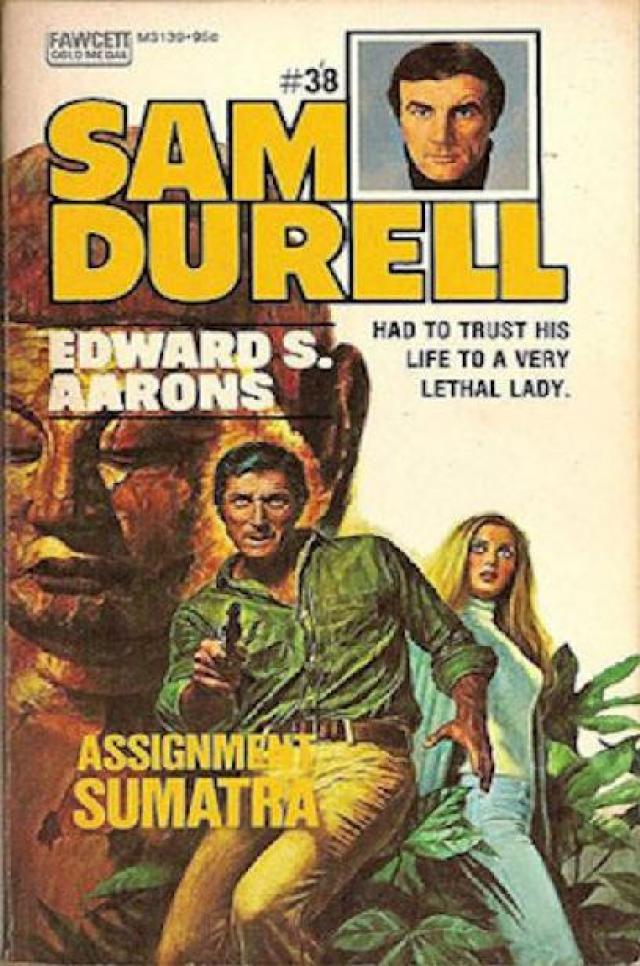
part #38 of Sam Durell Series


Durell scanned the faintly fluttering prayer slips. There were scores and scores to choose from. Some of them he could dismiss, since they showed their age, or had become soggy bits of yellow, stuffed in the cracks between the stones, decayed by rain. He began choosing the newest, crispest pieces of paper, and discovered that the odd script was illegible to him.
“Could you help me?”
“One does not intrude on the pleas of troubled souls.”
“It is for peace,” Durell said.
“Yes. I begin to believe you. Here. We will try these, in this place.”
The monk was slow, carefully replacing each bit of paper in its original niche after scanning it, before he tried another. The minutes ticked by. Durell listened to the wind in the pine trees, heard the chanting in the temple, listened for any sound of intruders. A half hour passed. The old monk was careful and diligent. Durell felt uneasy and impatient to be out of here. The night was moving on, and by morning, unless he produced Premier Hueng at the conference hall, he would have failed his assignment. He helped the old man replace the slips of ragged paper in the wall and then, abruptly, he heard a small sigh of satisfaction from the monk.
“Here. Here is Mr. Hueng’s note.”
“Can you read it?”
“It is only a simple prayer.”
“Please read it, father,” Durell insisted.
The old man blinked. “He wrote, ‘May the blessings of safety come to us with Tadjeh’s wisdom.’ ”
“Is that all?”
“It is a devout prayer, sir.”
“I apologize for my ignorance. Who is Tadjeh?”
“A most revered and pious monk who helped to found this order many hundreds of years ago. He was a saint, sir. His bones are buried in Tadjeh’s Cave.”
“Where is that?”
The old man gestured. “Near the mountaintop. A path goes through the forest from this place to the holy cave.”
“Is it far?”
“It might be dangerous in the dark.”
“I am not concerned about danger to myself.”
“In daylight, when one can see where one places each footstep, it will take a strong man like you perhaps a half hour.”
“Thank you, father.”
The old man blinked. “No one is at the cave during the night hours. Will you go there now? Long ago, we posted brothers to stand guard to see that Tadjeh’s peace was not disturbed during the darkness. But the custom has lapsed. A pity. I am too old to guide you, and all my brothers here are also old men.”
“Just set my feet on the path,” Durell said.
3.
It was past midnight when he reached the end of the way up the mountain. He had returned to Alyce Remple-meyer’s jeep, found a flashlight clipped under the seat, and used it sparingly during the climb. The lowering yellow moon was a help, but halfway up the mountain, he noted the clouds that boiled up from over the western shore of the island, out of the Indian Ocean. The sullen rumble of thunder indicated another tropical storm brewing over there.
Ten minutes later, before he reached the top, the rain came with savage suddenness. The sky reflected wild ribbons of blue incandescence from the lightning that tore at the dark fabric of the clouds. The rain came with cold, pounding fury, drenching him instantly. He paused, used the flashlight to determine the next few feet ahead, and saw a rock wall barring his path. The trail turned sharply to the right. Water tore down the face of the rock in increasing torrents. There was no shelter for him. Thunder crashed, drowning all sounds except the hissing of the downpour.
He saw the eyes gleam briefly.
Blue lightning ripped the sky.
The eyes were gone in an instant, lost in the black foliage to the right of the path, away from the rock escarpment. The ground sloped to the right, but not too much to deny a footgrip in the sodden soil. He did not look that way again. He tried to hear the footsteps, but the thunder and pounding rain drowned out every other sound.
The eyes gleamed again, pale and feral, as more lightning flashed. He was soaked to the skin. He tried the flashlight again and saw the mouth of a cave, crudely ornamented with antique pilasters, with a naga head carved in the stone. The eyes were behind him now. He flicked off the torch and halted at the cave entrance, his back to the wild wind. From this height, he could see a few lights still twinkling in the town around the lake, and this helped him to orient himself on the narrow path. There were only twenty more feet to the small plateau of the hilltop. A gust of wind tore at him. The trees whipped and clashed in fury. He went past the cave mouth, flicking the light inside for only a moment. The faces of death grinned back at him. Hundreds of skulls, the bones of monks dead for countless generations, were plastered into the wall of the cave.
He went on to the top of the hill, aware of the eyes behind him. In a brief blanket of darkness between the spasms of lightning, he turned suddenly, stepped to the right, off the path into the rain-soaked brush.
He waited.
His right hand, holding his gun, was soaked and slippery. He tried to dry his palm a little.
He waited another minute.
The eyes had vanished.
A small tinge of worry clouded his thoughts. He faced the wind. The rain blinded him. He turned the other way as lightning ribboned across the sky. There were a few breaks in the clouds now. The sudden tropical storm would soon be over. He did not want it to end yet. He moved into the brush between lightning strokes—then the eyes suddenly gleamed wild and predatory, in front of him.
The slender knife hissed, ribboned through his sleeve as he ducked to the right. He caught at the pale hand, but the slender wrist was slippery, eluding him. The knife slashed again. He would have been a dead man if he hadn’t been warned by the glimpse of the eyes. As it was, he felt a rip in his shoulder, and he fell, driving forward, his arms encircling a narrow, familiar waist, crushing inward hard, aiming to collapse the ribs and squeeze upward into the lungs and liver. His opponent was good. A remarkable strength resisted him, quick and elusive, drawing back and away. Wet leaves slapped his face. Twigs scratched him as he plunged forward. He did not use his gun. He did not wish to maim or kill, unless he had to.
His opponent was just a dim figure, thrashing in the brush. There was a long pause between lightning flashes, and the rain slackened for a moment. He crouched low, ducked under an angry swipe of the knife, drove for the knees, made contact, and they both rolled down the slope, crashing through the brush below the cave.
He came up on top, felt the lithe musculature squirm under him, and slammed an arm across the throat.
He laughed softly.
“Lydia.”
“What?”
“Lie still.”
“But I thought—”
“It’s me. Sam.”
“Oh, my God.”
“Drop your knife,”
“I’m not—”
“Drop it.”
Lightning flared again. He saw her face now, changed by dismay, despair. Her hair was sodden, plastered across one side of her head. Her wet clothes left nothing to the imagination. Her eyes shone white in the flashes of blue in the night sky.
“Drop it,” he said again. “You knew it was me.”
“No, Sam.”
Her body relaxed slowly under him. He waited.
“All right,” she said.
“Now.”
“You’re hurting me.”
“It will get worse if you don’t obey.”
“Sam, I thought you were one of K’ang’s people. I think they finally got only me. How did you get away? Did you have any trouble with them?”
He said, not so gently, “The knife, Lydia.”
She finally dropped it.
4.
He followed her tall, swaying figure up through the brush to the mouth of the cave. He had lost his flashlight up here, and he waited for more lightning to find it on the path. The girl stood quietly, waiting; she pushed her wet hair out of her eyes and then hugged herself, shivering.
“Do you have Hueng here?” Durell asked.
“Yes. I got His Excellency out of the shrine all right. But I had to knock him around a bit, after that thing with those two men of K’ang’s. The one I had to kill and the one who ran away. It was stupid of me to faint. And then you disappeared.”
Durell did not mention that he had seen the second Chinese acting as a gateman for Alyce Remplemeyer. “I was hooked by another interested party when I went back to the road,” he said. “It was Major Sanu, no less.” He added sharply, “Why did you have to ‘knock around’ Mr. Hueng to get him to come with you?”
“He just didn’t want to,” she said bitterly. “Mr. Hueng just doesn’t trust me.”
He urged her back into the cave, keeping her ahead of him. He touched the button on the flashlight for a moment. The skulls of countless dead men grinned back at him from the cavern walls. The floor was polished smooth by the centuries-old processions of barefooted pilgrims who had paid homage at Tadjeh’s Cave. He felt briefly pleased that his hunch to follow up Hueng’s prayer slip had proved correct. But his brief moment of relief was dissipated as they went farther into the cave, with its gruesome religious relics. Hueng sat in a niche in the stone wall, between a pile of leg bones, ribs, and skulls whose jaws had dropped away.
“Sir,” Durell said.
The small Salangapese blinked into the brief touch of light which Durell squeezed from his torch. His eyes looked vacant and blind without his glasses. A trickle of blood had run down from a scalp-wound and dried on his round forehead. His clothing was ripped and frayed, and he looked small and defenseless, resigned to an unknown fate, as he lay trussed hand and foot in the niche, among the bones.
“Sir?” Durell said again.
“Ah. Mr. Durell. You have—ah—come to answer my prayer to Tadjeh?”
“You were wise to be devout among the monks.”
“Yes. But be careful of the young woman.”
“I believe she meant well.”
“She treated me with anger and scorn.”
“She meant no real harm,” Durell said. “It’s been a very difficult and trying time for all of us.”
“In Salangap,” said Premier Hueng, “when we met some years ago and drank tea on the terrace and discussed the world, I thought you were an exceptional man. My estimate proves correct. Will you please untie me?”
Durell knelt beside the small man. He kept Lydia in sight, in the glow of the flashlight. “Why did Miss Morgan feel it necessary to treat you like this? We are both trying to help you, to get you to the conference tomorrow morning.”
Lydia stood tall, her legs slightly spread, her attitude angry and defiant. “He wanted to go back to town and stay at a hotel there. He insisted on it. Openly, without any protection. How long would he have lasted, walking around innocently like that? K’ang would have picked him up in nothing flat. So we argued, and he tried to run away, that’s all.”
Durell looked at her. “You fainted when I told you Plowman was dead, and then I was picked up by Major Sanu. What happened to you after that?”
She pouted a bit. “After I came to in the brush and found you were gone, I went back to the monastery, and that’s when Hueng and I argued about hiding out some place until you showed up again.” She grinned. “As I knew you would, Sam.”
Durell said nothing. Premier Hueng rubbed his ankles and wrists slowly. Durell helped him to stand. His weight felt slight in his grip. The Salangapese murmured regrets. The girl looked at them with a face carved from stone.
“I wouldn’t trust him anymore, Sam,” she said flatly. “For a while, I even thought he was playing K’ang’s game. Anyway, what do you plan to do with him?”
“I’ll take him to Eli Plowman. Now, don’t faint again.” Lydia looked stunned. “But you said Eh—” She paused. “You said he was dead.”
“Well, he isn’t. He is very much alive.”
“You—you’ve actually seen him?”
“Half an hour ago,” Durell said.
She leaned against the wall of skulls. The bones did not seem to bother her. She put a hand against her cheek and rubbed her face hard. Her pale eyes never left Durell’s.
“You were so certain he was dead.”
“I was mistaken.”
“I think you’re lying to me.”
“Help me with Hueng, Lydia. I should think you would be pleased and happy with the news that your boss has survived.”
“Oh, I am. Of course I am. Yes. I somehow always knew—I somehow felt—” She swallowed. “Eli is like a fat cat, very quick on his feet. But you said—”
“I learned that he wears an armored vest at all times,” Durell said.
“Where is Eli now?”
“Across the lake, with Alyce Remplemeyer. Do you know she has a hotel here?”
“I heard of it, but I thought she never came here.”
“Well, she’s there now. With Eli.”
“That fat old whore,” Lydia said viciously. “She could have let us know, after all these hours, these days and nights.” Her voice changed. “But you felt that Eli sold us out for some reason, didn’t you? Have you changed your mind? If it wasn’t Eli Plowman who tipped off K’ang about Tu Fu, who was it? And what about Tu Fu, anyway?”
“You’ll get an explanation later. Have you got your knife? And the derringer?”
“Yes.”
“Then let’s go.”
It was not that easy.
K’ang’s men were waiting outside of Tadjeh’s Cave.
Chapter Eleven
THE sudden storm had ended, rumbling off to the east and south over the low, marshy coastal plain below the mountains. The trees dripped, and the wind made a soughing sound in the trees and brush below the narrow path that led up to the cave mouth. Durell urged the girl out of the cave first, then followed Premier Hueng’s slight, stumbling figure.
The night had darkened again, but there were rifts in the ragged tropical clouds, and the moon shone intermittently to the west.
His first warning came when Lydia made a small yelping sound on the path to the right. It was a poor place to attack them, but apparently Deputy K’ang was now desperate. Only one or two men could come at them at a time, and there were, at the most, a half dozen of them. Lydia moved fast, throwing herself to the brushy side of the path as the first two men lunged at her. Another appeared, charging up to grab at Hueng. Behind them, at a safe distance, was the short, stout figure of K’ang himself.
Durell shoved Hueng’s thin body behind him, back into the cave. There was a muffled scream from one of the attackers as Lydia’s knife found its mark. A shout, a stream of Chinese oaths, a thrashing in the brush below the path indicated that Lydia had tackled her second opponent. The others rushed for the mouth of the cave. Durell wondered why they simply had not used their guns to mow them down. Maybe they were afraid of hitting Hueng. Perhaps they wanted to take the premier alive now, for new reasons of their own.
Then he had his hands full. They charged at him fast, cudgels swinging in their hands; their breaths panted like wild animals. The moon vanished behind the storm clouds, and the darkness was all but complete. He was driven backward by two men, then retreated a few steps into the cave and slammed one man against the wall, heard his head crack satisfactorily, stepped over the slumped figure, chopped at another’s throat, felt a blow on his shoulder from one of the clubs, staggered, came up low, charging, and tumbled another man off the path and down into the steep, brushy slope. The rain had made the earth soft and slippery. The dark confusion helped him. He could not find Lydia, but K’ang’s short, stubby figure was briefly visible on the path. There was some fighting going on above him, on the little plateau that formed the hilltop, but he paid no attention to it. He stepped back, conscious of the need to defend little Mr. Hueng in the cave.
The first shot came from K’ang’s gun. It sounded thunderous above the heavy, breathy scuffling.
K’ang’s voice cracked, “You will please stop all resistance to us, Mr. Durell.”
About a dozen paces separated them on the narrow path. K’ang’s voice rumbled again in the momentary silence that followed his gunshot.
“It is hopeless for you, Mr. Durell. Moreover, you are interfering with the internal affairs of the People’s Democratic Republic of Salangap. Please bring Premier Hueng out to me at once. Otherwise, you will be charged with kidnapping and attempted murder.”
Durell grinned. “That’s typical. It’s you who want to kill him.”
“No one would listen to such a ridiculous charge. Hand him over, if he is still alive.”
“And if I don’t?”
“Then you and your associates will die here and remain in Tadjeh’s Cave.”
“With all the other dead people. I suppose that seems appropriate to you.”
“Let me speak to the premier,” said K’ang sharply. “I should advise you, of course, that I am an excellent shot with this weapon. Your hands are empty. You are quite a fine target.”
Durell wondered about Lydia. K’ang did not seem to be concerned about her disappearance from the brief struggle.
One by one, K’ang’s men gathered on the path, but they were careful not to step between the Salangapese and Durell’s tall figure in the mouth of the cave.
Lydia came climbing up from the brushy slope and stepped onto the path.
She looked different. Her eyes glowed. She had looked like that when Durell had taken her in the mine. Her fine figure seemed to have a vibrant aura that was out of place at this moment.
K’ang flicked her a contemptuous glance.
“My dear, you will please remove yourself. You are in my line of fire.”
There was no apparent weapon in Lydia’s hands. Durell could not see the derringer or the knife. But there was a streak of blood on her arm, another on her thigh. Her smile was tight and controlled. Everything about her was controlled, like a finely coiled steel spring.
“You’ve lost, K’ang,” she said. “Eli is alive. I’m sorry.”
“You will be sorrier—”
They were K’ang’s last words. Durell could not see the girl’s movement, it was so quick, so sure, and so deadly. The knife flickered, not in a stabbing motion, but in a clean swipe across the stout man’s throat. K’ang stared at her, while a great spray of blood leaped from the wound. His eyes goggled, he touched his neck, his hands halting and unsure. He was already dead when he turned, his face refusing to accept the awful view of his life’s blood gouting from out of the sliced flesh. He opened his mouth, coughed, bent forward, and sank to his knees. He faced the cave entrance. Darkness puddled under him. For one more instant, his braced arms supported him on the path outside the cave. Then he bent slowly forward, in a posture of obeisance toward Tadjeh’s Cave.