Death trap, p.6
Death Trap, page 6
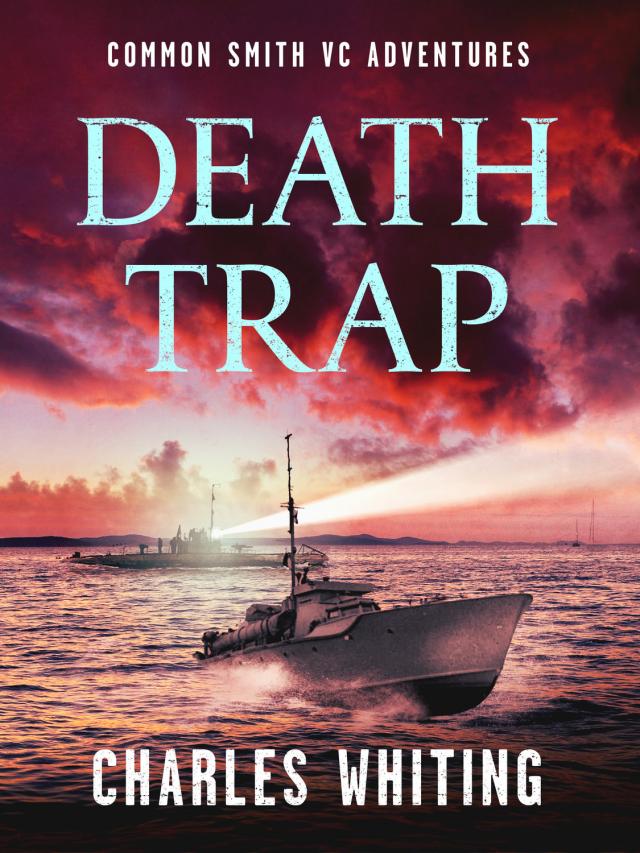


Every time anyone moved on the deck of the Swordfish, there was the nasty ping of a sniper’s bullet and it was obvious that their attackers, whoever they were, were crack shots.
By this time they had discovered what had stopped them so surprisingly at the exit to the little inlet. While they had been sleeping in the Swordfish, not only had their attackers blocked the exhausts, but they had also stretched a steel chain across the narrow exit knowing, obviously, that at the speed the crippled Swordfish would be able to move, it would be unable to burst through the chain.
It was Smith’s intention now to cut that chain if he could, take the attackers by surprise and, as he had remarked to Dickie Bird who was now in command of the Swordfish, ‘Get the hell out of here ‘toot sweet’ before they launch an all-out attack, which as sure as cats have kittens they will as soon as it really gets daylight.’
He paused at the rail and whispered, ‘Ready, Billy?’
‘Ready as ever I’ll be, sir,’ the plump sailor answered stoutly.
‘All right. Over I go.’ Holding his Tommy-gun aloft with his left hand, Smith lowered himself into the pleasantly warm water.
Moments later, Bennett, armed with a sledgehammer and cold chisel, did the same. With a slight splash Bully, the dog, joined them a second afterwards.
Slowly, almost noiselessly, the three of them dog-paddled to the shallows where Billy Bennett would find the leverage he would need to wield the big hammer. And even as he swam, Smith told himself that once he did so all hell would probably be let loose.
Aboard the Swordfish every man was standing by tensely, for all of them guessed the same thing. Once big Billy Bennett started trying to snap through the chain, their attackers would begin trying to knock the two of them out. Dickie Bird, chain-smoking up on the bridge next to the anxious-faced Ferguson, moaned, ‘Why the hell did I let him go, Chiefie? I could have done the job just as well. God, I’ll never forgive myself if this thing goes wrong.’
‘Now don’t take on, Mr Bird,’ Ferguson tried to soothe him with unusual kindness for the crabby old Scot. ‘This is the way the skipper wants it. He’d never risk another man’s life, ye know, for something he wouldn’t tackle hissen.’
‘I suppose you’re right, Chiefie,’ Bird agreed, lighting yet another cigarette from the stub of his last one. ‘But I do think—’ He stopped short. He had just heard the sound of metal striking metal. As yet it was faint and probably hadn’t disturbed the men waiting to attack, but he knew it was the start of more noise to come. ‘Billy’s just got the cold chisel in place.’
‘Ay, that he has, sir,’ Ferguson said. ‘Now he’ll start hammering and then…’ he shrugged his thin shoulders and left the rest of his sentence unsaid. The time for words was over anyway.
‘All right, Billy,’ Smith whispered. They were standing up to their waists in water. In one hand, Smith held the chisel while in the other he clutched the Tommy-gun somewhat awkwardly. He knew that with only one hand free he wouldn’t be able to aim if they were attacked, but at least the noise might frighten off any would-be attacker. He hoped so at least.
‘I’m ready.’
‘Watch yersen, sir,’ Billy cautioned as the little dog stared up at him, still paddling in water that was too deep for it. ‘Here we go!’
He raised the hammer and brought it down hard. There was a terrific noise as the hammer struck the steel chain.
Smith jumped. God, he told himself, they probably could hear that racket in Tiranha, the Albanian capital. He tensed and waited for the fireworks to start.
Surprisingly, nothing happened.
‘Once agen, sir,’ Billy Bennett grunted and spitting on his big hands he gripped the hammer more tightly and brought it down. This time the noise was added to by a cutting sound. Smith’s heart leapt. Billy was getting into chain. Perhaps they might pull it off without trouble after all?
But that wasn’t to be. Suddenly from the rocks to the right, close to the edge of the water there came a cry of rage. They had been spotted. ‘Get cracking, Billy!’ Smith urged as the first wild volley of rifle fire erupted.
Bennett needed no urging. He knew just how vulnerable the two of them were standing here in the open without protection. With all his strength he raised and swung the big sledgehammer once again. The blade slammed into the chain savagely. ‘It’s coming, sir,’ Billy said through gritted teeth in the same instant that a shadowy figure, clad in baggy black trousers and wearing a kind of a turban wrapped around a skull cap, came clambering out of the rocks directly to their front.
Smith fired instinctively. Slugs howled off the wet rocks in a series of angry red sparks but still the native came on. He was carrying one of the curved swords they had seen before and it was obvious he was intent on using it.
‘Keep hammering, Billy!’ Smith cried desperately and fired again, then again.
In the ugly light of dawn Smith could see their attacker’s hook-nosed, rapacious face grinning wickedly. He thought he had them at his mercy. The man raised his sword to bring it down on one of their skulls.
But he had not reckoned with Bully.
Barking angrily, Bully dashed forward. Before their attacker knew what was happening, the brave little dog had leapt up and fastened its teeth in the man’s right leg. The move caught him completely by surprise. He faltered and shouted something, lowering his curved sword as he did so.
Billy took advantage of the delay. He swung the sledgehammer once more. Suddenly startlingly the chain parted. He had done it.
‘Quick!’ Smith yelled, dropping the chisel as if it was red hot and levelling the Tommy-gun.
Billy Bennett didn’t need a second invitation. He whistled and cried, ‘Come on Bully, come back to daddy!’
The dog obeyed instantly. It relaxed its hold on the attacker’s leg and, springing neatly into the water, started paddling swiftly to the two sailors. Their attacker surged forward once more but not for long. Smith pressed the trigger of the Tommy-gun. It chattered frantically as he held it tightly to his right hip. The burst caught the attacker right across the chest, which was ripped to bloody pieces in an instant. The sword tumbled from abruptly nerveless fingers. For what seemed an eternity the man simply stood there, then slowly, very slowly, his legs crumpled underneath him and he pitched forward on his face, dead before he hit the ground.
They hadn’t waited to see that happen. Now they were swimming back to the Swordfish, where already the crew were returning the enemy’s fire which was coming from both sides of the inlet. Slugs started to patter in the water all around them, throwing up angry little spouts of white water. Desperately, they kept on swimming, while Ginger and the rest peppered the rocks behind which their attackers were concealed.
‘Come on, Bully!’ Billy Bennett gasped. ‘Keep up with daddy.’ On another occasion Smith would have thought that Billy was going off his head. Now he admired the fat matelot’s love for the little mutt. ‘Just you keep up!’ he began and ducked as a salvo of bullets hissed inches above his head.
On the bridge, Ferguson called urgently to Mac below in the engine-room, ‘Start them up, Mac. Let’s get out of this hellhole while we’ve still got a chance.’
The engineer needed no urging. He could hear the angry snap-and-crack of the fire-fight outside only too well. He started the turbines. They croaked into thick, turgid activity and he cursed to himself. His beautiful engines were being ruined, but he knew it had to be done.
‘Come on, sir!’ A sailor reached down and grabbed Smith’s hand. Gasping and choking, Smith allowed himself to be hauled aboard. Then together with the sailor, he helped to fetch up Billy Bennett, who was clutching the soaked, yapping dog to his chest like a fond mother might do with a favoured child.
All around them the big homemade slugs were slamming into the superstructure, gouging raw metal scars on steel, chipping the rest to matchwood.
‘The skipper’s on board,’ Dickie Bird yelled and blazed away with his Tommy-gun, a savage angry light on his normally placid face.
‘Ay, ay, sir,’ Ferguson responded. ‘Both ahead,’ he called down the voice tube.
Slowly, sluggishly, the battered Swordfish started to pull away, followed by the increased, angry fire of their attackers who knew they were being cheated of their prey after all.
‘Cease firing,’ Smith, who suddenly felt unutterably weary, yelled above the racket. ‘Don’t waste any more ammo.’
Slowly, as Swordfish drew ever farther away from the exit to the inlet, the firing petered away until now it was only their attackers who were still purposelessly firing, for already the little craft was out of range, puffing and spluttering with its blocked exhausts. Then, as the sun started to rise on the horizon, flushing the sky a bright, warm red, the Swordfish disappeared completely.
* * *
Surprisingly, Mussolini didn’t explode with rage when the adjutant brought him the news. The young giant had expected he would do so, after all this was the third time they had failed to deal with the perfidious English. But Mussolini had quite calmly taken the information that the Albanian plan had failed, though he had scowled a couple of times as he had read through the signal. Now he raised his polished bald dome and said, ‘They have been lucky three times, these English. I think their luck will soon run out.’
‘How do you mean, Duce?’ the adjutant ventured, now that his Leader had taken the news so calmly.
‘Because they are well and truly in the Adriatic now, and we Italians control the Adriatic. It is our Mare Nostrum, just like the Mediterranean is.’ He thrust out his chest proudly at the thought. ‘So,’ he concluded, looking at the young ox, ‘they are in and we have the key which will lock the door to letting them out.’
‘I see, Duce. We wait till they attempt to return and in the Straits we will catch them,’ the giant adjutant said.
‘Exactemente,’ the Duce snapped, apparently very pleased with himself. ‘Inform the naval adjutant that he will contact the admirals. I want a standing patrol to cover the Straits. There must be no escape for those Englishmen this time. Heads will roll if there is any failure this time. Claro?’
‘Claro, Duce,’ the adjutant snapped back.
‘Good! Then you may go.’ He looked maliciously at the handsome young giant with his pomaded, sleeked hair, ‘Now I must relax. You understand.’ Without giving the officer a chance to reply, he strode away, already fiddling with his flies.
Book Two
Into the Mountains
One
‘’Fraid young Thompson’s had it, sir,’ the radio operator said. With his good hand, he closed the eyes of the now dead rigger lying in the cover of the wrecked courier plane’s wing.
The second pilot, Flight Lieutenant Hurd, shook his head in sorrow. ‘Poor young devil. He was barely nineteen,’ he said, as if talking to himself. But then all three of the survivors had begun to do that after three days on short rations in this snowbound mountain wilderness.
Softly, the first new snowflakes started to drift down and Sergeant Burrows, the radio operator, an old sweat who had once been a founding member of the Royal Flying Corps before the war, said, ‘I think we ought go back inside again. I know it’s cramped, but it’s better than out here.’
Flight Lieutenant Hurd, looking at the body lying there under the snapped-off wing of the Fokker and Burrows, answered his unspoken question, ‘We’ll bury him, sir, after the snow stops.’
Somewhere farther up the mountain where the treeline stopped, a wolf howled and it hastened the officer’s decision. ‘I suppose you’re right, Sergeant. Let’s get inside for the time being.’
Hurd straightened himself with difficulty, for he had injured both legs in the crash. They weren’t broken, but they were black with bruises and very swollen. Burrows helped him rise with his good hand and prayed that the young officer, whom he liked and respected, had not got gangrene. Twice when he had been applying a soothing salve to the officer’s legs from the medical kit he had sniffed secretly to check whether they were giving off that sickly sweet smell which indicated the dreaded gangrene. So far there had been no odour save that of an unwashed body.
Like two very old men, they clambered inside the jumble of the wrecked plane which had been their home for the last three days, but as Burrows had snorted, it seemed more ‘like three bloody years’.
They crawled into the wrecked mess of boxes, smashed instruments, a shattered compass, wooden boxes of rations, carefully stored so that the wood could be used to heat their only hot meal of the day, tins of M & V stew, dating back from the war. There weren’t many of those left now.
‘What do you think, sir?’ Burrows asked as they settled themselves into the mess. It was icy cold inside the metal skin of the Fokker courier plane, but at least they were out of the snow.
The flight lieutenant frowned. ‘God!’ Burrows told himself. ‘He’s only a kid and I’m asking him what he thinks!’
‘Well, Sergeant, we’ve got rations for at least three days, if we stretch them a bit. The hardtack’s almost gone, but we’ve got three tins of the Irish stew. We’ve got enough wood to heat the tins, too, and,’ he shrugged a little helplessly, ‘if the worst comes to the worst we can burn the documents and use them as fuel. They mentioned we could. You took the message.’
‘Yes, sir,’ the Sergeant answered loyally. He knew just how much the young officer would hate doing that. His sense of duty would be offended.
For a moment or two Sergeant Burrows peered through the cracked window at the valley floor far below. There was no snow down there and in the far distance he thought he caught a glimpse of smoke drifting into the sky. He licked his lips. Perhaps down there, sitting before a crackling fire, someone was heating up a cauldron of hot stew. His stomach rumbled at the thought and he licked his lips once more as if in anticipation.
‘A penny for them, Sergeant?’ the young officer said.
Sergeant Burrows forced a grin, but it took some effort to do so. ‘I was just thinking that there are people down there, sir, people living in warm houses, eating plenty of grub. They might even have some wallop. God, I’ve forgotten what beer tastes like!’
Now it was the flight lieutenant’s turn to grin. ‘And what is all this leading up to, Sergeant?’ he asked with mock severity.
‘Well, sir, I was just wondering,’ Burrows answered slowly and thoughtfully, ‘how long we should stick it up here. I mean, sir, wouldn’t we have a better chance if we tried to get down the mountain while we were relatively fit enough. ’Cos once we start to run out of grub and weaken even more…’ He shrugged and left the rest of his sentence unspoken.
The officer’s grin vanished and he, too, became serious and thoughtful. ‘I’ve been thinking on those lines myself, I must admit, Burrows. I mean we’re not in particularly good shape as it is, you with your hand and me with my gammy legs. But I suppose we could help each other.’
‘Of course we could, sir,’ Burrows said enthusiastically. ‘And it’s not as if we were climbing up the bloody mountain. We’ll be going down it.’
‘Yes, I know,’ Hurd agreed. ‘But it would mean disposing of the documents and Cairo did signal that a party was on its way to rescue us.’
‘Yes, sir. I understand, sir. But when? We could all be in Brown’s Garden by then.’
‘Brown’s Garden?’ Hurd queried.
‘Old saying, sir,’ Burrows enlightened him. ‘In the cemetery, sir.’
‘I see.’
Flight Lieutenant Hurd frowned. ‘It would be a difficult decision to make, Sergeant,’ he said thoughtfully. Outside it was snowing hard again, coming down in white sheets, as if it would never stop. ‘And I know it’s one I – we – will have to make soon. It’s obvious that winter’s on its way in this God-forsaken hole.’
Burrows nodded his head in agreement and stared glumly at the falling snow, too, telling himself that even if they were fit, which they weren’t, it’d be damn difficult getting down the mountain in this kind of weather.
Hurd raised his voice. ‘Let’s do it like this, Burrows,’ he said. ‘We’ll give them another twenty-four hours to contact us. If they’re not here by then, we’ll destroy the papers and have a crack—’
Suddenly he stopped. On the battered little desk, the Morse key attached to the wrecked plane’s only source of power, the wet battery underneath it, had begun to clatter.
‘It’s working by Christ!’ he cried with sudden enthusiasm.
Burrows, his body flooded abruptly with new energy, sprang across to the earphones. With his good hand, he slipped them over his cropped head and started taking down the message on the official pad, scribbling away industriously, while Hurd waited in tense expectation.
With a flourish, Burrows scribbled the last few syllables as the key went silent and handed the buff form swiftly to the waiting officer.
Hurd almost snatched it from his hand. Hurriedly he ran his eyes across the signal, repeating it aloud to himself as he did so.
‘“RP – rescue party passing Greek coast. Expect to make landfall approx. 2200 hours tomorrow night. Acknowledge.”’
He nodded furiously at the NCO crouched over the battered table.
Sergeant Burrows acted at once. With practised skill he tapped out the acknowledgement, keeping the signal short, for he didn’t know how long the wet battery would last. Then he simply sat there, panting a little as if he had just run a race.
Opposite him, the young officer’s bloodshot eyes glittered excitedly, as he ran his hand over his unshaven face, saying enthusiastically, ‘My God, now I’ll be able really to indulge myself. For me the first thing will be the big three S’s.’
Sergeant Burrows laughed drily, ‘Yer, shit, shave and shampoo! Me, I’ll stay mucky and enjoy a pint of wallop first, sir. Well, they’ve got a fix on us. They know where they are.’
‘Yes, Sergeant, and to the best of my knowledge we’re some twenty miles inland. My guess is they’ll use the river as far as they can and then they’ll trek across country to up here. I’m sure we’re visible from the valley below.’