Death trap, p.4
Death Trap, page 4
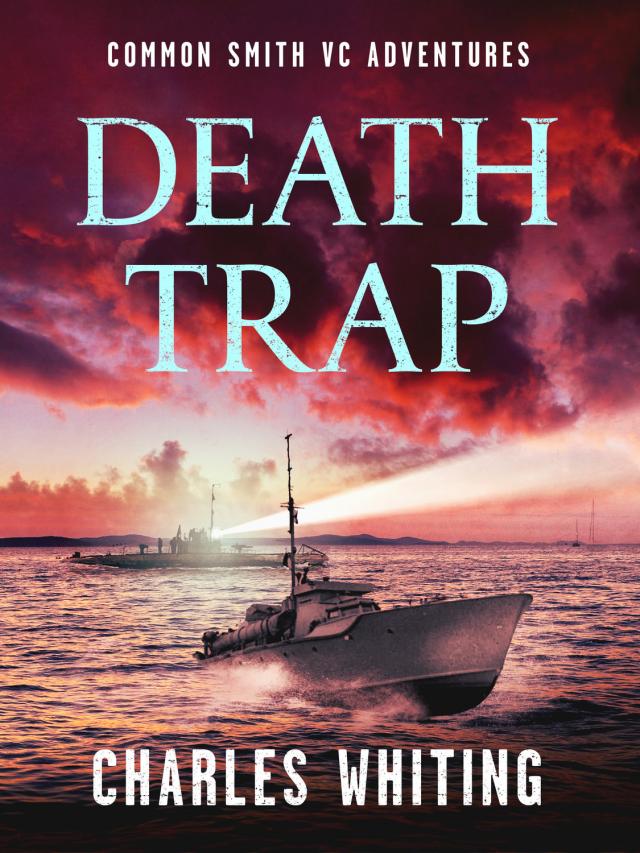


An aldis lamp started to blink off and on on the Italian destroyer. ‘Ignore it,’ Smith snapped. ‘We’re outside of Italian territorial waters. The Italians have no jurisdiction over us.’
‘I don’t think that’s going to worry him very much,’ Dickie Bird answered grimly, as the Italian destroyer began to change course.
Almost immediately there was a hollow boom, followed a few moments later by a great howling as if a gigantic piece of canvas was being torn apart.
Smith flashed a glance at the for’ard deck of the destroyer. Cherry red flames rippled along her ‘B’ turret. ‘Christ Almighty,’ he yelled above the bansheelike shriek, ‘they’re fir—’ The rest of his words were drowned by the noise of a shell exploding only a hundred yards or so away. A great spout of angry white water rose high into the grey sky.
‘What utter cads,’ Bird exclaimed in mock indignation. ‘They’re not even giving us a fair chance. Not quite cricket, what.’
Smith didn’t answer. He was already calculating the distance between the two craft. For the time being the Italian was gaining on them. The Swordfish had still not reached that top speed that might just take them out of the Italians’ range. ‘Dickie,’ he yelled above the roar of the engines, two huge combs of white water curving upwards and outwards from the Swordfish’s bows. ‘Get on the telegraph and tell Mac’ – the chief engineer – ‘to put his foot down hard and move her. Otherwise we might well be down in Davy Jones’ locker.’
As unflustered as ever, Dickie Bird spoke into the voice tube in the same instant that the Italian destroyer’s ‘A’-turret opened fire with both four-inch guns. Great spouts of water erupted to both sides of the speeding boat. Now the Italians were really ranging in, Smith told himself grimly. If they didn’t get away soon, they might well be visiting that celebrated ‘locker’ at the bottom of the sea.
CPO Ferguson, his raddled old face red with the effort, came clattering up to the bridge. ‘The smoke pots, sir,’ he gasped, his skinny chest heaving frantically, ‘I’ve ordered the off duty watch to fire the smoke pots.’ He staggered and Smith caught him quickly.
‘My God, Chiefie, you’re a genius! I’d never have thought of that.’ Already the off-duty men were running along the deck to fire the smoke pots, knowing that their lives were at stake now, their nausea forgotten.
Almost immediately they started to trail a stream of thick black smoke behind them, which made the ratings cough and gasp. But it didn’t matter. The Italian gunners, unable to see their target, ceased firing after another couple of harmless rounds, which fell far short of the hurrying Swordfish.
Half an hour later they had obviously outrun the Italian destroyer, but as a relieved Smith sighed to Dickie Bird, ‘We’ve done it this time, old chap. But the Italians obviously knew we were coming and what our course was. God knows how they knew that.’
Dickie Bird shrugged. ‘Search me, old man.’
‘But one thing is clear, once we enter the Straits at Otranto, the buggers’ll be on to us again.’
‘I suppose you’re right,’ Dickie Bird said quite seriously. Then he brightened and remarked, ‘Come, Smithie, let’s tuck ourselves round a large – a very large – pink gin. I dare say we deserve it.’ He thrust his arm through Smith’s and they sauntered off to the wrecked wardroom as if they hadn’t a care in the world.
Watching them, Thirk’s face wrinkled into a sneer of contempt. ‘Bloody officers!’ he muttered under his breath. ‘Nothing better than a bloody lot of Mary Anns…’
Six
Now it was noon. Up ahead, and just visible on the horizon were two smudges of land to port and starboard. One was Greece; the other the ‘boot’ of Italy. They were now about to enter the Straits: a prospect that didn’t please a worried Smith one bit. If the Italians were going to take another crack at him, he knew it would be here.
But he had worked out a rough-and-ready plan. As he had already told Dickie Bird and CPO Ferguson, ‘We’ll stay close to Greek territorial waters in the hope that the Italians won’t attempt to violate them. At the moment there’s no love lost between the two nations.’
‘Ay,’ CPO Ferguson had commented, ‘but ye’ll soon be out o’ Greek water and into the Albanian area.’ He had paused significantly before saying, ‘And the Albanians dinna have a navy. What can they do if the greasers move into yon three-mile limit?’
To which Dickie Bird had replied, ‘You are a real ray of sunshine, Chiefie, you really are. If anyone can cheer a chap up it’s Chief Petty Officer Ferguson.’ But Smith knew the grizzled old Scot was right. Albania was a very primitive, backward country. He doubted strongly whether Italy with its powerful navy would worry about offending the Albanians. But he dismissed his worries. He would meet that particular problem when and if it turned up.
Time passed leadenly. Smith had ordered speed reduced. He didn’t want to attract attention from any watcher by too high a bow wave. All the same, he ordered double lookouts and that the Lewis guns, at least, should be brought from down below and set up on their mountings.
But tension mounted as they came ever closer to the Straits. The crew knew, of course, that the Italians were on to them and that they stood little chance of escaping with their lives if an Italian destroyer got within range again. Visibility was excellent and as Ginger Kerrigan expressed it, ‘Even a four-eyed man who couldn’t hit a bleeding barn-door normally, wouldn’t be able to miss us.’
Now the lookouts constantly swept the horizon to port and starboard with their glasses, taking the greatest of care, waiting tensely for the first smudge of smoke which might indicate an approaching enemy. The bridge, too, was fully manned by Ferguson, Smith and Bird, all of them knowing that the next few hours might well be decisive.
But when the attack came, it caught them completely by surprise. They had just sailed by Sarande, the nearest Albanian town to Greece, when two tiny specks appeared, growing larger by the instant, in the clear blue sky above Albanian coastal waters. ‘Planes!’ yelled Thirk, the first to spot them.
Instantly the three at the bridge flung up their glasses. Two biplanes were winging their way towards them from the west, coming in low across the glittering blue of the Adriatic. Behind them on the monkey island, Ginger Kerrigan swung round his twin Lewis guns to meet them – just in case.
‘What d’ye make of them?’ Ferguson queried.
‘Don’t know,’ Smith answered. ‘My aircraft recognition is pretty rusty. But they are certainly damnwell not Albanian. They haven’t got past the donkey stage yet.’
‘For what we are now about to receive…’ Dickie Bird intoned gravely, ‘let the Good Lord make us truly grateful.’
‘Do you think—’ Smith began.
Next moment Dickie was proved right as the twin machine-guns mounted on both sides of the planes’ engines chattered into frantic life. Tracer started to zip towards the Swordfish in lethal fury.
‘Bluidy Italians,’ Ferguson cursed and ducked instinctively as the first bursts hissed across the deck of the Swordfish.
Crouching next to Billy Bennett and his dog behind the shelter of the superstructure, Thirk moaned, ‘I knew this bloody cruise was jinxed right from the start. I should have jumped ship back in Alex if I had had any ruddy sense.’
‘Cheer up, Chief,’ Billy Bennett answered equably, stroking the head of Bully, which had begun to whimper at the noise. ‘Might never happen, mate.’
The rest of his reply was drowned by the clatter and snap of the Lewis guns as Ginger Kerrigan opened fire with, ‘Try this one on for size, you frigging bastards!’
Tracer, curving like glowing golf balls, increasing in speed by the instant, rushed to meet the attackers. The two biplanes reacted at once. They broke off their attack, each plane zooming to the side and Smith knew with a sinking feeling that the tactic indicated that these were battle-wise pilots. They would press home their attack, he was sure.
Now he started to zig-zag at rapid speed, hoping to put them off their target, as they came round again in a tight curve to attack once more. Behind him on the monkey island, Ginger Kerrigan slapped on new pans of ammunition and waited. On the deck those of the men who were armed with rifles aimed them in readiness in the pathetic hope that they might be of some use in defending the Swordfish.
The two biplanes came in from the sun so that the defenders had to narrow their eyes against the glare, putting them off their aim. It was a classic tactic and again Smith told himself the Italians knew their business. Desperately he swung Swordfish from side to side.
The Italians started to fire. On the monkey island, Ginger did the same. There seemed little hope for the Swordfish. This time the Italians would surely not miss.
But luck was on the side of Swordfish once again. Suddenly the radial engine of the leading biplane began to cough and splutter. Next to Smith, Dickie Bird yelled, ‘I say, old Hawkeye behind us must have hit him!’ Ginger had. Black smoke started to stream from the Italian’s engine. Desperately the pilot tried to keep his plane airborne. In a frantic manoeuvre he wrenched the biplane to the right, out of the line of fire, while Ginger poured a steady stream of tracer at him. The tactic proved fatal. For in that very same instant, the second plane came hurtling in, so intent on the attack that it was too late for its pilot to realise that he was on a collision course with his comrade.
Next moment the second biplane smashed into the first crippled plane. There was a loud, rending crash. For a few seconds the planes remained airborne, locked together in an embrace of death. Suddenly there was a violent explosion and angry purple flames seared across the two planes like a gigantic blowtorch. An instant later the bits and pieces of the wrecked planes came raining down like metal leaves to splatter on the sparkling blue sea, while on the deck the crew of the Swordfish cheered and cheered with relief, and Smith sagged at the wheel, all energy drained from him, as if from some invisible tap.
For what seemed an eternity, the three of them on the bridge just stood there, as if transfixed, saying nothing, perhaps even thinking nothing until CPO Ferguson broke the heavy, brooding silence with, ‘What now, sir?’
Smith shook his head like a man trying to wake up from a deep sleep. ‘I think we’ve got a respite of, say, a good few hours. The Italians wouldn’t expect those planes back,’ he indicated with a nod of his head at the spot where the body of one of the dead Italian pilots floated face downwards on the water, ‘at their bases at Taranto or Bari or wherever, before late afternoon. So it will be nightfall before they attempt to do anything more. By then we ought to be undercover somewhere or other.’
‘What do you suggest, Smithie?’ Dickie Bird asked.
Smith frowned for a moment, his harshly handsome young face tense. He hadn’t thought about that. Then he spoke. ‘What about lying up on that coast?’ He indicated the Albanian coast some two miles away. ‘It seems suitably remote.’ He focused his glasses on the land and swept them back and forth. ‘Can’t see anything in the way of human habitation. Just rocks and scrub. We could lie up there till the middle of night and push on for Yugoslavia then.’
‘Yes,’ Dickie agreed. ‘The Italians would have a bit of a job finding us there in the darkness, especially if we could find some snug inlet.’
‘Ay, and we could always see them coming by their riding lights, sir,’ CPO Ferguson added. ‘I mind the Swordfish’s crew is a lazy bunch at the best o’ times. But I think, ye ken, they deserve a bit of a rest. But we must nae spoil ’em o’er much or they’ll get even softer than they already are,’ he added sternly.
Dickie Bird grinned and said, ‘You’re getting soft in your old age, Chiefie.’
Ferguson glowered at him, but said nothing.
Two hours later as the sun was beginning to set like a blood-red ball on the horizon, Swordfish slowly sailed into the inlet.
‘Looks all right to me,’ Smith said thoughtfully as he surveyed the beach area: a patch of white sand and tufts of yellow, parched grass. Beyond, the land appeared to be barren, save for patches of gnarled trees. Two hundred yards from the beach there was a dusty white track. But it was devoid of traffic. The only sign that human beings had once been in the area was an abandoned and ruined hut, its roof long gone.
But as the Swordfish finally came to rest in the shallows and the anchor was lowered, Smith was making quite sure. ‘Dickie, be a good chap, take a couple of the men and have a quiet shufti around – and you better be armed.’
Dickie Bird nodded his agreement, and when he came back after half an hour, with the sun almost vanished beyond the horizon and the night shadows starting to slide across the land like the wings of some gigantic bird, he said, ‘Not a sausage, Smithie. It looks as if they’ve closed up shop and gone away for good.’ Smith felt a sense of relief. ‘Thank goodness for that, Dickie. We can get a few hours’ rest undisturbed. All right, Chiefie, you can splice the mainbrace.’
‘Ay, ay,’ the old chief petty officer answered with alacrity, and was off as fast as his spindly shanks could carry him.
Smith pushed his cap to the back of his blond head. ‘Phew!’ he sighed. ‘It’s been a day and a half, Dickie.’
Bird laughed softly. ‘There’ll be more of them no doubt, Smithie. Now come on, let’s get that pink gin.’
* * *
Half a mile away, the watcher told himself he had seen enough. There were twenty of the intruders and only a couple of them seemed armed. They’d be easy pickings for Mahmet. Silently he stole away into the growing darkness with his news, his hawk-nosed rapacious face already set in a cruel smile at the thought of the loot to come.
Seven
Aronson stared at himself in the big mirror opposite. He was a very handsome man, but he didn’t stare at himself in the mirror to reassure himself that he still was. He did so to check that his real personality was not showing. He had always made it a basic principle ever since he had started in the secret war in the shadows that he must always conceal his true personality from others. It was necessary if he was going to succeed in the task he had set himself at the time of the Revolution.
His wife didn’t know his true personality; neither did his mistresses. No one knew the true Aronson, which wasn’t his real name either. He grinned at his reflection, displaying his excellent teeth and told himself that perhaps he himself didn’t know the true Aronson either.
He forgot his personality. It had been a busy day. All morning they had been down in the cellars grilling the suspects involved in a new plot to assassinate the dictator, Stalin. Naturally they had got confessions, true or false, out of all the poor wretches. No one could stand the torture for long. Indeed Vlassov, the OGPU’s chief torturer, always boasted he could get even a mummy to talk. All afternoon had been spent shooting them in the inner courtyard. Surprisingly enough, most of them had died bravely. One or two had even cried ‘Long Live Mother Russia’ before the end. That had touched him a little.
Now, however, as he sat behind his desk he had time once more to consider what the English, who had plagued him for the past four years, were up to. Obviously, he told himself, they had rubbed the spaghetti-eaters – the Italians – up the wrong way. That’s why they were interested in this damned Smith and his Swordfish. So why were the English venturing into the Adriatic where they knew they were in danger from the Italians?
Outside, a new truckload of suspects had arrived and were being driven into OGPU Headquarters by secret policemen wielding their knouts, crying in their rough voices, ‘Davoi… davoi!’ From the cries of the prisoners he could tell that most of them were women, probably the last survivors of Leningrad’s aristocracy, those who had been foolish enough or slow enough not to have fled in 1918 when they still had had a chance to leave Russia. He frowned. They would be in for a terrible night before they were shot on the morrow. Vlassov and all the other torturers would rape them first and then the fun-and-games would really start.
He forced himself to concentrate on the problem at hand. The English were risking their necks, he reasoned, for something which had nothing to do with the Italians, that was for certain. What could a lone ship do against the power of Mussolini’s navy, the third biggest in the Mediterranean after the British and French navies? It had to be something else. But what?
Before he could tackle that next question, a quiet knock came at the door. He sat up. ‘Come,’ he called.
The door opened and the woman said very gravely, raising her clenched fist, ‘Mir boudit.’
He responded to the current party slogan with the same formula, ‘Peace is coming, comrade.’
Ilona, his chief mistress of the moment, closed the door behind her and winked mischievously.
He grinned. Ilona, his spy in the radio room, deep in the cellars of the OGPU HQ, was one of the few people he knew in Leningrad who still had a sense of humour, though he wondered how she had retained it after what she had suffered since the Revolution. He knew that the ash-blonde with the splendid figure, wide, generous mouth and exciting green eyes thought he was some kind of reactionary, secretly plotting against his Soviet masters. That was why she assisted him because she was a reactionary herself, whose father, the admiral, had been shot by his own sailors back in 1918, and whose mother had been systematically raped afterwards by a gang of them while lying next to the body of her dead husband.
Perhaps he was a reactionary in a way, Aronson told himself. At all events he had always allowed her to believe that. It was useful to have people like Ilona working for you who were a secret within a secret. Besides she was exceedingly passionate and did things in bed that a well born daughter of a Czarist admiral should never even have thought about. ‘What is it?’ he asked, lowering his voice as they all did when anything untoward came up.
‘The Prof sent me. He couldn’t get away.’ She held her hands up against her face, head tilted to one side. He knew what that meant. The academic was again in one of his cocaine-induced stupors.