Kipling and war, p.1
Kipling and War, page 1


Praise for Kipling Abroad
‘[Kipling] was one of the great travel writers […] This excellent selection shows us once again, if we were in any doubt, that this man really could write.’
Jad Adams, Guardian
‘This perfect bedside book collects the most descriptive and revealing of Kipling’s travel writing, never before published in a single volume. Kipling comes across as an engaging travel companion – thoughtful, curious, acute – and a writer perfectly able to evoke and crystallise the sights, sounds and spirit of a place.’
Clover Stroud, The Telegraph
‘There is scarcely a single piece that isn’t worth reading. Kipling’s keen observation and gift for illuminating phrase are everywhere apparent.’
Allan Massie, Literary Review
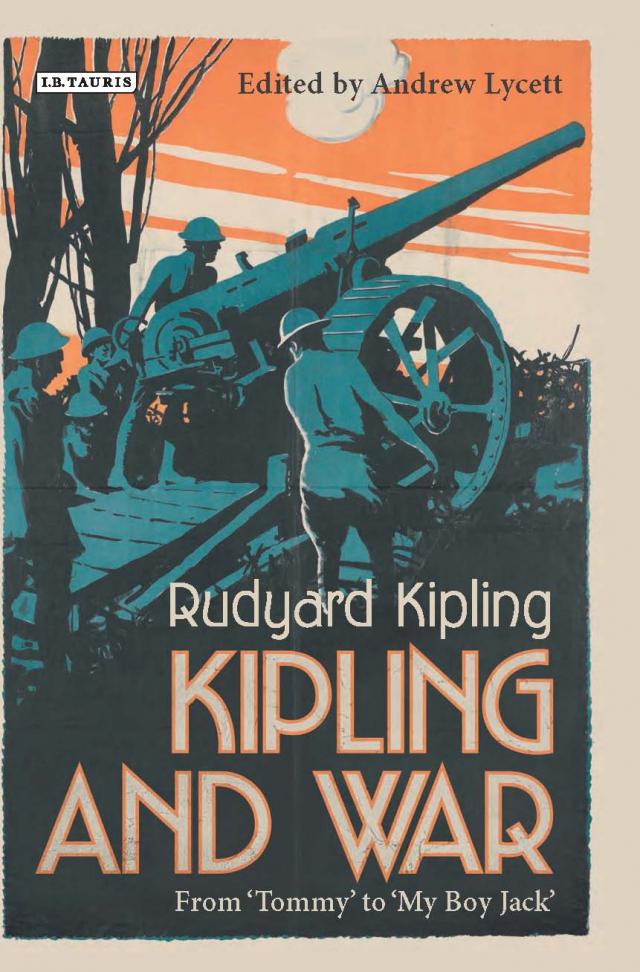
RUDYARD KIPLING
Kipling
and War
From ‘Tommy’
to ‘My Boy Jack’
Introduced and Edited by
Andrew Lycett
First published in 2015 by
I.B.Tauris & Co. Ltd
London • New York
www.ibtauris.com
Copyright © 2015 Andrew Lycett
The right of Andrew Lycett to be identified as the editor of this work has been asserted by him in accordance with the Copyright, Designs and Patents Act 1988.
All rights reserved. Except for brief quotations in a review, this book, or any part thereof, may not be reproduced, stored in or introduced into a retrieval system, or transmitted, in any form or by any means, electronic, mechanical, photocopying, recording or otherwise, without the prior written permission of the publisher.
References to websites were correct at the time of writing.
ISBN: 978 1 78453 333 5
eISBN: 978 0 85773 965 0
A full CIP record for this book is available from the British Library
A full CIP record is available from the Library of Congress
Library of Congress Catalog Card Number: available
Typeset by JCS Publishing Services Ltd., www.jcs-publishing.co.uk
CONTENTS
Introduction
Early Material
‘The Battle of Assaye’
India
‘On Fort Duty’
‘To Meet the Ameer’
‘Arithmetic on the Frontier’
‘Ford o’ Kabul River’
‘The Three Musketeers’
‘With the Main Guard’
‘Snarleyow’
‘The Ballad of East and West’
‘The Drums of the Fore and Aft’
‘Gunga Din’
‘The Taking of Lungtungpen’
‘The Rout of the White Hussars’
Return to England
‘Danny Deever’
‘Screw-Guns’
‘Gentlemen-Rankers’
‘Loot’
‘The Young British Soldier’
‘Ride to Kandahar’
‘Route Marching’
‘Shillin’ a Day’
‘Private Ortheris’s Song’
‘Tommy’
Egypt and Sudan
‘Fuzzy-Wuzzy’
The Light that Failed
Back in England, 1890s
‘Bobs’
‘The Men that Fought at Minden’
‘Ubique’
‘Sappers’
‘That Day’
‘Recessional’
‘The White Man’s Burden’
South Africa
‘The Absent-Minded Beggar’
‘Under Fire at Kari Siding’
‘Boots’
‘Chant-Pagan’
‘Lichtenberg’
‘Two Kopjes’
‘Piet’
‘With Number Three’
Pre-First World War
‘The Lesson’
‘The Army of a Dream’
‘Edgehill Fight’
‘Norman and Saxon’
‘Dane-Geld’
The First World War and After
‘For All We Have and Are’
‘The New Army in Training’
‘The Outlaws’
‘1915 – Loos and the First Autumn’
‘Trenches on a Mountain Side’
‘Out with the Fleet’
‘Mine Sweepers’
‘The Trentino Front’
‘My Boy Jack’
‘The Irish Guards’
‘Gethsemane’
‘Mesopotamia’
‘The Hyaenas’
‘Justice’
‘Epitaphs of the War’
Reflections on the Military Life
‘The Janeites’
‘The War and the Schools’
‘The Magic Square’
‘Ode: Melbourne Shrine of Remembrance’
Further Reading
I would like to thank Lieutenant Colonel Roger Ayers, President of the Kipling Society, who kindly read through and commented on my original manuscript.
INTRODUCTION
By Victorian standards Rudyard Kipling’s background was remarkably un-military. He was born in 1865 in Bombay, where his father Lockwood was an architectural sculptor in the service of the Raj. Although he was sent to England to be educated at the martial-sounding United Services College, a secondary school in Devon which specialised in turning out soldiers and administrators for service in the Empire, he only went there because the headmaster, Cormell Price, was a friend of his mother’s from her time on the fringes of the Pre-Raphaelite artists’ circle (her sister Georgiana married the painter Edward Burne-Jones).
Since his parents could not afford to send him to university, Kipling was forced to return to India when he was 17 to take up a job as a journalist on the Civil and Military Gazette in Lahore. The name of this newspaper had army connotations since Lahore was the capital of the Punjab, one of the more recent territorial additions to Britain’s empire in India, having been annexed in 1849 after the defeat of the Sikhs at the Battle of Chilianwala. Thereafter it had been run on efficient, often militaristic, lines by a succession of evangelically minded chief commissioners, such as John Lawrence (later viceroy of India). One reason for this military tendency was that the Punjab provided an important buffer between the heartland of India and areas of continuing unrest beyond its north-west frontier. Although the internal tensions that followed the Indian Mutiny of 1857 had largely abated, there were still concerns about the threat of Russian incursions through the generally unstable neighbouring country of Afghanistan. As a result, the Punjab had an important role to play in British India’s ‘forward’ foreign policy, and, along with its Mughal walled city and its modern European ‘civil lines’, Lahore boasted a large military cantonment at Mian Mir, five miles east of the town, where an infantry battalion and two artillery batteries – all British units – were permanently stationed.
Kipling soon discarded the Gladstonian liberalism of his teenage years and adopted the attitudes of the frontier society he was living in. He developed an intense respect for the British administrators, engineers, doctors, lawyers and soldiers who, he felt, were devoting their lives to bringing order, justice and the rudiments of health to the Punjab.
One of his favourite trips out of Lahore took him to Mian Mir, where he liked to mix with young subalterns not many years his senior in the officers’ mess. After some of them invited him to dine when they were on guard duty at Fort Lahore, he penned a poem, ‘On Fort Duty’, which contrasted the boredom of their existence in the fort with the excitements of active service on the north-west frontier .
Kipling’s journalistic assignments often required him to work closely with the military, as when he travelled to Peshawar in March 1885 to cover the visit of the Afghan Amir Abdurrahman and to Rawalpindi for the subsequent Durbar involving Viceroy Lord Dufferin. In one of his pieces for the paper he reported enthusiastically about the spectacle of the military parade put on for the Amir. He later recalled this event when he wrote his story ‘Servants of the Queen’, with its accompanying poem ‘Parade Song of the Camp Animals’, for his first Jungle Book.
In 1886 he volunteered to report for the Civil and Military Gazette on the military expedition that was sent to quell a rebellion in upper Burma. The news that a United Services College contemporary, Lieutenant Robert Dury, had been killed in this campaign encouraged Kipling to write ‘Arithmetic on the Frontier’, which was published in June that year as one of his Departmental Ditties. It gives an idea of his individual and often ironic approach to military subjects:
A scrimmage in a Border Station –
A canter down some dark defile –
Two thousand pounds of education
Drops to a ten rupee jezail –
By this time he had extended his contacts at Mian Mir to the other ranks. Whereas he was happy to poke gentle fun at naive young subalterns (notably in Plain Tales from the Hills, his stories which focused mainly on the political and emotional machinations of the ruling elite in Simla, the imperial summer capital), his admiration for the ordinary British soldier was rather deeper. He appreciated their humour and resolution, despite the hardships of living and fighting in India on behalf of ‘Missis Victorier’, ‘the Widow at Windsor’. He lobbied on their behalf on issues such as improved facilities for sufferers from venereal disease. This was necessary because, although Lahore had a ‘Lock’ hospital specialising in these ailments, Kipling realised that the authorities turned a blind eye, particularly towards the health of native prostitutes, with the result that 9,000 ‘expensive white men a year [were] always laid up from venereal disease’.
This did not mean that he was po-faced about these ordinary soldiers. Drawing on his encounters, in March 1887 he wrote ‘The Three Musketeers’, the first of 18 stories about a mischievous but always engaging trio of privates in ‘B’ Company of the Ould Regiment – an Irishman, Terence Mulvaney, Cockney Stanley Ortheris and Yorkshire-born Jock Learoyd.
These ‘Mulvaney stories’ can be an acquired taste, with their casual racism and their widespread use of slang. But as no one since Shakespeare had written sympathetically, let alone humorously, about the realities of being a soldier, they became an instant hit, encouraging Kipling, from 1888, to gather them in a series of books which were published as part of the Indian Railway Library by the Calcutta firm Thacker and Spink.
The best of these stories mixed intimate detail about the indignities of regimental life in India with rollicking accounts of feats of courage and comradeship. In ‘With the Main Guard’, Mulvaney tries to enthuse fellow members of the guard at Lahore Fort with a stirring account of hand-to-hand fighting at ‘Silver’s Theatre’, a fictional battlefield very similar to that at Maiwand, near Kandahar, where a British column was forced to retreat towards the end of the Second Afghan War in July 1880. The main unit involved on that occasion was the 66th (Berkshire) Regiment, for whom Kipling later wrote the ballad ‘That Day’, after he met up with them as the 2nd Battalion the Royal Berkshire Regiment while on a visit to Bermuda in 1894.
This same Afghan conflict (and specifically the return of the northern column to Peshawar at the end of the war in August 1880) also provides the background for ‘Love o’ Women’, in which Mulvaney describes in graphic details the tribulations of the gentleman-ranker soldier called Tighe who is dying of syphilis.
The three soldiers also participated in other imperial wars, such as the campaign in Burma in the mid-1880s, as featured in the comical tale ‘The Taking of Lungtungpen’, which had Mulvaney and friends subduing a Burmese village which they arrived at stark naked, after having had to swim a river. On their return from this conflict, Otheris (in the story ‘The Madness of Private Otheris’) is plunged into despair about his profession:
I’m a Tommy – a bloomin’, eight-anna, dog-stealin’ Tommy, with a number instead of a decent name. Wot’s the good o’ me? If I ’ad a stayed of ’Ome, I might a married that gal and a kep’ a little shorp in the ‘Ammersmith ’Igh.– ‘S. Orth’ris, Prac-ti-cal Taxi-dermist.’ With a stuff’ fox, like they ’as in the Haylesbury Dairies, in the winder, an’ a little case of blue and yaller glass-heyes, an’ a little wife to call ‘shorp!’ ‘shorp!’ when the door-bell rung. As it his, I’m on’y a Tommy – a Bloomin’, Gawdforsaken, Beer-swillin’ Tommy.
This tale is not based on any particular action, but is in keeping with another Kipling speciality – his stories about the harsh realities of life as a private soldier (the ‘New Readers’ Guide’ on the Kipling Society website lists 25 such stories). In this case Otheris makes arrangements to desert and return to London. Luckily his depression lifts and he is soon eager to return to his pals and the military life he knows.
While in India, Kipling also wrote about the military life outside what are generally regarded as the ‘Mulvaney stories’. For example, ‘The Drums of the Fore and Aft’ (first published in Wee Willie Winkie and Other Child Stories, No. 6 in the Indian Railway Library, in 1888) drew on a mix of the battles of Ahmed Khel in April 1880 and Maiwand in July that same year to depict two drummer boys, Jakin and Lew, who rouse their demoralised fellow troops by marching up and down the front, playing ‘The British Grenadiers’.
Sub-continental conflicts provided the background for several other poems, such as ‘Ford o’ Kabul River’ which recalled the incident when an officer and 46 troopers from the 10th Hussars were drowned trying to cross the Kabul River in March 1879. Additional stories and poems looked back to episodes in South Asian history – including ‘Gunga Din’, based on an incident during the Mutiny, ‘Snarleyow’ about the Sikh wars, and ‘The Ballad of East and West’, a snapshot of two great warrior traditions ranged against each another, apparently referring to the Guides at Peshawar in the 1850s.
Kipling’s journalistic sense of detail has sparked interest in the real-life models for the ‘Ould Regiment’ in the Mulvaney stories. While he was in Lahore the two main regiments at Mian Mir were the East Lancashires, followed by the 5th (Northumberland Fusiliers) Regiment of Foot. In his book Sixty Years in Uniform, John Fraser, a former colour sergeant with the 5th (the Tyneside Tail Twisters, Kipling called them), remembered being asked by a young officer to take Kipling to the canteen and to introduce him to some of the men. He was told that his visitor was a writer who, for professional reasons, wanted to get ‘into direct touch with Tommy Atkins’. The sergeant took Kipling to meet the musketry fatigue party led by Corporal MacNamara who, he claimed, was the spitting image of Mulvaney in Kipling’s later stories.
When Kipling moved to The Pioneer newspaper in Allahabad in late 1887, he fell in with another regiment, the 1st Battalion the East Surrey, 31st Foot, which added colour to his portrayal of the Ould Regiment as ‘a London recruited confederacy of skilful dog-stealers, some of them my good and loyal friends’.
But the opportunities for Kipling’s type of writing were limited in India, so in 1889 he made his way to London, where initially he lodged in the teaming heart of the city in Villiers Street, off the Strand, where his favourite form of relaxation was his evening visits to Gatti’s Music Hall, underneath the arches at Charing Cross Station. There he met a new kind of soldier – garrisoned in London, often rowdy and eager to sing popular songs of any description. As Kipling wrote in his autobiography, Something of Myself, ‘The Private Soldier in India I thought I knew fairly well. His English brother (in the Guards mostly) sat and sang at my elbow any night I chose.’
He recalled something of this atmosphere in his story ‘My Great and Only’ which he despatched to the Civil and Military Gazette from London in early 1890:
I glanced at the gallery – the Red-coats were there. The fiddle-bows creaked, and, with a jingle of brazen spurs, a forage-cap over his left eye, my Great and Only began to ‘chuck it off his chest’. Thus –
‘At the back of Knightsbridge Barracks,
When the fog was gatherin’ dim,
The Life Guard talked to the Under-cook,
An’ the girl she talked to him.’
‘You may make a mistake when you’re mashing a tart,
But you’ll learn to be wise when you’re older,
And don’t try for things that are out o’ your reach,
And that’s what the Girl told the Soldier,
Soldier! Soldier!
An’ that’s what the Girl told the Soldier.’
I thought the gallery would never let go of the long-drawn howl on ‘Soldier’. They clung to it as ringers to the kicking bell-rope. Then I envied no one – not even Shakespeare. I had my house hooked – gaffed under the gills, netted, speared, shot behind the shoulder – anything you please! With each verse the chorus grew louder, and when my Great and Only had bellowed his way to the fall of the Life Guard and the happy lot of the Under-cook, the Gallery rocked again, the reserved stalls shouted, and the pewters twinkled like the legs of demented ballet-girls. The conductor waved the now frenzied orchestra to softer Lydian strains. My Great and Only warbled, piano –
‘At the back o’ the Knightsbridge Barricks,
When the fog’s a gatherin’ dim,
The Life Guard waits for the Under-cook,
But she don’t wait for ’im.’
The British literary world at the time was split between conservative romantics, who looked back to the adventure stories of Robert Louis Stevenson, and progressives inspired by the intimations of realism, aestheticism and even decadence making inroads from Europe. Kipling tended naturally to the former school, whose heartier elements – the proto-imperialists, known as the Henley Regatta, who congregated around W.E. Henley, editor of the Scots (later National) Observer – looked to him as a ‘star from the east’ to take up the mantle of manly storytelling.