Testament, p.1
Testament, page 1
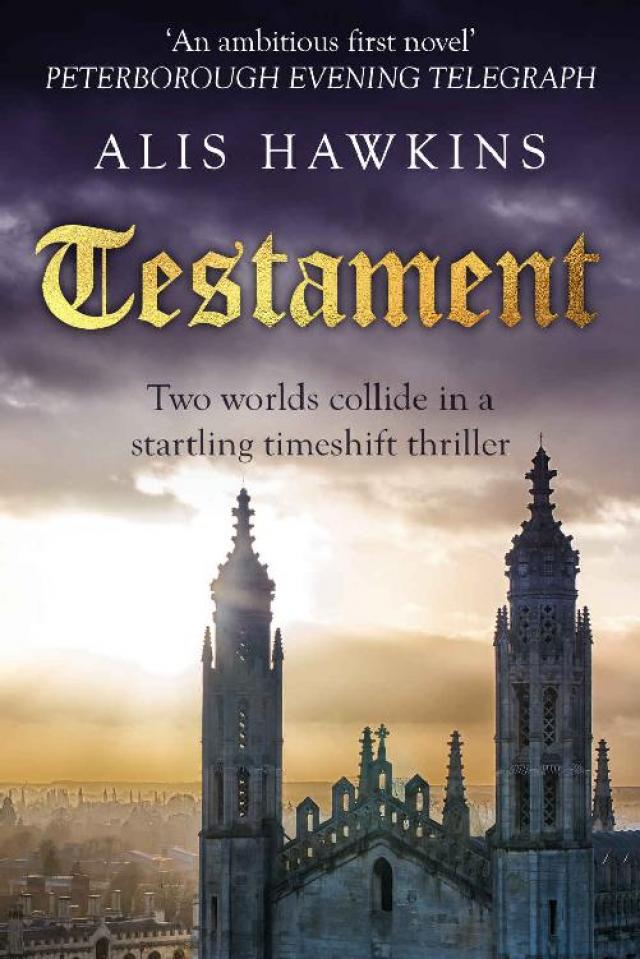


TESTAMENT
Alis Hawkins
Table of Contents
Prologue
One
Two
Three
Four
Five
Six
Seven
Eight
Nine
Ten
Eleven
Twelve
Thirteen
Fourteen
Fifteen
Sixteen
Seventeen
Eighteen
Nineteen
Twenty
Twenty-one
Twenty-two
Twenty-three
Twenty-four
Twenty-five
Twenty-six
Twenty-seven
Twenty-eight
Twenty-nine
Thirty
Thirty-one
Thirty-two
Thirty-three
Thirty-four
Thirty-five
Thirty-six
Thirty-seven
Thirty-eight
Thirty-nine
Forty
Forty-one
Forty-two
Forty-three
Forty-four
Forty-five
Forty-six
Forty-seven
Forty-eight
Forty-nine
Fifty
Fifty-one
Fifty-two
Fifty-three
Fifty-four
Fifty-five
Fifty-six
Fifty-seven
Fifty-eight
Fifty-nine
Sixty
Epilogue
A NOTE TO THE READER
HISTORICAL NOTES
ACKNOWLEDGEMENTS
For Edwina, Sam and Rob, who fill my life with love and laughter.
Prologue
Kineton and Dacre College, 2019
It was a small, almost insignificant fire, caused by wiring overdue for replacement a decade earlier; an irritating addition to the maintenance team’s job-list rather than a major item of college news. But when the carpenters came to remove a small section of charred oak panelling they were confronted by an image that would change the story of Kineton and Dacre College.
There, on the newly uncovered patch of wall behind the Tudor woodwork, a soot-blackened face stared out, its mouth agape. And in that gaping mouth, a tiny figure writhed, an infant child, its arms outstretched.
The man nearest the wall jerked back with a muttered obscenity.
His companion peered into the space they had just created. ‘Jesus…’ He half-turned. ‘No one ever said anything about a painting, did they?’
The crude flesh-colours of the faces had been darkened and streaked by the fire, making the image even more hellish. The carpenter put out a hand to wipe away the soot.
‘Better not, Will,’ warned the other. ‘You never know.’
The younger man, used to falling into line, dropped his hand. ‘He’s a stonemason,’ he said instead. ‘He’s got those compasses.’
‘The baby has too.’ The other nodded at the infant’s clutching hands. ‘Come on, leave the bloody thing alone — we’d better go and tell ’em.’
After four and a half centuries of obscurity, the wall painting of Kineton and Dacre College was about to be restored to the light of day.
One
Salster, the week before Easter, 1385
In all the twenty years that Gwyneth of Kineton had waited to conceive a child, she had never imagined that giving birth might be the death of her. Though she had known others die in childbirth — had observed, bleakly, that her barrenness saved her from that, at least — she had not, in her bones, truly imagined that she would die bearing the child for which her very soul ached.
Yet here she lay, exhausted and almost beyond the reach of agony, sinking towards death. The child she had treasured all these months in her womb was killing her, stuck fast as he was.
She lay on a pallet, her knees drawn up, her damp shift twisted around her. Next to her stood the birthing stool from which she had fallen, vomiting, in an extremity of agony. Beside the stool, their eyes flicking nervously from one another to the semi-conscious woman at their feet, sat the midwives. Both had seen women die with their children unborn and both feared that Gwyneth of Kineton would make another.
They did not speak since neither had comfort to offer, but sat in resigned helplessness.
Worlds away from them, transported by narcotic pain into a delirium state, Gwyneth’s mind raced through her life, stopping here and there momentarily, like a housewife anxious to reassure herself that everything is in order before she embarks on a long journey.
Her first certain memory: taking a wooden-headed mallet from her father’s outstretched hand, feeling its weight and balance.
‘They may not see you a master, Gwyneth, who can tell in these times? But the craft may be meat and drink to you.’
Thirty years ago and more. A long time to grow from a child to a woman dying of a child.
Her father again, Simon at his side. Simon as a young man, before he and Gwyneth married. Husband and father, mason and carpenter, burning energy and slow craft.
Years skipped by, their comings and goings ignored until her searching mind found him: Henry Ackland. Henry who had lived under their roof and learned Simon’s trade. Henry who had been all but a son to them.
He had visited, brought news — what was it? Important news. He had been away — too long! — but when he had come back to them he had brought news. Her mind searched restlessly, needing to know this last thing. Was it his love for Alysoun, her foster-daughter?
Again her unquiet mind shifted in its accounting. Alysoun: the child who had saved her from barren bitterness. That child had cost a death, and now her own child was demanding another. It was owed.
Alysoun’s father had fallen to his death from a roof of Gwyneth’s own design. The sound of his brief cry as he fell, the butcher’s-club impact of flesh and bone on trodden-earth floor, came back to her now.
She had always said that it would be with her till her dying day.
Michael Icknield had lived for more than an hour, clinging to life with senseless desperation. All work suspended around him, he could not die in peace; they had not dared move him for fear of increasing his agony. They were all helpless, hushed, appalled. Masons fell to their knees, invoked saints; some for swift death, some for a miracle of healing.
A miracle. Simon had called this child’s conception a miracle. Was it actually a curse? Would Simon lose both wife and unborn child in one death? Perhaps he would marry again and have the son he had prayed for for so long.
Was she already halfway to another world, that she could look at her life as if it was already over? Why did they not call a priest?
They had called a priest for Michael. He had done what he could, but Michael’s wits had been shattered by the fall: he could voice neither confession nor repentance. Gwyneth had seen nothing in him but a beast-like will to cling to life.
The women, drawn by some change in the air, perhaps the sudden silence, had come from the workers’ dwellings crowded around the site. Seeing the helpless shuffling of the still and silent men and the broken form on the floor, some had turned back, forestalling the curious children and sending them away to their games.
Gwyneth knew that Icknield’s child was motherless, and when his comrades had carried the mason’s body away, she went, without indecent haste, to speak to the women.
And now, it seemed, she must answer for that and for everything else that her thirty-nine years had said and thought and done. But, in truth, it was only her greed for a child that she truly regretted — that hunger had robbed her of compassion.
And was it Simon’s need for a son that was responsible for this double death now? Had her husband’s passionate petitions, his prayer-broken knees, his refusal to bow — even to God’s ‘No’ — brought her to this?
Was the Father Almighty so very just and so very unmerciful?
What little was left of her spirit rose up against such ingratitude. If God had given her a child, then he meant her to live.
‘Oh God! Help me!’ she groaned aloud, willing herself back into the startling brightness of full consciousness.
The midwives, shaken into motion by this evidence of a persistent will to live, took her under the arms and lifted her once more to the birthing stool. The heave and lunge that this required of her doubled body, straining against the tight-bound agony, forced a scream from Gwyneth. But as she heard the sound she also felt a twist of new, lurching pain and then fluid, copious and hot, flowing from her.
The elder midwife, ignoring her protests and pushing away her hands, felt inside. At her fingers’ probing, the pain seized Gwyneth with fresh teeth, but through her own scream she heard the midwife shouting, ‘The head is down! The head is down!’
Amidst her anguish at each new, widening pain, Gwyneth almost laughed with relief. The pain would soon be over and she would not die. She would see her child, hold it in her arms, feel its downy face against her own. Soon, soon…
Simon of Kineton had no idea how close his wife had come, mere rooms away, to dying with his child unborn.
As Gwyneth struggled to keep a grip on both her wits and her life, her husband drew. Lines flowed from his hand’s assured movements upon the sheet before him; bold lines, far from the meticulous, measured plans required of him as master mason. As his pen arced and scored, Simon of Kineton’s mind was brimming over with ideas for this half-drawn building, because the commission was his: to build a college at Salster for Richard Daker, one of the city of London’s mightiest.
Only yesterday — yesterday, the day his son began to be born! — the news had finally come.
Simon, mallet and punch in hand, had been finishing the carving of a cross and horn — the personal emblem of the King’s Bench judge for whom he had built a new, palatial London home — above its gatehouse arch. With his master mason’s eye as always on the weather and the season’s end, he had deliberately left all carving work until the building season was over.
‘Master Kineton.’
As Simon turned on the scaffolding of withies, he was aware, from something in the man’s tone, that he had worked on, oblivious, through several attempts to rouse him from his concentration.
‘I’m sorry, friend,’ he said. ‘I didn’t hear you.’
‘No matter, master. I have a letter for you, from Master Ackland.’
Simon stuck his tools in his belt and put his foot to the ladder that stood behind him.
Dusting his hands palm against palm, he took the letter, broke the seal and opened it to be confronted with Henry’s expansive hand. The boy had never lost that profligacy with ink and parchment, despite more than one thrashing at the hands of the monk who had made him literate.
From Master Henry Ackland to his fellow master and friend, Simon of Kineton, greetings and respect.
Sir, Master Daker now having given attention to all those plans and drawings presented to him for his college, he desires to see you in Salster at your earliest pleasure. I am in his confidence, and I know that he is best pleased with your designs. But he must meet with you. Please send word when you will come.
This fellow, Robin Yewell, is bid to business in London on my behalf, and will bring me any reply you are pleased to make.
I trust this finds you and all your household well, as I am indeed.
Written this Tuesday fortnight before Easter.
Henry! The beggar’s boy Simon had taught now looked set to more than repay the favour. Once his apprentice, now a King’s Mason; when they first met, Henry had been nothing but a rickety, palm-up brat.
All those years ago — how many was it? — eleven, twelve? — Simon had been at work on a new refectory at a priory a day or so’s ride from Westminster. Carving a saint’s uplifted face on a stone for the pulpitum, he had suddenly known that he was being watched. Looking up, he had seen a small, dirty face in which darting, lapis lazuli eyes gazed warily at his work. He recognised the spy as one of the children who haunted the site, begging from the masons and hovering around the monks to be first in line when the leftover bread was distributed.
‘Are you waiting for me to give you something?’
‘No, Master. I was just watching. Watching you draw that face out of the stone.’
If he had said ‘watching you carve that face’ the whole course of his life would have been different. The fact that he could see what Simon felt, that he merely uncovered something in the stone which had been waiting to be revealed, turned Simon’s heart over. He had worked with scores of masons, but not a single one had ever shared this feeling.
‘Have you ever tried to work stone?’
If he frequented building sites, perhaps he had tried his hand with a nail and a pebble on a discarded piece of stone.
The boy shook his head. ‘No. But I can carve wood.’ And with the embarrassed pride of all creators he drew from some secret place within his tattered, inadequate clothing a small piece of wood that he offered to Simon.
Taking it, Simon looked at it carefully and, once again, his heart lurched. On the piece of wood, no bigger than the bowl of a ladle, was a copy, in miniature but faithful detail, of the Virgin Mary that Simon himself had carved for the priory church.
In the Mother of God, he had carved Gwyneth with an infant in her arms. He had transformed the sadness of his childless wife into tenderness for the newborn, the deftness of her craftswoman’s hands into a sure and confident hold upon the child, the smooth softness of her body — his joy and delight — into a warm, womanly Virgin. And this beggar child had recaptured it all.
‘Did you really carve this?’ he asked, hoarsely.
‘Yes, Master.’
‘Do you know who carved the image in the church?’
‘No, Master.’
It was true, Simon thought, now, as he drew. The child had not copied that particular statue to flatter its creator, but because he found it beautiful. Henry, he reflected, had never mastered guile.
From that day on, it had not been difficult to find the boy small tasks around the site. He had a quick mind and deft hands, and soon Simon sought and was granted permission to take Henry as his apprentice, waiving the usual requirements of money.
Ten years a lodger in their house, Henry had learned, little by little, all Simon’s love and mastery of stone. Master in his own right now, it was Henry who had first given Simon the news — months before — of Richard Daker’s intention to build a college in Salster. While Simon was in London working at the judge’s court inn, Henry was in Salster doing the king’s work on the city’s walls and gates. Salster was only half a day’s ride from the coast and would need sturdy defences if the French carried their coastal harrying further inland.
Word of Daker’s plans had been given to the two lodges in Salster — one housing the masons at work on the priory’s cathedral church, and the other home to those busy on the walls and Pilgrim’s Gate — and would, Daker knew, go out from there to every lodge, and every master mason, in England.
Once Simon knew of Richard Daker’s ambitions, he began to find that he could leave work on the judge’s residence to others. As if drawn by the promise of delight, he would sneak away, from his sunlit buildings and make his way into the gloom of the lodge. Apprentices more accustomed to cleaning tools suddenly found themselves scraping sheets of parchment clean. But if they wondered what their master wanted with large drafting-sheets when there was no more falsework to be made, no more mouldings to be cut, they had enough sense not to ask.
Drawings began to appear at the desk where Simon worked, bold drawings quite unlike the buildings that had been his stock-in-trade. He drew walls that curved like a pilgrim-maze, pierced by vast, round windows; domed roofs beyond the skill of English craftsmen; stonework of banded colour like a striped garment. Simon had never worked outside England, had never travelled to study the ideas of continental masons; these were designs drawn from the pattern-books of masons who had seen the countries of the south, the buildings, cheek-by-jowl, of infidel and crusader.
But, little by little, Simon began to see that such blatant foreignness would not take permanent root in Salster, home to the bones of Saxon saints.
As the days passed, the drawings piling up on his desk became more assuredly English, more to the taste of a people inclined to favour their own after so many years at war with France.
So now, to dull the nervous ache of waiting for his son to be born, Simon drew. His attention to line and form was so complete that he did not hear the midwife enter the room. Perceiving her suddenly at his elbow, he started, marring his work with the unintentional movement.
Simon leaped to his feet. ‘Is he born?’
The midwife sighed, her hands busy with the linen headcovering which she had neglected to tidy before coming to him. ‘Your wife has borne a son, yes,’ she said, ‘and is alive —’ her glance from beneath her twisting hands was sharp — ‘though it seemed she might not survive the child.’
‘But she is well?’
The midwife, tucking in the end of her coif, gave her whole attention to him. Was it really possible that he had not considered the danger to his wife of giving birth to her first child at an age when many women were looking for grandchildren?
‘Mistress Kineton will do well enough,’ she said, watching him carefully.
‘My thanks for the pains you have taken —’ Simon blurted, oblivious to the shifting glance and uncomfortable air that would have moderated the thanks of a more observant man. ‘I must go and see my wife.’
He pulled the door shut behind him without breaking stride, leaving the midwife stranded. Looking around, she stared at Simon’s drawings and wondered, as her eyes puzzled at his designs, what this unpractised father would make of his new son.