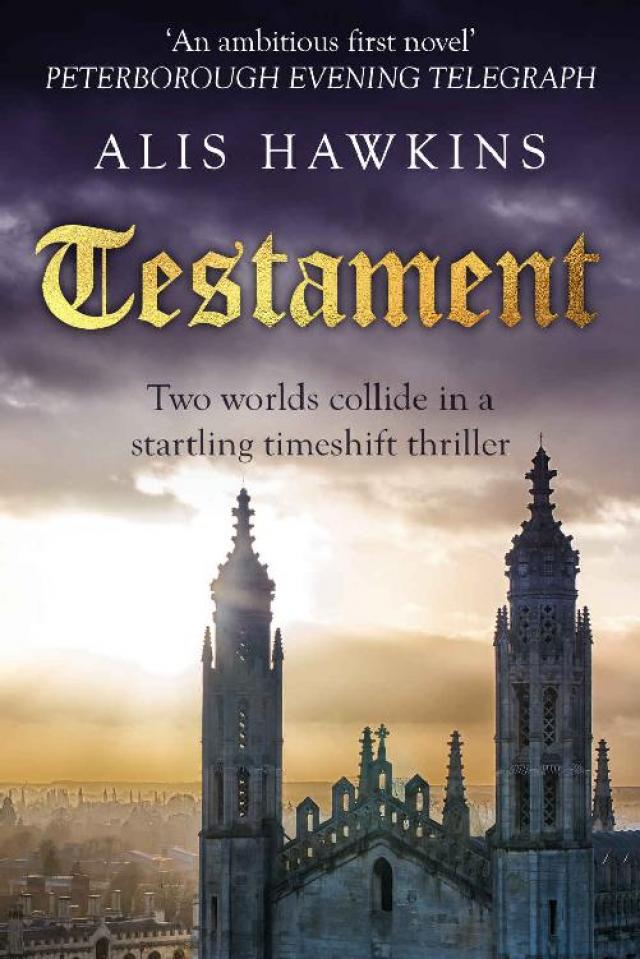
Testament, p.19
Testament, page 19


Then — when it seemed that the miracle of a fine, cloudless day had finally been granted him — Simon strode out of the lodge, Toby on his hip, to be confronted by two of the mayor’s officers.
Surprised, he gave them good day and they responded in kind. One, a thin, lank figure of middle years, gazed about him like a clerk with an inventory while the other, a younger and more wholesome-looking fellow, kept his eyes very firmly upon Simon. His reputation for unpredictable irascibility had spread beyond the building site.
‘Well?’ Simon prompted, shifting Toby’s weight, holding his son’s wayward arms down as he did so. Both men’s eyes moved involuntarily to the writhing face of the child and Simon felt the familiar surge of irritation that wanted to cover Toby’s face, to tell him not to gurn so, to be still. He quelled it and snapped, ‘I have work to do, I cannot be standing about. What is your business?’
‘The weather being set fair,’ the younger man blurted, startled into speech, ‘the harvest is to be gathered this week while it may be.’ He faltered to a halt.
Simon’s eyes narrowed slightly as he looked at the men. ‘What has harvest to do with me?’
The inventory-eyed man ceased his surveying and looked Simon in the eye. ‘All journeymen and apprentices are required to lay aside their crafts and bring in the harvest.’
The hair on the back of Simon’s neck began to prickle like the sting of tiny needles. ‘Required by whom?’ he asked, his eyes on the man’s sallow, pockmarked face.
‘The mayor —’
‘It is a statute of Parliament,’ the younger man interrupted quickly, ‘which the mayor cannot but enforce.’
‘Then he can enforce it elsewhere —’ Simon dismissed them, turning away — ‘amongst craftsmen who do not depend on the weather. I need this sun as much as the harvest does. Go and impress weavers and tanners — or the goldsmiths, let them blister their hands for once in their lives.’
The officers, forced to follow him, picked their way suspiciously over the lime-strewn site as if their shoes would rot beneath them if they trod unwarily.
‘All journeymen and apprentices are to come,’ the younger officer protested at Simon’s retreating back. ‘We cannot pick and choose. All must come.’
‘Not today.’ Simon did not look back. ‘Today I have building to do and I need all my men.’
Before noon, by that peculiar method of travel which only news can accomplish, it had become known on the college site that, though Simon’s journeymen and apprentices had been required to put down their tools and take up sickles, Salster’s other masons had not. Masons on the king’s business were to see it pursued as usual, whilst those at work in the priory were apparently judged — by the bishop and prior at least — to be beyond the reach of city regulations.
Simon, enraged beyond endurance, stalked from priory to castle lodge, demanding that masters at both sites bring their elected representatives to a meeting of the masons’ council.
‘It was Brygge’s idea that this council of masons should exist,’ Simon ground out between gritted teeth as Henry Ackland stood, not giving the advice that was plainly tickling the tip of his tongue. ‘So now let us see how he likes the combined force of our opinion. He shall not make reapers out of my masons for his own benefit.’
Henry, who had watched Simon’s impatience and frustration stretching him, fibre by fibre, to breaking point all summer, understood his feelings. He had waited so long for this chance that, now, to see delay piled upon delay was more than his nature could bear. The wet weather was beyond his control, but a stark order from the mayor was too much. But Henry feared for Simon in his appeal to his fellow masons. For Simon’s was seen as an unblessed cause, and no mason willingly courted ill luck.
The meeting had been set for that evening and Simon, not wanting to involve the mayor, had insisted that the council should be held in his own lodge. But when the priory bell rang for Vespers, none appeared but the smirking functionary who had come earlier in the day.
‘You are bid to the Guildhall,’ he said. ‘This dispute is over city regulations and not your own craft —’
‘So says Brygge,’ said Simon, bitterly, seeing how he had allowed himself to be outflanked by the mayor.
‘You can’t stand against him, Master Mason,’ the officer advised as he turned to accompany Simon. ‘Others have tried. And all have failed.’
Silently, Simon stalked past him and strode, alone in his rage, to the Guildhall.
Nicholas Brygge, having made his point by moving the council from Simon’s domain to his own, was prepared to be conciliatory once the meeting began. He did not attempt to interfere but allowed Hugh of Lewes — agreed as senior master craftsman in Simon’s absence the previous summer — to begin proceedings. Not looking at Simon, the priory’s master mason began.
‘We are here to listen to the matter that Simon of Kineton, master mason to Richard Daker, wishes to put forward. He asks for the impressment of his journeymen and apprentices to be waived. Are we ready to hear him?’
As nods and assorted ‘ayes’ of varying degrees of enthusiasm were forthcoming, Simon looked around at the city’s masons. Those from his own lodge — Edwin Gore, site foreman and master craftsman of long standing, and Alfred Mogge, a younger man who, like Simon, had a particular skill in image carving — were resolute behind him. They sat, their eyes upon him, waiting for him to begin. No other mason in the hall was as eager. Even Henry, the youngest master present, and one of the few who would meet his eye, did not look entirely at ease.
‘The case is simple,’ Simon began baldly. ‘The mayor asserts that all journeymen and apprentices must lay aside their crafts and turn reaper. But if the king’s masons do not and the priory’s masons do not, tell me — why should my masons do differently?’
Richard Oldman, master to the king’s fortifications in Salster, stood wearily. ‘We are exempt on ground of speed,’ he said. ‘There is no benefit in having the harvest safely gathered and the people fed through the winter if we cannot defend ourselves against the French, if they should come. All speed is needed to finish the improvement of the walls. It is nothing against you, Simon of Kineton, but my first loyalty must be to the king.’
The king. Though Simon’s eyes were on Richard Oldman as he sat down, in his inner eye he saw the face of the young king’s grandfather. A face with broken veins beneath the skin. The face which had kept him from royal works ever since. Masons were not slow to notice each other’s preferment and common gossip had surely invented a dozen reasons for his lack of royal patronage.
‘Very well.’ Simon stood and turned towards Hugh of Lewes. ‘But there is not the same need for haste in the priory works, surely? If my masons are needed more in the fields than on my building site, why are yours not needed equally?’
Hugh of Lewes rose to his feet with the look of a cat who has dined off stolen fish. ‘The priory masons are not subject to parliamentary statutes concerning labour —’ he began, but Simon, full of outrage, interrupted.
‘You cannot protest that the city’s guild regulations do not hold good within the priory walls!’
‘I say no such thing,’ said the priory’s master mason, complacently. ‘We are exempted by a licence granted us by the king.’
He unbuckled the deep wallet that hung at his belt and took out a small roll of parchment. Without opening it, he waved it in Simon’s direction. ‘The king is keen to see the nave finished as soon as may be.’ Simon felt the man’s triumph as he thrust home the fatal shaft. ‘His Majesty was pleased to be able to give our bishop special dispensation to see the building work speeded.’
Copley. The young king’s love of beauty was well-known, as was his childlike unworldliness; it must have seemed to Richard that he was giving Copley a well-deserved favour.
‘So —’ Simon stood wearily for one last assault upon inevitability — ‘both your lodges plead a special need for haste.’ He looked around at his fellow masters: only Henry and his own masons would meet his eye. ‘Are my masons then to be treated differently because our patron is not the king? Does it sit easily with you that your journeymen and apprentices shall stay within the walls and speed the work through the dry days whilst mine shall take up sickles and bring home the harvest, leaving our works languishing for want of labour?’
There was no reply.
Nicholas Brygge, watchful and silent until now, addressed Simon. ‘What question do you wish the council to decide, Master Kineton?’
Simon turned to face him. Their eyes locked, Simon sending out sparks like a poked fire in his frustration and humiliation, Brygge’s self-contained stillness giving nothing away.
‘The question I wish my fellow masons to decide,’ Simon said bitterly, taking each of them in with his gaze, ‘is whether there shall be one rule for all masons in the city.’ He paused and then laid his final card. ‘I thought that to have been the purpose of the masons’ ordinances laid down last summer.’ The mayor cast his gaze around the hall like a net. ‘Well?’ Not a man stirred. Not a word was exchanged. Decisions, Simon realised, had been made before ever the council was convened.
Finally, Richard Oldman stood. ‘This is not a matter of whether there shall be one rule for all masons, it is a matter of whether the king’s writ runs in the city. There is a statute which says that, for a few days, journeymen and apprentices must — for the common good — help to bring in the harvest. For the king’s own good reasons, which we have heard, two of the three masons’ lodges in the city are exempt from this. It is not our business to help you go against the king’s interests, Simon. Our lodge will not stand with you if you defy the statute.’
‘And you?’ Simon directed his words roughly to Hugh of Lewes, knowing the substance of his answer but unwilling to allow the man the luxury of sitting in silence.
‘My bishop is sworn to uphold the king’s peace,’ the master mason said, smoothly. ‘It would hardly befit him to begin encouraging rebellion against statutes within a stone’s throw of his own priory.’
Kings and bishops. Power and dominion. Authority and rule. The misuse of power for their own ends that Wyclif had preached against the princes of both Church and state. Never had Simon felt such common purpose with Richard Daker.
Nicholas Brygge stood. ‘Then it is decided. The lodges of the priory and the king’s works are exempt from the need to provide reapers. The lodge of Simon of Kineton is not, and all journeymen and apprentices of that lodge must set aside their building tools until the harvest is gathered. Is that your decision?’
Nods and ayes assented.
‘Then this council is ended.’
As the other masons left and Henry Ackland hesitated in the doorway for him, Simon approached Nicholas Brygge. ‘And if I choose not to send my men?’ he asked, bluntly.
‘Then I would have all your shipments of stone and other necessaries stopped at the gates and turned away,’ Brygge replied, evenly. ‘As mayor of the city, I cannot afford to have my authority flouted. Neither will I tolerate council meetings from which I am excluded,’ he said, pointedly. When Simon made no response, he said, ‘I am no more a lover of the bishop than you are, man. But he is shrewd and has seen a way to get what he wants whilst pleasing the king and vexing you. But there is nothing to be done.’ He stared at Simon, his eyes unwavering. ‘I am not your enemy, whatever you may think. I want Daker’s college built. Indeed, he could not hope to build it in Salster without my consent. But do not try to take on everybody at once. There is more than one way to kill a rabbit, Simon. Dropping a boulder on the creature will only mar the meat.’
Thirty
From: DamiaMiller@hotmail.com
To: CatzCampbell@hotmail.com
Subject: art
… see, we need a big event, something that’s going to grab the attention of the media, so we can make a splash and get our message out there to Tobyites we’ve lost touch with. So, I thought — naturally! — art event. The whole concept of an auction seems fun and also something the media might pay attention to — a major artist giving a work of art to the college and having it as the centrepiece of an event. Not that your profile needs raising, but it couldn’t do you any harm either?
I thought we’d have a theme — all works to be inspired by the college: its history, architecture, current work, whatever.
So are you up for it?
I know this is going to sound cheesy but I’d really like it if you were involved a bit in what I’m trying to do here. Maybe you were right, it is too soon to be starting to think about having a baby — maybe we need to do some other things together first…
From: CatzCampbell@hotmail.com
To: DamiaMiller@hotmail.com
Subject: lots of things…
… You’re right, we do need to do more together, be more involved in each other’s lives … we’ve made a mistake in not living together. I can see that now. I seem to be seeing things so much more clearly here… I want us to live together.
Come to New York, Mia. Come to New York and live with me…
Damia stared at the email she had forwarded to her office. Opening the message at Toby, at her desk overlooking the yard, positioned Catz’s plea very firmly in the real world; there was no possibility here, within sight of the Toby statue, that the email was a manifestation of her own fantasy world, the world in which she and Catz and two-point-four smiling, crinkly-haired children lived in untroubled accord.
Come to New York and live with me…
Catz’s vagueness as to time-frame made Damia profoundly uneasy. Was the move to New York now becoming open-ended, not limited by Catz’s year as artist in residence at a Greenwich Village gallery?
I seem to be seeing things so much more clearly here…
Did that include her work, still substantially stalled at Christmas?
Damia, though she had longed for little else for the four years of their relationship but to live with Catz, had never questioned her lover’s initial declaration that ‘I don’t do living together, it’s just not my thing.’ To have Catz perform a U-turn now, when geographical factors were disastrously inauspicious, was bitter.
And if Catz wanted her to go to New York, was this her oblique answer to the question of the art auction? Stop obsessing about that little Salster college and come and do something really important — live with me?
A sudden electronic ‘plunk’ startled her unreasonably and Damia moved the cursor to her inbox.
From: Peterdefries@dmlplc.co.uk
To: Damia.Miller@kdc.sal.ac.uk
Subject: Fw: Something alumni should know about Kineton and Dacre College
Dear Damia,
As you will see from this forwarded message, someone seems to have access to your mailing lists.
I’m assuming there’s no truth in the allegations and that the photograph at the head of the message is either a digital manipulation or more innocent than the writer implies?
By the way, I tried responding to the email address on the original — my message just bounced back to me. It was obviously an address created just to send this message and then immediately closed.
Is this a job for the police, do you think?
Yours Peter.
The photograph that preceded the forwarded email’s text was of Edmund Norris shaking hands with a man unknown to Damia. Made apprehensive both by the tone and content of Peter’s message, her eyes tracked down to the body of the email below.
Recently, Kineton and Dacre College alumni have received an email message inviting you to contribute to the ‘By, For and With’ campaign. Though the campaign claims to support the Fairings team, ‘By, For and With’ is actually an appeal for regular tax-free giving to the college.
Before you consider giving money, please take a few moments to read some facts about the finances of Kineton and Dacre College.
One: The tendering process for the contract to build the accommodation block which has sent the college into near bankruptcy deserves scrutiny. The successful company was Smith and Cowper, an interesting choice, given that this firm has never bid for a project on anything like the scale of the accommodation block before. Admittedly, there is a long-established association between Smith and Cowper and your college — they have carried out numerous, much smaller, building projects for Kineton and Dacre — but this seems a weak reason for taking a risk which has had disastrous results. Wouldn’t the builders normally associated with the project’s architects have been a more logical choice?
Two: Ms Damia Miller, new Marketing and Development Manager at the college, has stated that the appeal which funded the building of the accommodation block was incompetently managed. Since she is in a junior position to all the college worthies who oversaw that appeal, it’s difficult to see how the current ‘By, For and With’ appeal will do any better.
Three: medieval documents were discovered before Christmas while the college was engaged in a search for deeds or endowment documents so that it could sell tenanted land to developers. These documents — including a rare ‘proof of age’ and other, unspecified, papers — were discovered inside the Kineton and Dacre statue together with a set of medieval masonry tools.
Without the approval of his governing body, or the knowledge of the rest of the college, Edmund Norris has sold these unique college artefacts in a private deal to an unnamed collector.
It is only possible to speculate on Norris’s motives for acting in such an unorthodox way, especially when the minutes of a committee formed to rescue the college from financial ruin reveal that it was agreed that Sotheby’s should be consulted on a valuation before any further decisions were taken.
I’m sure you’ll agree that these are matters which must be clarified before any more money is made available to the college by its alumni.