

A gale stronger than lon.., p.1
A Gale Stronger Than Longing, page 1


“Val H. Stieglitz has written an absolutely mesmerizing memoir of adolescent awakening - a stunning debut for this lawyer-turned-writer. Even better, his book comes with an intriguing twist. It is also an acutely-observed recounting of a young man's pursuit of mastery in sport - in this case, mastery of the vexing game of golf - and the ways in which his pursuit awakens his very consciousness. Stieglitz's prose is highly refined, lyrical, and engaging - with not infrequent moments of breathtaking beauty. Gale is a love-letter to a time and a place and a wonderful cast of characters. It is marked throughout with an elegiac tone that is deeply affecting, but never sentimental. I could not put this memoir down, and it lingers.”
Stephen Cope, best-selling author of
’The Great Work of Your Life,’ and many others.
“In his elegantly written debut book, A Gale Stronger Than Longing, Val Stieglitz gives us an intriguing coming-of-age work wherein he wrestles with learning the intricacies of golf while navigating moving into adulthood, amid the challenges of moving from his childhood home to Milford Haven, Wales, then returning to America. If you love the game of golf, competitive golf drama, and encountering a lively array of characters - such as the rotund Irish golf pro, Dick Flynn - then you will find A Gale Stronger Than Longing as refreshing as a stroll through the Welsh countryside while listening to a reading of Dylan Thomas.
Thomas Cofield, author of ’Scuffletown.’
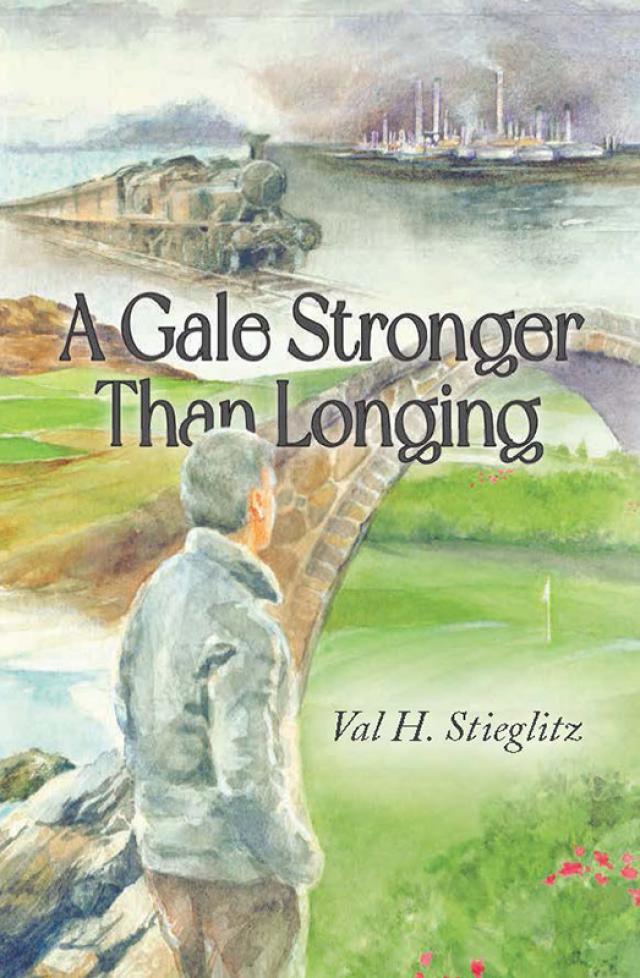
A GALE STRONGER THAN LONGING
A Gale Stronger Than Longing
Copyright © 2023 by Val H. Stieglitz
All rights reserved
No portion of this book may be reproduced, stored in a retrieval system, or transmitted
in any form by any means–electronic, mechanical, photocopy, recording, or other–except
for brief quotations in printed reviews, without prior permission of the author.
First Edition
Hardcover ISBN: 979-8-8229-1766-8
Paperback ISBN: 979-8-8229-1767-5
eBook ISBN: 979-8-8229-1768-2
Table of Contents
FORWARD and ACKNOWLEDGEMENTS
THE DYING DAY
THE MAGIC WAND
THE GENTLEST OF SKIES
THE AGE OF OIL
THE VANGUARD
TURNING THE SWITCH
MARSHAL HOUSE
A DANDY START
UP AND OVER
BASE CAMP
THE JUNIOR XV
LORD NELSON'S HARBORAGE
THE CADDY
THE LONG TREE-LINED HILL
RABBITS
A SHORT MESSAGE
AN EAGLE REMEMBERED
A HEAVEN IN A WILDFLOWER
THE HARDY PEMBROKESHIRE CHARACTER
A SAD CASE
THE GRIM MARAUDER
FRAMES IN A FILM
IT'S A GOOD LIFE
THE FOLLOWER
FORWARD and ACKNOWLEDGEMENTS
The title of this work – A Gale Stronger Than Longing – comes from a phrase in the poem Sea Virus, by Gwyneth Lewis. Ms. Lewis was named the first National Poet of Wales in 2005, and has been widely recognized for her poetry. I believed the phrase captures the spirit and mood of this book.
There is an observation in the introduction to Tobias Wolff's memoir, This Boy's Life, which expresses how I think about this book. The observation reads, “… this is a book of memory, and memory has its own story to tell.”
In the same way, this work is a story told by memory. It sits somewhere between fiction and memoir, and is not meant to be literally factual or historically precise in all respects. It is meant to reflect and convey the way in which my experiences in a small town in southwest Wales settled within me over time, and affected my larger life and larger perspective. It is the version my memory wishes to tell, not a recitation or checklist of facts. Thus, no person should see themselves, or anyone else, in any character, or any specific description of events. I did live in Pembrokeshire as a youth, and did learn to play golf there, on the 9-hole course described herein, which is now a full 18. And I did return some 35 years later. The people, places, and events described in these pages are inspired and informed by my time there, but represent a mixture of the true, the imagined, the embellished, and the remembered. My feelings for the place, the people, and this period of my life are, however, entirely real.
I should acknowledge several people who were crucial to the commencement and completion of this book. First, my wife, Sandra, who is always my biggest supporter, in matters small and large. Then, my mother and father, who undertook the logistically daunting family relocations described in the story, with four children in tow, and not only made it work, but work like a charm. I think then of the many friends who shared my time in Milford Haven, Wales, but especially Gillian Knowles, who tracked me down to return to the school reunion that sparked my commitment to writing this book, and who read and commented upon a very early draft. I also thank Joanne (Arkell) McCay, whose family resided in Milford the same time as mine, as our fathers worked together on the construction project I describe, who read and commented upon a much later draft. Thanks also go to my brother-in-law, Stephen Cope, himself a noted author, for his encouragement and advice. Finally, I appreciate the professional editorial counsel of Alexia Paul, who opened my eyes not only to the many ways I could improve this book, but to becoming a better writer as well; and Ellen Fishburne Triplett, for applying her artistic imagination and skill to the cover artwork and design.
As for a formal dedication – well, that is easy: to my children, Henry and Catherine.
October, 2023
Columbia, South Carolina
THE DYING DAY
T
he town of Milford Haven, in Pembrokeshire, sits along the northern edge of a great cleft sliced into the southwest flank of Wales during the last Ice Age. This cleft is vast and wide and deep, fed by cold waters from the turbulent North Atlantic but calmed to a smooth sheen by the myriad bays, inlets, marshes, and mudflats that line and protect the sinuous, winding estuary. In winter, the weather can turn wild and unpredictable. In the brief and poignant months of summer, however, the northernmost influence of the Gulf Stream warms the seas, the days assume a kind of sleepy languor, and all feels at peace along the tranquil Milford waterway.
Sun and light command these mild, mid-year months. Tankers, sailboats, watercraft of all kind, glide serene and untroubled upon the glistening Haven. The sky is rich and blue. Seabirds swoop in lazy circles. The breeze comes warm and gentle, fragrant of salt and blooms and wild grasses from the hills, tilting the mind toward gentle thoughts and optimism.
It is only a passing thing, however, this fair and placid season. Soon enough, the skies will fill again with rain and cloud. Winds will whip the waters. The land will brown with autumn. The season will have changed. As if knowing their time is short, therefore, the splendid days of summer glory in their brief and transient reign and refuse to yield the skies. And thus, as each sun-sprinkled summer day nears its close, a quiet struggle grips the quiet, drowsy Haven.
It begins with what the senses perceive as an alteration in the composition of the air, as if something is withdrawing, draining away. Nothing is definite or measurable – the day simply loses its solidity, ceases being what it was, and changes. The warm air cools. The waters lap. Bird cries soften. The colors of the sky, the landscape, the sea, all darken a shade - or appear to, at least, the eye less reliable with the advancing hours. A hint of mist, at first a mere wisp, collects atop the soft, green hills. The sensation of lassitude deepens, accompanied by an impression that the light itself, that thin, frail, northern summer light, is disintegrating.
As this subtle contest hastens, thin ribbons of pink and orange materialize above the western horizon, flooding the skies with blazing streaks - then fade and disappear, all spent. Passersby on the streets, gardeners tending their roses, shopkeepers closing their shops, children at play, all feel the approaching chill, gaze skyward, and tighten their jackets. As the fiery color-bursts recede, a pale, translucent outline forms, and the ascending moon emerges as a faint sketch, barely visible against the graying background. The earlier mood of weary indolence, so benign, gives way now to a hollow foreshadowing of the impermanence of things, and this empty feeling threads steadily through the atmosphere.
It feels unnatural, this silence, this emptiness, and cannot last. Into the solemn stillness, therefore, arises an anticipation, a suggestion of vibration, pitched just beyond hearing, humming from sea to sky to land - then suddenly it is done, the day has died, and dusk drops full and quick like a violet cloak across it all – the hills, the towns, the country lanes and fields, the houses and the waters – and another summer day along the sheltered Haven has met its end.
On one such evening, a balmy July Monday, in the year 1968, we find this familiar little drama repeating itself. The day has been long and warm and filled with light; but moves now toward its familiar conclusion. A chill rises from the water. Mist gathers in the hills. Flames of gold blaze resolutely on the western horizon, only to expire. Evenfall steals over Milford Haven and descends upon the weathered Milford Railway Station, there to circle and swirl about a train that crouches taut in readiness, blue and silver on the iron track.
This waiting train is the Great Western's overnight express to London, which departs at 8:45 p.m. every Monday in the summer – and its departure this evening is imminent. Slanting rails of willowy sunlight are fading against the coming darkness. Night, with its sudden sea-borne draught and strange, lonely quiet, is draping steadily across the waterway, and the thick, leafy trees surrounding the station sway loosely in the freshening breeze. Little collections of passengers – mothers and fathers shepherding wide-eyed children, white-haired ladies carting worn-out bags, frowning men bearing briefcases - scurry aboard the express as the conductor whistles shrilly to sound its departure and the steam begins to blow. Moments later, there emanates from the train a low, menacing rumble, then another, followed by an eerie interlude; and then abruptly, almost without warning, like a dark creature rousing fitfully from slumber, the big train shudders and coughs and lurches and begins to labor away from the station, its enormous wheels straining painfully against the rails, its cars and couplings clanking in a high, metallic cry that cuts against and through the silver faint-light's calm repose. The rending cry sharpens as metal grinds against metal, as thousands of tons bearing hundreds of people to a hundred different destinations stir agonizingly to life. 8:45 p.m. has arrived and the train, indentured to its timetable, is on the move.
Although the express departs every Monday with monotonous sameness, and nothing of interest ever occurs, as the engine now heaves forward the form of a young man of sixteen can suddenly be seen, craning out the window of one of its compartments, waving his arms round and round at a circle of youths gathered together back on the platform. And these clustered figures, alone on the now-deserted siding, eight or ten of them, bright-eyed, fresh-faced, red-cheeked - they cry out to the one on the train who is leaving. He can tell they are calling to him, for their mouths are wide and straining, and their expressions urgent, but he hears nothing above the tumult of the departing train. Inaudible against the furious roar, they may as well be a ring of mutes. Leaning from the compartment window, however, he knows otherwise; knows without hearing that they are shouting, imploring him to come back, to stay, and never to forget them. But the train presses forward, on and on, louder and louder, leaving them behind.
The young man's face falls stricken. Squinting his eyes against welling tears, he watches the small knot of his friends and companions draw together on the platform, recede, recede, and grow ever smaller against a backdrop of dirty yellow clouds drifting in from the sea, smudging the darkening sky. From among the little corps, arms reach into the dusk – two, three, four arms reaching out as if to grab and pull him back; and out he stretches too, in helpless reply.
Now, however, to the strengthening beat of the train, it all begins to blur, and he grimaces with one final effort to catch and keep just one brief word or call; to no avail, however. For night has fallen over the little station, and over the trees and the hills and the rippling waters, and the whipping wind cuts cold against his face and smells suddenly of rain, and the boy's eyes sting in the gathering rush as he stares back blank and still. The train picks up speed and power and wraps him within its hurtling mass; and then his tiny group of friends draw together on the platform as if one, then vanish, leaving his eyes to scour the darkness. There is nothing to see, however; nothing save the pale half-moon lifting timorously against the purpling sky as the speeding train leaves Milford Station far behind and thunders on through the night, far away.
THE MAGIC WAND
T
he Milford Haven Golf Club's opening hole is a modestly short par-5, bordered to the right by an immense, thick hedgerow thrusting up luridly from a muddy bog. This dense and untamed growth - never trimmed - presents a sinister jungle of vines, brush and nettles, disarmingly so in springtime, when adorned with thousands of pastel-hued coastal wildflowers. Beyond the hedgerow's greedy grasp, however, and farther to the right – off the property completely - the terrain elevates, dries, and unfolds undisturbed into a broad pasture littered with stubble, rocks, and rabbit-holes.
Playing the course as a youth, just learning the game, my concentrated objective had been to hit the ball hard, not straight; and thus, I catapulted countless golf balls deep into the hedgerow's spiny maw, or high and wild into the rough pasture, leaving them lost forever, to be nibbled lazily, perhaps, by a wayward goat on a windy stroll, or rolled upon lasciviously by a farm dog marking a new and treasured possession.
I was slight of build, and Gary Player was my idol. How could it have been otherwise? His eyes glimmered like hard steel in the late afternoon sunlight. His garb was all black; black trousers whipping in the breeze, black turtleneck clinging to his lithe and wiry frame, black cap pulled tightly down upon his black-haired head. Surveying his shots, he narrowed his gaze like a sharpshooter. Stalking the fairways, he leaned into the gales, calling to mind some fearless hero striding to meet some unknown danger, or a hunter tracking prey. His every aspect claimed attention and respect.
Along with my family, I had migrated from hot and sunny Miami, early in 1966, briefly to London, and then to Milford, unknowingly primed for adventure and new things. Looking back, I came to Milford as a boy. When I left, however, it was as something else – not yet an adult, but something more than a boy. A fledgling explorer, perhaps, in a small kind of way. For in retrospect, my time in Milford had been a first discovery of that wide, deep expanse of experience, both within and without, which lay waiting ahead in life. And for me, golf in Milford became not only a part of this exploration, but an exceptional realm of discovery all its own, mysterious and rich, in which some part of me has remained ever since.
Not long after arriving in Milford, my father bought my first set of clubs, which he presented to me one windy Saturday afternoon, with a conspiratorial gleam in his eye. I remain confident even today that my reaction did not disappoint, for never before had I beheld objects of equal purity and grace, much less been entrusted with such voluptuous instruments. Touching them, feeling my fingers close around their tacky rubber grips, my father beaming, I felt a solemn kind of awe; a peculiar form of responsibility, almost. I possess them still, these first golf clubs – old and dusty in the basement, where every now and then I pick one up and turn it slowly in my hands, feeling again the weight, fashioning a half-swing, remembering the excitement – both mine and my father's - with which they first became my own.
Shortly after my clubs, I next acquired – from where, exactly, I cannot recall - a paperback instructional book by the great Mr. Player, perhaps thirty pages of pen and ink drawings, accompanied by dozens of pithy admonitions and tips, and several grainy photographs. He illustrated the proper grip. He demonstrated the backswing and the subtle shifting of the weight onto the right side. He depicted the position of the club at the top of the back swing, slightly past parallel, poised and almost quivering in anticipation of its downswing, then the controlled explosion at impact and the long, full, sweeping follow-through.
The book's cover displayed a black-and-white photograph of his flinty visage glaring at the ball as it sped away down the fairway, as if in a great rush to escape his pitiless stare. I studied this picture, and played at reconstructing the circumstances in which it might have been taken. Perhaps he needed a birdie in order to claim an important tournament, and was going for the green with a one-iron, into a driving tempest, over a perilous brook, on the final and deciding hole. Something dramatic was clearly afoot. Unquestionably, some great prize lay in the balance, so stern was his countenance, so implacable and hard.
On the back cover appeared a different photograph, however, suggesting a different mood; the smiling, debonair sportsman now cradling a large trophy from some exalted championship, not a single jet-black hair out of place, at ease and affable but not fawning, never fawning, the pinnacle of style and grace and strength. He represented all I held to be fine in a golfer – indeed, in a man, as I imagined at that time of my young life a golfer to be the finest sort of man. And the sum of his counsel, in my mind, seemed to congeal into one simple rule, which I adopted as my supreme command: Hit the ball hard. Thus it settled into my consciousness as the undiluted essence, the distilled quintessence, of the sage's philosophy. As I was nothing if not the most devout of pupils, therefore, this is precisely what I strove to do, with unwavering zeal. Hit the ball hard.






