I hear you calling eri.., p.1
I Hear You Calling - Eric Frank Russell., page 1


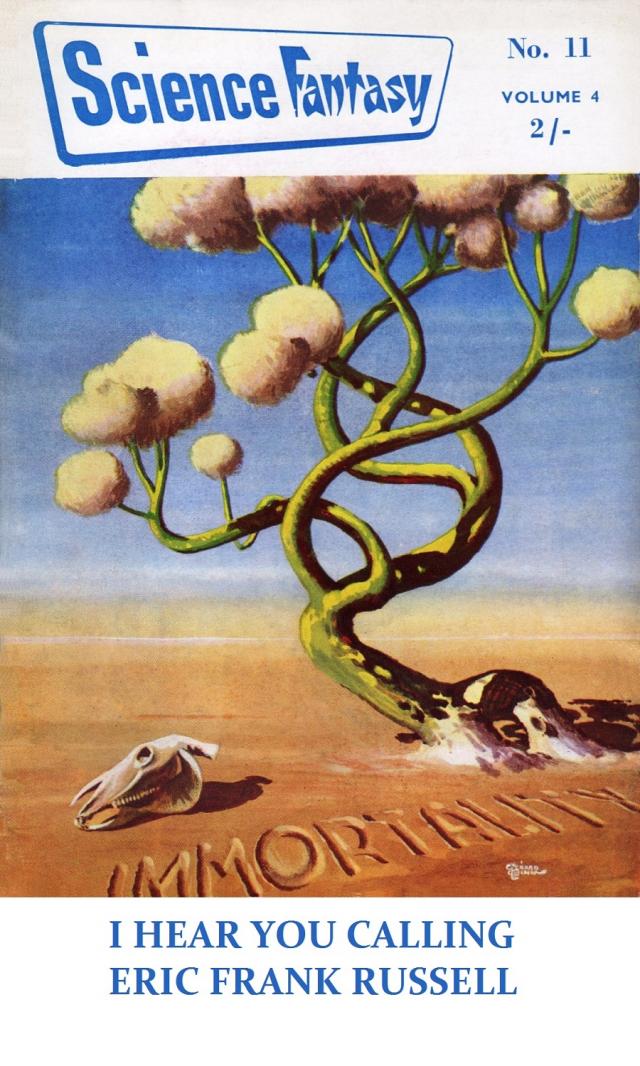
In the following story one of Britain's most popular
science fiction writers offers a particular gruesome
but logical explanation to that popular quotation
“ ghoulies and. ghosties . . . and things that go
bump in the night."
I HEAR YOU CALLING
By ERIC FRANK RUSSELL
From: Science Fantasy December 1954 issue
A frightened town, dark and deadly. A minor name on a vast map. Formerly noteworthy for nothing save the idle rumour that a flying saucer had landed nearby. That had been a month ago and proved baseless. Police and pressmen scoured the outskirts. No saucer.
This event faded, lost significance as hunters took off in pursuit of something else, something weightier and more urgent that cleared the streets by night. On the main stem a few dusty, neglected neons glowed over empty bars while cops lurked in shadowy doorways, watched cats playing leapfrog and jumping low.
Widgey Bullock knew nothing of this. To him the town had its virtues. That was why he had just arrived there. It was forty miles from port, devoid of naval patrols, officers, pick pockets and the same old bunch of painted trollops. A new landfall. A place where a naval stoker first-class could roll the boat without getting tossed into the brig.
Entering a likely bar, he shoved his pork-pie on to the. back of his head, said, “ I’m in the mood, Mac. Give me an Atom Bomb.”
“ What might that be?” inquired the barman. He was a fat sample, pasty-faced with too little sun, too little sleep.
“ I should have to tell you?” Widgey hitched his lean bulk on a stool, rubbed blue jowls. “ Equal parts rum, tequila and vodka. Add a pinch of red pepper and shake.”
“ God !” said the other. He slopped it together, vibrated it, slid it across. Then he watched warily as if awaiting the mushroom cloud.
Widgey poured some down. He twitched his scalp and the cap jerked with it.
“ What a joint,” he commented, staring around. “ No juke-box, no dames, no company, nobody but you and me. Where’s everybody?”
“ Home,” said the barman. He nodded toward the wall-clock. “ Ten thirty and it’s dark.”
“ Mean to say the town’s closed down?” Widgey tipped the cap over his eyes, stared incredulously. “Ten thirty’s the time for things to start livening up. The place should get jumping around midnight.” “ Not here,” said the barman. His gaze drifted toward the door, came back. He didn’t seem to know what might enter next but obviously didn’t want it, not at any price.
“ What’s wrong with here?” demanded Widgey, ignoring the door. “ Folk are getting themselves killed.”
“ How’s that? Somebody feuding?”
“ They just lie around dead,” said the barman. “ Dead and empty.” “ Empty?”
“ No blood,” said the barman.
“ Give me another,” Widgey ordered, poking his glass. He got it, took a deep gulp, coughed with the fire of it. “ Now let’s have this straight. Who’s being killed?”
“ One here, one there,” the other said. “ Mostly strangers.”
“ I’m a stranger myself,” Widgey pointed out. “ Does that put me on the list?”
“ Wouldn’t be surprised.”
“ What a dump !” Widgey complained. “ Forty miles I come for bright lights and freedom. What do I get? A hick town heading for bed and a barkeep measuring my corpse.”
“ Sorry,” said the other. “ But you might as well know.” He waved a hand to emphasise the sheer emptiness of the place. “ This is just the way it’s been every night for the last three weeks. When I go home I keep close by the wall and wear my eyes in my pants the whole way. I keep my door locked twice over.”
“ How many,” asked Widgey, “ have been laid and emptied?”
“ Twelve so far. Next one will be number thirteen.”
“ What are the cops doing about it?”
“ Looking,” said the barman. “ What else can they do?”
“ This sounds like a bar-yarn to me,” observed Widgey, suspiciously. “ Are you figuring on getting rid of me and shutting shop early?”
“ Dead wrong,” the barman told him. “ It’s all in the papers. A dry stiff every other night.” He eyed the door again. “ Besides, I can’t close up when I like and I need the company.”
“ I’ll say you do,” Widgey assured. “ Fellow your weight will have buckets of blood. You’re a major target.”
“ Shut up !” said the barman, looking sick.
“ I’m not worrying,” Widgey went on. “ Just one night here and back to the ship tomorrow. After that, you can have this lousy town and welcome.” He took a long swig, smacked his lips. “ Know of any other joint where there’d be more than two of us?”
“ No. Not at this time.”
“ Well, d’you know of an address where I can knock three times and ask for Mabel?”
" What do you think I am?” asked the barman, frowning.
“ I think you ought to know your way around seeing this is your own stamping ground.”
“ It isn’t mine. I’ve been here only a couple of months.” He wiped the back of his neck, peered toward the street. “ That’s what scares me. I rank as a stranger too.”
“ Take it easy,” Widgey advised. “ When you’re dead and empty you won’t know it even if you look like a slack sack.” He poked the glass again. “ Make it a double. If you can’t give me an address I’ll have to do without. Maybe I can drink myself beyond what I have in mind.”
At eleven forty the barman said, “ Any more you’d better take with you. This is where I shut shop.”
Widgey pointed to a yellow bottle. “ I’ll take that.” He fumbled clumsily in a pocket, dug out money and paid. A couple of coins fell to the floor. He teetered as he picked them up.
“ It’s working on you," said the barman.
“ Which is all that is,” said Widgey.
Pocketing the bottle he rolled out with a decided list to starboard. The street was a mess of greys and blacks, the neons gone. A thin sliver of moon rode above bulging clouds.
He headed uncertainly for the crummy hotel where he’d booked a room. A leering tomcat slunk across his path, wanting the same as he did. Hidden in the dark entrance to an alley a policeman watched his passing, made no sound to betray his presence. On the other side of the road a woman hurried along, wary and fearful.
“ Hi, Babe !” he hoarsed across, not caring whether she were hot or cold, young or old.
She broke into a near-run, her heels making a fast and urgent clop-clop. Widgey stood watching her and swearing under his breath. The policeman emerged from the alley, kept an eye on both of them. The woman stopped two hundred yards down, frantically stabbed a key at a door, went into a house. The slam of the door sounded like the crack of doom.
“ Bet they say their prayers, too,” scoffed Widgey.
Alcoholically aggrieved, he lurched onward, found the hotel, climbed upstairs. Savagely he flung his cap across the room, pulled off his jacket and shied it the same way, kicked his shoes under the bed. He spent a minute examining himself in the mirror over the washbasin, pawing his ears and making faces at himself. Then he went to the window and looked out at the night.
There was another woman on the road below. She drifted along in a strange, unhurried manner, an undulating glide like that of a column of grey smoke wafted by a gentle breeze. She was blurry as if draped and veiled. A lot of things look blurry when a man has heavy cargo under the hatches.
But a woman is a woman. One who travels late and without haste is always a good prospect, thought Widgey. Slipping the catch, he opened the window and leaned out. No cops were visible. Nobody but the vague figure.
“ Yoohoo !”
It achieved nothing. Perhaps she hadn’t heard.
“ Yoohoo ! ”
The figure stopped. Moonlight was too poor to show which way she was looking but at least her halt was encouraging.
“ YOOHOO !” bawled Widgey, bending farther out and throwing discretion to the winds. He waved an energetic arm.
The figure made a vague gesture, crossed the road toward the hotel. Closing the window, Widgey delightedly tried a slow soft shoe routine but his balance had gone to pot. Seas were rough tonight.
He left his door a couple of inches ajar so she would know which room was which. Hurriedly he cleaned a couple of glasses by sloshing water around them, put them on the bedside table along with the yellow bottle.
A timid knock sounded.
“ Come in !” He spat on his hands, used them to brush back his hair, fixed a welcoming grin on his face.
The knocker came in.
Widgey backed away fast, then more slowly as strength flowed out of his legs. His grin had vanished and he’s gone cold sober in one-fifth of a second. He wanted to yell bloody murder but couldn’t emit a squeak.
The edge of the bed caught behind his retreating knees. He flopped backward, lay on the bed with chest and throat exposed. He couldn’t do a thing to save himself, not a damn thing.
It glided soundlessly to the bedside, bent over and looked at him with eyes that were black pinheads set deeply in green fluff. Its long, elastic mouth came out and pouted like the nozzle of a fire-hose. The last that Widgey ever heard was a whisper from a million miles away,
“ I am Yuhu. You called me.”
—Eric Frank Russell.
The End
Unknown Author, I Hear You Calling - Eric Frank Russell.
Thanks for reading the books on GrayCity.Net