The montanans v1 0, p.1
The Montanans (v1.0), page 1


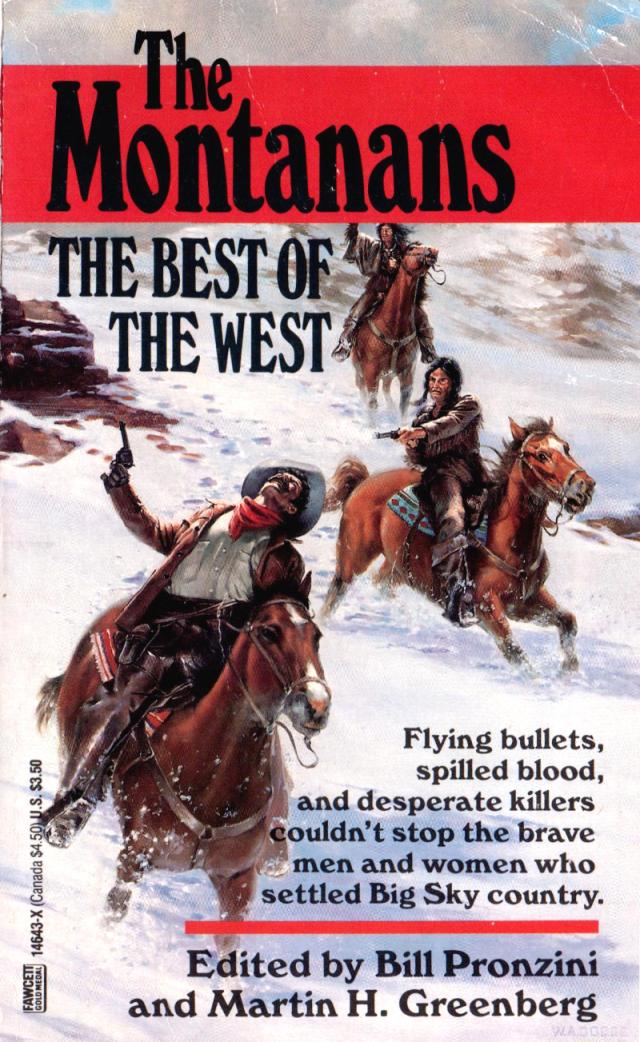
THE MONTANANS
These legendary men and women battled the brutal frontier to forge a state as majestic as any in the Union.
THE BEST OF THE WEST
For the first time ever a collection of thirteen blazing stories about the myth and the making of the great western state of Montana.
Other Western Anthologies
Edited by Bill Pronzini and Martin H. Greenberg:
TREASURY OF CIVIL WAR STORIES
THE WESTERN HALL OF FAME: An Anthology of Classic Western Stories Selected by the Western Writers of America
THE BEST WESTERN STORIES OF STEVE FRAZEE
THE LAWMEN*
SECOND REEL WEST
THE COWBOYS*
THE WARRIORS*
THE THIRD REEL WEST
THE RAILROADERS*
THE STEAMBOATERS*
THE CATTLEMEN*
THE HORSE SOLDIERS*
THE GUNFIGHTERS*
THE TEXANS*
THE CALIFORNIANS*
THE ARIZONANS*
THE NORTHERNERS*
THE NORTHWESTERNERS*
*Published by Fawcett Gold Medal Books
Edited by
Bill Pronzini and
Martin H. Greenberg
FAWCETT GOLD MEDAL • NEW YORK
A Fawcett Gold Medal Book
Published by Ballantine Books
Copyright © 1991 by Bill Pronzini and Martin H. Greenberg
All rights reserved under International and Pan-American Copyright Conventions. Published in the United States by Ballantine Books, a division of Random House, Inc., New York, and simultaneously in Canada by Random House of Canada Limited, Toronto.
Library of Congress Catalog Card Number: 90-93473
ISBN 0-449-14643-X
Manufactured in the United States of America
First Edition: March 1991
Contents
Acknowledgments
The Lamb of the Flying U - B.M. Bower
Bannack Doctor - Norman A. Fox
Beyond the Frontier - Dorothy M. Johnson
Killers’ Country! - Dan Cushman
Psychology and Copper - W. C. Tuttle
No-Fights - T. V. Olsen
Bargain - A. B. Guthrie, Jr.
All the Long Years - Bill Pronzini
Bet the Wild Queen! - Norman A. Fox
Blood Truth - Ed Gorman
Wooden Indian - Jack Foxx
Buffalo Horns - Arthur Winfield Knight
Queen of Rustler’s Range - Les Savage, Jr.
About the Editors
Acknowledgments
“Bannack Doctor,” by Norman A. Fox. Copyright © 1947 by Norman A. Fox. From They Rode the Shining Hills by Norman A. Fox. Copyright © 1968 by Rosalea S. Fox. Reprinted by permission of Richard C. Fox, executor for the estate of Norman A. Fox.
“Beyond the Frontier,” by Dorothy M. Johnson. Copyright © 1948 by Dorothy M. Johnson; copyright renewed © 1976 by Dorothy M. Johnson. Reprinted by permission of McIntosh & Otis, Inc.
“Killers’ Country!” by Dan Cushman. Copyright © 1950 by Popular Publications, Inc. First published in Dime Western. Reprinted by permission of Scott Meredith Literary Agency, Inc., 845 Third Avenue, New York, N.Y. 10022.
“No-Fights,” by T. V. Olsen. Copyright © 1968 by T.V. Olsen. First published in War Whoop and Battle Cry, ed. by Brian Garfield. Reprinted by permission of the author.
“Bargain,” by A. B. Guthrie, Jr. From The Big It and Other Stories by A. B. Guthrie, Jr. Copyright © 1960 by A. B. Guthrie, Jr.; copyright renewed © 1988 by A. B. Guthrie, Jr. Reprinted by permission of Brandt & Brandt Literary Agents, Inc.
“All the Long Years,” by Bill Pronzini. Copyright © 1988 by Bill Pronzini. First published in Westeryear. Reprinted by permission of the author.
“Bet the Wild Queen!”, by Norman A. Fox. Copyright © 1948 by Popular Publications, Inc. Reprinted by permission of Richard C. Fox, executor for the estate of Norman A. Fox.
“Blood Truth,” by Ed Gorman. Copyright © 1991 by Ed Gorman. An original story published by permission of the author.
“Wooden Indian,” by Jack Foxx. Copyright © 1989 by Davis Publications, Inc. Reprinted by permission of the author.
“Buffalo Homs,” by Arthur Winfield Knight. Copyright © 1991 by Arthur Winfield Knight. An original story published by permission of the author.
“Queen of Rustler’s Range,” by Les Savage, Jr. Copyright © 1950 by Ziff-Davis Publishing Co. First published in Mammoth Western. Reprinted by permission of Mrs. Marian Savage.
B.M. (for Bertha Muzzy) Bower was the first woman to write traditional cowboy stories. Beginning with Chip of the Flying U (1906), she published more than seventy novels of the old and new West, most of them featuring the often humorous adventures of Chip and his comrades on the Flying U ranch. “The Lamb of the Flying U,” which recounts the spectacular and surprising fashion in which a tenderfoot named Pink is intiated into the flock, is one of several shorter works about the ranch and its “Happy Family.” Bower (1871-1940) was extremely popular during the first four decades of this century, but at her best she was more than simply an entertainer. Her depiction of the day-to-day working conditions of cowboys provides a vivid and realistic picture of life on a large Montana cattle ranch circa 1880-1910. She knew whereof she wrote: She herself was born and reared on just such a ranch.
The Lamb of the Flying U
B.M. Bower
“Scuse me,” said a voice behind Chip Bennett, foreman of the Flying U. “Lookin’ for men?”
For two days the Flying U herd had grazed within five miles of Dry Lake waiting for boxcars along the Montana Central line, which had never come. Then two of his men had gone to town on a spree and continued missing. They were not top hands, but every hand is vital in shipping time, so Chip had ridden into town to bring them back, or acquire facsimiles thereof.
He twisted his head to look down at a dandified little fellow who was staring up at him with bright blue eyes. He wore a silk shirt, neatly pressed gray trousers held up by a russet belt, and gleaming tan shoes. Golden hair, freshly barbered, just showed its edges under an immaculate Panama hat. The foreman was slightly taken aback.
“Sorry, son,” he muttered. “I want men to work.”
The fashion plate flashed a pair of dimples that any woman would have envied.
“My mammy done to me,” he murmured, “never to judge a book by its cover.”
“We were speakin’ of men,” Chip reminded him. “And work. I can’t quite see you punchin’ cows in them duds. Look me up when you’ve growed a bit, son.”
A hand on his arm stopped him as he was turning away again. “Say, did you ever hear of Old Eagle Creek Smith of the Cross L?”
“Why, sure,” said Chip. “I—”
“—Or of Rowdy Vaughan, or a fellow up on Milk River they call Pink?”
“I’ll say!” Chip Bennett turned back. “I’ve heard tell of Eagle Creek Smith. And Pink—they say he’s a bronc fighter and a little devil. Why?”
The blonde shoved his Panama back and grinned into Chip’s face. “Nothin’,” he said. “I’m glad to meet yuh. I’m Pink.”
Chip digested that in silence, his suddenly alerted eyes measuring the slender figure from Panama to polished shoe tips. “You travelin’ in disguise?” he asked.
“It’s a long story,” Pink said, and sighed. He found an empty case, upended it in the shade and sat down to roll a cigarette. “I helped Rowdy Vaughan trail a herd of Cross L stock across the Canadian line, bein’ a friend of his an’ anxious to do him a favor. But I ain’t long in our friendly neighbor country to the north when one of them boneheaded grangers gets unfriendly and I has to scatter his features around a bit to pound some sense into his thick skull.
“Then up rises a bunch of redcoats and I fogs it back across the line just about one jump ahead of the Mounties. I headed back to the Upper Milk River, but the old bunch was gone and it was plumb lonesome, so I sold my saddle an’ gatherin’ and reformed from punchin’ cows.”
He grinned his engaging, dimpled grin. “Well, I took the rattlers back to Minnesota and spent all winter with the home folks chewin’ the fatted calf. It was mighty nice, too, except that the female critters outnumbered the males back there and each one carries a bear trap an’ a pair of handcuffs. I dodged the traps as long as I could, but I seen I was gettin’ right gun-shy, so I sloped.
“Besides, even though I’d swore off cowpunchin’, I was gettin’ plumb mad at all the fences surroundin’ everything, and lonesome to straddle a cayuse again. Seems like cow nursin’ is in my blood after all. For Pete’s sake, old-timer, stake me to a string! You won’t be sorry.”
Chip sat down on a neighboring case and regarded the dapper little figure. Such words, coming from those girlishly rosy lips, had an odd effect of unreality. But Pink plainly was in earnest. His eyes were pleading and wistful.
“You’re it!” said Chip. “You can go right to work. Seems you’re the man I’ve been looking for, only I didn’t recognize yuh on sight. We’ve got a heap of work ahead, and only five decent men in the outfit. It’s the Flying U. Those five have worked years for the outfit.”
“I sure savvy that bunch,” Pink declared sweetly. “I’ve heard of the Happy Family before. Ain’t you one of them?” Chip Bennett grinned. “I was,” he admitted, a shade of regret in his voice. “But last spring I got married, and settled down. I’m one of the firm now, so I had to reform. The rest are a pretty salty bunch, but you’ll get on all right, seein’ you’re not the pilgrim you look. Got an outfit?” “Sure. Bought one, brand new, in the Falls. It’s over at the hotel now, with a haughty, buckskin-colored suitcase.” Pink pulled the silver belt-buckle of his russet belt straight and patted his pink and blue tie.
“Well, if you’re ready, I’ll get the horses and we’ll drift. By the way, how shall I write you on the book?”
Pink stooped and with his handkerchief carefully wiped the Dry Lake dust from his shiny shoes.
“Yuh won’t crawfish on me, if I tell yuh?” he inquired anxiously, standing up.
“Of course not.” Chip looked his surprise.
“Well, it ain’t my fault, but my lawful, legal name is Percival Cadwallader Perkins.”
“Wha-at?”
“Percival Cadwallader Perkins. Shall I get yuh something to take with it?”
Chip, with his pencil poised in air, stared again. “It’s sure a heavy load to carry,” he observed solemnly. “How do you spell that second shift?”
Pink told him. “Ain’t it fierce?” he wanted to know. “My mother must have sure been light-minded when I was bom, but there are two grandfathers who wanted a kid named after ’em. Them two names sure make a combination. You know what Cadwallader means, in the dictionary?”
“Lord, no!” said Chip, putting away his book.
“Battle-arranger,” Pink told him sadly. “Now, wouldn’t that jostle yuh? It’s true, too. It has sure arranged a lot of battles for me. When I went to school, I had to lick about six kids a day. At last, seein’ the name was mine and I couldn’t chuck it, I throwed in with an ex-pugilist and learned how to fight proper. Since then things come easier. I ain’t afraid now to wear my name on my hatband.”
“I wouldn’t,” said Chip dryly. “Hike over and get your haughty new war bag. We’ve got to be in camp by dinner time.”
A mile out Pink looked down at his festal garments and smiled. “I expect I’ll be pickings for your Happy Family when they see me in these war togs,” he remarked.
Chip Bennett studied him meditatively. “I was just wondering,” he said slowly, “if the Happy Family wouldn’t be pickings for you.”
Pink dimpled and said nothing.
The Happy Family were at dinner when Chip and Pink dismounted by the bed tent and went over to where the men were sitting. The Happy Family received them with decorous silence. Chip got plate, knife, fork, and spoon and started for the stove.
“Help yourself to the tools, then come over and fill up,” he invited Pink, over his shoulder. “You’ll soon get used to things here.”
The Happy Family looked guardedly at one another. This wasn’t a chance visitor, then. He was going to work!
Weary Davidson, sitting cross-legged in the shade of a wagon wheel, looked at Pink, fumbling shyly among the knives and forks, and whistled absently: “Oh, tell me, pretty maiden, are there any more at home like you?”
Pink glanced at him quickly and retreated inside the tent. Every man of them knew the stranger had caught Weary’s meaning. They smiled discreetly at their plates.
After dinner—during which Cal Emmett tested the tenderness of the newcomer with tales of his life as a desperado—Pink asked Chip if he should change his clothes and get ready to go to work.
Chip told him it wouldn’t be a bad idea, and Pink, carrying his haughty suitcase and another bulky bundle, disappeared into the bed tent.
“By golly!” spoke up Slim.
“Where did you pluck that modest flower, Chip?” Jack Bates wanted to know.
Chip sifted some tobacco into a paper. “I picked it in town,” he told them. “I hired it to punch cows, and its name is—wait a minute.” He put away the tobacco sack, got out his book, and turned the leaves. “Its name is Percival Cadwallader Perkins.”
“Oh, mamma! Percival Cadwolloper Perkins!” Weary looked stunned. “Yuh want to double the guard tonight, Chip. That name’ll sure stampede the bunch.”
“He’s sure a sweet young thing—mamma’s precious lamb broke out of the home corral!” said Jack Bates. “I’ll bet yuh a tall, yellow-haired mamma with flowing widow’s weeds’ll be out here hunting him up inside a week. We got to be gentle with Cadwolloper.”
The reappearance of Pink cut short the discussion. He still wore his Panama, and the dainty pink-and-white striped silk shirt, the gray trousers, and russet-leather belt with silver buckle. But around his neck, nestling under his rounded chin, was a gorgeous rose-pink silk handkerchief, of the hue that he always wore, and that had given him the nickname of “Pink.”
His white hands were hidden in a pair of wonderful silk-embroidered buckskin gauntlets. IBs gray trousers were tucked into number-four tan riding boots, with silk-stitched tops. A shiny new pair of silver-mounted spurs jingled from his heels.
He smiled trustfully at Chip Bennett, got out papers and tobacco, and rolled a cigarette.
“If there’s anything I hate,” Cal remarked irrelevantly to the crowd, “it’s to see a girl smoke!”
Pink looked up and opened his lips to speak, then thought better of it. The cavvy came jingling up, and Pink turned to watch. To him the thudding hoofs were sweet music for which he had hungered long.
“Weary, you and Cal better relieve the boys on herd,” Chip Bennett called. “I’ll get you a horse, P-Perkins”—he had almost said “Pink”—“and you can go along with Cal.”
“Yes, sir,” said Pink, with a docility that would have amazed any who knew him well. He followed Chip out to the corral, where Cal and Weary were already inside with their ropes, among the circling mass.
Chip led out a little cow-pony that could almost day-herd without a rider of any sort, and Pink bridled him before the covertly watching crew. He did not do it as quickly as he might have done, for he deliberately fumbled the buckle and pinned one ear of the pony down flat with the headstall.
Happy Jack, who had been standing herd disconsolately with two aliens, stared open-mouthed at Pink’s approach and rode hastily to camp, fair bursting with questions and comments.
The herd, twelve hundred range-fattened steers, grazed quietly on a hillside a half mile from camp. Pink ran a quick, appraising eye over the bunch, estimating correctly the number and noting their splendid condition.
“Never saw so many cattle in one bunch before, did yuh?” queried Cal, misinterpreting the glance.
Pink shook his head. “Does one man own all those cows?” he wanted to know.
“Yeah—and then some. This is just a few that we’re shipping to get ’em out of the way of the real herds.”
“How many are there?” asked Pink.
Cal turned his back upon his conscience and winked at Weary. “Oh, only nine thousand, seven hundred and twenty-one,” he lied boldly. “Last bunch we gathered was fifty-one thousand, six hundred and twenty-nine and a half. Er—the half,” he explained hastily in answer to Pink’s look of unbelief, “was a calf that we let in by mistake. I caught it and took it back to its mother.”
“I should think,” Pink ventured hesitatingly, “it would be hard to find its mother. I don’t see how you could tell.”
“Well,” said Cal gravely, sliding sidewise in the saddle, “it’s this way. A calf is always like its mother, hair for hair. This calf had white hind feet, one white ear, and the deuce of diamonds on its left side. All I had to do was ride the range till I found the cow that matched.”
“Oh!” Pink looked convinced.
Weary, smiling to himself, rode off to take his station at the other side of the herd. Even the Happy Family must place duty before pleasure, and Call started down along the nearest edge of the bunch. Pink showed inclination to follow.