

Want me, p.1
Want Me, page 1


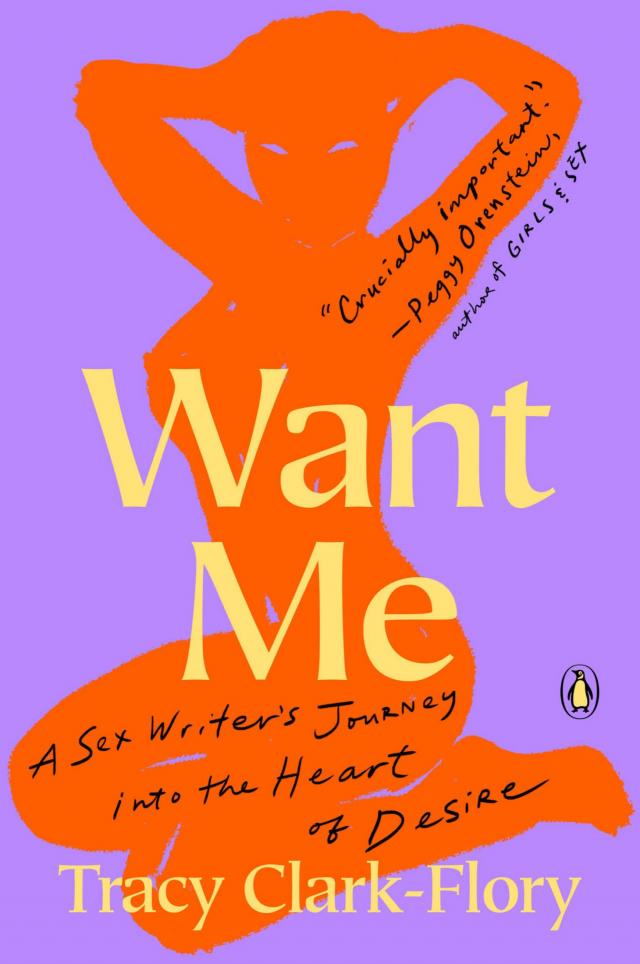
Praise for Want Me
“Tracy Clark-Flory is among the first of a generation of young women to grow up in a digital world, an Alice shaped by the web’s wonderland. Her journey reveals possibilities, but also the impact of turbo-charged messages that present ‘empowered’ female sexuality as all about performance: being desirable rather than recognizing your desires; pleasing others rather than understanding your pleasure; being wanted rather than asking for what you want. This book is absolutely, crucially important to read in order to understand the world in which all girls, and boys, now come of age.”
—Peggy Orenstein, New York Times bestselling author of Girls & Sex
“This book is about much more than sex—it’s a candid and brave story about the collision of fantasies, ideals, and truths; it’s a story about the search for self.”
—Daniel Bergner, author of What Do Women Want?: Adventures in the Science of Female Desire
“I loved reading Want Me—its joys and sorrows, laughter and pain, all the memories and mysteries that resonate with women of all ages who wonder how we got here. A compelling, important read.”
—Debby Herbenick, author of Because It Feels Good
“Tracy Clark-Flory is one of the best journalists of our generation writing about sexuality. When she turns her incisive lens on herself, the results are revelatory. The book is everything I want a memoir to be—a bracingly honest, messy, self-aware, inspiring road map to sexual selfhood.”
—Tristan Taormino, sex educator and bestselling author of Take Me There
penguin books
WANT ME
Tracy Clark-Flory is a senior staff writer at Jezebel. Her work has been published in Cosmopolitan, Elle, Esquire, Marie Claire, Salon, the Guardian, Women’s Health, and the yearly Best Sex Writing anthology. She lives in the San Francisco Bay Area with her family.
PENGUIN BOOKS
An imprint of Penguin Random House LLC
penguinrandomhouse.com
Copyright © 2021 by Tracy Clark-Flory
Penguin supports copyright. Copyright fuels creativity, encourages diverse voices, promotes free speech, and creates a vibrant culture. Thank you for buying an authorized edition of this book and for complying with copyright laws by not reproducing, scanning, or distributing any part of it in any form without permission. You are supporting writers and allowing Penguin to continue to publish books for every reader.
library of congress cataloging-in-publication data
Names: Clark-Flory, Tracy, author.
Title: Want me : a sex writer’s journey into the heart of desire / Tracy Clark-Flory.
Description: New York : Penguin Books, 2021. | Includes bibliographical references. |
Identifiers: LCCN 2020045383 (print) | LCCN 2020045384 (ebook) | ISBN 9780143134619 (paperback) | ISBN 9780525506423 (ebook)
Subjects: LCSH: Clark-Flory, Tracy. | Clark-Flory, Tracy—Sexual behavior. | Journalists—United States—Biography. | Self-realization in women.
Classification: LCC PN4874.C54 A3 2021 (print) | LCC PN4874.C54 (ebook) | DDC 070.4/49306092 [B]—dc23
LC record available at https://lccn.loc.gov/2020045383
LC ebook record available at https://lccn.loc.gov/2020045384
Some names and identifying characteristics have been changed to protect the privacy of the individuals involved.
Cover design and illustration: Lynn Buckley
pid_prh_5.6.1_c0_r0
For Mom
Contents
Prologue: “Girls These Days”
Chapter 1: Perfect 10
Chapter 2: Adult
Chapter 3: Cautionary
Chapter 4: Rough
Chapter 5: Winning
Chapter 6: Faking
Chapter 7: Just Friends
Chapter 8: Heartbeats
Chapter 9: Porn Valley
Chapter 10: “Moms”
Chapter 11: I Want
Chapter 12: Drive
Acknowledgments
Notes
I’m always interested to hear how a woman conceives of herself as a sexual person, because there is really no map for this, only a series of contradictory and shaming warnings. So whatever any of us comes up with is going to be wholly unique and perhaps a little monstrous—like a creature that has survived multiple attacks yet still walks, still desires.
Miranda July1
PROLOGUE
“Girls These Days”
I’m in a warehouse in Los Angeles’s San Fernando Valley anxiously scribbling in my reporter’s notebook while waiting for a porn shoot to begin. Charles Dera, a performer with jet-black hair and a well-groomed beard to match, is crouched in front of me, stretching his calves. Tommy Gunn, a legendary performer named after his biceps, is sitting on the floor flipping through a release form. He hops to a stand and asks to borrow my pen.
We’re in a fluorescent-lit office with paneled ceiling tiles and shuttered vertical blinds. A metal gurney and hospital privacy curtain are pushed into a corner alongside a rolling cart of textbooks and a plastic houseplant. Fake eyelashes and foundation in various shades of beige are spread out on a vintage wooden desk that practically purrs, “The principal will see you now.” As a reporter writing about sex, I’ve been on porn sets more times than I can count, but this shoot is making me uncommonly nervous.
I started watching porn as a teenager in the late nineties with a spotty dial-up connection. It seemed a vibrant human sexuality textbook next to lackluster sex-ed classes featuring black-and-white anatomy diagrams and condoms rolled onto bananas. When I started actually having sex, porn became my aspirational guide to seductive moans, gymnastic positions, and superior blow jobs. One person I saw receive lots of superior blow jobs was Tommy Gunn, who is now standing next to me, handing back my pen. That explains the anxious scribbles: I’m starstruck.
Then I hear something that yanks me from my distracted state: “Girls these days.” Girls. These. Days. Three such innocuous words, until they are strung together in that particular order. I’m not even sure who said it, but I start taking notes—real ones underneath my scribbles. “Girls watch our porn, because it’s free everywhere, and then they grow up thinking that’s what sex is,” says Dera. Gunn joins him in delivering the last four words such that they resound in stereo: That’s what sex is. “They go and have sex with a normal dude,” Dera continues, “and he’s like—” He screws up his face in mock horror—the kind of face, actually, that women give in those tube site ads where they’re surprised by a home intruder, snooping stepdad, or photoshopped monster cock.
This riff is a reversal of the usual media narrative: that boys spring pornographically inspired moves on unsuspecting young women. Nevertheless, Gunn nods knowingly. “When I have my private sex, I’m not trying to be like, ‘Huh-huh-huh,’” he says, theatrically grunting while aggressively humping the air. It’s a parody of the work he’s done for well over a decade.
They turn to me, a rapt audience of one with a notebook and digital recorder on my lap, and recount stories of the young women who send them naked selfies on Instagram and ask them to “fuck them like a porn star.” That means choking, gagging, and face slapping, they explain. “Then pay me, because this is work now. I’m not enjoying this, I’m putting on a performance,” says Dera, as if talking to one of these girls. “It’s, like, not even my cup of tea. I want to go to dinner and have a fucking nice meal and take it from there. Where the ladies at anymore?” Gunn shakes his head and says, “It’s a whole ’nother generation.”
At this, I hear what I’ve already heard from conservative culture warriors, misogynistic internet trolls, and feminist critics alike: today’s young women are sexually misguided, dreadfully warped. I’m brought back to the years I spent as a feminist blogger, attempting to defend against generational attacks on everything from hookups to “raunch culture.” It’s only on future listens to the audio on my recorder that I will recognize something other than familiar “girls these days” hand-wringing. These men are speaking to the way that they are conflated with their work, reduced to what they portray, and assumed to be sexually available. They are talking about the confusion of fantasy and reality, and how it impacts them as sex workers. But my vision is restricted, my focus folded inward. All I hear is: You got it wrong, you did it wrong, you are wrong.
Soon, Gunn throws up his square hands and tosses back his head as if doing Seinfeld-esque stand-up. “The new first date is anal,” he says. Later, Gunn tests out another version of the punch line: “Anal is the new handshake.” I’m laughing, like I’m in on the joke. The joke, as I narrowly understand it, being the absurdity of girls who think that porn is real, who want to be roughed up in the bedroom, who don’t know what it means to go on a real date. But I was “girls these days.” In many ways, I still am.
I grew up amid fizzy declarations of “girl power” and exhortations toward empowerment. It seemed to me women had every opportunity to break the glass ceiling. The same was true with sex, which was everywhere. The sexual revolution already happened, yes? Now I could do as men: watch porn, sleep around. Never mind the old double standards and dichotomies, which had persisted and expanded ever more confusingly with expectations of sexiness. Girls contended not only with the labels of “virgin” or “slut” but also with “prude.”1
Against this backdrop, as a mostly-pretty-sure-I-was-straight girl, sexual empowerment seemed to me an being both like men and wanted by them. So, I tried to become an expert in both—mining tube sites, visiting strip clubs, embracing casual hookups, and delivering the kinds of bedroom performances that led one man to exclaim, “I feel like I’m a teenager discovering Playboy for the first time. No, make that Penthouse.” Meanwhile, I faked nearly all of my orgasms.
In theory, my career as a journalist only furthered those ends of knowledge: reporting on peacocking pickup artists, interviewing guys about every never-before-told facet of their sex lives, reviewing virtual-reality porn shot from a man’s point of view. Instead, it has complicated my assumptions, undercut my so-called expertise. Now, ironically, one of my unwitting, de facto teachers is saying that porn is an inaccurate representation of what many straight men want. In fact, his costar is suggesting that women like me horrify “normal” dudes.
It is far from the first time I’ve encountered these kinds of messages, but it is the most arresting. My ears pound with blood, like I’ve been hung upside down by my ankles. This isn’t about porn. It’s about the countless ways I’ve chased after a vision of straight men’s desire only to watch it vanish right before me. I consider explaining all of this, inviting these men into this private moment of disenchantment. Instead, I keep laughing along like one of the guys at the specter of young women who treat anal like the new handshake. Hahaha, girls these days. I have to admit, there is something darkly funny about the possibility that I rerouted my desires in pursuit of a mirage.
Still laughing, I think: The joke is on me, isn’t it?
CHAPTER 1
Perfect 10
I like to say that I was raised in Berkeley, California, by a pair of pot-smoking hippies. This is factually true, but it gives the wrong impression. Tie-dyed shirts, Birkenstocks, unwashed hair, co-ops, free love. Berkeley in the sixties, basically—the identity to which the city still so desperately clings. This creates an easy shorthand for a childhood lived outside the norm, but the abnormal aspects of my childhood can’t be summarized by such a cliché.
We lived in a Craftsman in North Berkeley on a busy two-level street bisected by the Hayward fault line. You could walk a couple of blocks—down a secretive sun-dappled path, beyond the fence that neighborhood kids had, in a united act of delinquency, covered with discarded bits of bubble gum—to nearby Solano Avenue. There was a small movie theater with a vintage marquee, a progressive bookstore, and a wide array of “ethnic” restaurants, as some graying white hippies would imperiously call them.
It was small-town living in a not-so-small town. One that trumpeted its liberal politics and famous history of war protests, and above all embraced the giddy spectacle of people doing their own thing—like Pink Man, a guy who donned a head-to-toe hot-pink bodysuit and silver cape and rode around town on a unicycle. “Berserkeley,” I called it, smiling proudly. Across the sparkling blue-green bay was San Francisco, or the City, which I understood as a kid to be kooky in its own way. Although, all I really knew early on was Pier 39 with its kitschy souvenir shops and stinky, raucous sea lions—essentially, the opening credits to Full House.
Despite the setting, my childhood wasn’t organic greens and whole grains. It was Lay’s potato chips and party packs of Pepperidge Farm cookies (see: pot-smoking hippies). My mom had brought her Midwest roots with her to the crunchy Bay Area, so we didn’t go to farmers markets, join a co-op, or grow vegetables in our garden. We didn’t even compost. Instead, we bought Coca-Cola by the case and went to Disney on Ice. My parents rebelled in other ways, though, like the pot, and my last name: Clark hyphen Flory. It was what so many people did in their milieu at the time, which paved the way for plenty of jokes about a future Berkeley populace full of double and triple hyphenates. It’s such a small thing, that hyphen, but it represented the kind of partnership that they wanted to have: emphatically, sometimes inconveniently equal.
My mom ran her own graphic design business in San Francisco and woke while it was still dark out in an attempt to beat traffic across the bridge. That meant my dad, a programmer at a Berkeley tech start-up, got me ready for school in the mornings when I was little. He supervised tooth brushing, poured my bowl of cereal, and combed out my long mass of hair. A “rat’s nest,” as he called it, often developed overnight, and he would take me out onto our sunlit porch so that he could delicately pick at it with a comb, whistling to himself while French-braiding my hair, a skill he had picked up from some moms on the playground during his paternity leave.
Even in our sensitive, liberal climate, my dad was unusual for a man. In my mom’s circle of predominantly queer women friends, I would hear things like, “He’s a special guy, your dad.” He was stereotypically masculine—deep booming voice, copious body hair, towering stature—but quick to tear up at little things, like a thoughtful gesture or a dramatic movie scene. During college he had trained to become a peer counselor as an extracurricular activity and went through emotional workshops where, as he put it in his characteristically confident and unselfconscious way, “I got really good at crying.”
Right on up until puberty, I spent every Sunday afternoon adventuring with him—rock climbing, windsurfing, skateboarding, hitting balls at the batting cages. It was our version of church, the objects of worship being nature, sun, and sweat. Sometimes he brought me to a sprawling park in the Berkeley hills, where we climbed through a creek looking for water skippers, threw whistling Frisbees on the grass, and picked blackberries from gnarled thickets. My tan scrawny legs were often caked in dried flecks of mud, my feet slipping and squishing in soaking wet Keds.
In those days, time with my dad always carried the thrill of possibility. We were going to go do things in the world. Things that made me burst through the front door with an exciting proclamation. I threw a Frisbee! Look how many blackberries we got! I scraped my knee, but I’m okay!
He never treated me like a princess, but then he did build me a castle—a large wooden structure that sat in our front yard, looming over our five-foot fence, with a drawbridge, stairs, and even a turret. He painted it gray to approximate the color of ancient stone and flew a rainbow-colored windsock at the top. But if I was a princess, he made sure that I was a roller-skating, creek-jumping princess who kissed banana slugs, and without any hope they would turn into a prince. Then again, I also was a princess who stopped using her castle when spiders moved in and spun pillowy nests of eggs in every corner. But he tried, really, he tried, to counteract every other message I might absorb about what it meant to be a girl.
* * *
• • •
My mom was what many men pointedly called a “strong woman.” That’s because, you know, she was smart and had opinions, but also because she made it clear she was not ever going to be stepped on, especially by any man. “Watch it, buster” was a signature line, said if my dad impishly overstepped even small bounds, like lightly teasing her about the trivial talk show she had on or stealing a bite off her plate. My mom had developed this defensive posture growing up with a 1950s caricature of a dad who worked too hard, drank too much whiskey, and, in her words, “ruled like a tyrant.”
She was no tyrant with her “little bunny.” From those early years, my mom lingers as a sense memory of safety and comfort: her hair-sprayed perm pressing against my cheek as she hugged me, the drip of wet washcloth held to my feverish forehead, the smell of Kraft singles melting onto a sizzling pan as she made me a grilled cheese. All the pain she experienced as a little girl and beyond? None of that for me. Maybe her daughter wouldn’t have to be such a “strong woman.”
My mom didn’t exactly identify as a feminist—she preferred the term humanist in part because she felt there was something pleading and fragile about feminism—but the definition of the word described her fundamental belief: men and women are equal. That belief fueled her arm’s-length relationship with feminine presentation. Her closet was filled with loose-fitting blouses, stretchy black cotton pants, and sensible flats with flexible rubber soles. She didn’t own anything more than a modest kitten heel. During the workweek, she put her hair in curlers, unwrapped her flowy tops from the dry-cleaning plastic, and applied chalky makeup that dusted the top of her dresser, but she made a point of telling me that she had to do this to be “professional,” not because she wanted to or believed in it. For my mom, makeup in particular was a drag, and a kind of drag.






