Desperate people prepper.., p.1
Desperate People (Prepper Aftermath Book 1), page 1


CONTENTS
Title page
Works by Tom Abrahams
Prologue
Chapter 1
Chapter 2
Chapter 3
Chapter 4
Chapter 5
Chapter 6
Chapter 7
Chapter 8
Chapter 9
Chapter 10
Chapter 11
Chapter 12
Chapter 13
Chapter 14
Chapter 15
Chapter 16
Chapter 17
Chapter 18
Chapter 19
Chapter 20
Chapter 21
Chapter 22
Chapter 23
Chapter 24
Chapter 25
Chapter 26
Chapter 27
Chapter 28
Chapter 29
Chapter 30
Chapter 31
Chapter 32
Chapter 33
Chapter 34
Chapter 35
Continue The Adventure
Epilogue
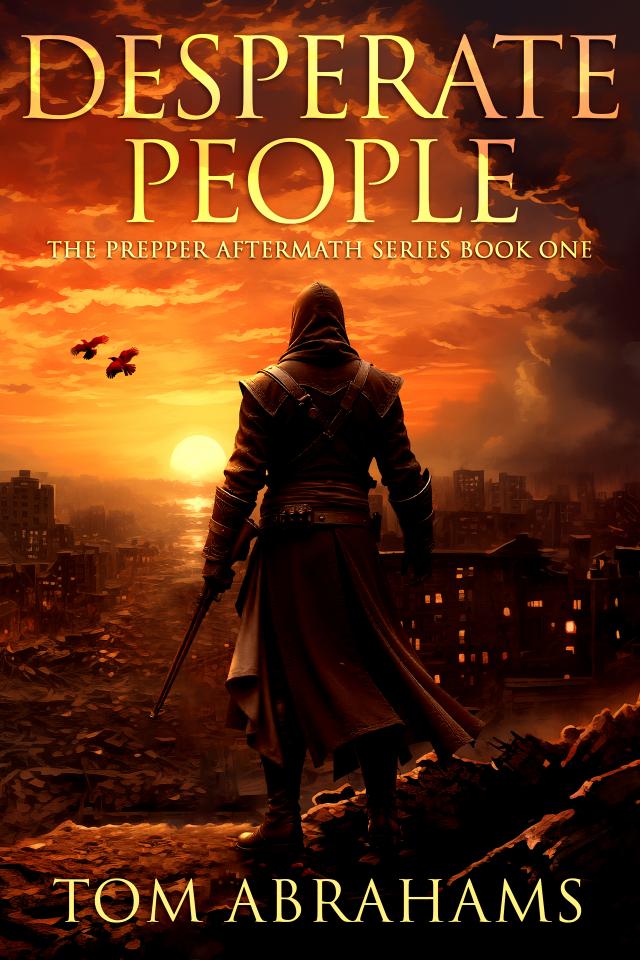
DESPERATE PEOPLE
PREPPER AFTERMATH
POST-APOCALYPTIC/DYSTOPIAN SURVIVAL SERIES
BOOK ONE
By Tom Abrahams
A PITON PRESS BOOK
DESPERATE PEOPLE
PREPPER AFTERMATH: BOOK 1
© 2025 by Tom Abrahams
All Rights Reserved
Cover Design by Hristo Kovatliev
Edited by Sabrina Jean at FastTrack Editing
Proofread by Pauline Nolet
This book is a work of fiction. People, places, events, and situations are the product of the author’s imagination. Any resemblance to actual persons, living or dead, or historical events is purely coincidental. No part of this book may be reproduced, stored in a retrieval system, or transmitted by any means without the written permission of the author and publisher.
http://tomabrahamsbooks.com
Click here to join the free PREFERRED READER’S CLUB
Formatted with Vellum
WORKS BY TOM ABRAHAMS
PREPPER AFTERMATH
DESPERATE PEOPLE
DESPERATE TIMES
DESPERATE MEASURES
PREPPER NATION
WAR IS PEACE
FREEDOM IS SLAVERY
IGNORANCE IS STRENGTH
PREPPER GRID-DOWN POST-APOCALYPTIC/DYSTOPIAN SURVIVAL SERIES
BOOK 1
BOOK 2
BOOK 3
BOOK 4
BOOK 5
THE CRUSADER POST-APOCALYPTIC EMP SURVIVAL SERIES
BEST LAID PLANS
NO GOOD DEED
ONE IN THE HAND
BETTER LATE
ALL FOR ONE
THE ALT APOCALYPSE SURVIVAL SERIES
ASH
LIT
TORRENT
AFFLICTION
POX
THE WATCHERS SERIES
THE BAR AT THE END OF THE WORLD
THE BAR AT THE EDGE OF THE SEA
THE BAR IN THE MIDDLE OF NOWHERE
THE SCOURGE SERIES
UNPREPARED
ADRIFT
GROUNDED
THE TRAVELER POST-APOCALYPTIC/DYSTOPIAN SERIES
HOME
CANYON
WALL
RISING
BATTLE
LEGACY
HERO
HARBOR
I, MARCUS: THE TRAVELER’S JOURNAL
THE SPACEMAN CHRONICLES POST-APOCALYPTIC THRILLERS
SPACEMAN
DESCENT
RETROGRADE
JACKSON QUICK SCI-FI ADVENTURES
ALLEGIANCE
ALLEGIANCE BURNED
HIDDEN ALLEGIANCE
A POLITICAL CONSPIRACY
SEDITION
INTENTION
BUFFALO BAYOU: A NOIR SUSPENSE THRILLER
PILGRIMAGE: A POST-APOCALYPTIC SURVIVAL STORY
EXTINCTION RED LINE: THE EXTINCTION CYCLE PREQUEL (WITH NICHOLAS SANSBURY SMITH)
SONS OF WAR 4: SOLDIERS (WITH NICHOLAS SANSBURY SMITH)
For Courtney, Sam, and Luke
I carry with me indelible memories of you. Always.
“Without memory, there is no culture. Without memory, there would be no civilization, no society, no future.”
—Elie Wiesel
“Do not dwell in the past, do not dream of the future, concentrate the mind on the present moment.”
—Buddha
PROLOGUE
The war was brutal and world changing. Allies became enemies. All nations fought for what remained. What remained was not enough.
The decline of long-standing civilizations and their alliances began benignly enough. Trade imbalances and political shifts from one extreme to the other forced economic challenges into deep hardships. Nations that long benefitted from fruitful arrangements found themselves at odds. Supply chains sputtered. Access to clean water, medicines, and healthy foods shrank, and those least likely to have access were cut off altogether.
Opposition parties pounced on the depressive conditions and won handily in fair (and unfair) elections in regions that stretched across Asia, the Middle East, Europe, Africa, and the Americas. In some cases, military coups overwhelmed shaky autocracies in small nations with big resources. The control of valuable minerals, arable farmland, and fossil fuels fell under the control of those inclined to hoard them or sell them at highly inflated costs.
A terrorist attack on the state of Texas in late 2029 sparked the embers of a civil war. And though full-scale war was averted, it sowed the seeds of lingering discontent with a system that deepened the divide between the haves and have-nots.
Political violence exploded globally. Once-stable governments fell.
Warlords and despots played increasingly visible roles on the world stage as international organizations, including the United Nations, the International Monetary Fund, the World Trade Organization, and the Group of Twenty, fell into disarray. Longstanding member nations withdrew their cooperation and chose, instead, isolationism and autarky. Reciprocal travel allowances and immigration halted across much of the world. The European Union dissolved, as did OPEC. Banks and other financial institutions failed after runs from which they could not recover. Markets crashed. Governments failed to meet their insurance obligations. Nothing was too big to fail.
The global economy shrank and then stagnated. This persisted for years.
Those accustomed to online shopping, food deliveries at the tap of a screen, easily available fuel, or even a night out at a club, movie theater, or ballpark found themselves without any of those conveniences or diversions. Air travel was a luxury for the ultra-wealthy on the few remaining carriers that survived the waves of devolution.
Life was hard for all but the few in power or with the stored resources to withstand the onslaught of ruin. There was hope, however.
As populations shrank, global travel disappeared, and the mechanics of high-tech manufacturing and production stagnated or evaporated, the economic winds shifted.
After years of strife, nations began to mend bridges. Allies reopened the lines of communication. The late twenty-first century saw a renaissance of global kinship.
But the scare of the preceding decades of distrust and gamesmanship persisted, slowing progress, and just as the leveled playing field started producing positive financial gains, another less avoidable kink in transnational cooperation twisted the growth and strangled it. The forward momentum lost its oxygen.
This time, the harm was irreparable and irreversible. Some claimed that humanity bore the responsibility for the melting glaciers and the rising seas, the droughts, the fires, the arctic winters, and Saharan summers. They claimed that the lack of international cooperation for so long, at an inflection point in the Earth’s ecosystem, reversed gains and accelerated the harm.
Others believed the changes were natural and part of an ending ice age that altered the globe’s climatic zones. They cited a return to cleaner air, less litter, and a rebirth of nature unseen since the days of COVID-19 some half-century earlier as proof that the undoing was not manmade but rather a function of time and space.
There were many who pointed to surviving religious texts across a swath of organized beliefs that foretold of a coming apocalypse and rapture. They prayed for their own souls and for those they were certain would be refused entry into heaven and find themselves left behind in a living hellscape.
Still more refused to believe any changes existed at all. They went about their lives ignoring the obvious and concerning themselves with the daily struggle of subsistence.
Regardless of the actual cause or causes, a resurgent global population boom mixed with once-again diminishing resources and bore catastrophic results. The most important crops for human existence were rice, corn, and wheat. Combined, they accounted for more than half of the world’s caloric consumption.
Scientific efforts to clone or genetically modify agrarian staples failed to produce enough substitutes. The research communities, still decimated by decades of underfunding and nonexistent international collaboration, failed in their mission.
Starvation and increasingly non-arable or marginal land initiated regional conflicts that metastasized into intracontinental wars. Long-held borders between nations moved or dissolved as larger powers devoured those with smaller armies, less advanced technol ogy, or weaker resolve. Isolationism, which had faded into uneasy and informal leagues of nations, gave way to domination and empire-building.
Much of northern Japan sank into the Pacific after a series of earthquake-induced tsunamis. The archipelago nations of Indonesia, Fiji, the Philippines, Comoros, and Cabo Verde ceased to exist, drowned underneath the oceans that once made them island jewels.
Iceland’s population dwindled to nothing after volcanic eruptions along the Reykjanes Peninsula destroyed the Svartsengi Geothermal Power Plant. The constant activity buried the nation under thick clouds of ash, making the air unbreathable and disrupting the remaining air and sea travel for weeks at a time. Trade and commerce between western Europe, Greenland, and North America stopped altogether.
Back-to-back plagues of permafrost and wildfires crippled Moscow. As it limped, China seized its opportunity and invaded. With the help of Iran and Türkiye, the nation states conquered ports along the Caspian and Black Seas and the northern Atlantic Ocean.
Iraq attacked Kuwait. Israel remained in an endless war against Lebanon, Syria, Jordan, and splinter groups from Saudi Arabia. Without help from the United States, it was fighting a losing battle, and its territories shrank at its fringes by the day.
The United States was not immune. Its fifty-one states succumbed to the cancer that infected Asia first, the Middle East, Africa, Eastern and then Western Europe. Australia ate itself alive and became a land of warlords, ruled by nomadic tribes of barbarians intent on seizing control of whatever they could.
Pirates, some state sponsored and others acting alone, terrorized coastal territories, ports, and shipping lanes. Lawlessness ruled the oceans and the land. The strong tightened their grip on what they wanted, and the weak lost their hold on what they needed.
Illness abounded. Poor conditions led to rampant spreads of cholera, dysentery, and pneumonia. Previously uncommon animal- or insect-borne diseases resurged. Hantavirus killed thousands in North America. Typhus did as well. Two outbreaks of bubonic plague bloomed over the course of months in Europe and Asia. Malaria took millions in Central and South America. Countless scores of Africans died from Ebola, tuberculosis, and HIV/AIDS.
The world regressed a thousand years. The scales of morality teetered, and a version of the Darwinian theory prevailed. The fittest, or the most instinctively brutal, survived.
Our story begins in what was the United States ten years after the grid failed, the economy collapsed, the central government fell, and the wars left the vast landscape between the Atlantic and Pacific Oceans scarred and inhospitable.
Those who did not die of starvation, the onslaught of rampant disease, or the targeted conventional and nuclear attacks on large cities and critical infrastructure found themselves struggling to build a new civilization from char and rubble. They lived in small villages, in caves, along evaporating rivers or lakes, or they traveled, searching for a place to begin anew. Some were sick from the fallout or the rampant bacterial and viral infections that plagued any dense population.
Wars intensified. The mechanical, technological, and societal advances of the previous millennia evaporated. Only the lucky, or brutal, few had access to the weapons and tools of the mid-twenty-first century.
Survivors worked for themselves or for collectives that promised protection in exchange for labor and loyalty. Among these groups were the benevolent and the evil. Some of them carried dark memories of the past with little hope for the future. Others had little memory at all, and that, incredibly, gave them confidence in what could be.
None was comfortable. None led lives of leisure.
The cultivation of the remaining natural resources was paramount. Those who controlled water and food controlled what was left of the world. They called themselves Caretakers, but they were oppressors who ruled their loosely affiliated territories with iron fists. Those over whom they lorded were becoming restless.
These were desperate people living in desperate times. And they would take desperate measures, employing any means to prevent their end and secure their freedom from tyranny.
CHAPTER
ONE
THE FUTURE
NORTH AMERICA
Campbell stood on the ridge and looked over the narrow valley below. He checked the rubber seal around his eyes. It held. For now. The yellow tint of his goggles gave the world an orange, vibrant hue. The goggles lied.
Campbell’s world, what was left of it, wasn’t vibrant. If the glasses had somehow shown him solitude, pain, and loss, they’d be believable. He wore them because without their protection, the thick tsunamis of sand and grit that surged across the wind in suffocating waves would blind him.
A black and white checkered rag covered his nose and mouth. He smelled his breath. It was sour and stale. He tried to ignore it and focus on the valley below and what traveled through it.
The sun was behind him, hot on the exposed skin at the back of his neck. It also made it difficult for the caravan to spot him. This was part of the plan.
He dipped his chin, eyes still on the targets below, and lifted the bottom of the rag. His lips were dry and cracked. They were always dry and cracked. At least they weren’t bleeding. Not today. An ancient whisper spoke to him, reminding him to take care of himself. Self-sufficiency was more than guns and goggles.
Campbell did not recognize the internal voice, but it was somehow familiar. It spoke to him from the recesses of his mind, buried along with most of his lifetime’s lost memories. The voice offered sage advice from time to time as if calling to him through dimensions and another place and time.
His fingers found the valve to the hydration bladder hidden in his backpack, and he fed it between his front teeth. A soft bite released the flow of warm water. He took just enough and released the pressure.
A couple of swishes in his mouth and he swallowed. It would do for now. Until the job was finished. Until he could set up camp.
The caravan was exactly what his employer told him it would be. The group traversed the choke point with such malaise that Campbell wondered if it was moving at all. There were two men in the front and two in the rear. Four adversaries and one prize. The prize was in the middle.
The thing was, it didn’t belong to them, these people in the caravan. They’d stolen it. Campbell did not know they’d stolen it. That didn’t matter. Not to him. Not to the people who paid him to retrieve it. Morality was not part of the equation. What was morality in this world anyhow? Who defined it? Campbell did not. That much was for sure. He did not judge. He did his job. He focused on the prize. He did what his bosses told him to do. Nothing more and nothing less.
The “what” was the key. The “how” and “why” were always irrelevant. They got in the way. They clouded the mission. They interfered with his focus on the end game and the promise his employer made to him, should he do his job without asking the “how” and the “why”.
These people in the caravan might have taken the prize without permission, but now they’d pay for it. Campbell would exact the toll. That was his mission. All the missions were like this, give or take a body.
Campbell was what they called a Finder, a hired hand who found things and returned them to their rightful places. It was simple in concept but complicated in execution. Sometimes the finding was easy and the taking back was hard. Or the finding was difficult but the procurement was simple. Occasionally, both parts were near impossible.
There was always blood.
Always.
So much blood that when Campbell slept at night, the scent of it filled his dreams. It colored them. It made the dreams almost seem real. Vibrant. Like the goggles.
Dreams lied too. They became nightmares.
He ran a finger along his chin and found the familiar bump from a scar that ran horizontally, like a miniature flatline smile, above his jawline. Campbell did this out of habit, not even conscious of the motion. The scar had been there longer than he could remember, and there was something comforting about its familiarity. In a world where he recognized so little of what life had been, the keloid protrusion was a sort of consolation.
A swirl of wind blew sand across his face, and a rattle distracted his concentration. He looked to his left. The wind buffeted the remains of a sign post whose faded markings offered directions to places that no longer existed.