The lizard princess, p.1
The Lizard Princess, page 1


The Lizard Princess and the Princess Lizard
Copyright © 2015 by Tod Davies
No portion of this book may be copied or reproduced for commercial purposes, with the exception of quotes used in critical essays and reviews, without the written permission of the publishers.
EXTERMINATING ANGEL PRESS
“Creative Solutions for Practical Idealists”
Visit www.exterminatingangel.com to join the conversation
info@exterminatingangel.com
Exterminating Angel Press book design by Mike Madrid
Layout and typesetting by John Sutherland
eBook ISBN: 978-1-935259-30-5
Library of Congress Control Number: 2015905429
Distributed by Consortium Book Sales & Distribution
(800) 283-3572
www.cbsd.com
CONTENTS
Editor’s Note
A Letter from Dr. Alan Fallaize
The Beginning
I.The Lizard Princess
II.Through the Enchanted Wood
III.In the Bower of Bliss
IV.Conor Barr
V.The Centaur and the Mermaids
VI.In the Dead Wood
VII.On the Ruined Surface
VIII.Susan
IX.Rowena
X.To the Moons
XI.Livia
XII.The Moon Itself
XIII.On the Road of the Dead
XIV.In the Domain of Life
XV.Sophia the Wise
Afterword by Shanti Vale
Three Young Women and Death: An Arcadian Fairy Tale
EDITOR’S NOTE
The Lizard Princess is the third book in the History of Arcadia, the latest that Arcadia sent us from their world. And I think I see the pattern that these books are meant to form.
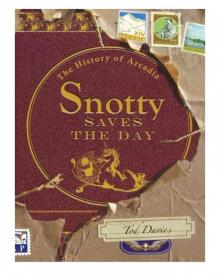
The first, Snotty Saves the Day, was a story for ‘children’. Although the footnotes by an Arcadian physicist hinted at something more. That book came by air.
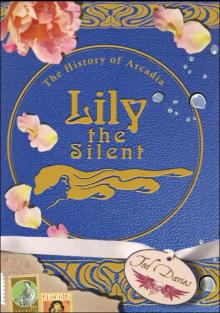
The second, Lily the Silent, was obviously meant for an older reader, what we would call a ‘young adult’. For it was a more romantic story than the first. That book floated to me on a mountain lake. By water.
The book you’re holding now, The Lizard Princess, came by fire. Through a mirror reflecting the last of a blazing sunset, all red and gold and green and violet around the edges. I was pleased to find that communication with Arcadia flows much easier now. For when the light is right, I can see through that mirror into Arcadia.
When the sun sends out one last ray, I can see Arcadia through the tawny shadows in the mirror—the forests and the rivers, the green and gold fields. I can make out dim figures of people I’ve come to know from its history. I can see these people at different times in their stories, which confirms what I suspected: Arcadian time doesn’t march with ours. It spins in the same space as our own, at a different rate of speed. And we can enter its present, its past, or even in its future, depending on luck and the physics of the place.
I think I see now what Arcadia itself is trying to get through to our world. Although only time will tell if I have it right.
If Snotty Saves the Day was a book for children, and Lily the Silent one for young adults, who is meant to read The Lizard Princess?
I always thought there were two kinds of truth in the world: truths of reasoning and truths of fact. But the Lizard Princess proposes a third: truths of imagination. I think the book you hold now is meant for those who believe that kind of truth has the potential to show us new ways of seeing, and with them, new ways of being. I think that is what Arcadia is trying to say.
I believe Sophia when she says she learned that truth in her days as the Lizard Princess. She says it takes a lizard, an angel, and a girl to make a great queen. All three together made Sophia the Wise.
And I look, hopeful, into the mirror in my room waiting to see what next missing piece of the story—of the History of Arcadia—will emerge from the golden shadows there.
Tod Davies
The Colestin Valley, Oregon
Spring 2015
FROM THE DESK OF DR. ALAN FALLAIZE
Dear Editor,
Much has happened to Arcadia in the days since Queen Sophia set down the story of the Lizard Princess. You know some of it from the works we’ve managed to send to you from our world, happily with increasing ease. But it’s only recently we’ve discovered this text, which our queen meant for us to find, along with Snotty Saves the Day and Lily the Silent.
I completely understand why Queen Sophia kept these tales to herself all these years. She was right: we wouldn’t have understood their meaning before now. We barely yet have come to grips with the undeniable physical fact that it is symbols joined with energy that form the stories making up the reality of our every day (or, as the equation has it, ). Even more astonishing is the fact that stories change as the symbols appear, grow, die, and are replaced by new ones.
These are truths that Professor Aspern Grayling and his Megalopolitan backers (for I can call them nothing less) challenge and attempt to suppress—with contempt to start with, and then, when that doesn’t work, with violent control. “Childish” is what they call the History of Arcadia. “Works of imagination,” they scoff—as if works of imagination are not the basis of our past and the hope of our future.
“Unproved by science.”
But in that, at least, they’ve been proved wrong. For the fact that our reality is formed by our symbols is proved by Arcadian scientists, in every branch of our science, every day.
The work of all the great natural scientists is not mere fact collection. It is also theoretical, and that means constructive, work. This spontaneity and productivity is the very center of all human activity: humanity’s highest power. At the same time, it delineates the natural boundary of our human world. In language, in religion, in art, in science, human beings can do no more than build up their own universe, one that enables them to understand and interpret, to articulate and organize, to synthesize and universalize our human experience.
It is in this deeply satisfying activity that I have found my life’s work. I, along with so many others, was led in this by our late colleague, Professor Devindra Vale, she who Professor Grayling professes so loudly to despise. Would that Devindra, who would have found so much to study and ponder in this text, were here with me now! For those of us who knew her best, the years since her death have only served to illustrate her uniqueness, and to deepen her memory. They have made us feel how much our research has suffered from losing her sense of humorous adventure, sympathetic fellowship, and deep delight.
Yet much remains that we will share, as long as we are able, with your world.
First Queen Sophia, and then Professor Vale, left us to continue alone, to fight our battles with Megalopolis as well as we might, with little but these texts as our guide. For the Key has once again been hidden, or has hidden itself, as happened in the past after the death of Queen Lily the Silent. The civil war rages on, with Aspern Grayling at its head. He holds that it is ridiculous of Arcadia, if not actually insane, to resist the greater power of Megalopolis, rather than joining with it. ‘Joining’ here means ‘being swallowed by’, and we hold that our own rooted experience, lived day by day in Arcadia, is worth any amount of promised Megalopolitan power.
But whether the smaller, kinder, nimbler, and—I would argue—wiser land that is Arcadia can survive, thrive, and live to encourage others is another question altogether.
It’s this question that has led to our great experiment: sending word of our history and our plight to other worlds, to uncover what solutions might be found there. Our first attempts have been stories of Arcadia, as we found these were the only words capable of breaching the barrier between worlds. But further work leads us to hope that works of other types, differently illustrative of our situation, may be able to follow. We plan to send you next the recently discovered Report to Megalopolis, written by Professor Grayling, with my annotations meant to counter certain twisted facts and outright falsehoods therein.
Our thanks to you in sharing this work in your world. I’d also like to thank Shiva Vale and Walter Todhunter for the tact and energy they have shown in readying these texts to be sent across the barrier.
Most of all, I salute our late queen, Sophia the Wise, she who was the Lizard Princess, for grasping the Key and showing us the way. In doing so, I defy Megalopolis and my former mentor Professor Aspern Grayling to do their worst. For if truth exists, one can hide it from oneself. But it can never be destroyed. Sooner or later, it will find us all out.
With faith and hope, for your world and for Arcadia, that the truth will find us before it is too late,
For Lanny
“ ‘Where shall wisdom be found and where is the place of understanding?’. . .‘Under an apple-tree, by pure meditation, on a Friday evening, in the season of apples, when the moon is full.’ ”
—Robert Graves, The White Goddess
The Beginning.
There are stories you tell because you can, and there are stories you tell because you must. This is one of the latter. A life is a story after all, a story filled with symbols, or, more precisely, a story made of symbols: symbols married to the actions we take and the wisdom we bring. Do we know our own lives? Not directly, I have found. We know them through the stories we tell. And the images in those stories. They come to life, join, divide, multiply…and when they are done, they fall back, letting other symbols, other stories, rise up from them. That is the trajectory of all things human, for it’s humans who are made of stories.
What else am I but that?
I dreamt last night there were no symbols left. They had all moved out of that land to the North, where they’re born into a phantom existence on the Crossroads of the Road of the Dead, passing through the Wall of Fire, coming down over the Samanthan Mountains into Arcadia, their outlines getting sharper, their persons more colorful and solid with every step. Singing and picking flowers as they came—it was spring, in my dream, and the wildflowers and the dogwood were everywhere, even though, in the slim, half spring that we, poor humans, can only manage to see, they bloom at different times. In this Spring, the whole of the mountain was in bloom, and the air filled with deep smells that were like food. With every scent those walking, strolling, hiking symbols breathed in deeply, greedily, the more they were nourished, the brighter they stood out against the greens of the meadows and the forests they passed. The greens were greener than any I have ever seen before; the pale green at the ends of the newly unfurled leaves more silver, trembling in a light I knew, in the dream, that I had seen before, maybe before I was born, a light clearer than any seen in any of the worlds where human sight is still too dim to bear it. One that touches the viewer until she can feel it all the way through to her heart.
That light both showed the symbols as they came to life, and fed them, encouraging them to step out of the phantom land where they lay, heaped, until…until when? Do I think it was me who timidly opened the door in the wall to the Domain of Life beyond, letting, without even knowing the good of what I did, some light, some small part of that greater light, in to make them stir and feel themselves vaguely, and groggily half wake, shambling out through to the green light of our world?
I did think it, in my dream. I greeted them as they came down the mountainside into Arcadia, greeted them as a true queen—not the silly, trivial and vain, gilded doll some of my own people would have me be, but a real queen, one who is free in herself, and in the help she gives when she can to others around her to be free in themselves. Because what does it mean to be queen, if it doesn’t mean that the world will be lighter and brighter and larger and more joyful than it was the day that the princess was born?
Hasn’t that always been what I thought? More than what I thought, what I felt? And wasn’t it those feelings that led me to those symbols, that led me, shyly, to greet them and suggest that they might want to step outside, come over the desert, come over the sea, come over the chasm, come over the mountains, through the dense wood, and down the foothills until they reached Arcadia? Wasn’t it those feelings that formed the possibilities that rose to meet them, and greet them at our door, as it were, and love them and mate with them and have new symbols as their children, living symbols that I will never live to see?
Wasn’t it my feelings that told me that life is a river running into a sea coming up into clouds, falling down like rain and making a river again….and that no moment lasts, but every moment moves as part of one great whole?
It was. It may have been my thought that led me on, and taught me the ways to get on, and terrified me, too, at the perception that there are no guarantees. But it was my feelings that urged me to act, and, reckless, led me to that place of symbols, even while they told me, laughing a little as they did, that when I had held open the door and emptied the room filled with my own possibilities, then it would be time for me to go. Go where? My feelings didn’t answer that when I asked, and my thoughts tried out many answers, not one of which they could vouch for with any certainty. But my feelings surged up again, with sorrow, and then with joy, then with sorrow again, until I saw that joy was too small a word for what the combination of joy and sorrow can bring. Which is renewal. Which is Spring, indeed.
My own symbols have played themselves out, have spent themselves on the world, and I know what that means. It means I don’t have that much time left. Having done my job, I can dust off my hands, and sit down, tired in that good way you feel at the end of a long, productive day. And then…then I believe what will happen then is the arrival of another exuberant symbol cut off from the others, tumbling down the mountainside after them, asking anxiously about my whereabouts. Its job: in gratitude to bear me up and away, and back to everyone and thing I have ever loved. For I have found in my own time, that the symbols we release into the world help us in their turn. Unless we have done badly, and crippled or enslaved them. Or, worse, turned them to evil and squalid ends.
There are no symbols left, no dead possibilities, none in my life, none left by my hand. I can say that. There are no symbols left where I am now. They have all come to life.
A glass filled full takes one more drop and overflows.
All my symbols have come to life.
Part I: THE LIZARD PRINCESS
I was born in the winter, in a cave in the snow, with only women and children and animals looking on. This was in the Ceres Mountains, which run across the southern border of Arcadia, butting into the dry, high Calandals to the east, and running to join the evergreen-covered Donatees at the west. The sacred mountains, we call them, though by the time of my mother, Queen Lily the Silent, people had begun to forget what that meant. My mother came down out of the winter mountains where she had led the refugees from the disasters of Megalopolis—the Great Flood, caused, our scientists say, by the insatiable demand for growth and power that the Empire had laid on a groaning earth. And by the time she appeared, at the start of spring, holding me in her arms, accompanied by the hardy women who had made it over the range—by that time Arcadia itself was exhausted. Years of occupation and enslavement had drained our land of its original charm.
My mother’s adventures had been as harsh as Arcadia’s—kidnapped by Megalopolis at the start of the Occupation, forced to work in the Children’s Mine in the Donatees, then saved by my father, a prince of Megalopolis, and taken to live as a passionately loved slave (for that’s what she was) in the Villa in East New York where his mother Livia reigned. And then, losing my father to the rich beautiful young woman he had always planned to marry. Tearing herself away from him to seek out her own home before it was too late, walking wearily over the cold mountains, pregnant, leading a band of trusting women. And she was only sixteen.
But she never lost her charm, which was light and joyful (if tinged with unspoken sadness, the way true joy always is), utterly female and strong. All mothers are endowed, in their children’s eyes, with a certain glamour, and then, of course, I lost her early, which just enriched her mystery, her loveable enigma. When I think of her (and she was so young! So much younger than I am now! Will she recognize the little daughter she left behind when I find her at the end of my own last journey on the Road of the Dead?) I remember her great beauty, the lushness of her gold-tinged black hair, the slimness of her ankles and wrists and hands (the right one showing her one flaw, that strangely missing finger), the pale coffee sheen of her skin, and, most beautiful of all, the soft, silent, searching, loving gaze of her dark green-brown eyes. Those eyes were like a forest to me, a friendly forest, where there was much that was unexplained and hidden, but all of it—all!—wishing heartily for the good of whoever walked there.
My mother had a great capacity for love. That was both her strength and her weakness. I, who have a less single-minded nature, find much to envy in that, though I know her road was much rougher than my own. The upheavals that Arcadia saw in her early life were missing in mine. And, I, and all of Arcadia, have her to thank for that. She did what she could to restore Arcadia to what it had been before the horrors of the Occupation. But it was a task that would have been beyond anybody, let alone a young woman who undertook it out of a sense of duty, rather than love—even though love was always the strongest current in her life. Let Aspern Grayling say what he likes. Let pompous old Michaeli, her Lord High Chancellor and then mine, Goddess help me, think what he likes, and mutter to himself about how it would have been far more sensible to entrust the guidance of Arcadia to him and his descendants. Let them all fantasize and second guess as much as they please about how things might have been different. It’s a waste of time, of course, that kind of petulant muttering—to say ‘what if?’ when you should be concentrating on the far more interesting and necessary ‘what next?’ I don’t have a lot of patience with it. And when I sift through what I know and what I’ve learned, I realize that my mother was called to do what she did because only she could do it. No one else could have done the same, or better.