

Antunas story the antuni.., p.1
Antuna's Story (The Antunite Chronicles Book 1), page 1
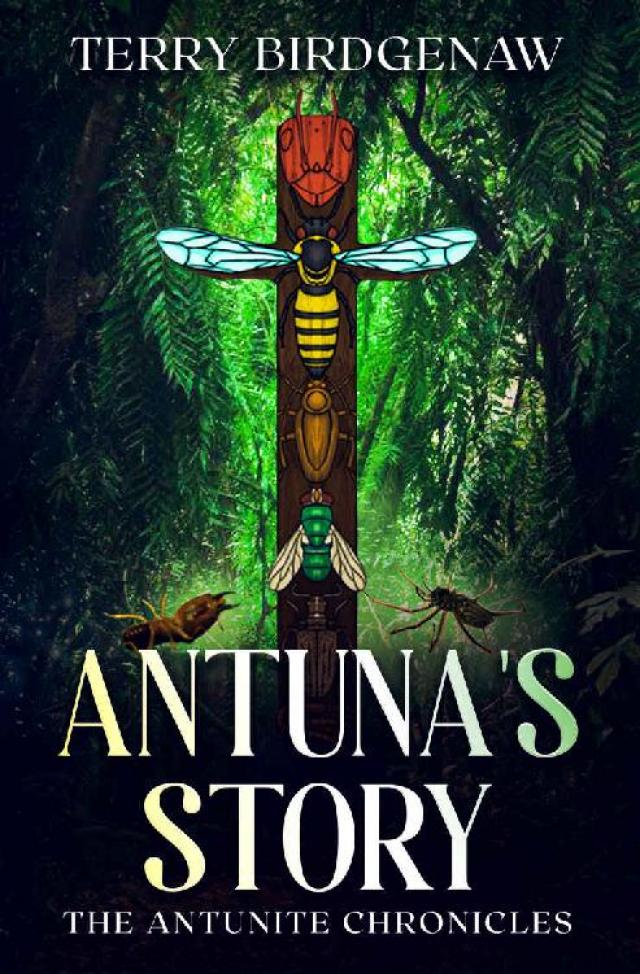


Copyright © 2022 by Terry Birdgenaw
All rights reserved. No part of this publication may be reproduced, distributed, or transmitted in any form or by any means without the author’s prior written permission, except with brief quotations within critical articles and reviews permitted by copyright law.
While reading this book, you will come to know historical arthropod fictional figures whose names, words, or actions may resemble people here on Earth, either from the present or past. The resemblance is only implied for humoristic purposes and is not meant to reflect literal, thematic, or chronologic historical accuracy, as the novel epitomizes political satire or parody. Except for public or famous historical figures whose statements appeared in the public domain, any resemblance of the insect and insectoid characters to persons living or dead is coincidental. The views and opinions expressed by these rhyming insects, or the insectoid historian narrator, are their own and should not be attributed to the author.
ISBN: 978-1-7781516-0-6 (paperback)
ISBN: 978-7781516-1-3 (ebook)
Legal deposit, Library and Archives Canada, May 2022
This book is dedicated to the victims of the invasion of Ukraine by Russian aggressors, and casualties in all wars throughout human history.
MAPS AND CHARTS
MAP OF POO-PONIC’S FIRST COLONY
CHARACTER HIVE FOR ANTUNA’S STORY
TABLE OF CONTENTS
Prologue
Opening Podcast [Interview]
Chapter 1: Where Are We?
Chapter 2: Can’t We Work Together?
Chapter 3: Banishments Begin
Chapter 4: Friendship Lost
Chapter 5: Bountiful Brains Beget Brawn
Chapter 6: Not All Is Lost
Closing Podcast [Interview]
Appendices
Acknowledgments
About The Author
About The Series
PROLOGUE
Yucatan Peninsula, Earth, late Cretaceous period (~65 million years B.C.)
THE LONG GRASS swayed in the gentle breeze, casting a shimmering picket fence-like silhouette that dappled the bright sunlight from the parched ground. A small ant appeared to struggle very little while carrying a deceased wasp on her back across the sward-covered plain. The solar light piercing through the wasp’s translucent wings intensified the hues of the ant’s caramel-colored cranium, thorax, and shiny, licorice-black abdomen. The wasp’s glassy sails magnified the candy apple-red flecks splattered across the ant’s thorax, giving her a distinctive glow.
Out of nowhere, a threatening termite challenged her for the quarry, and six of the ant’s comrades appeared to encourage its retreat. A spider witnessed the encounter on overhanging arid sagebrush, but since he had recently devoured an enormous meal, his interest waned, and he returned to weaving his spiraling web. Further overhead, two honeybees flew by, buzzing to each other on their good fortune that they were not the objects of the pall-bearing ant. While fixated on the departed wasp, the bees needed to veer their course to avoid a flying swarm of houseflies headed south, following the pungent aroma of a decaying mouse carcass calling them to breakfast. Due west, a possi of wood-boring beetles gnawed through a broken but live sequoia limb, tasting the sweet sap as ample sawdust littered the meadow floor. As the litter rained down, roaches rustling in a bed of dried leaves below indulged in the free buffet falling upon them and bouncing off their slippery shells. The ant vibrated and stumbled when an earthworm surfaced from an underground expedition next to her. Unfazed by the tremor, the ant continued along her way.
In the surrounding hectares, countless other scenes like this mirrored the ant’s journey in the complex yet unsophisticated intertwining of insect life. But a few hexutes before the ant arrived at her nest, as the bees neared their hive and the flies only moments before had reached their scavenged feast, it happened. A powerful force ripped rhododendrons and fledgling apple trees from their loamy moorings. Coconuts and green cones were heaved like metal shards drawn to a powerful magnet. The gravitational energy pulled honey-laden beehives as a vacuum cleaner sucks dust bunnies into its bagged belly. Termite-filled deadwood was tossed like flotsam sailing towards a broken shore on hurricane-lashed waves. With a deafening boom, the turbulence gobbled up insects, grasses, plants, and soil for miles around, like a tornado drawing shoddily constructed dwellings towards the heavens. Then, as fast as it began, it was over.
Without understanding their fate, a group of Earth insects was displaced from their comfortable habitat to a new reality on a planet they never knew existed. They did not choose to migrate to an unknown world—this life-changing event was thrust upon them. The story of the small wasp-laden ant, Antuna, is only known because she barely survived the wormhole passage. Her descendants kept a pheromonal history of the account on Earth and what followed. The insects later recorded the story with chemical structures for their pheromonics, written either on clay tablets or papyrus. Below is the tale of Antuna’s arrival and survival, what she remembered, and what her new friends told her. The account taught us a lot about the insects’ ancient history on their new planet—their struggles, growing pains, accomplishments, and how circumstances realized or squashed their dreams.
OPENING PODCAST [INTERVIEW]
Vive:
This is Vive McDougall with my weekly Astro-science read-u-mentary podcast, What’s Out There? [momentary pause] It’s September 3, 2050, and our first show of the new season. For new listeners, this is a podcast where we interview Astro-science fact and science fiction authors about their books and read excerpts or chapters from them. Our goal is to excite listeners about breakthroughs in the astronomical sciences and learn more about our society through an intense examination of science fiction [00:31]. And folks, we have a treat for you today! Actually, you’re in for an entire bag of goodies because the read-u-mentary podcast that starts today will last several weeks since it’s so fascinating that we could not cram it all into one or two sessions. These podcasts are going to be a little different from usual. First, the author we’re interviewing is a historian, not an Astro-scientist or science fiction writer. And he comes from, wait for it [pause] another galaxy! [laughs] [01:00] Second, our guest has agreed that we can read his entire book because of its phenomenal significance. We will read a chapter from his book each week and interview him today and after the last chapter. Yes indeed, we have with us, well remotely, or I should say very remotely, Narrant, the famous historian from the moon of our sister planet, Bilaluna. He’s been the talk of planet Earth ever since we learned he’d be releasing the first book in his series, The Complete History of Poo-ponic and Bilaluna: Part one–Antuna’s Story. [01:31] [short pause] Welcome, Narrant, or should I call you Professor?
Narrant:
Narrant is fine. After all, the people and insectoids from our two worlds have become so friendly since we first met.
Vive:
Narrant, I am thrilled to read your manuscript on our podcast because the history you have written is so detailed, and our listeners are eager to learn about it. Most we know about your planet and moon is based on rumors and the bits of information released by NASA and other space organizations. [01:58] We know that your insect society went through an enormous upheaval when you left Earth and traveled through the wormhole, and now we will all hear about it. But first, tell our listeners a little about you.
Narrant:
I am a cyborg insect or insectoid known as an ANT, for allied noble tripod, the first cyborg insect phylogenetic family created on Poo-ponic. I live along with 999 other insectoids on Bilaluna, Poo-ponic’s moon. We are descendants of the colonists that came to Bilaluna from Poo-ponic 15,000 hexs ago. [02:30]
Vive:
Narrant, I hope you don’t mind if I sometimes interrupt for clarification. Please explain to our listeners what a hex is. Or should I say—What the hex? [laughs]
Narrant:
We use a heximal counting system as insects have six limbs. I created words for you like hexonds and hexades using hex as the root of all time units to show they’re heximal, and each step goes up by X6, not X10.
Vive:
I saw you have an appendix in your book which explains this.
Narrant:
Yes, I used the decimal system for most numbers, but as a historian, I wanted to retain our own system for time units. [3:03]
Vive:
Let’s get back to you, Narrant, and your book. Could you give our listening audience a little more background about your engaging society, how you evolved, and why you wrote your books?
Narrant:
Vive, our first colonists were refugees from Poo-ponic, where our small biological insect ancestors first constructed cyborg insects. To avoid the cultural and environmental mistakes of our past and to provide a caution to our new friends on Earth, the All-insect Historical Society or AHS deemed it time to record the history of Poo-ponic and Bilaluna. [03:35]
Vive:
That seems like a tall order. Had you any reservations at first?
Narrant:
Absolutely. I found myself staring into my telescreen and down at my claw pad. I dreaded scratching the chemical formulae one by one with the two claws on each of my forelegs for the task given to me.
Vive:
Please explain what you mean by chemical formulae.
Narrant:
Well, ants communicate with each other and other
Vive:
You use a syntax generator that your scientists developed to translate ‘pheromonics’ into English?
Narrant:
That’s correct. But I also had to probe deeply into human civilization, so I could make references and analogies that you would recognize. I am what we call an amateur humanologist.
Vive:
That is an exciting approach, and the story is remarkable. Could you tell our listeners what period of your history the first volume covers?
Narrant:
This volume extends from the arrival of our insect ancestors on Poo-ponic to the end of the Spider and Termite war. It is our ancient history. [04:40]
Vive:
I see that the story, as all histories are, is about your people, or should I say insects, and how they coped. You have such detail, even from mega-years ago.
Narrant:
Yes, the treatise follows the tales of great and infamous insects and cyborgs, including one of our first colonists, Antuna, the first Queen bee, Beefirst, and the warrior ants Genant, Malevolant, and Antistry. This first volume follows a detailed pheromonal record, like human oral histories, kept by Antuna’s descendants. [05:07] It reflects her time growing up. So, it allowed me to write this history, at times more like a story.
Vive:
I loved the parts about Antuna and her friends and how they facilitated the early survival of insects on the planet. Are those true stories?
Narrant:
Yes, but I dramatized them to flesh out the details. I changed the names since I could not translate them from pheromones to any intelligible English words. They always start or finish with the character’s species to make it easy for you. [05:30] I often used the rest of the moniker to reflect their position or physical characteristics, so I could keep them straight. Sometimes, I used a name because I thought it was funny.
Vive:
So, you called your character Beefirst because she was the first queen bee on Poo-ponic?
Narrant:
Exactly, and I named Antuna with the Spanish word ‘una’ after ‘ant’ because she was the first ant described in the book.
Vive:
Ah, very clever, and Spanish too.
Narrant:
Well, I am a historian, so I tried to acquire as much knowledge about Earth as I could. [06:01] Some names reflect famous people in your past. This book is not only translated, but it is also a version targeted to you—insectoids would not understand many references.
Vive:
And your history is so rich. It seems your society went through an incredible evolution, one that you might say parallels human history.
Narrant:
That’s true. This first book records momentous events throughout our past, including our early survival on Poo-ponic, intellectual evolution, and struggles between species. [06:31]
Vive:
Indeed, your account seems like a roller-coaster ride of highs and lows.
Narrant:
Well, it was not all gloom and doom. Some parts were heartening, some were humorous, and there was hope.
Vive:
I enjoyed the balance of tragedy and comedy. There was such misfortune, but I sometimes laughed aloud while discovering it. And poetry before every chapter, that’s quite unusual for a history book.
Narrant:
As a historian, my account was as accurate as possible. [07:00] However, I reserved the right to make poetic preludes to each chapter to acknowledge my rhyming ancestors.
Vive:
Wait, did you say rhyming ancestors? What do you mean?
Narrant:
It goes back to one of our early poets, Antspeare, a poor but wise ant. His poems were very popular—he was a little like your own Dr. Seuss. Yet his poems were not for children but for adults.
Vive:
Antspeare [laughing] that’s a good one. And I am guessing he influenced how insects spoke?
Narrant:
Yes, Antspeare had an adage about good insect speech: [07:31] ‘It won’t ring my chimes if it ain’t got no rhymes!’ But ironically, it was the elites in the society that took up what we dubbed Antspearean speech. Most ordinary insects didn’t bother with it unless they wanted to make a statement.
Vive:
I see you broke your history up into two books. Why is that?
Narrant:
Each book covers a vital part of our history, with mega-hexs separating them. In between, we either have little information, or not much of great significance occurred. [07:59]
Vive:
And what would you say to our listeners about why they should read this book? I assume you wish to highlight the struggles between aggression and altruism.
Narrant:
Yes, [in a severe tone] other civilizations should learn from the error of our ways.
Vive:
Our leaders have also steered us down the wrong path, and our world is worse off for it. And with that, we should start with the first chapter.
Narrant:
I am excited to share our story with Earthlings.
Vive:
Okay, listeners, let’s begin. Every podcast will present a chapter—each one starting with Narrant’s lovely poems. [08:34] Our chapter readings will go week-by-week until we finish the six chapters. Narrant will join us at the end of this volume for another interview to sum things up.
Narrant:
You flatter me too much, Vive.
Vive:
And by the way, listeners, as with all our podcasts, you can either listen each week on Saturday or read the clean verbatim transcripts uploaded the next day. Here goes—The Complete History of Poo-ponic and Bilaluna: Part one—Antuna’s Story by our guest Narrant. [09:00]
CHAPTER 1
WHERE ARE WE?
A marooning like a bolted hatch can
unfasten portholes to a new sphere.
And what is the island on that frontier?
But terrain that engulfs one’s eye as it juts out
in the vast sea of its new atmosphere.
Unknown planet, 23.03 billion light-hexs away from Earth, moments after the Prologue.
BEEGAN FOUND HERSELF several hundred feet from her broken-down hive, grounded and covered in dirt but otherwise unhurt. Another honeybee, Beebie, arose first, shaking the soil off her silky wings.
“Hey, watch that shaking. You’re burying me alive here!” Beegan called out from under a nearby pile of soil, releasing a ragged reek. I feel so cranky I’m losing it.
Beebie stopped shuttering and leaped away from the dirt pile. “Sorry, Sis, I didn’t see you there. Are you okay?”
“Yes, if I could see any light.” Beegan fluttered her wings to dust off, lacking her usual grace. “What the heck happened?” Shaking off the dirt, she revealed her sleek body, which mirrored her identical twin sister. Her slender head had large compound eyes on each side that dominated the oblong spheroid. Her hairy skull was perched atop a fuzzy, mellow yellow thorax, affixed to a shiny, hairless, ebony, gold striped abdomen. Glossy, translucent wings extended from her fluffy middle almost to the end of her bulbed rear tip.
“I don’t know, Sis. Maybe it was an earthquake,” surmised Beebie.
Beegan twirled, trying to get her bearings. How can I not know where I am? I’m usually so grounded. “Could be, but look over there,” she said. “Where did that water come from?”
“Is it a marsh?” questioned Beebie.






