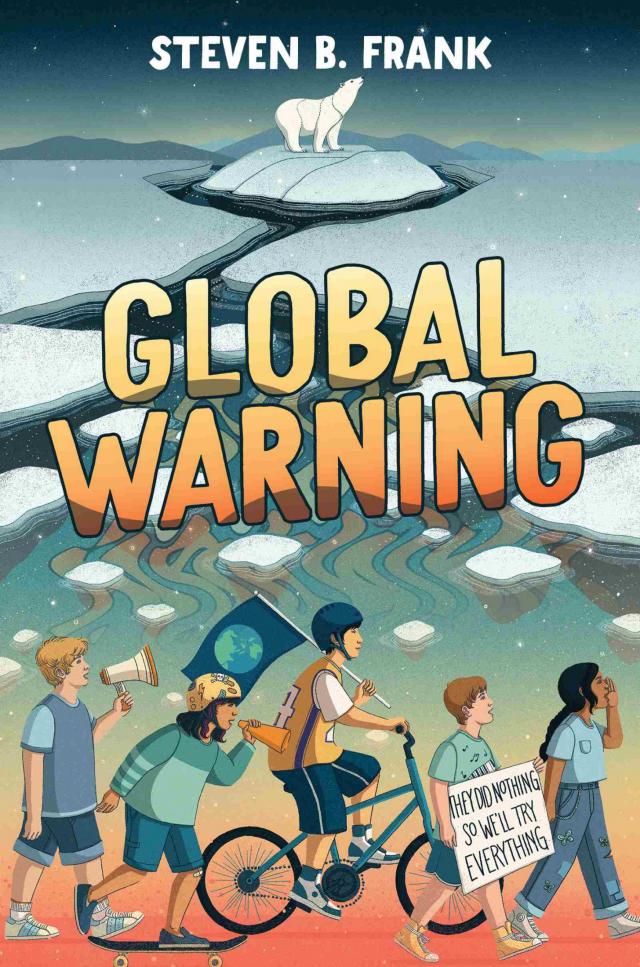
Global warning, p.1
Global Warning, page 1


Dedication
For climate warriors everywhere—especially the young ones leading the way
Epigraph
Young people—they care.
—DAVID ATTENBOROUGH
Contents
Cover
Title Page
Dedication
Epigraph
1. I Have to Download the Anxiety App Again
2. Somebody Gets Arrested
3. His Own Recognizance
4. The Necessity Defense
5. The Lounge War
6. We Build a Case
7. We Zoombomb the Supreme Court
8. Nobody Wants Snacks
9. Alistair Writes a Love Letter, and I Get Taller, I Guess
10. The Man Who Knows Everything
11. We Don’t Have an Appointment
12. The Senate Floor
13. Living the Truth
14. Action
15. How to Get to Norway Without Flying
16. The Blue Eye
17. Storm Warning
18. Perpetual Repercussion
19. We Take 500,000,000 Hostages
20. The Norwegian Prison System
21. Alistair Cooks
22. Dinner Is Served
23. We Finally Get Wi-Fi
24. Home
Epilogue
Appendix
Gratitude
About the Author
Copyright
About the Publisher
1
I Have to Download the Anxiety App Again
“Sam, smell my hair.”
Catalina leans in close. She probably tried a new shampoo last night and wants to know how it smells to the world. What better way than to ask a friend who would never lie to her?
But I’m about to lie to her. Because her hair smells like lighter fluid.
“Smells nice, Cat. New shampoo?”
She gives me a look.
“Reminds me of summer. The Fourth of July. Burgers on the grill.”
“That’s the stink of jet fuel. Fifteen thousand gallons dumped from the sky onto the playground at my sister’s school. I spent a whole hour with her in the bath, washing her hair. She was so freaked-out, she slept in my bed.”
We hear the roar of a jet engine overhead, and we look up. Catalina’s little sister’s school isn’t the only one in a flight path. Our middle school is just a few miles from the Hollywood Burbank Airport.
“Why would a jet dump fuel on a schoolyard?”
“Engine trouble, they said. They had to turn around but were too heavy to land. So they dumped fuel.”
“On kids?”
“And their teachers. And a whole neighborhood. My neighborhood. The school is going to sue the airline.”
Anytime I hear the word sue, part of me wakes up. It reminds me of what we did last year to stop homework. My friends Alistair, Jaesang, Catalina, and me, along with my big sister, Sadie, and her boyfriend, Sean, filed a class action lawsuit against the school board. We argued that kids have a constitutional right to a childhood and that homework was taking away that right. With a lot of legal help from our neighbor, Mr. Kalman, we took our case all the way to the Supreme Court. That made me very anxious. But it was worth it.
Alistair comes over to our regular lunch table. It’s under Jaesang’s favorite tree, a magnolia. We like its shade all through the school year and its white blossoms when summer is just a month away.
Instead of saying hi or good morning, Alistair greets us with, “Know how many animals died in the Australian wildfires? A billion. We’re not talking about common roadkill, either. These animals are cute. Koalas. Kangaroos. Wallabies. Wallabies! I used to sleep with a stuffy of one. Named her Julia.”
For Julia Child, one of Alistair’s top-five favorite chefs.
“Used to?” I say.
“Well . . . my seventh-grade resolution is to leave her on the shelf.”
Then he makes us watch a YouTube about the fires.
Alistair’s always doing that, shoving a video in my face before I have a chance to say yes, that’s something I want in my head, or no thanks, I’d rather not. I appreciate how enthusiastic he gets for the right cause, but some things activate my anxiety.
Like baby koalas with burnt paws.
I can’t look away. Neither, it seems, can Alistair. He stands beside me, watching. He starts to cry.
“Alistair,” I say.
“I can’t help it, Sam. I’ve seen it twenty times. Each time, it shatters me.”
He puts his head on my shoulder and weeps.
“Please, don’t.”
“What’s wrong with crying? Crying is caring.”
“You’re getting my shirt wet.”
He lifts his head from the wet spot on my Miles Davis T-shirt just as Jaesang walks up.
“What’s he crying about?” Jaesang says.
“Burnt koalas,” Catalina says.
“Want to cry some more? Look at this.” Jaesang holds up his phone to show a satellite image of a hurricane forming in the Atlantic. It’s this massive swirl of clouds headed for the Eastern Seaboard.
“That’s Clyde. The third named tropical storm of the season. Meteorologists think he’ll be a Category Four by the time he makes landfall in Florida.”
Jaesang used to want to own the Lakers someday. But when Kobe fell from the sky, he got so depressed he dropped his dream of owning an NBA team. Now his passion is the weather. His grandfather bought him a Falcon weather station with wind speed monitor, barometer, soil monitor, rain gauge, and hygrometer. All the basketball stats in his brain turned into facts about the weather.
I wonder if he ever thinks about the bad weather that brought down Kobe’s helicopter.
“Did you know that when the World Meteorological Organization names tropical storms, it can reuse names after six years, but it never reuses the names of the truly awesome ones?”
“Why not?”
“Out of respect for the people who died or lost their homes.”
“Kind of like the NBA retiring the jerseys of the really great players,” Alistair says. I love Alistair, but sometimes food isn’t the only thing that lands in his mouth. This time it’s his foot.
But the thing about Jaesang . . . he’s strong inside and out. “Yeah,” he says. “There’ll never be another Katrina. Or Kobe.”
Jae also tracks temperatures. “Last summer it hit 114 degrees in Portland, Oregon, 80 in the Arctic, 120 in Sicily, 130 in Death Valley. And for a week in winter, Dallas was colder than Anchorage. The planet is discombobulated. Even Mount Shasta lost all its snow. The UN climate report calls it code red for humanity. And it’s all our fault.”
It gets quiet at our table. We look around the schoolyard. Trash cans filled past the top. Kids playing handball, cramming for quizzes, hanging out. It’s code red for humanity, but life seems to just go on.
“You know we could reduce greenhouse gases by twenty percent if we all stopped eating meat?” Alistair says.
“Are you going to stop eating meat, MasterChef Junior?” Catalina asks. That’s been Cat’s nickname for Alistair since he actually went on the show—and won.
“Already have. I got inspired by Greta.”
He pulls Time magazine’s Person of the Year issue out of his backpack, touches the front cover, a picture of the climate change activist Greta Thunberg, then touches his fingers to his lips.
“Ask me anything about her.”
“What’s the name of her—”
“Dogs? Roxy and Moses. Boat? La Vagabonde. Sister? Beata.”
“When did she first get depressed over cli—”
“Third grade. Her teacher showed her a video. It wrecked her.”
“What kind of work does her mom—”
“Opera singer. Greta flygskammed her—that’s Swedish for flight shamed—and now she takes the train to all her performances.”
“How tall—”
“Five feet. But she stands tall to power. One day she sat herself down in front of the Swedish parliament with a sign: SCHOOL STRIKE FOR THE PLANET. One person one day. Two people the next. Then twenty more. Then a few hundred. Then, all over the world, millions knew about her. Have you guys heard her TED talks? They kill me every time. And she makes this little sound when she pauses. Not everyone can hear it, but I can. A soft grunt, like she’s getting control of her anger. A tiny exhale of total poise. That sound . . . That girl . . . Man, what I wouldn’t give to cook for her. Just one meal.”
“Alistair,” Catalina says, “I think you’re in love.”
After school, I’m on my bike, riding home, when I see a for sale sign in front of Mr. Kalman’s house. Naturally I assume the worst. I always do. He probably fell, hit his head, and died. He promised my mom that when he was gone, she could have the listing. Sure enough, there’s Jenny Warren’s face on the sign. And there goes my career as Mr. Kalman’s handyman, water boy, and tech guy—a trifecta of odd jobs that have made me reasonably rich for a twelve-year-old.
But how can I be thinking of lost income at a time like this? I’ve lost a friend, our legal leader who was like a grandpa to us.
Or is this one of Mr. Kalman’s stunts? He always likes to keep us guessing.
I hop off my bike in front of his house. His Los Angeles Times is still on the driveway. I used to pick it up out of the gutter sludge and walk it to his front door. Seeing it now, on his driveway, I think, This isn’t a stunt. He’s really gone.
I start to cry.
I Facetime Sadie. She’s in h er first year of college at Brown. She answers in a library and has to whisper.
“Sam, what’s the matter?”
“This.”
I flip the camera around to show her the newspaper on the driveway, our mom’s face on the for sale sign.
“I know,” she says. “Mom told me.”
“Why’d she tell you and not me?”
“I think they were waiting to tell you in person. I’m sorry, Sam. I know how much you’ll miss him.”
“When did this even happen?”
“Well, you know he promised Mom the listing.”
“I don’t mean that. I mean, when did Mr. Kalman die?”
The screen freezes. Poor connection.
I try to reconnect. Must be in a dead zone. That’s appropriate.
So I cry alone.
“Did the mail come?”
I look up and see a ghost in track pants, a Brown University sweatshirt, and a scarf. When he was alive, he always complained about the cold.
“Mr. Kalman? What . . . I mean, I thought—”
“You thought your mom would have sold the house in one day? She’s a good realtor, Sam, but not that good.”
“No. I thought you were dead.”
“Just downsizing. An apartment became available at a senior housing complex nearby. Not, mind you, an assisted-living facility like your sister tried to push me into. This is an apartment building for independent seniors. The NoHo Senior Arts Colony. There’s a theater, a pool, weekly movie night, yoga classes, a ceramics studio, and a writers’ group for those with a story to tell. I may take up yoga.”
He peeks inside his mailbox, empty, and looks up at me.
“I’m afraid, Sam, that I won’t be needing your gardening services anymore. I apologize for the loss of income. You’re welcome to use me as a reference.”
“That’s okay, Mr. Kalman. At least you’re still alive.”
He starts to head back into his house, then stops and says, “I could use a little help unpacking tomorrow. The NoHo Senior Arts Colony. Apartment 303. Come by around ten.”
That night, I have a hard time falling asleep. I keep thinking of little kids whose hair stinks of jet fuel. Deadly storms brewing in the Atlantic. And that koala with charred fur. More of Alistair’s videos pop into my head: a polar bear frantically paddling in search of ice, levees in New Orleans breached by seawater, dead puffins washed up on an Arctic shore, and forests full of dry, brown trees.
And then I see the face of Alistair’s crush, the Person of the Year who’s fighting for the planet’s survival. I start to worry. What if she fails? What if our future is a Noah’s Ark–size flood, only there won’t even be two of each animal left to save?
I reach for my phone, tap the App Store, and download the anxiety app again. The guided meditation lady tells me to breathe, and I wonder, what kind of air?
2
Somebody Gets Arrested
Mr. Kalman wasn’t kidding. At the NoHo Senior Arts Colony, they have yoga, movie night, and memoir writing. The bulletin board in the elevator makes this place look fun.
I press 3 for his floor. The doors start to close, but a voice calls out—
“Can you hold that?”
I stick my hand between the closing doors. They open again.
A girl with purple highlights in her short hair comes riding up on a skateboard. She turns back, calls out, “Nana, elevator’s here,” and kicks up her board.
“Betty’s slow, but she never falls,” she says. Sure enough, around the corner comes an older lady pushing a walker. Not one of those depressing gray metal walkers with tennis balls on the feet. This looks like something a kid would dream up, a cross between a skateboard and a bike, with a seat in case the old person gets tired—or wants to transport a bag of fertilizer and a tin watering can.
They must’ve walked all the way from the nursery.
“Thank you for holding it,” the woman says. “Not everyone does.” She glances at the panel. “We’re on four.”
The elevator is slow to lift off. Probably it’s programmed that way so the seniors don’t pass out from a sudden jump in altitude. The slow ascent gives me a chance to notice that the grandma is pretty chic in khaki pants, white sweater, orange scarf, and blue suede Adidas. She’s wearing a baseball cap, too, that says RATIFY THE ERA.
I’m not sure what it means to ratify an era, but I’ll ask Mr. Kalman.
“We forgot the cages for the tomatoes,” the grandma says.
“We won’t need them for”—Skateboard Girl glances at a seed packet in her hand—“seventy-five days. At least.”
“If I get a craving for tomatoes, there’s always Instacart.”
“They’ll taste better from your own balcony, Nana. Promise.”
The car stops, the doors open, and I step out. I head down the hall, around the corner, to apartment 303. I ring the doorbell, and soon the door opens.
Mr. Kalman waves hello with a hammer.
“Need help hanging pictures?” I say.
In his house, he had a wall full of photographs of all his clients, mostly kids whose cases he argued in court. There was one of me and Alistair and Jaesang and Catalina and Sadie and Sean on the steps of the U.S. Supreme Court. The day we organized a Million Kid March.
“Something like that.”
He leans out, looks up the hall and down, sees that we’re alone.
“It’s a mezuzah.”
“Wait, a what?”
“Mezuzah. A tiny Torah scroll encased in glass or metal. It gets hung on the doorpost of a Jewish home.”
He holds out a small glass that has a rolled-up paper inside and a couple of thin nails.
“I get it. You can’t see the nail.”
“It’s true that my eyesight isn’t good enough to hammer a small nail,” Mr. Kalman says, “but it is good enough to read the fine print on my lease, which prohibits hammering outside the apartment. Problem is, according to Jewish law, the mezuzah has to hang outside the door.”
“The lease is unconstitutional, then,” I say. “It infringes on your religious freedom.”
Mr. Kalman smiles. He’s taught me well.
“But do we really want to drag the management to court for a thing like this?”
“De minimus non curat lex,” I say. “The law does not concern itself with trifles.”
“Exactly. So it’ll be better if you hang the mezuzah. That way, if anyone gets in trouble, it won’t be me.”
There’s another Latin legal term he taught us, qui facit per alium facit per se. He who acts through another, acts for himself. But I decide to keep that one to myself.
“Where do you want it?” I ask, taking the hammer.
“Halfway from your head to the ceiling.”
I put the mezuzah against the doorframe and slide it up.
“A little lower. You’ve grown.”
I bring it down a few inches.
“Good. Now slide the bottom edge forty-five degrees to the right. It’s supposed to be on a slant. That’s it. Hold it right there. But don’t swing. Wait for the music.”
He heads back into the apartment and turns on his record player. I don’t know what the fine print in his lease says about loud music on a Saturday morning, but I doubt he’s in compliance. Suddenly Count Basie brass is blasting into the room.
Mr. Kalman gives me the thumbs-up, and I swing. The nails go in easy—two taps each—and we’re in the clear.
He lowers the music, and I look around the apartment. “Where are all the boxes?”
“In the Buick.”
The Buick is Mr. Kalman’s classic station wagon from the 1970s. A cream puff of a car. A handy hauler. A real workhorse. Those are some of his nicknames for the Buick. We love it for its tape deck and his collection of cassettes. And for the stories it reminds him to tell.
“Where’s the Buick?”
“Donated.”
“What?”
“To KCRW. They took care of all the paperwork. She was too thirsty for gas, Sam. And anyway, my driving days are over. If I want to go somewhere, I’ll rely on my phone. Or my feet, which are now a carbon footprint size smaller.”
“So you don’t need help unpacking?”
“Already done. But I’m always happy for a visit.”
We have croissants and hot chocolate on his balcony. It’s a beautiful February day. The fourteenth, I realize, glancing at his classic L.L. Bean watch.
“Happy Valentine’s Day, Mr. Kalman.”