

Meditations in green, p.1
Meditations in Green, page 1


The characters and events in this book are fictitious. Any similarity to real persons, living or dead, is coincidental and not intended by the author.
Copyright © 1983 by Stephen Wright
Cover design by Lauren Harms
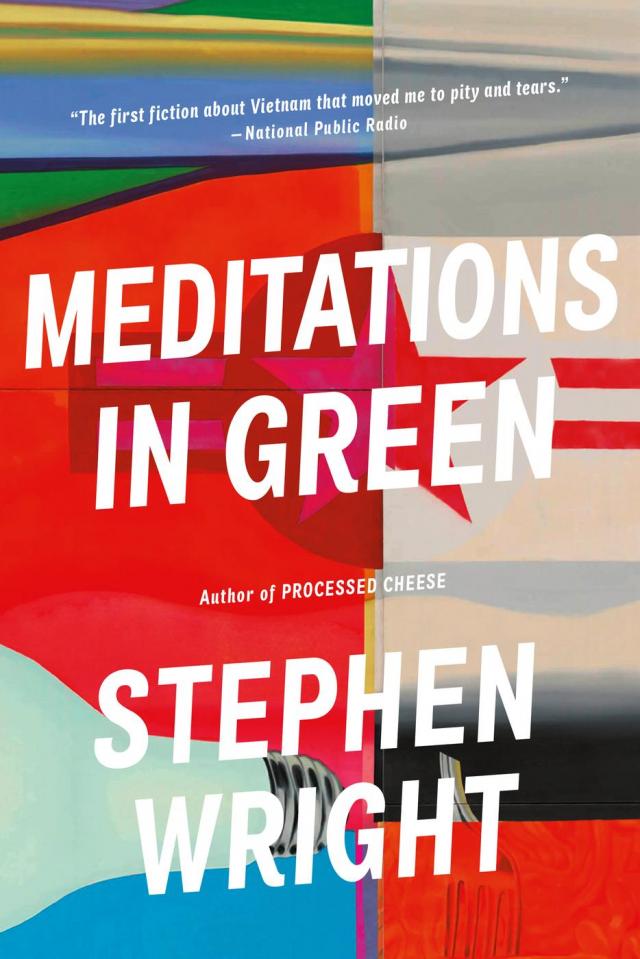
Cover art depicts detail of F-111 (1964–65) by James Rosenquist
Oil on canvas and aluminum (multipanel room installation); 10' x 86' (304.8 cm x 2621.3 cm)
The Museum of Modern Art, New York, purchase gift of Mr. and Mrs. Alex L. Hillman and Lillie P. Bliss Bequest (both by exchange), 1996
Artwork copyright © 2020 Estate of James Rosenquist / Licensed by VAGA at Artists Rights Society (ARS), NY. Used by permission. All rights reserved.
Digital image copyright © The Museum of Modern Art / Licensed by SCALA / Art Resource, NY
Cover copyright © 2020 Hachette Book Group, Inc.
Hachette Book Group supports the right to free expression and the value of copyright. The purpose of copyright is to encourage writers and artists to produce the creative works that enrich our culture.
The scanning, uploading, and distribution of this book without permission is a theft of the author’s intellectual property. If you would like permission to use material from the book (other than for review purposes), please contact permissions@hbgusa.com. Thank you for your support of the author’s rights.
Little, Brown and Company
Hachette Book Group
1290 Avenue of the Americas, New York, NY 10104
littlebrown.com
twitter.com/littlebrown
facebook.com/littlebrownandcompany
Originally published in hardcover by Charles Scribner’s Sons, August 1983
First Little, Brown ebook edition: January 2020
Little, Brown and Company is a division of Hachette Book Group, Inc. The Little, Brown name and logo are trademarks of Hachette Book Group, Inc.
The publisher is not responsible for websites (or their content) that are not owned by the publisher.
The Hachette Speakers Bureau provides a wide range of authors for speaking events. To find out more, go to hachettespeakersbureau.com or call (866) 376-6591.
ISBN 978-0-316-42736-4
E3-20191218-DA-NF-ORI
Contents
Cover
Title Page
Copyright
Dedication
Epigraph
Meditation in Green: 1
Meditation in Green: 2
Meditation in Green: 3
Meditation in Green: 4
Meditation in Green: 5
Meditation in Green: 6
Meditation in Green: 7
Meditation in Green: 8
Meditation in Green: 9
Meditation in Green: 10
Meditation in Green: 11
Meditation in Green: 12
Meditation in Green: 13
Meditation in Green: 14
Meditation in Green: 15
Discover More
About the Author
Praise for Stephen Wright’s
Also by Stephen Wright
To the graphed, the charted, the data processed and to all the uncounted
If I knew for a certainty that a man was coming to my house with the conscious design of doing me good, I should run for my life.
—Henry David Thoreau, Walden
All God’s chillun got guns.
—The Marx Brothers, Duck Soup
Explore book giveaways, sneak peeks, deals, and more.
Tap here to learn more.
Meditation in Green: 1
Here I am up in the window, that indistinguishable head you see listing toward the sun and waiting to be watered. Through a pair of strong field glasses you might be able to make out the color of my leaf (milky green), my flower (purple-white), and the poor profile of my stunted growth. In open country with stem and root room I could top four feet. Want a true botanical friend? Guess my species and you can take me home.
The view from this sill is not encouraging: colorless sky, lusterless sun, sooty field of rusted television antennas, the unharvested crop of the city; and below, down a sheer wall, the persistent dead unavoidable concrete.
This is what it means to be torn from your native soil, exiled in a clay pot five stories vertical, a mile and a half horizontal from the nearest uncemented ground. I feel old. I take light through a glass, my rain from a pipe.
Have you talked to a plant today, offered kindnesses to something green? These are crucial gestures. A plant is not free. It does not know the delirium of locomotion, the pyramidical play of consciousness, the agonies of volition. It simply stands in the dirt and grows. Vegetable bliss. But trapped indoors a plant’s pleasure becomes dependent upon human hands, clumsy irresponsible hands, hands that pinch and prune, hands that go on vacation, abandon their ferns to northern exposure, cracked beds, stale air, enervations, apathy, loneliness.
Help! My stalk is starting to droop.
* * *
Up late and into the street, that was my habit then, the night’s residue still sifting softly through my head, I’d wander down to the corner, stand shivering in the sun, waiting for the light to change and my reconnaissance to begin. I was a spook. All my papers were phony. The route was the same every afternoon, a stitching of right angles across the heart of the city where I mingled anonymously with the residents of the day world.
I was under a doctor’s care at the time, sixty minutes exercise q.d., an order I probably wouldn’t have bothered to honor had not these prescribed walks delivered me into the relief of cacophony and throng. I needed the glow of animate heat, of blood in motion, regular doses of herdlike solidity, curses, jostles, tears, life. I ogled the goodies in the big windows with the other shoppers. I rode express elevators to offices where the receptionists smiled behind bulletproof glass. I burst into violent sidewalk imprecations on the government. Nothing urban was alien to me.
At the end of the day, I’d find myself come to rest atop a public trash can. Same can, same corner, same attitude. I became a fixture of the neighborhood. There were certain faces I learned to recognize, faces I suppose recognized me, but we spoke no words, exchanged no names, in accordance with the rules of metropolitan intimacy. I sat on my can, watching the heads bob up and down the avenue like poppies in a spring meadow until the constant nodding movement turned unreal, the slow agitation of pink marine life swaying in tempo to oceanic tunes. The heart idled, breathing deepened, silver bubbles popped against my ears.
“You’re ruining the symmetry,” I announced one day to an old derelict tramping unsteadily past. He was walking the street backwards, the rear of his head advancing blindly down the block. His dress was equally distinctive: orange Day-Glo painter’s cap, field jacket fastened with safety pins, patched jeans bleached the bluish white of skim milk, purple hightop tennis shoes split at the creases.
He turned and his face was that of a young woman ready to be amused. “You’re sitting on a fucking garbage can,” she said.
“I was tired.”
She hopped up beside me. “I like it,” she said. “Gargoyles.”
I saw her fairly often after that. She’d stop by my post to share a pretzel, a carton of orange juice. “Professional interest,” she explained. “I’m a part-time social worker.” She said her name was Huette Mirandella. The rest of her history was a series of true-false propositions. Her parents had died in a hotel fire or an auto accident or a plane crash or an artful combination of the three. Orphans at ten and four, she and her younger brother were abandoned to the indifferent care of a senile great aunt. Home was boring. School was boring. Staying out late and running away were interesting and then boring. The five universities she attended were universally boring. She drifted. Minor jobs, petty boyfriends. There was an abortion, a botched suicide, a hospital vacation, “the stupid clichés of an unimaginative life,” she said. When I met her she was twenty-two years old, she studied Chinese, played electric guitar, read a science fiction novel every two days, practiced a lethal form of martial arts once a week with a garageful of women, painted vast oil abstracts she called soulographs, and speculated that if there was another Renaissance lurking about the bloody horizon of our future then she was a candidate to be its Leonardo—“the smart clichés of a pop life.”
We met on the corner for weeks and then came periods when I wouldn’t see her at all. She was home, she was at work, a soulograph required a more steely shade of blue. I continued diligently to push the leg uptown and down, in sun and snow, through needles and cramps. It seemed to change size from day to day in phase with its own moods, its own dreams. On bad days, when it dragged behind me like a sea anchor, the blocks telescoped outward, the pavement all slanted uphill, and I’d entertain notions of traveling in style. Imagine commandeering a tank, one of the big ones, forty-seven tons of M48, cast steel hull, 90 mm gun, 7.62 mm MG coaxially mounted in the turret, and running down the boulevard. Imagine the clanking, the honking horns, the cheers of the liberated masses, the flattening of each tiny car beneath the monstrous tread, the squash of automotive cockroaches. Imagine the snap, the crackle, the pop.
One bad gray afternoon I had just reached home and was rounding the turn on the first landing when, “Bang, bang,” a voice echoed harshly up. I leaned over the splintered banister. In the gloom at the bottom of the stairwell a face materialized luminous as a toy skull. I could see shining teeth and that chipped incisor that always seemed to be winking at someone over my right shoulder.
; “No fair. I had my fingers crossed.”
“You’re dead,” said Huey. “You’re lying out on the front steps with the change falling out of your pockets.”
“Yeah? Where were you?”
“Sitting right on the stoop.”
“What can I say? Come pick out your prize.”
Up in my kitchen she dropped a fat brown package onto the table. Dozens of rubber bands of all colors, red, yellow, blue, green, were wound around it like shipping twine.
“That’s a mean looking bundle,” I said.
“A prize. For you.”
“Wonderful,” I said, weighing the package in my hand. “Who wrapped this, a paranoid paper boy?”
“Rafer.”
The colors of the rubber bands flipped into bright relief like thin neon tubes switched suddenly on. Rafer was her brother, executive officer of a street gang notorious for reckless drug use and dropping bricks on pedestrians from tenement rooftops. We’d once spent an amicable afternoon together, comparing scars, tattoos, chatting about the effects of various arms and pharmaceuticals.
“Three guesses,” she said, rattling open a drawer. “This the only knife you’ve got?”
I took the bayonet and began to saw. It was like cutting into a golf ball, bits of elastic flying about the room. The wrapping paper was a greasy grocery bag. Inside, pillowed upon a golden excelsior of marijuana, lay a large plastic envelope containing a small glassine envelope containing a few spoonfuls of fine white powder. Embossed in red on the large envelope was a pair of lions rampant pawing at a beachball-sized globe of the earth. Indecipherable Oriental ideograms framed the scene except beneath the cats’ feet where appeared the figure 100% and below that in English the identification DOUBLEUOGLOBE BRAND.
“What’s that?” asked Huey, peering.
“Ancient history.”
“It looks like a bag of dope.”
“Yes.”
“It looks like junk.”
I pulled open the glassine envelope, dipped a finger, and sniffed. A line from powder to nostril formed the advancing edge of a fan that spread in regal succession before inturned eyes a lacquered arrangement of glacial rock, green-toothed pine, unbroken snow, then the shimmer, the shiver, the snaking fissures, melting mountains, gray rain, animate forest, the dark, the warm, the still time of mushroom-padded places.
I was amazed. I hadn’t seen those magic lions in years. It wasn’t often you encountered an adolescent able to weld a connection into the high-voltage Oriental drug terminals.
I began rolling the unfiltered end of a Kool cigarette between thumb and forefinger. Shreds of brown tobacco sprinkled onto the white enamel table.
“What are you doing now,” asked Huey, “sleight of hand?”
I emptied out about an inch of cigarette. I poured in the powder. I tamped it down. I twisted the end shut.
“What are you laughing at?” she asked.
I struck a match, touched it to the cigarette, and inhaled deeply. A dirty yellow dog ran barking into the red muddy road and beneath the tires of a two-and-a-half-ton truck.
“You want any of this?” I offered in a strangled voice, leaning forward, the joint poised in midair between us. A thick strand of smoke slipped snakelike from the moist end, raised itself erect into blue air, smiled, and dissolved without a sound. In the corner the refrigerator began to hum.
This is not a settled life. A children’s breakfast cereal, Crispy Critters, provokes nausea; there is a women’s perfume named Charlie; and the radio sound of “We Gotta Get Out Of This Place” (The Animals, 1965) fills me with a melancholy as petrifying as the metal poured into casts of galloping cavalry, squinting riflemen, proud generals, statues in the park, roosts for pigeons. My left knee throbs before each thunderstorm. The sunsets are no damn good here. There are ghosts on my television set. What are we to do when the darkness comes on and we wait for something to happen, as Huey, who never even knew she shared her name with a ten-thousand-pound assault helicopter, sprawls on the floor with her sketchbook, making pastel pictures of floating cities, sleek spaceships, planets of ice, and I, your genial storyteller, wreathed in a beard of smoke, look into the light and recite strange tales from the war back in the long ago time.
* * *
A sweltering classroom in Kentucky. Seated, in long orderly rows, a terrorized company of grimy, red-faced trainees. Stage center, on an elevated podium before their fatigued eyes, a sergeant, a captain, a war.
SERGEANT: (Hands poised on hips. Booming voice.) Okay, gentlemens, listen up! This morning your commanding officer will speak on the subject of Vietnam. I’d advise you all to pay close attention to what he has to say. He’s been there, I’ve been there, we’ve all been there, and since ninety-nine point nine percent of you candy-asses now sitting in this room will also soon be there bawling and yelling for your mamas you might want to know why. So if your memory ain’t too good, takes notes. And let me warn you, anyone I catch asleep will wish to Christ he was already safe and snug in a nice bronze box with the colors draped over his face. Understand? (Pause.) Ten-HUT! (The company springs up. CAPTAIN, a collapsible pointer tucked under his right arm, strides smartly to the lectern.) Take your seats! (The company falls down.)
CAPTAIN: (Low authoritative manner.) Too slow, sergeant. Have them do it again.
SERGEANT: Yessir! On your feet! (The company springs up.) Now all I want to hear is the sound of one large butt slapping against the bottom of one chair or we spend the afternoon low-crawling through the gravel parking lot. (Pause.) Taaaaake…seats! (The company falls down.) Good.
CAPTAIN: Thank you, sergeant. (He steps to stage left, extending pointer to its full length with a brisk snap.) Gentlemen, a map of Southeast Asia. This stub of land (Tap) hanging like a cock off the belly of China is the Indochinese peninsula. Here we have North Vietnam (Tap), South Vietnam (Tap), and Laos, Cambodia, and Thailand (Tap. Tap. Tap.). The Republic of Vietnam occupies the area roughly equivalent to the foreskin, from the DMZ at the seventeenth parallel down along the coast of the South China Sea to the Mekong River in the delta. Today this tiny nation suffers from a bad case of VD or, if you will, VC. (Smiles wanly.) What we are witnessing, of course, is a flagrant attempt on the part of the communist dictatorship of Hanoi to overthrow, by means of armed aggression, the democratic regime in Saigon. (Clears throat.) Now I know the majority of you could give a good goddamn about the welfare of these people or their problems; they live in a land twelve thousand miles away with habits and customs foreign to our own so you assume that their struggles are not yours. Believe me, this is a rather narrow shortsighted view. Consider the human body. What happens if an infection is allowed to go untreated? The bacteria spread, feeding on healthy tissue, until finally the individual dies. Physicians are bound by a moral oath which forbids them to ignore the presence of disease. They cannot callously turn their backs on illness and suffering and neither can we. A sore on the skin of even a single democracy threatens the health of all. Need I remind you that four presidents—I can’t emphasize this strongly enough—four presidents have recognized the danger signs and have seen fit to come to the aid of these afflicted people with massive doses of arms, troops, and economic assistance to ensure their continued independence. (Walks methodically back to lectern.) Certainly, we seek no personal gain; we’re just pumping in the penicillin, gentlemen, just pumping in the penicillin. (Long pause.) I’m sure we are all aware that this policy of limited intervention has been challenged by large segments of our own population, but just remember one thing, as far as the United States Army is concerned all debate ceased the moment you raised your right hands and took that one step forward. As men in uniform your duty is not to question policy but to carry it out as ordered. (Grips sides of lectern, leans forward menacingly.) Those are the facts regarding our present involvement in Vietnam. Are there any questions? (Short pause.) Very good. We’ve got a movie here, an excellent one as a matter of fact, produced by the State Department, which will explain the historical origins of this conflict in greater detail. And since this is probably the last time I’ll see you together as a group, I’d like to leave you with a few words of advice: keep a tight asshole, leave your pecker in your pants, and change your socks twice a day. (He winks.)






