Tupac shakur, p.1
Tupac Shakur, page 1
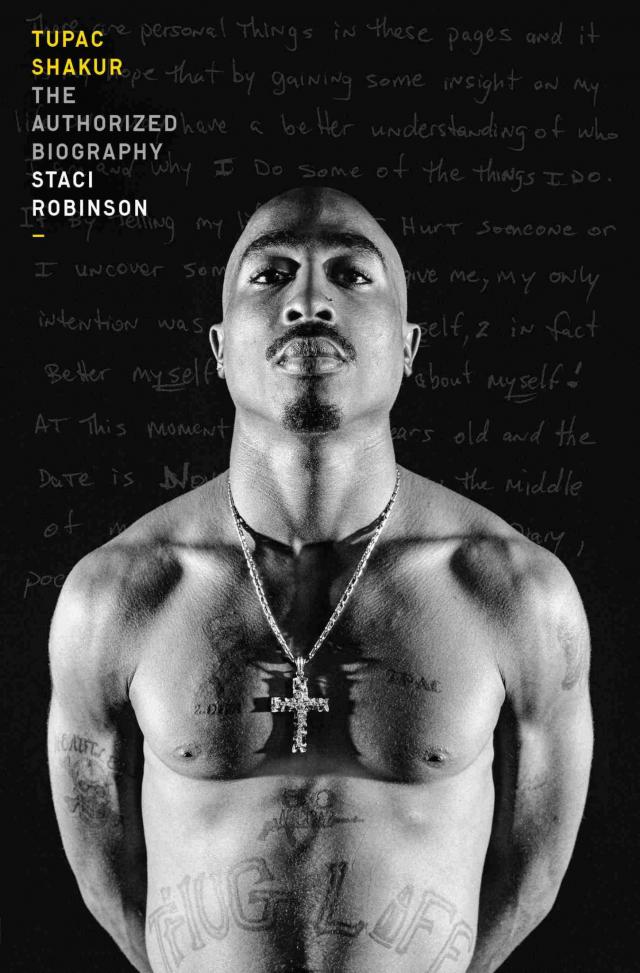


Copyright © 2023 by Amaru Entertainment, Inc.
All rights reserved.
Published in the United States by Crown, an imprint of the Crown Publishing Group, a division of Penguin Random House LLC, New York.
Crown and the Crown colophon are registered trademarks of Penguin Random House LLC.
Library of Congress Cataloging-in-Publication Data
Names: Robinson, Staci, author.
Title: Tupac Shakur / by Staci Robinson.
Description: First edition. | New York : Crown, 2023. | Includes index.
Identifiers: LCCN 2023012070 (print) | LCCN 2023012071 (ebook) |
ISBN 9781524761042 (hardcover) | ISBN 9781524761066 (ebook)
Subjects: LCSH: Shakur, Tupac, 1971–1996. | Rap musicians—
United States—Biography. | LCGFT: Biographies.
Classification: LCC ML420.S529 R63 2023 (print) |
LCC ML420.S529 (ebook) | DDC 782.421649092 [B]—dc23/eng/20230314
LC record available at https://lccn.loc.gov/2023012070
LC ebook record available at https://lccn.loc.gov/2023012071
Ebook ISBN 9781524761066
crownpublishing.com
Book design by Debbie Glasserman, adapted for ebook
Cover design: Christopher Brand
Cover photograph: Reisig/Taylor © Amaru Entertainment, Inc.
ep_prh_6.1_145301140_c0_r0
Contents
Cover
Title Page
Copyright
Intro
Part I: New York
01 Cradle to the Grave
02 Dear Mama
03 The Streetz R Deathrow
04 Nothin but Love
Part II: Baltimore
05 Nothing to Lose
06 In the Depths of Solitude
07 Keep Ya Head Up
Part III: The Bay
08 Thug Style
09 Panther Power
10 Words of Wisdom
11 Fame
12 Nothing but Trouble
13 Violent
14 Only God Can Judge Me
Part IV: Los Angeles
15 Souljah’s Revenge
16 Holler If Ya Hear Me
17 Me Against the World
18 Letter 2 My Unborn
19 It Ain’t Easy
Part V: To Live and Die in L.A.
20 California Love
21 In the Event of My Demise
Photo Insert
Dedication
Acknowledgments
Notes
Image Captions and Credits
Permissions
Index
About the Author
_145301140_
The table of contents to Tupac’s autobiography that he started writing in 1989 at the age of eighteen.
Click here to view as text
The introduction to Tupac’s autobiography that he started writing in 1989 at the age of eighteen.
Click here to view as text
INTRO
When I met Tupac, he was only seventeen years old. To me, he was just another friend in our social circle. He and I attended the same high school, Tamalpais High, in the small town of Mill Valley in Northern California, and I’d met him during a trip home from college. In that moment, I would never have guessed I’d just been introduced to someone who would go on to be a cultural icon, a global superstar…or that he’d become the legend that he’d become—except for of course when he told us. Even at that young age, he was confident, certain that he would leave an imprint on society. I think more confident than anyone else I knew.
Months later, after I’d gone back to college in Los Angeles and he had decided that high school was a waste of his time, he called my roommates and me, all of us from Mill Valley, to ask us if he could stay with us for a while and sleep on our couch. “I need to move,” he said. At the time, he was anxiously awaiting news of a recording contract from his manager. “My career isn’t taking off fast enough,” he explained, “and I think I need to be in L.A.” A few days later, he showed up at our door with a backpack and blue notebook.
Each day, my roommates and I would leave for school or work while he stayed in our apartment alone writing feverishly in that notebook. When we returned in the late afternoon, he’d want to share with us what he’d written that day. Picture a teenage Tupac, sittin’ at our dinner table while we ate our Top Ramen and mac ’n’ cheese, rapping about the young Black male, his lyrics filled with purpose, pleading for change.
Looking back on that moment, I realize now that I didn’t know yet. I listened. I heard him. I appreciated his concerns. But I didn’t know that I was in the presence of a young man who was on a fearless path to address the inequities in our society in whatever way he could. I didn’t know because, although I hate to admit it, I wasn’t ready to talk about the young Black male and the problems they faced as one of the most vulnerable groups in our population. I wanted to talk about the young Black male in my lecture hall that day and how cute he was. At twenty, I was selfish. At seventeen, Tupac was selfless.
When his manager, Leila Steinberg, found a place for him to stay, he thanked us and was on his way. As he walked out the door that evening, with just his backpack and blue notebook, my roommates and I wished him luck. And it seemed as soon as the door closed behind him, he became a household name.
After I graduated from UCLA, I embarked on my own writing career, writing novels. But I still wasn’t yet writing about the young Black male as Tupac was; I was writing about that same young Black male I had met in the lecture hall and the heartbreak that inevitably occurred years later. During the day, I worked in the sports industry as an assistant to professional athletes, the New York Jets number one draft pick Keyshawn Johnson and NBA star Brian Shaw. At night, I’d write.
While at work, I’d often get phone calls from Tupac’s assistant. “Tupac keeps asking when you’re gonna leave the sports industry and come work for him,” she’d say. One afternoon, the request was more specific: “Tupac is forming a writing group. He wants you to join.” He had started writing screenplays and was building a team, a group of female writers to ensure that his characters’ voices, perspectives, and tones were authentic. I was excited to be a part of that group. We set a meeting for Tuesday, September 10, 1996.
Three days before that meeting, Tupac was shot in Las Vegas. He fought for his life, but ultimately lost the battle, passing away on September 13. That meeting and countless other plans that he had in place would never happen. I, and the rest of the world, had lost a friend. A brother. An uncle. A nephew. A cousin. An inspiration. A leader. A soldier. And Tupac’s mother, Afeni Shakur, the woman who taught him everything he knew, who spoke as vehemently as he did about hope and change, lost her only son.
A few years later, Afeni asked me to write her son’s life story. For me, her request was met with a mix of emotions. Of course, I was honored. But as I pondered this huge undertaking, I was also fearful. I hadn’t been an A student at Tamalpais High School, nor at UCLA. I’d never been an A student, and, in my mind, those were the people who went on to write biographies about leaders and figures like Tupac Amaru Shakur. The biographers I knew of had extensive experience as staff writers and editors at newspapers such as The Washington Post and The New York Times, or contributors for magazines like The New Yorker. They were often renowned historians or professors at prestigious institutions. But I was a B student. I wrote stories about love and loss, and screenplays in the silly romantic comedy genre. Why was Afeni asking me?
I learned it was because she trusted me. She believed I could tell her son’s life story with integrity and with a fair and balanced perspective. The good and the bad. His struggles and successes. The bloopers and the blemishes. She felt the family would be comfortable sitting down with me to tell stories they had never told before. And most important, just as her son had done, she wanted to give me a chance. Tupac and Afeni were always ones to give a chance to people who might not otherwise get one. Many of Afeni’s decisions during those years were made with her son’s intentions in mind, and I believe that her asking me to write Tupac’s life story was no exception.
So, in 1999, I bought an eMachine personal computer and hunkered down in my apartment in Inglewood with a deadline less than a year away. The first thing I did was create a timeline of Tupac’s life from birth to death. I taped the hundred-plus pages to my wall, transforming my apartment into Tupacland. Then I started interviewing. And typing. And interviewing. And typing. And interviewing some more. I flew cross-country and spent days in the Georgia home Tupac purchased for Afeni. I sat in her kitchen while she cooked fried chicken, one of Tupac’s favorite meals, as we spent hours talking about his life. At night, we sat on her porch while she chain-smoked, alternating between Newports and weed, talking about her life. The more we talked, the more I understood how similar the two of them were. And just as with Tupac, the more I got to know Afeni, the more my admiration grew.
To research the book, I spent hours on the phone with and in the living rooms of Tupac’s family members. I shared endless laughter with c
A few weeks later, I was informed that the project would be put “on hold for now.” I was disappointed, but when I thought about all the people I’d met and the stories I’d heard, I felt overwhelming gratitude to have been given this once-in-a-lifetime experience. Through my interviews, I had discovered the most intricate and personal details of the life of a friend, one who had come from a rich and honorable family lineage. I knew, if given the chance, I wanted to be any part of the team that would do the work to carry on his legacy. From that moment, I excitedly accepted every opportunity Afeni presented to me.
One day, a few years later, Afeni invited me to come to her houseboat in Sausalito, California. She heard I’d published a novel and she wanted to congratulate me. When I arrived, she handed me a gift, a biography of the great Harlem Renaissance writer Zora Neale Hurston. “Thank you, Afeni,” I said, “but I’m a little embarrassed. Because here I am writing about the silliness of love and heartbreak when the Shakurs write about the important things in life.” Her response was one that anyone who knew Afeni would expect. She told me that it didn’t matter what I was writing about. “Just write!”
Even during the years that there were no Tupac projects for me to help with, I remained close with Afeni and various members of her family. And when I became a mother, Afeni and her sister, Glo, were there cheering me on from the sidelines. I was grateful that in the final years of her incredible life, she and I ended up living only a few miles apart.
Over the years, I didn’t give the manuscript much thought. But in 2017, the lead archivist working on an estate-sanctioned documentary found my name on some of the past projects and asked if I could be hired to assist in story development. Soon after, the Shakur estate embarked on yet another project I was asked to join, a museum exhibit to honor Tupac and his life’s work. Two years into the museum project, everything came full circle: I was asked to return to the manuscript I had written so long ago.
As I sit here today, more than two decades later, finishing this book for the second time, with added interviews, new stories, and many, many revisions, I can’t help but reflect on what Tuesday, September 10, 1996—the date Tupac had set for our first writers’ meeting—might have been like, with all of us getting bossed around by him at his Wilshire House condo. If I close my eyes and think back to those months I spent writing the first draft of this book, I can see Tupacland, those pages of his life events filling the wall in my apartment. I think of that day in 2006 on Afeni’s houseboat, when I was questioning my own path, and how I felt empowered as I heard Afeni’s voice, filled with conviction, her eyes squinted as she looked at me to say, “It doesn’t matter what you write. Just write!”
When Afeni Shakur tells you to do something, you better do it.
—Staci Robinson, 2023
01
CRADLE TO THE GRAVE
1970–1971
June 16, 1971, Mama gave birth to a hell raisin’ heavenly son.
—TUPAC SHAKUR
In the predawn hour of April 2, 1969, Afeni Shakur and her husband, Lumumba, lay asleep in their apartment on 112 West 117th Street in Harlem. A hard, almost violent pounding on the front door woke them. Five cops, including Detective Francis Dalton from the New York Police Department, stood outside. Dalton, armed and strapped in a bulletproof vest, lit a rag on fire.
The officers yelled, “Fire! Open the door! Get out! Fire, Fire!”
Afeni, with her petite frame, smooth brown skin, and tiny, neat afro, woke to the noise. Still groggy, she followed Lumumba through the darkness and warily stumbled toward the front door. She looked through the peephole and saw smoke. As section leaders for the New York branch of the Black Panther Party, an organization that had for the past two years been under siege by the U.S. government, they were alarmed but also highly suspicious. They feared it was a setup.
Lumumba unlocked and cracked the door, Afeni close by his side. Quickly, the door swung in on them. Visions of men with guns flashed before their eyes. One gun shoved to Afeni’s stomach, another to Lumumba’s forehead.
“Police! If you move, I’ll blow your fuckin’ brains open!”
Afeni and Lumumba surrendered. Handcuffed, they were hustled outside to the waiting police car and taken to the District Attorney’s Office, where they were booked and processed. As more members of the Black Panthers arrived at the office, handcuffed and perplexed, Afeni tried to make sense of what was happening. She soon learned that men she had trusted, who had stood beside her as Black Panther comrades and taken oaths of solidarity, vowing to fight for social justice, were actually undercover cops and instrumental in the arrests. One man in particular, Yedwa Sutan, whom she had questioned and tried to warn her fellow Panthers about, she learned was police officer Detective Ralph White, validating Afeni’s suspicions and marking the beginning of what would become a lifelong “trust nobody” mentality.
White and the other arresting officers were the NYPD’s Bureau of Special Services and Investigations Unit, known as BOSSI, a decades-old undercover intelligence operation that worked in conjunction with FBI director J. Edgar Hoover’s Counter Intelligence Program (COINTELPRO). The program was a clandestine effort to spy on and infiltrate “disruptors” of American society. Hoover considered the Black Panther Party a “subversive” group, publicly declaring them “the greatest threat to the internal security of the United States of America” and claiming they would be extinguished by the end of that year. He released aggressive directives that included the use of informants to work undercover operations and neutralize Panther leaders in order to prevent the spread of their “radical” teachings. He vowed to break up all efforts at solidarity with regard to the ideologies of Black nationalism, to prevent the rise of a “Black Messiah who could unify and electrify,” and to prevent Black leaders “from gaining respectability by discrediting them.” By 1969, hundreds of Black Panther members across the country had been targeted and arrested.
A page from Afeni’s autobiography in progress. In it she documents her memories from childhood, her days on trial with the Panther 21, and time spent in the Women’s House of Detention.
Click here to view as text
Out of the twenty-one Panthers targeted in this particular raid, Afeni, Lumumba, and ten others (plus two who were already in jail and four who were arrested later) were booked and indicted on charges of conspiracy to blow up a commuter railroad’s right-of-way, the Bronx Botanical Gardens, and five department stores: Abercrombie & Fitch, Macy’s, Alexander’s, Korvette’s, and Bloomingdale’s. All were New York landmarks and symbols of American capitalism. That afternoon the Panthers were shuffled off to eight different jails in New York and neighboring states, where they would await one of the most significant trials in African American legal history: The People of the State of New York v. Lumumba Shakur et al., which became widely known as the Trial of the Panther 21.
* * *
—
Arriving into the tumult of a postwar America still suffering under Jim Crow, Afeni, born Alice Faye Williams, was ushered into the world on January 10, 1947. That year would see the dawn of the Cold War and the establishment of the CIA. It also saw the unveiling of America’s first Polaroid camera. Tupperware was invented, and a loaf of bread cost twelve cents. And even as Jackie Robinson took the field as a Brooklyn Dodger, becoming the first African American to step onto a professional baseball field, the Ku Klux Klan ruled much of the Southern landscape. Delivered at home with the help of a midwife, Afeni was welcomed by her mother, Rosa Belle; father, Walter Williams, Jr.; and two-year-old sister, Gloria Jean, who mostly went by her middle name.