Benefit, p.1
Benefit, page 1


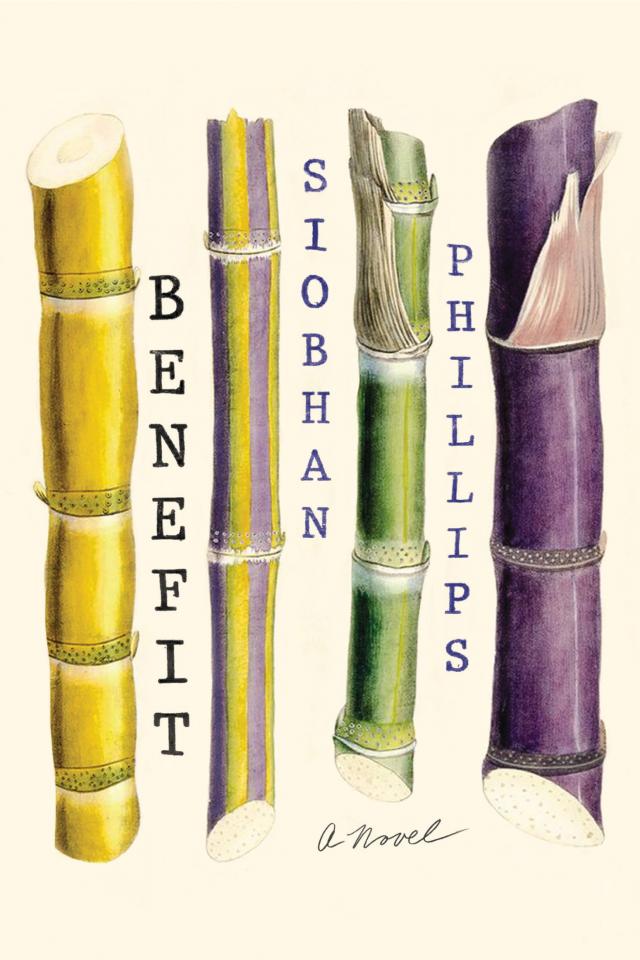
Benefit
SIOBHAN PHILLIPS
First published in the United States in 2022
by Bellevue Literary Press, New York
For information, contact:
Bellevue Literary Press
90 Broad Street
Suite 2100
New York, NY 10004
www.blpress.org
© 2022 by Siobhan Phillips
This is a work of fiction. Characters, organizations, events, and places (even those that are actual) are either products of the author’s imagination or are used fictitiously.
Library of Congress Cataloging-in-Publication Data
Names: Phillips, Siobhan, author.
Title: Benefit / Siobhan Phillips.
Description: First edition. | New York: Bellevue Literary Press, 2022.
Identifiers: LCCN 2021033503 | ISBN 9781942658993 (paperback) | ISBN 9781954276000 (epub)
Subjects: LCGFT: Novels.
Classification: LCC PS3616.H473 B46 2022 | DDC 813/.6--dc23
LC record available at https://lccn.loc.gov/2021033503
All rights reserved. No part of this publication may be reproduced or transmitted in any form or by any means, electronic or mechanical, including photocopy, recording, or any information storage and retrieval system now known or to be invented, without permission in writing from the publisher, except by a reviewer who wishes to quote brief passages in connection with a print, online, or broadcast review.
Bellevue Literary Press would like to thank all its generous donors—individuals and foundations—for their support.
This project is supported in part by an award from the National Endowment for the Arts.
This publication is made possible by the New York State Council on the Arts with the support of the Office of the Governor and the New York State Legislature.
Book design and composition by Mulberry Tree Press, Inc.
Bellevue Literary Press is committed to ecological stewardship in our book production practices, working to reduce our impact on the natural environment.
♾ This book is printed on acid-free paper.
Manufactured in the United States of America.
First Edition
10 9 8 7 6 5 4 3 2 1
paperback ISBN: 978-1-942658-99-3
ebook ISBN: 978-1-954276-00-0
1
I STOPPED WORKING IN AUGUST 2011, after I saw Mark Harriman at a symposium on war. I’d lost my teaching job three weeks prior. “A Decade of Global Conflict”—that was the symposium, part of a list of university events still deposited automatically into my email once a week. I recognized Mark’s name under “distinguished speakers.” He and I knew each other briefly, right after college, when we were both Weatherfield fellows. Before the global conflict. So that was more than a decade ago, I thought when I saw the announcement. Of course I knew it was. Still.
Losing the teaching job, I should clarify, wasn’t what made me stop working. That post had always been temporary, stopgap, two introductory English classes a term at a small all-women’s school north of Boston, renewed semester by semester as I stayed on in my Cambridge apartment applying for permanent positions. “It’s fine,” I said automatically to the assistant dean when he called. “It’s fine.” My mind accepted his regretful news with the speed at which one can seize on a bad outcome already much imagined. The dean felt terrible, he explained, especially given my exemplary performance, though he knew nothing about my performance except for the patchy comments on student evaluations. One I remembered: She seems like she’ll be a hard grader but she isn’t. “It’s fine,” I said again. I hung up on our mutual embarrassment as soon as I could. Losing the teaching job meant I worked more. I could spend all my time on a revise-and-resubmit I needed to finish, an essay about Henry James’s friendships. The first version was theoretical—what was James’s idea of human connection?; now I turned it historical, assembling sandy heaps of details into which I might pour additional effort. Lists of names. The one-bedroom I rented didn’t have air-conditioning. I left the windows open to the dark when I was too tired to read anymore, then came to a sweaty consciousness around two or three without any sensation of rest except the knowledge of waking. Sometimes I fell back into sleep around four or five.
Losing the job did mean I had no source of income, and I couldn’t logically renew my lease at the end of the month; I called my mother and asked if I could stay with her for a bit. “Are you all right?” she said. “Of course. Labor Day? That will be nice. And you’re okay? It’s no trouble. You’re sure?” I wanted to get off that phone call, too. But my mother’s baffled worry at the world has always accompanied her acceptance of it. And I would be all right: the security deposit, plus I could sell my car, which still worked, some of my furniture maybe—this is what I figured, almost instantly, while listening to the assistant dean. I would be all right. “I’m just working,” I said to my mother. “I just need a place to work.” I drove over to a strip mall in Allston, where a bored man in a coverall showed me the rectangle of aluminum and concrete into which I could place all the cheap books and printed-out articles that wouldn’t fit into my mother’s house back in Royce. Also my yard-sale desk, if I wanted, my card table, my milk crates of pans and stained mugs and mismatched bowls. In my twenties I seem to have eaten most meals out of bowls. “Climate-controlled,” the man told me, and spit, though that couldn’t have been true without a strange definition of control. I carted my things over in six trips.
This felt like working, too. I should have rented a van. I should have asked to borrow a larger car from someone—easier, quicker. I didn’t have enough money, though, or the right friends, and I trusted whatever took the most time and effort. I assumed more was better, or would prove to have been better, at some future date. Further along than a decade, evidently. This faith had always been what I substituted for ambition; the Weatherfield Foundation identified “students of promise and ambition.” I promised only to work. James, for example—James was my chosen specialty because his collected writings seemed to offer not only the most frustrations but also the fewest rewards. He produced many long books that grow progressively more difficult without ever becoming obviously experimental or solidly classic. James’s writing would never be significant or easy. On this I had spent a decade. On this I could spend a lifetime.
Yet I think I knew my reliance on sheer effort wouldn’t fool others that long. Rejection—jobs, the last job—didn’t entirely surprise me. Acceptance surprised me. The Weatherfield, for example. There were twenty-four fellows each year granted some paid postgraduate time at Oxford or the Sorbonne, universities at which the fellowship’s patron, a younger-son American heir to money from Weatherfield Sugar, spent some of his aimless Gilded Age adulthood not quite getting a degree. Most of the others chosen seemed not to have reached this point in their lives by striving to make sure that there was always more to do. Except Mark, maybe—Mark wasn’t at all like me, but I recognized in him a familiar drive toward the uselessly difficult. I’m sure I took justification from it. Once, he mentioned that he had picked his events in swimming because they were the hardest—this was after he repeated a mocking comment from someone else about his status as a dumb jock, to which I responded that I thought he was a swimmer, and he laughed and said, “What are you implying?” and then, to my apologies, my protestations, “Don’t worry. I’m kidding.”
“Okay,” I agreed, relieved. “I was trying to pay a compliment.”
And he was only half kidding. “Swimming is hard, you know.”
I nodded. “What is your thing? Is that the question? Your event?”
“Distance.” He explained: “five hundred free, one thousand free, sixteen fifty free.”
“And those are the hardest.”
“Well, it’s subjective, what’s hardest.” He reconsidered. “But yeah, the sixteen fifty—” He stopped, shrugged, looking down and away. “It doesn’t matter.”
I said, “It matters.” I stopped there. You don’t need to dissemble, I wanted to say. But to mention the tactic presumed too much. That would have to wait. Mark was tall and broad and muscular, with pale, mottled skin and rough reddish hair, too irregular in his features to be uncomplicatedly good-looking while offering a restful impression of steady physical competence. With this, though, came an almost sheepishness, diffidence shielding the intensity. Publicity and hearsay in our little group of American fellowship winners already knew that he held some sort of college athletic record along with a perfect undergraduate GPA; during social gatherings, he was often gently teased about his accomplishments, in the reassuring assumption that no teasing could rile him. Yet his serenity was watchful. His characteristic expression was that half shrug accompanied by a glance down and away—to avoid pretension, to let everyone off. “Yeah, well—” Others could relax, should relax; others should experiment or enjoy or be themselves. He had things to do. Since we left Oxford, Mark had completed the Marine Corps Officer Candidates School and been commissioned as an officer in the United States Marine Corps and served three tours in Iraq and one tour in Afghanistan.
I read the biography in the symposium program. I got to the event a little late. I didn’t put to myself why I was going, the day before I left Cambridge with the last of my boxes packed—I didn’t ask why because I’d never really decided to go. I slipped into the back of the small auditorium at the Mitchell Center, where wide carpeted tiers of seats looked down on a stage, a podium, a table and chairs fo
But a friendly older man in the back row, shifting to let me find a seat, didn’t seem bothered by my presence. “Are you at the center?” he asked.
“No, I …” A pause. His question was kindness, I knew; at these sorts of events, it was welcome: say where you belonged. I didn’t have a good answer to where I belonged or what I did or what I was—no longer a student, no longer or not yet a professor. I usually said “an academic,” a convenient adjective turned noun that indicated something irrelevant, or something tied to a certain kind of institution. “I thought it was open to the public,” I said.
“Of course,” he said. “Very important.”
I went back to the program. Up front someone making introductions explained how lucky we were to hear from a variety of experts, including those with “real on-the-ground experience. This symposium is about letting those different experiences talk to one another.”
Everyone on stage nodded. Four men in suits. I didn’t see Mark anywhere.
I don’t want to give the impression that Mark and I talked much to each other back in our fellowship days. We were not friends. A kind of sorting happened with various supposedly selective groups of postgraduates, and the small size of the Weatherfield cohort did not exempt us, made divisions more important, rather. Small towns maintain good and bad neighborhoods as compact as a couple of blocks. I grew up in the not-good-enough part of Royce but didn’t expect to recognize so firm a consensus, so quickly, about which Weatherfield fellows were, in fact, going to be distinguished, famous, powerful and which others would fade into a respectable professionalism. The third option was hardly to be entertained; at worst you could do something offbeat, like the fellow a few years older who moved to Berlin and became a sculptor. Mark was friends with Greta, who went to Dartmouth and studied chemistry; Caroline, from Brown, who had already spent a year working for an NGO in Senegal; Justin, who went to Yale and knew three or four languages and played the cello; Zac, Stanford, currently working at a biotech firm in Silicon Valley. Others of the successful group seemed slightly more independent—Heather, for example, who graduated from a state school and studied math. But Mark and Greta and Justin and Caroline and Zac—as far as I could tell—were the ones who met for pints in the evening and stopped by one another’s rooms without invitation or reason and decided together where they would travel during term breaks. “Is Mark coming?” one of these friends might ask, in his absence from a required event where the full group of us milled about, and another might reply, “I’ll text him,” or “Yeah, he said he’d be late.” They talked enough to know where they all were.
Meanwhile, Mark and I had, I think, a total of three conversations. The first was in the fifth or sixth week of Michaelmas term, when we both were assigned to a dinner with a wealthy donor who had graduated about four decades before. These meals happened once in a while, purpose unclear. A card arrived: The dress code was “smart.” Smart was difficult for women. But I squashed my worry over the ambiguity with the thought of a free meal; living stipends, I found, drained quickly if they were all you had to live on, even though I didn’t eat out much, nor did I often buy tickets to the Hall. Mostly I heated soup and assembled sandwiches in the kitchen at one end of my dorm floor: a sort of toaster oven, a sink, one burner, a fridge with defensively labeled cartons of expired milk. I took food back to my room as I continued my attempt to read everything already written about the topic of my weekly essay. My room was a 1970s-era bed-sit with thin orange carpet in a concrete block off one of the side streets, the kind of structure tourists edit out of their Oxford impressions. Sometimes, admittedly, I panicked that I was not experiencing enough; then I scheduled an hour to look at labels in the Ashmolean or spent five pounds on a chunk of the strangest-looking cheese I could find in the covered market. But I couldn’t manage enough of those spasms of real life to make them amount to anything, nor did I know what they were supposed to amount to; I went back to my schedule of work, my notebook of page numbers and quotations.
At the dinner with Mark, however, in Mark’s sure management of the alumnus, I could pretend for a little while that I was making memories to which I would later return with fondness and pride. The three of us met at a low-ceilinged restaurant with a fire and a piano and a few small rooms of round white-clothed tables. The menu included an elevated rarebit and a trout of noteworthy origin and an interpretation of toffee pudding. Outside, the evening dampness thickened into rain. I remember Mark arrived in a lined trench coat over his suit. The right outerwear was a step above the basics of “smart,” the dark skirt into which I had squeezed my always unsatisfactory thighs. But Mark was consistently well dressed as well as trim, well dressed in a manner stylish for being absolutely free of originality. I suppose his attitude toward clothing somehow made it more rather than less plausible that he would end up in uniform. He talked with the older man about half blues and the Port Meadow; he confirmed the happy memories of what didn’t change and sympathized with the regretful memories of what did. Mark already had plans for Bonfire Night. He put “sir” on the end of his replies until the other said, “No need for that ‘sir,’” after which Mark sounded just as natural with a first name. I was not natural about anything. Following a brief question about my course of study, the alumnus only asked about a Shakespeare scholar he had studied with, a genius, “but he probably retired.”
“Yes, he retired,” I agreed.
“Really.”
“Uh—I’ll check.”
“Oh, it doesn’t matter.”
I hated again my tendency to automatic assent, in conversation, when I was nervous—it felt like I was always nervous—and I resolved not to say anything I didn’t know to be true. At coffee, when the older man decided to give me one last chance, looking over with an avuncular indulgence to ask about me, my future, had I ever “thought about public service”—I swallowed and began: “Well …” What would be the truth? “Probably not.” On the walk home, I tried to apologize.
Mark looked at me sidelong, assessing, and didn’t reassure me too quickly. I appreciated that. “You think it went bad?” he asked.
“No, you did fine,” I said. I also appreciated his blunt, not-quite-grammatical question. “He liked talking to you.”
“He just liked talking.” Mark thought for a moment more, his face intent; then his forehead smoothed and he half-shrugged, a decision: “I think we did okay.”
I held on to the “we.” The two of us shared his umbrella, walking too quickly and closely to get out of the rain; I could feel the uncertainty of my heels on slick cobblestones every few steps, and my elbow just grazing his.
“You all right?” he asked.
“Yes.” I looked for something else to say. “That guy wants you to run for office.”
Mark waited long enough to respond that I had time to realize this was the wrong topic. Then, more quietly: “Yeah, well.” That look down and away. I kept silent for a half block more.
The rain went peevish. Mark squinted at his phone and steered us into the recessed gate of a college to read the screen under cover. “Where are you headed? You meeting everyone at the Turf?”
I was not meeting everyone. I did not know about these meetings, or about everyone, really. “I have to work.”
“You do?”
“I have an essay.”
“For real?” His voice sort of lilted when he was interested.
“Yes.” He was waiting. “A real essay,” I said, making a grimace.
Mark didn’t match my mockery. He was serious. He said, “You’re showing me up.”
“What do you mean?”
He shook his head. “You’re doing it.”
“It’s just work.”
“Nah.” He stared, figuring something out. I gave the sort of exhaling laugh that signals someone is looking too hard to see you. That didn’t change his demeanor, either. “I got it,” he said.
“What?”
“All that stuff about Henry James.”
“Oh, God. At dinner? Please forget that. I don’t know what I was saying.”
He smiled. “You said a lot of it.”
“I’m sorry.”