The feathers of death, p.1
The Feathers of Death, page 1
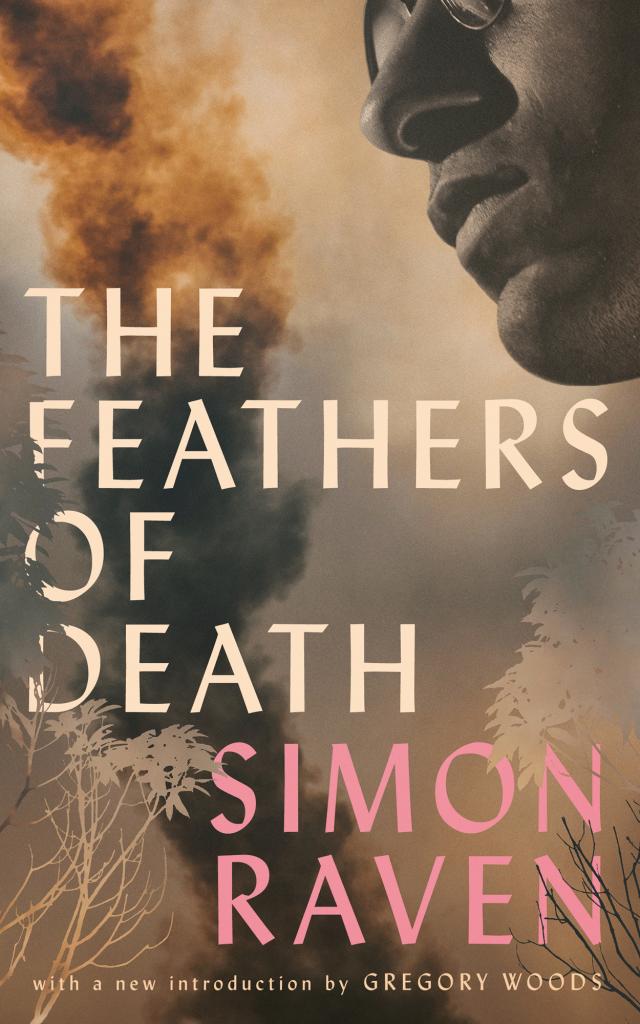


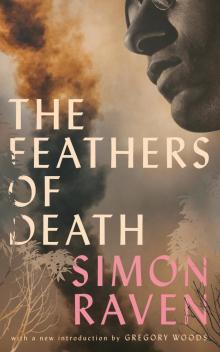
SIMON RAVEN
THE FEATHERS OF DEATH
with a new introduction by
GREGORY WOODS
VALANCOURT BOOKS
The Feathers of Death by Geoff Brown
First published in Great Britain by Anthony Blond in 1959
First U.S. edition published by Simon & Schuster in 1960
First Valancourt Books edition 2018
Copyright © 1959 by Simon Raven, renewed 1987 by Simon Raven
Introduction copyright © 2018 by Gregory Woods
Published by Valancourt Books, Richmond, Virginia
http://www.valancourtbooks.com
All rights reserved. The use of any part of this publication reproduced, transmitted in any form or by any means, electronic, mechanical, photocopying, recording, or otherwise, or stored in a retrieval system, without prior written consent of the publisher, constitutes an infringement of the copyright law.
Cover design by Henry Petrides
INTRODUCTION
An institutional insider opposed to institutions, Simon Raven was anti-establishment even when safely ensconced in the citadels of the Establishment itself. His ambivalent relationship with authority developed early. Remembering when he had been in love with another boy at Charterhouse School, he said: “My attitude was measured against what I honestly believed to be the best possible frame of reference for such matters—the utterance and custom of the ancient Greeks.” To him, the rules of Plato’s academy overruled those of Charterhouse. He was duly expelled in the autumn of 1945 when found to have been having sex with many other boys, but, crucially, with one who was two years younger than himself. However, the expulsion never harmed his career and, typically, he later claimed to feel cheated of the disgrace it might have merited.
After school, Raven did his National Service in the army before going to university. Of King’s College, Cambridge, to which he went up in 1948 to read Classics, Raven said: “Consenting adults at King’s could do pretty much as they pleased, the only proviso being that they must not offend either the porters or bedmakers.” Somehow, he modelled his Cambridge style on that of Rhett Butler. “Nobody minded what you did in bed or what you said about God, a very civilised attitude in 1948.” However, times were changing and literary studies at Cambridge beginning to experience the rather puritanical seriousness of the literary scholar F. R. Leavis.
Although Raven received a second-class degree, he was granted a Studentship for postgraduate study; but his lifestyle proved too lavish for his means. The money soon ran out and he withdrew from the university. He married in 1951 a woman who was pregnant by him, but married life loomed only as a threat: he avoided her and their son. That and mounting debts (we are beginning to identify a theme) drove him back into the army in 1953, and it would be debt, again, that forced him out. He was allowed to resign before his rather languid regiment got around to cashiering him.
Journalism had to fill the gap. He was given reviewing work by J. R. Ackerley, the renowned literary editor of The Listener, and he also began writing for The Spectator. Before long, he was allowing himself to wander into areas previously left unexplored by respectable journalists. An essay of his on “The Male Prostitute in London”, which Encounter published in 1960, is said to have been “well received on the Stock Exchange”. Diversifying his skills to shore up his income, he decided also to turn to fiction. The publisher Anthony Blond paid him to write a novel, but imposed a stringent condition: that he leave London—with all its excesses and expenses—in order to do so. With a heavy heart, Raven went to stay with his parents in the countryside and applied himself to the task. In his 1963 retrospective book Boys Will Be Boys, he said of this period in his life:
When a man of over thirty is reduced to living with his parents, there is something dangerously wrong. He has claimed the right of a child and so must forfeit many of the privileges which attend maturity. Although my parents were patient and tolerant, they were not above pointing out that I was now, once again, their dependant. I thus had an extra incentive: to make my name as a writer would also restore my proper freedom as a man. And so I went to work for my freedom.
Fortified on copious amounts of brandy he paid for on his parents’ account, Raven wrote The Feathers of Death very quickly, seven days a week, twelve hours a day, between April and June 1958. For its launch in the Reform Club, Anthony Blond enterprisingly collected together all the gay booksellers in the country, or so the novelist claimed.
Raven had no great artistic pretensions: he wrote to make money. He tended to write about the kinds of people he knew. Characters were based on friends—and enemies. Plots were elaborated around society gossip he had either generated in his own behaviour or enjoyed at second hand in that of people he knew. Occupations were set in institutions of which he had social, if not professional, experience. The tone, especially of his later books, is equally divided between laughter and rage. That generated their popular impetus.
He also knew how to harness current affairs in order to optimize sales. Homosexuality had been much in the news at the time The Feathers of Death was published. The Wolfenden Report of September 1957 had recommended that “homosexual behaviour between consenting adults in private should no longer be a criminal offence”. (It meant male adults: there was no law against lesbian sexual behaviour.) The recommended age of consent was 21, the same as the then age of majority. There would be a long wait until, in July 1967, the law was accordingly changed, if only in England and Wales and with many exclusions, including those serving in the armed forces. (This ban would not be lifted until 2000.)
The Feathers of Death belongs to a thematic category that almost amounts to a genre in itself: fiction about gay men in the armed forces. The list begins, I suppose, with D.H. Lawrence’s ardent tale “The Prussian Officer” (1914) and includes Carson McCullers’ Reflections in a Golden Eye (1941), Jean Genet’s Querelle of Brest (1947), James Barr’s Quatrefoil (1950), Walter Baxter’s Look Down in Mercy (1951) and Dennis Murphy’s The Sergeant (1958). Many of these novels make a crucial point in that stage of the battle for homosexual emancipation: that homosexual men and women do not necessarily disrupt gender norms—the majority of the men being masculine, the women feminine, indistinguishable from their heterosexual counterparts—and neither do they seek to subvert society. With such glaring exceptions as the Genet, these novels are full of gender-normative patriots.
Raven’s novel is set in an invented colony, Pepromene, somewhere to the east of Suez. The regiment is sent there to quell rumblings of rebellion on the part of local tribesmen. Martock’s Foot is a regiment that prides itself on its relaxed but steadfast values:
we had none of the prying into Mess bills, complaints about gambling, or investigations of sexual morals so common in the dowdier regiments. In all matters, moral or otherwise, our standards, I like to think, were liberal, tolerant, civilised and worldly[.]
At a superficial level, one might call these attitudes progressive, but the book’s narrator, Andrew Lamont, Intelligence Officer, immediately concedes that they might be thought “reactionary”. The same ambivalence hangs over all of Raven’s work, I think.
The novel’s central character, Lieutenant Alastair Lynch, is a perfect fit for this moral universe. According to Lamont, Lynch “left Harrow in 1946 a tolerant, sceptical and often witty young man. Mistrustful of all enthusiasms, contemptuous of all causes, he was firmly and forever convinced that in literature, conversation and wine were to be found at once the staples of civilised existence and, if one added travel, the only possible consolations for the bedraggled world in which he had grown up”. In this respect, I think we can assume, the author identifies as closely with the attitudes of Alastair as with those of the regiment as a whole.
To some extent, the values expounded by Raven in these two portrayals—of the regiment and the character—coincide with those of the whole of the British army’s officer class. Yet there is a contrary tendency that ensures restraint. At the military academy Sandhurst, according to Lamont:
Military subjects are taught capably and broadly, academic subjects with sympathy and even liberality; but there is with all this a nagging insistence on the Arnoldian virtues and a distinct tendency to employ Arnoldian methods. There is much talk of keenness and responsibility.
But to which Arnold is he referring? Thomas Arnold, père, headmaster of Rugby School and advocate of morally improving austerities; or Matthew Arnold, fils, the poet and critic? The latter criticised the parochialism of English culture, its insularity and lack of curiosity, and its addiction to a utilitarian world-view. It was he who established the current meaning of the word ‘Philistine’ (one who is hostile to, ignorant of, or indifferent to the arts). Combine the two, and you end up with elegant rigour.
When Alastair’s men set up camp, his chosen password is “Sweetness”, the required response, “Light”. “Sweetness and Light” was the title of the first section of Matthew Arnold’s book Culture and Anarchy (1869). The sweetness is that of beauty; the light is that of intelligence. Together, they are the essential components of a valuable culture. Alastair’s choice of these two words as password and response, to be used in a potentially life-or-death situation, may be frivolous, but it is a serious frivolity of a kind we can justifiably call camp. Even though the camp aesthetic, because of its association with homosexual effeminacy, tends to be absent from gays-in-the-military fiction, there are moments like this when its appearance signals a tacit connection of even masculine characters with gay subcultural styles.
Alastair starts a sexual relationship with a young soldier, Drummer Harley, and puts little effort into concealing it. He is confident that it is not undermining his men’s discipline as a group or their efficiency as a fighting force. But the relationship does arouse jealousy and irritation in the camp, even if is largely ignored as being irrelevant to people’s main concerns.
The other type, the more acceptable type, of male intimacy develops between the same Drummer Harley and Mounted Infantryman Simes. Andrew Lamont considers this type “quite common between private soldiers [as opposed to officers] a long way from home”. He goes on:
It was a strong and apparently innocent bond between lonely men, but with passion and sexual inclination ever present though ever unacknowledged: inevitably unacknowledged, because the upbringing and prejudices of such men made it unthinkable to them that two soldiers could conceivably be more than “mates” to each other. Their position was mathematically simple: no women, no sex. You went to the cinema or got drunk with a mate; but whatever unaccustomed impulses you might feel on the way home, you said “good night” and went off to your own bed.
Note the point about class. These are “private soldiers” and theirs is an “upbringing” that fosters the internalised “prejudices” that prohibit the physical expression of male love.
When trouble both public and personal does eventually break out, Alastair is subjected to a court martial—but not for the relationship itself. Mind you, it is not until the novel shifts into the courtroom that the illegality of Alastair’s relationship with Harley is even mentioned. Even Alastair himself, albeit with heavy irony, echoing other men’s words, describes it as “immoral and illegal”. Although it is not strictly the reason for his being on trial, the court’s various opinions of it are seen as being likely to determine the outcome.
Anti-homosexual prejudice is snobbishly seen by the liberal wing of the officer class as a sure sign of lower status. At the court martial, Lamont feels confident that the judges advocate, being respectively members of the Guards and Dragoons, will not be “unduly dismayed by the idea of a homosexual liaison—they were surely above middle-class prejudices of that kind.” Not only present status, but past status too, that of educational background, will determine such things. Lamont continues: “Godfrey, I thought, showed in his face all the typical signs of a minor public school distrust for what might be called ‘Etonian’ goings-on” (Eton College being the most major of the major public schools, in terms of class status).
Colonel Sanvoisin, the regiment’s commanding officer, represents the limitations of the liberal stance, with his supposedly practical, pragmatic objection to the visibility of homosexuality within his own sphere of influence: “The open homosexual, however likeable to you or me personally, is just a pure bloody nuisance in the sort of world in which you and I are forced to live and run an army.” He offers the mess Alastair has created—and which his own languid tolerance has allowed to develop—as evidence of this.
Much of what happens in the book is reported at second hand. Initially, it may seem as though the young novelist does not yet have the nerve, or the skill, to give a direct account of things, whether they be dramatic actions or powerful emotional states. The disadvantage of this strategy is that the central relationship between Alastair Lynch and Malcolm Harley is only sketchily conveyed, as it were off-stage. Lynch tells us of it, in rather unconvincingly cut-and-dried terms, but from Harley we hear nothing. If this is meant to sow doubts in our minds about Lynch’s version of things, the approach is a success.
The reader ought to recognise, though, that a degree of confidence, rather than lack of it, is in play: Raven already knows what he is doing. There is a brand of discretion in play here, and not just that imposed by the threat of censorship—although that is surely part of the picture. Raven appears not to want to engage the reader’s sympathy for the two lovers to the extent of arousing a sentimental identification. He keeps us at an objective distance from the book’s emotional core. Also, notwithstanding his (or his narrator’s) clear argument for the acceptance of homosexual relationships, even within the disciplined and pressurized environment of the armed services, he is unwilling to lead the pro- or anti- reader into the intimacy of the lovers’ tent, lest what we see there inspire us to desire or disgust, thereby biassing us beyond reasoned argument. Either would be superfluous to the book’s quite tightly circumscribed needs, which are coolly presented. In later novels he would adopt a more expansive and emotionally warmer approach.
Gregory Woods
Gregory Woods was Professor of Gay and Lesbian Studies at Nottingham Trent University until 2013. His main critical publications are Articulate Flesh: Male Homo-eroticism and Modern Poetry (1987), A History of Gay Literature: The Male Tradition (1998) and Homintern: How Gay Culture Liberated the Modern World (2016), all from Yale University Press. His poetry, of which An Ordinary Dog was the most recent collection, is published by Carcanet Press. His website is www.gregorywoods.co.uk.
“The wings of man’s life are plumed with the feathers of death.”
Elizabethan seaman in a plea to his Sovereign
PROLOGUE
If there is one thing which I shall remember until I die, it is the day Duthwaite and I set off into the hills to relieve Alastair Lynch. Why I should remember this ride so clearly I do not know, for in itself it was, like all journeys, only an interlude; and for that matter, you would have thought that the horrible scene which was waiting for us at the end of the journey itself would have driven out any other memory of that day. But this is not the case. I can still see, as though it were just at the other end of this room in which I write, Duthwaite talking in that grimly efficient way of his to Sergeant Major Mole, giving precise and sensible instructions about the composition and the mounting of the little party that was to come with us; I can still see poor Mole looking forlornly at the pitiful gaggle of spare signalers, batmen and native policemen who made up at least half of our expedition.
“I don’t know what Captain Duthwaite’s going to think of this little lot,” he said to me.
“He’ll think what I think—that there isn’t any choice.”
“Wish he’d let me come. Can’t sit still for thinking of poor Mr. Lynch up there with those black bastards all about, murderous swine. Do you suppose, sir, that if you had a word with Captain Duthwaite . . . ?”
“No, C.S.M.,” I said. “Mr. Byrt will need your help if anything crops up here.”
Mole grunted and ambled off without saluting. He had a soft spot for Alastair Lynch, who, among other things, had lent him money for his daughter’s wedding. I knew how much he wished that it was Duthwaite or myself up in the hills, that it was Duthwaite, with his prim manner, who was up there wondering if his throat would be cut in the night, that it was I who was waiting in the forest rain for the help that took forever to come. Not that Mole disliked either of us. It was just that he yearned, in his rotten and loyal old heart, for Alastair to be safely back at Company H.Q., laughing at the feeble jokes Mole loved to tell him or pulling Mole’s leg about the precision and punctuality of the company returns. As it was, the poor old man must simply sit and wait, though Michael Byrt, I thought, would be kind to him, would listen to his stories and see that he had enough whisky to make him sleep.
And then there was the first stage of the journey, along the track to the bottom of the escarpment, where Mole was to say goodbye to us and turn back to camp.
“You’ll see that Mr. Alastair’s all right, sir?” he said to me.
“We’ll do our best.”
He watched us make our way up the narrow track which led to the top of the escarpment, a lonely, stupid, sad old man sitting on his sad old horse. When we reached the summit and were about to disappear from his sight, he drew himself up and saluted, with great smartness and precision, and then lifted his cap and waved it above his head before he finally turned his horse away. It was a gay and gallant gesture; even Duthwaite was touched, and smiled as he returned the salute. But he meant all that for Alastair, I thought to myself; none of it’s for us.