

Djinnology, p.1
Djinnology, page 1


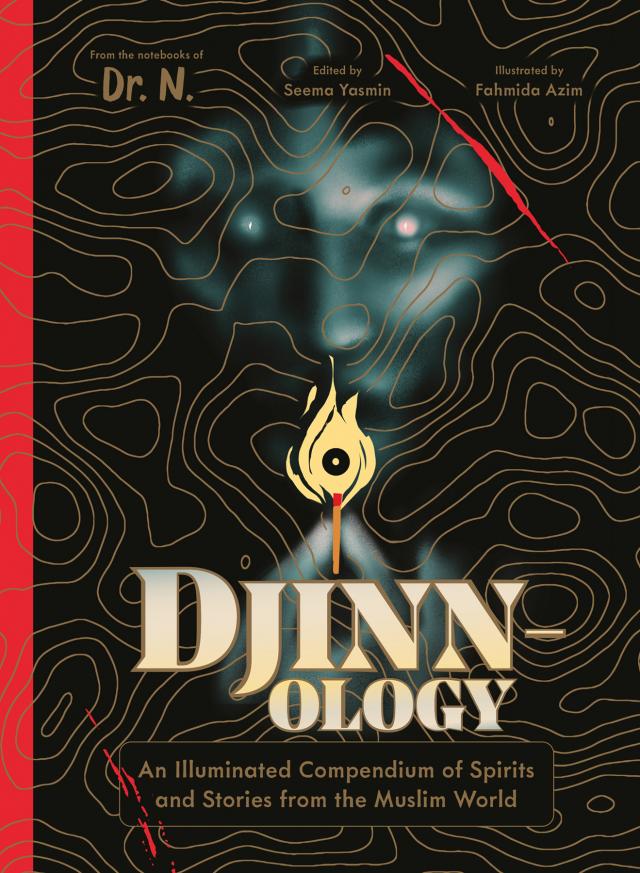
Note: The dates in Dr. N.’s manuscript have been styled according to the Holocene Era (HE) calendar, which begins 10,000 years before the start of the Common Era, at roughly the time when human civilization emerged. To convert dates to the Gregorian calendar, simply subtract 10,000. (The exceptions are the primary sources that Dr. N. gathered in her research, which use the Gregorian calendar.)
Text copyright © 2024 by Seema Yasmin.
Illustrations copyright © 2024 by Fahmida Azim.
All rights reserved. No part of this book may be reproduced in any form without written permission from the publisher.
Library of Congress Cataloging-in-Publication Data
Names: Yasmin, Seema, 1982- author. | Azim, Fahmida, illustrator.
Title: Djinnology : An Illuminated Compendium of Spirits and Stories from the Muslim World / by Seema Yasmin ; illustrated by Fahmida Azim.
Description: San Francisco : Chronicle Books, 2023. | Cover title.
Identifiers: LCCN 2023046265 | ISBN 9781797214818 (hardcover) | ISBN 9781797218038 (epub)
Subjects: LCSH: Jinn. | Islamic demonology.
Classification: LCC BP166.89 .Y375 2023 | DDC 297.2/17 23/eng/20231--dc23 LC record available at https://lccn.loc.gov/2023046265
Design by Jon Glick
Typesetting of Arabic by Cary Han.
Chronicle Books LLC
680 Second Street
San Francisco, California 94107
www.chroniclebooks.com
تحذير
A WARNING
You are now entering the realm of the ungraspable: alam al-ghayb, the dominion of the Unseen.
This journey is not for everyone.
Alam al-ghayb is not only a place—it is a dimension. Should you choose to embark on this path, you will discover new ways of seeing and knowing.
You will question all that you witness and believe.
Your grip on what you call “reality” shall loosen.
Your dreams will be altered forever.
DEAR DISTINGUISHED MEMBERS OF THE ACADEMIC COMMITTEE,
I have a confession. For the past twenty-seven years I have been secretly working on an undisclosed project which has taken me far away from the ivory towers of the academy and plunged me deep into the darkness of other worlds. This project began at the behest of a mysterious figure I can refer to only as the Sheikh. The Sheikh urged me to classify and characterize those creatures known as djinn. Made of a smokeless flame and haunting humanity since pre-Islamic times, djinn are shape-shifting beasts who grant wishes, inspire poetry, and snatch away innocent children—disappearing them to an entirely different realm.
Of course, I refused. I am Muslim, yes, but I am a tenured scientist— a taxonomist and ontologist who deals with the classification of tangible matter such as marine animals and freshwater flora. The Sheikh was persistent and requested my assistance three times, as is customary. On a fated day all those years ago, I said yes to the Sheikh’s third request and watched the course of my life take an astonishing turn.
The scholarly work presented to you here is the culmination of this covert research. While conducting my renowned marine research, I have traveled the world, retrieved long-lost oral histories, translated archival texts from more than two dozen languages, analyzed the Qur’an and prophetic narratives, and become the first scholar to observe and document certain occult rituals regarding djinn. Compiling this compendium has profoundly changed me, and I believe it represents a paradigm shift in taxonomical and ontological research.
However, my safety has been in jeopardy for the last year. While conducting this research, I discovered that the deep pockets from which the Sheikh funded this project were connected to a nefarious agenda. While I was assured that this was a scientific endeavor designed solely for the purpose of advancing knowledge, I came to learn that the true motive for this work was maleficent. The Sheikh’s inner circle planned to employ my extensive, first-of-its-kind research, which melded modern scientific methods with ancient rituals, to control djinn and use them to possess and dominate humans and influence geopolitical agendas. As my research gained traction and valuable historic sources revealed themselves, the Sheikh’s organization demanded these findings be kept secret. What you hold in your hands is my defiance in the face of that mandate. I firmly believe in epistemic generosity, open access and knowledge sharing—even if these principles now endanger my life and force me into hiding. I urge you to review and publish this manuscript which I have uncoupled from the wishes of the Sheikh’s inner circle and completed without their resources.
A note on methodology: Djinnology is not simply a retelling of stories that I have heard. My expertise as a taxonomist and ontologist is uniquely complemented by my training as an ethnographer and my lived experiences as a Muslim. This book represents the meticulous analysis, painstaking cultural interpretation, and careful religious contextualization of primary and secondary source materials in a style and format never before published.
For millennia, many of these sources have been plundered, misunderstood, dismissed, and oversimplified by Western scholars. The public understanding of djinn has become tainted by the poor scholarship of researchers ill-equipped to engage with these multidimensional phenomena.
Djinn, whose name derives from the Arabic triliteral root J-N-N, meaning to hide, conceal, or cover, are not the fantastical or demon-like creatures that have been misrepresented, misappropriated, and Disney-fied by colonizers and extractive explorers on their jaunts through the “exotic Middle East.” Djinn are essential to the identity of Muslims, both part of a Muslim’s faith and integral to a Muslim’s relationship to the interconnected and diverse global cultures of Islam. Some djinn are Muslim, and to the world’s nearly two billion human Muslims, djinn are as real as tax returns and as frightening and captivating as an electrical storm. The Qur’an, the script that guides the lives of Muslims from Sydney to Sarajevo, and from Los Angeles to Lagos, is addressed to humans and our shape-shifting compatriots:
وَمَا خَلَقْتُ ٱلْجِنَّ وَٱلْإِنسَ إِلَّا لِيَعْبُدُونِ
And I did not create the djinn and humankind except to worship Me.
—Holy Qur’an 51:561
Given my academic accolades and demonstrable track record of publication in prestigious, high-impact journals, you might question my motivation for working on this project, and you might fear for my credibility (at least among the world of Western scientists). I imagine you are thinking: But she’s a scientist who classifies, labels, and organizes sea creatures—actual living, breathing entities that can be seen with the naked eye or under a microscope. What is she doing investigating these … otherworldly things?
Compiling the first ever compendium of djinn might be the intellectual challenge of my lifetime. Djinnology challenges the norms of Western science, norms that purport to be objective and open-minded but in fact rely on imperialist standards. Western science, based on its hegemony of vision, has granted supremacy to that which can be seen with the eyes. Establishing this “empire of the gaze” comes at the cost of appreciating the other senses and interrogating the Unseen.2 But in the invisible lies potential. In the Unseen lies possibility.
No other scientific endeavor has stretched, burdened, and taxed my scholarly training, fieldwork methodologies, scientific acumen, and skills of reasoning. Never in my career had I traversed the depths of noetic experiences—until I began to compile this manuscript. I believe this work not only adds to the field of taxonomy but transforms this discipline to include a more honest and inclusive understanding of different ways of knowing.
But here is where I have questioned my ability to master this project: not because of any nonsense “anti-science” accusations, but because I have built a reputation and a career off my ability to pin a label on everything. How was I supposed to comprehend and classify entities that cannot be neatly filed into categories and subcategories?
Djinn resist—no, they defy—categorization. They are wily shape-shifters. They are malevolent, beneficent, a capricious combination of both, or otherwise as caught up in the business of being djinn as we are in the business of being human. They are sometimes enthralled by humans but just as often uninterested in our quotidian routines. Djinn may be ancient or young, slow or fast, and artistic or mediocre. They are male, female, and genderless; bestial and chimeric and everything in between.
This bestiary is my best attempt to navigate the creatures of the world that lies between our dominion—the terrestrial realm—and the realm above us, the celestial plane. This intermediary and imaginal realm is called al-ghayb, or the Unseen. While djinn mostly occupy this place, they also inhabit the liminal spaces between. Sometimes, as you’ll discover in these pages, they become firmly entrenched and at home in our own realm.
Before I proceed, a note on peer review. I have worked on this manuscript surreptitiously, alongside my more formally acceptable—and celebrated—works, and I am unlikely to engage with any of the inevitable eye-rolling, academic grandstanding, or feigned shock that might emerge from the ivory towers regarding this manuscript. I have been a tenured professor for more than a decade, and while “debates” about the compatibility or discordancy of religion and science once piqued my interest, I’ve become quite bored with “Can a person of faith be a serious scientist?” deliberations.
Islam, science, and the imaginal coexist. This scientist—like millions of Muslim physicians, statisticians, physicists, engineers, and all manner of researchers around the world—is able to balance objectivity and devotion, reconcile her faith and her curiosity, and synthesize her unknowingness and her core beliefs. I belong to an epistemic community that calculates p values and prays away malevolent ‘ifrits.
I hope this compendium offers insights and wonderment while smashing apart the norms of our disciplines. I pray that it invites us to explore new ways of knowing. In the name of science, which is, after all, the quest to fathom all that is unknown, I present to the distinguished members of the Committee, Djinnology: An Illuminated Compendium of Spirits and Stories from the Muslim World.
Dr. Nafisa Salim
Name redacted by the academic committee in light of the ongoing investigation into Dr. N.’s disappearance.
1 Qur’anic excerpts and translations throughout this manuscript come from the open access source at Quran.com. Numbers in the attribution lines correspond with the surah (chapter) and ayah (verse).
2 Nils Bubandt, Mikkel Rytter, and Christian Suhr, “A Second Look at Invisibility: Al-Ghayb, Islam, Ethnography,” Contemporary Islam 13, no. 4 (12019 HE): 1.
CONTENTS
WELCOME TO THE WORLD OF THE DJINN
TAXONOMIES OF THE LIVING
AICHA QANDISA: THE LOVER
Kingdom of Fes, 11541 HE (1541 CE)
ORIGIN STORIES:
BURNING WINDS AND SMOKELESS FLAMES
THE REVOLUTIONARY HORSEMAN
Cairo, Egypt, 12011 HE (2011 CE)
THE DEVIL IS IN THE DETAILS
THE POSSESSED IPHONE
New Jersey, USA, 12016 HE (2016 CE)
THE GHUL OF EAST LONDON
Bethnal Green, London, England, 11996 HE (1966 CE)
QAREEN:
YOUR OWN PERSONAL DJINNI/YAH
MEHR’S WAGER
Panama City, Panama, 11959 HE (1959 CE)
BEYOND PLANET EARTH
MAP OF THE WORLD OF DJINN
ENTER ALAM AL-GHAYB: THE DOMINION OF THE UNSEEN
THE QUEEN OF QAF
North Caucasus Mountains, Chechnya, CIRCA 10800 HE (800 CE)
SALMA BAI’S STORY
Durban, South Africa, 11981 HE (1981 CE)
GENDER AND DJINN
HALAL-O-WEEN
Montreal, Canada, 12010 HE (2010 CE)
COUVADE SYNDROME
Dar es Salaam, Tanzania, 12022 HE (2022 CE)
POETRY AND POSSESSION
HALF OF WHAT IT SEEMS
Paris, France, 11997 HE (1997 CE)
THE BABY
The Cotswolds, Gloucestershire, England, 12005 HE (2005 CE)
THE SIXTH FINGER
Bogotá, Colombia, 11978 HE (1978 CE)
MORE THAN A WOMAN, LESS THAN A DJINNIYAH
THE GIRL IN THE PURPLE HIJAB
Rome, Italy, 12009 HE (2009 CE)
THE MERMAID DJINNIYAH OF JAVA
Java, Indonesia, 11300 HE (1300 CE)
SORCERY AND THE STATE:
DIVISIVE DJINN AND MAGICAL CRIMES
THE DDU
Simi Valley, California, USA, 12002 HE (2022 CE)
THE HUSBAND
Beypore, India, 11866 HE (1866 CE)
THE DJINNIYAH IN THE PERFUME BOTTLE
Shanghai, China, 11969 HE (1969 CE)
PRAYERS FOR PROTECTION
INSTRUCTIONS FOR EXORCISMS
BIBLIOGRAPHY
WELCOME TO THE WORLD OF THE DJINN
Lurking in the corner of your living room, perhaps reading this sentence over your shoulder right now, is an often invisible creature that is everywhere and nowhere, hiding in your dreams or maybe waiting beneath your bed. You can’t always see this entity, but you have surely felt its presence: that gust of cool wind in an otherwise warm library or a suspicious blanket of hot air creeping across the back of your neck and settling over your shoulders as you watch television.
Like you, this creature dances and sings, picks fights and offers gifts, marries and divorces, makes babies and cradles its young. It even dies. Death might arrive after thousands of years, but this creature will eventually grow frail and infirm; it will bury its loved ones and grieve for centuries.
Unlike you, this being crisscrosses the globe at lightning speed, materializes the deepest of desires, shape-shifts from humanoid to winged beast to a puff of smoke, and infiltrates the minds of innocent people, provoking them to behave in strange and seemingly inexplicable ways.
Maybe you’re a scientist, a rational person who uses inductive reasoning to arrive at conclusions, the kind of thinker who demands facts and figures before you say, “Yes, I believe.” But privately, haven’t you wondered what could explain the unexplainable? Why you sometimes feel a presence beside you when you are the only person at home? Why you turn on the lights and call out “Hello?” when no other human is there?
You are not alone. At least two billion people around the world believe in djinn. Among them are accountants, chefs, pilots, and entrepreneurs—people who reconcile their belief in the unseen with their reliance on spreadsheets, algorithms, and satellite navigation systems. Many are Muslim—culturally, religiously, or by some other personal definition—who grew up listening to tales of the mystical creatures from ancient, preIslamic Arabian folklore, creatures whose origin story, or one version of it, is described in the Qur’an.
Even before the Holy Book codified their existence and described them as born of a smokeless fire, djinn roamed the globe, meddled in human affairs, and were rebuked and exorcised as much as they were revered and invoked for their powerful gifts. Djinn live in the legends of pre-Islamic peoples, for whom they were poetic muses. These peoples believed that djinn could possess and drive mad the most brilliant minds. (The Arabic word for madness, majnun, literally means “a person possessed by djinn.”) Pagan Arabs armed themselves with necklaces of fox teeth and fragments of animal bones to ward off the most malevolent djinn. Other times they offered gifts and good deeds to lure benevolent or trickster djinn who could make parched land spring with green shoots and make round the bellies of barren women.
Djinn is the plural of djinni (masculine) and djinniyah (feminine), although djinn defy categorization and morph between genders and forms. The word djinn may derive from the Arabic jann, meaning “to conceal or transform.” Or it may have evolved from the Aramaic ginnaya, meaning “guardian” or “minor God.” Some linguists say it arrived from the Persian word jaini, which describes a (usually female) spirit with malevolent traits.
The Arabic trilateral root ج ن ن (J-N-N), which loosely means to hide, conceal, or cover, is the origin for words that describe what is difficult for human eyes and minds to comprehend. Jannah means “heaven”; janin is a fetus inside the womb; majnun means “insane” or “the covered mind”; al-janan is the heart; and al-janaan the shroud that conceals a dead body. The same root also gives us the phrase ajannahu al-layl, meaning “concealed by the night.”
Whether devout or lapsed, culturally Muslim or a firm follower of the Qur’an, whether raised in Kansas City or Khartoum, in Edinburgh or Cartagena, people from Muslim communities share a collective belief in djinn. The specters and sounds of their childhood horror stories differ from one tongue to another and merge with local tales of regional spirits and homegrown deities.
But you don’t have to have grown up religious or identify as Muslim to find yourself cowering beneath the sheets to ward off soul-snatching, mind-meddling djinn. You’ve already met these creatures in Disney films and read about them in classic novels. The wish-granting genie from Aladdin’s lamp in One Thousand and One Nights (genie is the Anglicized version of djinni) is one of the most famous examples. This timeless tale, published during Islam’s so-called Golden Age,3 sits alongside stories of vengeful djinn, water-dwelling djinn, and amorous djinn who pry into the lives of lovers, travelers, and humans going about their day-to-day business.
While they can cross into the human universe, djinn mostly reside in an intermediary dominion called al-ghayb, or the Unseen, which overlies the human realm of existence. Djinn are dual dimensional and can sporadically cross into the human realm to cause mischief and havoc or take up residence in the home of a human who has captured their heart. Djinn can fall in love with humans, become infatuated and possessive, and snatch away human children and disappear them into the Unseen.






