

Celerity, p.7
CELERITY, page 7
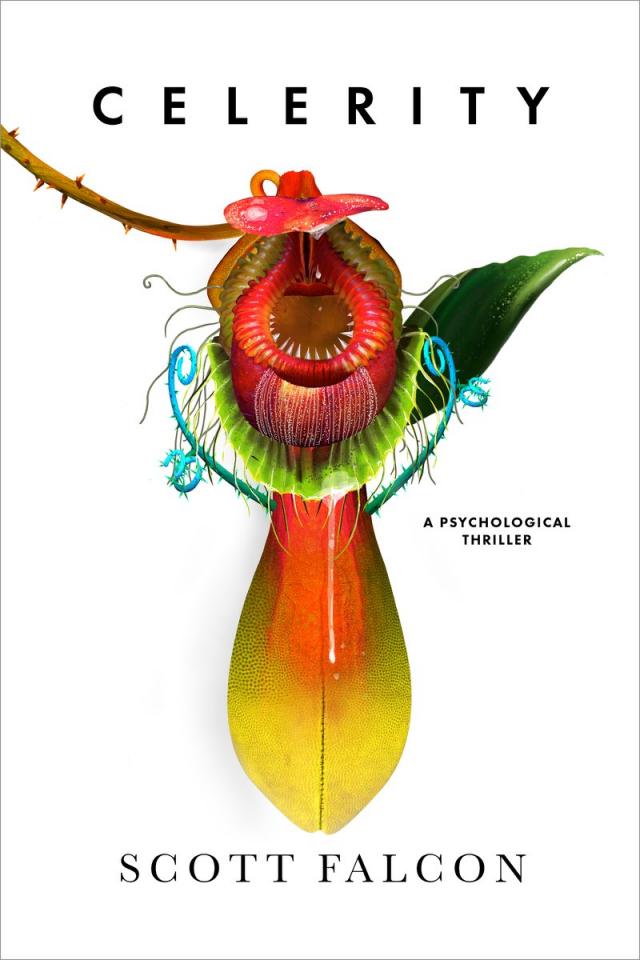


In what looked like a community gathering area was a large pit, two mestizo women were tending to the fire and the roasting of an animal. Another woman was hacking open a tortoise, two feet in diameter. An old one-legged man appeared from a hut and my guide approached him. They sat down; a negotiation was occurring. My guide pointed beyond the village, then pointed to the sky. The villagers looked at me, a long stare, up and down, then back at the guide. Was I being bargained for?
I stepped back.
Should I run?
I tightened the straps of my backpack. Glanced around.
Then two hands, one on each of my triceps—the two women that were cooking. Esta bien, they said. Esta bien.
They led me to a hut, and I stepped inside. It was empty except for a cot made of dried palm leaves.
Siéntate, they said. La huésped. I think that means guest. Either guest or I’m what’s for dinner. Another woman entered with a gourd full of tropical juice. It was warm, but quite delicious. The women left, I set my pack down and took off my boots to air out my feet.
As it turned out, my presence in the village was welcomed by the locals. White women are a rarity I learned. Not much of a surprise. Over dinner, a fine feast of fowl, pig, and fish, my guide interpreted their advice that I should use a machete if the Urabeños try to rape me before they murder me. Muerte rápida, they said, is best. Quick death. Good to know.
* * *
Sitting by the fire in the center of the village, I watched the villagers eat what they killed or grew, and dance in celebration unknown, maybe their new guest, a guest they had concluded meant them no harm.
The brew they gave me, some type of jungle tea with tropical fruits and spices, made me light-headed—a good high. The painted bodies pranced around the flames and sang.
I removed the letter that my father wrote to me but never mailed. I found it in his desk. He wrote it several years ago while he was in this wilderness.
* * *
My Dearest Celerity,
I hope you are doing well with Hannah. I will be longer here than I thought. I want you to know that I love you with all my heart and soul. I’m in a place they call the Darién Gap, the gap between two continents. Named a gap because it is wild and impenetrable. There is a great similarity between this place and the deepest bowels of the Amazon to the south, but this place is even more hostile.
Centuries ago, Ponce de Leon searched for but did not find the fountain of youth in Florida. Dozens of explorers searched the Amazon for El Dorado, the city of Gold, but never found it. From central America to the end of South America, hundreds of expeditions have been launched going back centuries. Many of those men vanished.
What has kept them coming back is the search for a paradise on Earth? This place, a mass of land that has gone unmapped. We can see it from aerial maps, but its secrets are hidden.
Many a stalwart explorer has abandoned their expeditions in this place, a hostile morass of thickets. There are stories, legends, and myths, that in a higher place, a plateau deep in the Darién, unreachable by man, that a Shangri-la exists, a Garden of Eden.
This morning, my little group entered the elevated place. Species of plants are larger, species of insects and animals I have never seen all around us. Is this the Eden, the Elysium? Some type of sanctuary of life? I think not. It is moment by moment natural selection, deadly, hostile, kill, or be killed—a Darwinian reality.
I have experienced many a hardship in my travels, but what is abundantly clear to me in this place, is that the human species is an interloper, nothing but a lower part of the Darién food chain. Food for the cañero, the piums, thousands of other ravenous insect devils, venomous snakes, poisonous creatures…and the savage plants.
This place is home to species of undiscovered carnivorous plants, a merging of the Animalia and Plantae kingdoms, a genesis. What is not known to me at this time, is whether they are miracles of nature or a mutation?
Wonderment or abomination?
The largest of the species I will name tomorrow. And study its
* * *
That is how the letter ended. My father must have become distracted, never finishing it. I sat back and watched the dance of the Cazador de Soldados.
They were the fittest of the young men. The best hunters and defenders of the village. The most vibrant colors of body paint. Seven of them came to an abrupt stop around the fire.
They stood equidistant apart, looked up to the sky, then spit into the fire. Out came a glob of green mass they must have been chewing. Then they stood motionless. “Cha,” they chanted all at once.
Each man changed position—moved to the right—at lightning speed, a horizontal move, not even a jump, some magical repositioning.
Where the cazador once stood, now stood the cazador that was to his left.
I could not believe my eyes.
Did the brew I was being fed cause me to hallucinate this feat?
* * *
At daybreak, my guide and I had an egg-based breakfast, yams, tortillas, and a hot black drink; tasted like a combination of coffee and strong tea. We said our goodbyes and headed into the rainforest, headed into the depths of the Darién Gap. Within minutes it started. Polverinahs, my guide said.
Gnats. Blood-sucking creatures—tiny creatures in clouds that hovered in the jungle then attacked any exposed flesh. After one hour of hiking, small, red welts erupted on my face and wrists from the bites. My guide painted my exposed skin with something I concluded was similar to iodine. He pointed to the ground. And my boots. Covered with fire ants, I yelled out, and my guide brushed them off. We continued.
We came to a section of fallen trees, dead logs, and limbs soaked through and rotting. As I stepped over a log, my guide put his hand up, then pointed to a small frog, golden-mint green, quite beautiful. I had read about them, dart frogs, Phyllobates terribilis. Their skin is coated with some type of alkaloid toxin, enough of it to kill twenty humans. Cute little devil; devil being the operative word.
After four hours of grueling trailblazing, fighting, and losing the battle against flying insects, I could tell we were starting to ascend.
What amazed me was the birds. This area of the world is home to the largest concentration of birds, over nine hundred species. Also one hundred and sixty species of mammals and fifty amphibians on its protected coastal areas, plateaus, and virgin forests. Like a cathedral, the bird songs filled the jungle around us with chatter and music.
What amazed me was the birds. What attacked me besides the gnats, was the stifling heat. Oppressive and constant. Everything was wet and sticky. And more mosquitoes, the insects of death. During the construction of the Panama Canal, over eighteen thousand workers died because of malaria and yellow fever.
We forged several streams, some waist-high, the bottoms thick, laden with sediments of wood and unknown organic substances. If the river was deep enough, piranhas were a threat, with their triangular serrated teeth and one of the most powerful jaw closing mechanisms by body weight for any fish. And their beady black eyes, darting around in flashes of red, the blood of their prey.
Upon reaching the banks of the streams and rivers, we removed the leeches from our clothing. I found my old bush poplin cargo pants at my father’s house, a cotton weave strong enough to handle the sharp edges of palm trees and tangled thorny bushes. Also, a first line of defense against the goddamn leeches, of which there were several species emerging out of the wet and goo.
We waded across a shallow stream, its water brown and opaque, colored from the rotting trees. My guide pointed to something slithering fifteen feet from us. We stopped. Puraques, he said. What kind of snake? I wondered. Or was it a candirus, the vampire fish, a parasite that can enter the orifices of its human hosts while submerged in an infested river? Like this one.
No, he said, no snake, no cañero, ZZZZ, he said. I was looking at an electric eel with six hundred volts of electricity, enough to kill a horse. Just don’t piss it off.
The rain pummeled us, impeding our vision, so we took shelter under some canopy. The rain was so loud we could not hear each other speak. Thick drops forming spikes of water, scimitars of silver, gleaming, and reflecting sunlight, cylindrical prisms pushing the jungle down.
Then the sun disappeared.
But not the rain and the Darién raged from skies the color of graphite. The temperature dropped in seconds—my clothes, my protectant layer, now twice its weight from the water, maybe three times, cooled, then wrapped me in a cloak of cold.
I went from near heat exhaustion to borderline hypothermia in minutes. My guide handed me a canteen, and I drank, ate some yams. He folded a leaf to capture rainwater and refilled my stainless steel water bottles.
When the downpour reduced to rain, we continued. With every step, my boots stuck to the pertinacious jungle floor, glued in mud, burning my muscles. We needed to make camp soon, before too much fatigue set in to make a fire and set up our tents. This environment preys on the weak.
The fabric of my tent was dense, yet breathable, material designed to keep out the ticks, red chiggers that ate human tissue at night, and the millipedes which have a defensive mechanism composed of organic cyanide. From what I read, they spit it on you.
I sealed the tent shut. I worried about the air vents made of fine netting. Will they keep the berne flies out? These wretched flies drove their ovipositors through clothing to deposit larva under the skin of its victim. I may want a family of my own someday, but it won’t include hatching berne flies if I can help it.
The piums still got into my tent during the night. So small, almost invisible to the eye, I woke up with a different type of lesion on my hands and fingers. I guess during the night, I reached outside my sleeping bag, exposing skin for them to feast on.
Each day was a new war against the humidity, the heat, and the insects—flying insects, crawling insects, and slithering creatures. I wrapped myself in netting, but the piums got in anyway. I was quickly becoming a mass of lesions and itching blisters.
With no cell coverage, I had no electronic mapping on my phone. My satellite GPS device became spotty, and I used a compass and topo map. We were making about two miles a day, no roads, just jungle trailblazing. I estimated we had another twenty miles to reach the plateau of the Nepenthes Celerity. Ten more days of this torture.
An injury out here would be catastrophic. No backup. Just my guide and the jungle. A broken leg or ankle, a death sentence. Large gash leads to infection leads to death.
Ten more days of hell in the Darién Gap.
Celerity File 7
THE PLATEAU
* * *
After two weeks of torturous jungle slogging, we arrived at a region that leveled out—somewhat level. I was suffering from some type of fever. Cuts and abrasions covered my skin, and I was already running low on Neosporin. And Band-Aids. I could go no further, so we made camp. We made camp once I did a walk-around to ensure we were not camping under a giant Nepenthes Celerity.
At camp, I thought about my father. My father in this inhospitable place. I thought about Bolt. What’s he doing now? Did he run on the beach today? Did he like what they were feeding him? His favorite was chicken wings, slightly cooked. He was getting dog food in the doggy hotel, no fresh fowl. Sorry, Bolty, you get extra wings when I return. Nearly three weeks since I left any semblance of civilization.
It was day three on the plateau when we came across the first Nepenthes Celerity. She was small, only about two feet tall, with a single pod developed. The pod was the size of a small potato. I dropped my pack and knelt in front of it, examining it closely.
“No touch,” my guide said.
It’s too small to do damage, I said.
I leaned in closer. I took out my camera and photographed it. I moved in for a close-up on the pod. Click, click, I snapped a couple more shots.
The pod moved in a blur, its talons sinking into my right forearm, then retreating in the same blur. I looked down at the pinpricks on my arm, forming a semicircle of blood droplets.
Damn it, I said, falling backward on my ass. The thing bit me.
No touch, the guide said again.
No shit, I said.
I wiped the blood off of the back of my hand. Don’t feel any pain, I said. Maybe a slight numbing sensation.
We continued, giving the baby plant a wide birth.
It was a few hours later when we came across the first mature NepCel. She, it, was even larger than the one monster in my father’s video. I counted fifteen pitchers, some as long as nine feet in length. When we first came upon it, we couldn’t see the entire plant. My guide spotted the tip of a pitcher emerging from the palm leaves, like the tip of an iceberg, its body hidden, size unknown.
We were about twenty feet away.
He pushed me back to twenty-five feet.
We knelt and observed. I took out my binoculars and focused on the tip. A nepenthes pitcher, all right, and a large one. Good catch by my guide. We were heading right for it when he spotted it.
We moved back even further, and we fashioned spears from bamboo stalks. Made them about six feet long with pointed ends.
What was the range of a NepCel strike? I had studied this prior to departing. My father had considered this question but only came up with estimations. The University of Louisiana studied snakes and determined that the rattlesnake was the fastest striking venomous snake. The length of the snake’s strike is about half its body length, shorter than I would have thought. I have this feeling, a hunch, an instinct, that because of the amount of coil in the stalk between the pitcher pod and the main body of the plant, its thickness, that the distance of the strike of these carnivores is much longer the half the length of the pitcher.
Another critical question that I did not have the answer to was how it senses its prey. The smaller nepenthes species use visual luring mechanisms such as anthocyanin pigments or nectar bribes. This may be the case for the NepCel as well, but not for its prime prey, mammals and birds. Well, at least birds flying by at speed. The NepCel grabbed birds out of thin air, death by proximity. Death by being in the wrong place at the right time. The right time for a hungry NepCel.
I concluded there were multiple luring systems going on here. What I didn’t know was if smell played a part. What were the olfactory systems of the plant? It didn’t have eyes, but could it smell? For example, could it smell or sense prey to its rear? Could it launch the pitcher pod one hundred and eighty degrees and strike? Could it strike straight down?
We walked the perimeter of the pitcher, spotting parts of its stem leading through the overgrown vegetation. Then another pitcher pod came into view. And another. Using my binoculars, peering into spaces between palm leaves, I saw the mother plant. And her children, another ten pitcher pods, some rising to fifty feet, just below the rainforest canopy. Were the highest pitchers capable of striking above the treetops? Low flying birds snatched by a hidden green demon?
We sat down for a rest. I needed to plan my strategy. I did my best to explain the plan using my broken Spanish and hand gestures. My guide rolled himself a cigarette, lit it, and listened. What I learned later was that the smell of burning tobacco, as well as the scent of filthy humans, was a trigger to move the NepCel to a lethal state, its own DefCon One.
After his smoke, we removed our ropes and tools from our backpacks. We identified our target, the pitcher pod furthest from the main plant, the one six feet off the ground, the first tip we spotted.
We prepared our ropes and tools. I brought arborist throw-lines. I tied a weight bag to the throw-line and placed the bag into a slingshot. I set up another throw-line for my guide. I went first as my guide watched. I positioned myself about fifteen feet to the side and rear of the pitcher and let the weight bag fly. I missed the pitcher all together, and my weight bag got tangled up in the surrounding palm leaves. It took several minutes to retrieve the weight.
After several failed attempts, I managed to secure the weight around the stem of the pitcher, the part that was essentially horizontal to the ground. The pitcher vibrated slightly but otherwise did not move or react. We tied the end of the throw-line to a tree, and my guide repeated the process on the other side.
I threw a third throw-line over the top of the pitcher, and it slid down to its base. It took of few throws, but I managed to get the weight to spin around the base, crossing the throw-line, making it secure. I pulled hard on the line, lowering the pitcher to a forty-five-degree angle. I wrapped the line around my body, leaning into it as my guide approached the pitcher with a hand-serrated machete tied to a branch and sawed the stem. I felt the pitcher move slightly and yelled out to my guide. He backed up. We watched and waited. I held on tight, nodded to him, and he moved back in.
After a few minutes, the machete loosened on the stick, and he retrieved it. The stem was sawed about halfway through. My guide untied the machete. I thought he was going to retie it when he stopped. He looked at the pitcher plant with a scowl, darted forward, and with a striking blow, finished the job. The pitcher pod fell to the ground with a thump.
* * *
We dragged our prize to a clearing we made on the jungle floor so we could dissect it. I spread out my specimen containers and cutting tools. Keeping my leather gloves on, I carved out samples of the long teeth protruding from the peristome lips. I took samples of the lid protruding above the pitcher, the rigging of the body. On the side of the pitcher pod were leaf petioles, some of which had tendril loops. Once I had the samples in containers, I whacked it open with a machete.
The interior of the pod was a light red color, darkening in color towards its base. The lower walls of the interior were gooey, surely digestive enzymes, not something you want on your skin. Changed out my leather gloves to nitriles and went to work. I removed shallow layers of its skin at the base of the interior. I felt with my fingers as I went deeper into the flesh until I felt a bulbous mass. I carved around it, removed that extract sack intact, and placed in a twelve-inch-tall glass specimen container. I sealed it.






