Montebello, p.20
Montebello, page 20


It took us a good week to get back in the water. Now I’m in there every morning again. Last year I was paddling out in the swell and I felt a huge whack on the side of the ski, and someone said, ‘Did you see that? It was a shark.’
There have been many sightings lately. Some say they’re after the whale calves, or that the fish stocks they feed on have been depleted down south, forcing them to come further up the coast.
I believe the same shark killed Ken that had attacked us. It’s too great a coincidence – both great-whites, both five metres long and in the same area. Obviously this one had set up territory.
I have this huge feeling of lost innocence now. When the shark attacked us, I talked about it and got it out of my system. But after Ken was killed the situation changed.
My house in Cottesloe overlooks the spot where we were attacked. I remember standing on the veranda looking at the ocean. I could feel the shark’s eyes looking at me. ‘Come in, I’m waiting for you!’ I stood there and I was openly crying.
36
Buttercup Island
For days I’d been wanting to explore Buttercup Island, across the lagoon from our Montebello camp. From the hut it resembled a classic desert island; not a single-palm-tree cartoon island, but one a castaway like Robinson Crusoe or Tom Hanks might wash up on. It appeared an easy walk at low tide from Hermite but the tides never seemed to coincide with my free time. Seeing the tide receding fast one morning, I determined to do it when we got back from the dawn animal-trap releases.
The thing about an island – if you’re an islomaniac and a sailor – is that you feel bound to circumnavigate it. If you’re on foot you’re compelled to hike completely around the shoreline at sea-level.
It took only fifteen minutes to plod across to the island over the bare sand that only a couple of hours before had been a sea-bed five or six metres down. Remembering this sweeping white expanse recently seething with dorsal fins and stingray wings, I cast the first of numerous wary glances towards the wide channel that led from the open ocean.
When I climbed up the steep dune to the island’s main level, following the scraped flipper-prints of a turtle, I thought how difficult it must have been for the ungainly animal to patiently haul itself up this forty-degree slope. Buttercup Island, of course, was ridiculously named. Its only vegetation was prickly spinifex: the dreaded Bushes of Doom, a plant at the farthest botanical and symbolic remove from English buttercups, and so thickly and spikily clustered as to be impenetrable without a machete.
Crusoe and Hanks would have been in trouble. The cliffs themselves, jagged black limestone teeth at sea-level, rose from the high-tide line into smooth and bosomy pink formations like Henry Moore sculptures. A pair of hawks nested in the cliff’s serrations. The legacy of the cats and rats was a comparative absence of Australia’s most common shore birds: seagulls and crested terns. The only seabirds I saw all morning were a pair of pied oyster catchers on the vast sandbank and a scattering of cormorants resting on the islets far offshore.
I stepped up onto the tidal platform and set off anticlockwise around the island. The flat rock ledge was still in shadow and the footing was slippery with many different algae formations – replicas of hair and lettuce and sausages and grapes and bubbles and necklaces and babies’ brains – all interlaced with rock pools and each presided over by a single fat sea-slug as black as patent leather.
I became conscious of the total silence. Apart from my squelching footsteps, there were no sounds. No waves broke and no boats were on the sea. There was no litter on the shoreline, no trace of human activity, past or present. Back on Hermite the hut was now out of sight and the only sign that people existed in the post-nuclear world were my footprints, already somehow eerie and foreign, in the sand behind me, and the dark outline of the bomb observation post, on top of Hermite’s highest dune and always starkly visible.
I reached the eastern end of Buttercup and followed the shore ledge around the corner to its seaward side. Immediately the sun was beating down and the open Indian Ocean stretched west to Madagascar, rippling and glistening over the reef. The shore ledge was drier and the walking easier, and everywhere I looked the rocks were swarming with vivid red and green crabs. Like liveried sentries, they emerged from caves and crevices to investigate the intrusion, advanced threateningly, rattled their weapons in a show of aggression, paused to reconsider the situation, thought better of it, and scuttled away.
I kept on around the seaward shore but I seemed to be making little progress. I’d wade around one more jagged headland, thinking I’d reached the end of what, after all, had appeared to be a very small island, only to find another stretch of rock ledge, more rock pools, more inky sea-slugs, scores more red and green crabs spidering up the cave walls, and yet another jagged promontory obstructing me and forcing me to step off the ledge and wade around it.
The water here reached my shins, and then my knees and thighs, and as I ever-warily glanced at the open sea, I noticed, bobbing gently over the reefs towards Buttercup Island, what looked like a human head.
It couldn’t be. I tried to imagine what a water-logged, decapitated head would look like. Dark or pale? Bloated, certainly; its features nibbled off by fish and crustaceans. From what I could see of it, this floating ‘head’ was discoloured: sallow, blotchy and bloated, its ‘features’ blurry. It didn’t look like a buoy or a fishing float or a bobbing coconut though; it was round but not perfectly round. It looked quite weighty and had a dark patch of what could have been short cropped hair. From where I stood it looked disturbingly like an Asian man’s head (an Indonesian fisherman, an asylum seeker?) that had been in the ocean for a while.
Yes? No? Scattering panicky crabs, I hurried along the rocks to the nearest point for a closer look. The shore ledge was too high and serrated here, and the water too deep – and full of sharks. If I swam out to it, it would turn out to be a beche-de-mer or something similarly mundane and squashy. Even if it really was a human head from a fishing-boat accident or a would-be asylum seeker fallen overboard (after the sharks had fed) I’d be risking myself for a lump of dead person.
It reminded me of a recent experience at home. I was strolling along the beach at Broken Head, south of Byron Bay, one Saturday morning, mulling over life at low tide, when something caught my eye on that flat expanse of firm clean sand unmarred by shell, pebble or jellyfish. A piece of pure white bone had washed ashore.
I stopped and picked it up. It hadn’t been long in the sea; it had no marine growth and wasn’t pitted or eroded. It didn’t look like picnic or barbecue rubbish and it was unlike any animal bone I could recall: thick, quite heavy and about twenty centimetres long.
As I turned it over in my hand it occurred to me, with that well-known icy sensation of hairs rising on the back of the neck, that it looked like a human femur. I was holding a section of thigh bone in my hand. The sides were smooth and one end of the bone was cleanly snapped. At its widest end the bone was jagged, with a zigzag edge of sharp points, as if it had been severed with a pair of pinking shears.
The discovery was a shock, for good reason. Three weeks before, a prawning trawler, the Sea Rogue, had overturned at night in rough seas off the north coast. The skipper and his two deckhands were believed lost. Then one of the deckhands, exhausted and dehydrated, crawled up on to New Brighton beach late the following afternoon. Guided at first by the light of Cape Byron lighthouse then, after dawn, by the misty blue peaks of Mt Warning and the Nightcap Range, he’d swum thirteen kilometres in fourteen hours to shore.
He was able to tell the rescue services approximately where the boat sank, and that he’d left his two companions clinging to floating debris. Sea and air searchers concentrated their hunt and, amazingly, after another twelve hours, they found the second deckhand alive, badly sunburnt and clinging to a styrofoam drinks cooler. Of the Sea Rogue’s skipper, however, there was no sign.
I held the white bone with the jagged, severed edge, recalling the intense search for the skipper: the patrolling coastguard craft, the helicopters and surf lifesavers and water police. For another week they combed the coastline and river mouths in a thorough but fruitless search for the missing man.
What should I do with the bone? Take it to the police station? The cops would probably laugh it off as bait from a lobster pot. But many different and difficult questions arose. If it was indeed the skipper’s thigh bone, would his next-of-kin even appreciate its discovery? Wouldn’t the evidence of the bone – that sharp, zigzag pattern – be too brutal a realisation? Shouldn’t there be a DNA test? Could you hold a funeral service for a piece of femur? What quantity of remains, what percentage of flesh or bone, was necessary in order for a vestige of a human to be counted as a body? Would a leg bone count? Did it have traces of a soul?
The white bone in my hand had assumed immense significance. It had emotional weight. In the harsh beach sunlight it had a pale aura and I didn’t want to hold it any longer.
I decided to continue my walk while I thought about what to do. I had no pockets and the bone was too cumbersome to carry. I placed it on a patch of dry sand securely far from the water, and jammed a branch of driftwood into the ground to mark the spot. I’d pick it up on my way back.
I was free of it. Suddenly I was tense and needed to jog. I jogged a couple of kilometres along the shore, all the time thinking about the bone, and at Tallow Beach I turned back. I decided I’d take it to the Byron Bay police station and leave any further assessments to them.
But a decision had already been made. I reached the spot I’d marked with the driftwood branch but it was gone. The tide was still fairly low but the patch of sand had been inundated by an errant wave, swamped so recently that air bubbles were still popping on its soggy surface. The bone was washed away too, returned to the sea.
On Buttercup Island, while I kept watching the head shape floating in the sea and tussled with questions of common-sense versus curiosity, with a touch of ethics thrown in, the decision was again made for me.
When the head – or the ‘head’ – was in line with the end of the island, it bobbed to a standstill for a moment, becalmed in the commingling tides. Then it met a faster receding current which swept it up, rotated it, bounced it around for a moment, and bore it away.
37
A Would-Be Writer
How many important either-or decisions in a lifetime? My first fork in the road appeared at seventeen, in my last year at school. One signpost said Would-be Writers This Way. The other said Cartoonists Over Here (We Have More Fun).
I was torn. I wanted to be a writer, as soon as I worked out where Writing Headquarters was, and who was the Person In Charge. The West Australian and its editor seemed the nearest thing to it. However, I’d loved comic books when I was younger and I was a keen would-be cartoonist. I was a slavish imitator of Paul Rigby, whose cartoons in the evening Daily News and gregarious personality had made him a local cult figure. I was also a fan of the English cartoonist Ronald Searle, and of Chester Gould who drew Dick Tracy, and the Phantom’s creator, Lee Falk.
I admired the different way these fellows drew noses. I drew noses for hours. My school books were covered in noses – in left and right profile, front-on, and as other nose-sketchers or possibly Freudians will appreciate, three-quarters on. My big-nosed, Rigby-influenced cartoons were prominent features in the Cygnet, as were my ‘poems’ and precise recording of sports results. Owing to a dearth of contributors, the editor gave my work a good run. I was the editor.
The West Australian took its journalism cadetships seriously. While still at school I was assigned to write trial editorials for the paper and invited to show them my cartoon portfolio. My ‘editorial’ on the Collie coal strike was heart-wrenching in its concern for the miners’ families – not an angle canvassed by the paper’s real leader writers. Nevertheless, I was eventually offered two cadetships for the next year: in the art department and on the reporting staff. The first-year salaries were the same, $23.80. Which should I accept?
Before I leave my schooldays behind, I should address a lack in The Shark Net: the absence of any mention of schooling after the age of eight. I managed to steer the memoir’s narrative away from my having attended school for all my high-school years.
I welshed on this matter for a very Australian reason, one recognised by Australian writers, and Labor politicians, too. I went to a private school. Those two words are often freighted with vehemence and envy. To make this transgression public supposedly alienates your readership (or voters). An eight-year-old child is hardly in charge of their educational future, but for the rest of your life you’re resented as an elitist.
Writers are keenly aware of the reverse social-climb. In the world’s most middle-class country, the middle-class is an unpopular backdrop for both life and art. The reading public and media are sentimentalists who prefer the Log Cabin to White House cliché for their writers. Keep the private-school education under wraps.
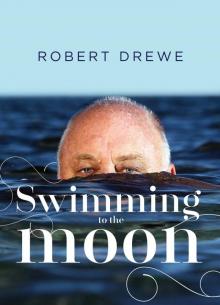
I know chip-on-the-shoulder ‘working-class’ writers with expensive boats and holiday houses. Sensibly, they’re never photographed anywhere near them. It’s safest to scowl into the camera on a moody windswept beach. Many is the shoreline I’ve been snapped on myself, frowning knee-deep in the ocean.
The alternative is to stand in a khaki work-shirt (sleeves rolled up) by the bookshelves in your publisher’s office. This is having a dollar each way: salt-of-the-earth but scholarly. You might never have actually ‘worked’ beyond writing, but in pictorial interviews you’re only a small step removed from a tiller of soil. (A grim city-alley backdrop is compulsory for younger writers. And no smiling.)
A small example of the ethos: my father sold rubber goods in a remote provincial city for a living. His mother used to sell hats in Myer’s millinery department. After the publication of The Shark Net, a memoir which outlined this family background, the first question I was asked by the chairman of a panel on The Memoir at the Melbourne Writers’ Festival was, ‘How was it growing up as part of the Establishment’s power structure?’
Before I leave the subject of my private schooling, I should say that the eight-year-old State-school boy received the news of the private-school years to come with some apprehension. The main reason was the motto emblazoned on the crest of my new cap and jacket: Duty.
As it happened, duty was the euphemism that generations of bowel-obsessed Drewe parents had used for defecation. As in (to five-year-old Robert) ‘Have you done your duty today?’ Or, too often: ‘Oh, no! The dog’s gone and done its duty on the carpet again!’
I should add (has he no shame?) that not only did I go to a private school, and take Duty as my daily maxim, but that in my last year I was school captain.
The school was an Anglican boys’ college, Hale School, the first private school in the State, a century-old limestone institution in West Perth that had indeed produced many notable characters, from explorers to State Premiers. But by my term it had fallen on hard times.
My final year was the school’s last on that campus and the student numbers, the staff morale, the crumbling buildings and the already rudimentary sporting facilities had been allowed to run down. For more than a decade the school’s funds had been channelled into the state-of-the-art Hale School which the following year would rise grandly from the grassy paddocks of Wembley Downs.
Our old headmaster, Vernon ‘Spud’ Murphy, had been invalided out against his will, and as a stop-gap measure the school was run by the deputy head, an enigmatic and often ferocious man who resembled a rhesus monkey. A.C. ‘Monkey’ Marshall was the Chief Punisher, a lean, wiry man whose abrupt rages, from standing start to foam-flecked apoplexy in a matter of seconds, and subsequent savage cane-wielding, sparked fear in hundred-kilogram farm boys and football heroes alike.
For an apt pen-picture of my year in command, imagine a particular sepia-tinted autumn afternoon. Twenty years after the German occupation of his country, and fifteen years after the formation of Tito’s republic, Ex-King Peter of Yugoslavia has let it be known he would be paying us bemused West Australian schoolboys a visit.
He was on a tour of the State to make contact with Yugoslav émigrés and to bolster anti-Communist morale. There was a growing Yugoslav community in Perth, mainly vegetable growers in Osborne Park. It included our teacher of Italian, a tall, saturnine gentleman named Dr P.V. Pusenjak, who favoured lemon-coloured, double-breasted, middle-European suits and pointy tan shoes, and looked and sounded like the suavely menacing actor Vincent Price. Dr Pusenjak had loyally invited his ex-King to address the school.
The school was slightly confused about where Europe’s continental monarchies stood at that moment. Naturally, we had turned out en masse for the Queen Mother’s two laps of Subiaco Oval in an open Land-Rover two years before. Now a (former) King wanted to visit us. As a Royal, he could hardly be knocked back.
After all the orange peels and lolly wrappers had been hastily picked up, everyone lined up on the asphalt in front of the assembly hall and awaited the visitor. Eventually Ex-King Peter arrived. He too was a tall, saturnine figure resembling the actor Vincent Price, although this wasn’t obvious at first. He was crammed, knees to chin, into the back seat of Dr Pusenjak’s green Morris, and when he extracted himself it was my duty to welcome him.
As school captain, I’d been instructed to stand on the marked spot on the threadbare school lawn where the Morris would come to a halt, and open the rear door with my left hand. As he emerged, I was to make a sweeping motion with my right arm – a gesture welcoming but suitably subservient – somewhere between a medieval courtier’s bow and Sir Walter Raleigh laying down his cloak. Then I had to snap to attention and shout, ‘School! Three cheers for King Peter of Yugoslavia!’