The deep zoo essays, p.1
The Deep Zoo: Essays, page 1


Copyright © 2015 Rikki Ducornet
Cover and book design by Linda Koutsky
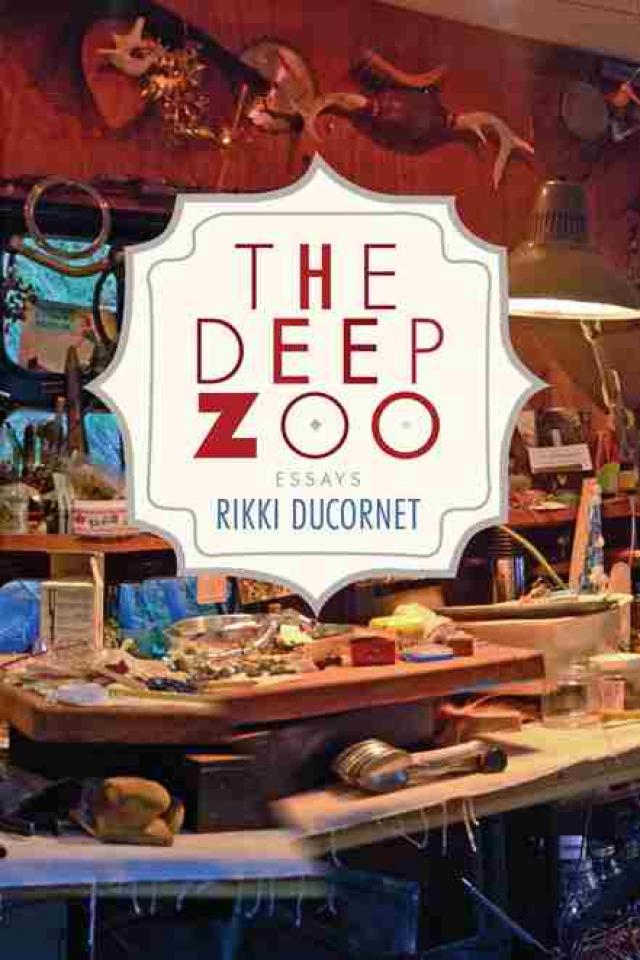
Cover image: The studio of artist Margie McDonald © Charles Wiggins
Photos in “Her Bright Materials: The Art of Margie McDonald” © Charles Wiggins
Paintings in “The Egyptian Portal: The Art of Linda Okazaki” © Linda Okazaki
Photos in “The World in a Seed: The Art of Anne Hirondelle” © Ann Welch
Photos in “The Practice of Obscurity” © Rosamond Purcell
Author photograph © George Marie
Coffee House Press books are available to the trade through our primary distributor, Consortium Book Sales & Distribution, cbsd.com or (800) 283-3572. For personal orders, catalogs, or other information, write to: info@coffeehousepress.org.
Coffee House Press is a nonprofit literary publishing house. Support from private foundations, corporate giving programs, government programs, and generous individuals helps make the publication of our books possible. We gratefully acknowledge their support in detail in the back of this book. Visit us at coffeehousepress.org.
LIBRARY OF CONGRESS CIP INFORMATION
Ducornet, Rikki, 1943– author.
[Essays. Selections]
The Deep Zoo : essays / by Rikki Ducornet.
pages cm
ISBN 978-1-56689-381-7 (ebook)
i. Title.
PS3554.U279A6 2015
814’.54—DC23
ACKNOWLEDGMENTS
I am deeply grateful to the Lannan Foundation for its support over these many years, and the many writers who have inspirited my own Deep Zoo, and who figure so prominently in this book: Bachelard, Borges, Calvino, Detienne, and Gass.
—RD
For my son, his spirited heart and music
CONTENTS
The Deep Zoo
Books of Natural and Unnatural Nature
Her Bright Materials: The Art of Margie McDonald
Houses on Fire
Water and Dreams
War’s Body
The Egyptian Portal: The Art of Linda Okazaki
Silling
Eros Breathing
A Cup and a River
Witchcraft by a Picture
The World in a Seed: The Art of Anne Hirondelle
A Memoir in the Form of a Manifesto
The Practice of Obscurity
Candles of Ink
Notes
Acknowledgments
The Deep Zoo
Writing is the uncovering of that which was unrevealed.
—GHANI ALANI, Dreaming Paradise
In the tradition of Islam, the first word that was revealed to Mohammed was Igrá (Read!). The world is a translation of the divine, and its manifestation. To write a text is to propose a reading of the world and to reveal its potencies. Writing is reading and reading a way back to the initial impulse. Both are acts of revelation.
The Ottoman calligraphers delighted in creating mazes of embellishments in which the text was secreted like a treasure. The text needed to be deciphered and the task proved the worthiness of the reader. These calligraphers' mazes remind us that if the text is the mirror of an exorbitant, mutable universe, it is playful too. The maze places the text within an intimate space, very like a garden, where the text hides, then reveals itself; perhaps it could be said such a text is irresistible. Writes Gaston Bachelard: “All the spaces of intimacy are designated by an attraction” (Poetics of Space).
The texts we write are not visible until they are written. Like a creature coaxed from out a deep wood, the text reveals itself little by little. The maze evokes a multiplicity of approaches, the many tricks we employ to tempt the text hither. The maze is both closed and open; it demands to be approached with a “thoughtful lightness” (Calvino). The powers lurking within it are like stars. Despite their age and inaccessibility, their light continues to reach us and to reveal us to ourselves.
A playful mind is deeply responsive to the world and informed by powers instilled during infancy and childhood, powers that animate the imagination with primal energies. A playful mind is guided as much by attraction as consistency and coherence—and I am thinking here of Lewis Carroll’s Looking Glass world—its consistent tyrants, the coherence of its nonsense and the energy of Alice’s fearless lucidity. The Looking Glass reminds us that the world’s maze is attractive to eager thinkers. After all, playfulness describes as much the scientist as the artist (and Lewis Carroll was both).
The idea that the world was engendered by the spoken word comes to us from Egypt. Here language flourished, mirroring and delighting in the phenomenal world. Here Paradise persisted; the gods and their creatures dwelling together in good understanding or, phrased differently, in knowledge of one another. And if the world of nature and its book indicated the divine, it also provided a place of unlimited encounters. To name a thing was to acknowledge and evoke its primary potencies—religious, medical, and magical. Plants, minerals, and animals were not only animated by the divine breath (nous), they were its vessels. Each tree, bird, river, and star was an altar, the dwelling place of a god. To gaze upon the world’s image reflected in the waters of the Nile was to gaze into and reflect upon a sacred face or body: Hathor the cow-faced goddess embodied by the moon, Horus, the falcon, perched among the reeds.
Deep in the desert, each fossil shell was seen as Hathor’s gift, tossed to earth from the sky; the fossil sea urchin’s five-pointed star needled to its back indicated its stellar origins and explains why such things are found placed near the dead in ancient tombs. To use a lovely term of Gaston Bachelard’s, such a reverie—and to leap from stone to star can only be called a reverie—“digs life deeper, enlarge(s) the depth of life.” Bachelard offers these lines from the poet Vincent Huidobro:
In my childhood is born a childhood burning like alcohol.
I would sit down in the paths of night
I would listen to the discourse of the stars
And that of the tree.
—The Poetics of Reverie
Such sympathies—the stone, the moon caught in the branches of the willow, the gods, the stars—are born of looking at the world and a deep dreaming. The ancient world of sympathies, rooted in inquisitiveness and informed by imaginative seeing, gave us marvelous aesthetic and scientific achievements; alchemy for example—that exemplary amalgam of science and poetry, that “immense word reverie” says Bachelard. It would be a mistake to dismiss such sympathies as mere foolishness, for they were born of qualities of mind that illustrate what Italo Calvino calls the “lightness of thoughtfulness” (Six Memos for the Next Millennium) and illumine his phrase: “Poetry is the enemy of chance.” The moment one reaches for the star-struck stone, the reverie begins; the moment its star is recognized as a piece of the night sky fallen to earth, the poem begins. Chance gives way to a deep seeing and the recognition of a pattern that informs the mind with light, a pattern that incandesces and burns like alcohol. If poetry is the enemy of chance, it is also the daughter of chance.
If I have chosen to open this essay with an evocation of an ancient world and its sympathies, it is because the urgencies concealed within the maze of the mind that animate our imaginations, provoke incandescence on the page. I am not calling for magical thinking, obscurity, or preciousness, but for an eager access to memory, reverie, and the unconscious—its powers, beauties, terrors, and, perhaps above all, its rule-breaking intuitions, and to celebrate with you the mind’s longing to become lighter, free of the weight of received ideas and gravity-bound redundancies. If we were scientists and not writers, we would not waste our time reinventing gravity. Speaking of a poet he especially admires, Calvino says,
The miraculous thing about his poetry is that he simply takes the weight out of language to the point that it resembles moonlight.
—Six Memos for the Next Millennium
And Bachelard:
For things as for souls, the mystery is inside. A reverie of intimacy—of an intimacy which is always human—opens up for the (one) who enters into the mysteries of matter.
—The Poetics of Reverie
The mysteries of matter are the potencies that, in the shapes of dreams, landscapes, exemplary instants, and so on, inform our imagining minds; they are powers. For Bachelard they take the form of shells, a bird’s nest, an attic; for Borges a maze, mirrors, the tiger; for Calvino moonlight, the flame, and the crystal; for Cortázar ants on the march and the cry of the rooster.
Potencies are never static but in constant flux within our minds, and what’s more, they fall into sympathy with one another. For example, for Borges, there is an evident sympathy between the tiger’s stripes, the world’s maze, language, and the maze of the mind; for Calvino, between moonlight and the lucent transparency of clear thinking; for Bachelard, between attics and a love of solitude; for Cortázar, between the cock’s cry and the knowledge of mortality, of finitude.
The world of animals is an ocean of sympathies from which we drink only drops whereas we could drain torrents from it.
—LAMARTINE
(as quoted by Giovanni Mariottini in his essay on Aloys Zötl, FMR #1)
One evening years ago, a family circus set up its shabby tent in the park of a French village—Le Puy Notre Dame—I called home. As I approached the park, I heard the sound of a powerful motor and searched the sky for an airplane—a rarity at that time in that place. The sky was empty of everything, even clouds, and the thrumming I heard was the purring of tigers. An instant later, I saw the cage and two ex quisite tigers, surely drugged; their contentment in such small quarters was uncanny. If I recall this distant evening, its circus and its tigers for you now, it is in the guise of an introduction to potencies in the shape of beasts.
For the first issue of Franco Maria Ricci’s magazine FMR, Julio Cortázar was asked to write an essay on the bestiary of a little-known and eccentric nineteenth-century painter from the foothills of the Bohemian mountains whose name is Aloys Zötl. From 1832 to 1887—the year of his death—Zötl painted 170 achingly beautiful watercolors of animals inhabiting the ideal landscapes of his imagination. Years were kingdoms: 1832 ruled by fish, 1835 by reptiles, 1837 by the gentle tyranny of birds. André Breton called his bestiary “the most sumptuous ever seen.”
Instead of describing Zötl’s bestiary, Cortázar chooses to walk us through his own Deep Zoo. His essay is titled “A Stroll among the Cages” and it is a parallel journey on a path burning like alcohol that generously leads straight to Cortázar’s own holding ground of totems, just as it prepares our eyes for the sight to come: Zötl’s lucent tigeries and tigered lucencies:
And then a cock crowed, if there is a memory it is because of that, but there was no notion of what a cock was, no tranquilizing name, how was I to know that was a cock, that horrible rending of the silence into a thousand pieces, that shattering of space throwing its tinkling glass down on me, a first and frightful Roc.
This shattering of silence precipitates the infant Cortázar into a waking nightmare that would never abandon him entirely. It informs the beasts that follow—with a vaguely menacing shimmer.
“What comes next,” writes Cortázar, “has a Guaraní Indian name: mamboretá, a name that’s long and beautiful just like its green and prickly body, a dagger that suddenly plunges into the middle of your soup or drops onto your cheek when the summer table is set,” and there is always an aunt who flees in terror, and a father who authoritatively proclaims the inoffensive nature of the mamboretá while thinking, perhaps, but not mentioning the fact that the female devours the male in the middle of copulation. And Cortázar recalls the terrible moment when the “mamboretá would become enraged” with him for past torments and look at him from its branch, accusingly. Barking frogs come next (Zötl, by the way, was especially partial to frogs, and the lion’s part of his bestiary belongs to them), and swarming ants that “pass through a house like a detergent, like the fearsome machine of fascism,” locusts whose devastation brings Attila to mind, and a couple of amorous lions, their bodies trembling “slightly with the orgasm.” Cortázar fulfills his promise to us admirably: we have strolled among the animals, although to tell the truth, there were no cages anywhere. The vision is clear, unobstructed, and hot. Cortázar has given us totemic potencies; he has given us Aloys Zötl.
Now, because I cannot offer you Zötl’s paintings, and because Cortázar chose not to describe them, the task falls to me.
The imaging consciousness holds its object (such images as it imagines) in an absolute immediacy.
—GASTON BACHELARD, The Poetics of Reverie
Immediacy is precisely the word that characterizes Aloys Zötl’s bestiary. With few exceptions, he had seen his subjects in books only, yet painted them with feverish deliberation. I imagine it was chronic and unrequited longing that drove him on, for his bestiary surges with all the kaleidoscopic opulence of a mushroom-enhanced daydream. Spangled and lucent, Zötl’s beasts have been conjured hair by hair; one can count their whiskers, their feathers, and their teeth. (One thinks of Borges’s magician, dreaming hour after hour and one by one the infinite elements that make for a living man.) Zötl’s creatures take their ease in gardens as lavish as wonder-rooms; he has packed his pictures with rarities, so that the overall effect recalls the haunting superabundance of Max Ernst’s experiments with rough surfaces and sopping rags, those hieroglyphic landscapes haunted by hierophantic loplops. Or Borgesian dream gardens, which are the amalgam of all the gardens one has ever loved. Zötl’s pictures provide a glimpse of paradise: it is a first glimpse, prodigal and unfettered. In other words, Zötl has painted the potencies of Old Time, when to name a thing was to bring it surging into the real. Even his scattered stones are poised for speech.
But—what about tigers? It seems there are none. However, there is a leopard, completed in April 1837. He is the same leopard that haunts the fables of the Maya and, as all the rest, he is meticulously painted and he is very still. Clearly he has heard a sound that has frightened him.
Perhaps he has heard, and for the first time, the crowing of a cock. And perhaps this is the writer’s task: to make audible a sound of warning—which is also the sound of awakening.
The subconscious is ceaselessly murmuring, and it is by listening to these murmurs that one hears the truth.
—GASTON BACHELARD, The Poetics of Reverie
Back to Egypt, where things and their names were not seen as separate entities, but were instead in profound sympathy with one another. These perceived sympathies are often very playful, as in this story of Isis and Seth.
Seth, in the form of a bull, attempts to overcome Isis. Fleeing, she takes the form of a little dog holding a knife in its tail and evades him. In his thwarted excitement, Seth ejaculates and his seed spills to the ground.
When Isis sees this she cries, “What an abomination! To have thus scattered your seed!”
Where Seth’s seed has fallen, a plant grows called the coloquint (or bitter apple). In ancient Egypt, the word for “coloquint” and “your seed” is one and the same.
Within a writer’s life, words, just as things, acquire powers. For Borges, Red is such a word, as are Labyrinth and Tiger. And if Beauty in the form of a yellow tiger or a red rose “waits in ambush for us” (Seven Nights), beautiful words are the mind’s animating flame.
In his essay on his blindness, Borges recalls a cage he saw as a child holding leopards and tigers; he recalls that he “lingered before the tiger’s gold and black.” Nearly blind, he is no longer able to see red, “that great colour which shines in poetry, and which has so many beautiful names,” but it is the yellow of the tiger that persists, as does its beauty and the power of its beautiful name. In his story “The Zahir,” the Tiger is the Zahir; it is the face of God, God’s name, the sound he uttered when he created the world, the “shadow of the Rose” and the “rending of the Veil” (Labyrinths). Tiger is the power that brings the unborn universe surging into the real and, what’s more, it is the name of the infinite book you and I are writing; it is the letters of each word of this book; Tiger is the calligrapher’s maze and also the text hidden within that maze.
It is the shell that tigers Bachelard—that lover of intimacy and solitude. A creature with a shell is a mixed creature; it reveals and conceals itself simultaneously. You will recall that in ancient times a fossil shell acquired the potencies of the moon. Stones of unusual shapes were empowered by Osiris also; they evoked the myth of his dismemberment and his own scattered limbs. In the myth, Isis gathers the pieces of her husband’s broken body and makes him whole; she revives him. For Bachelard, “The fossil is not merely a being that once lived but one that is still asleep in its form.” He is speaking of the “spaces of our intimacy, the centers of (our) fate”; he is speaking of our memories, those powers that, “securely fixed in space,” remain coiled within us, ready to spring and inform our lives with immediacy and our thoughts with urgency.
In his Poetics of Space, Bachelard writes:
We have the impression that by staying in the motionlessness of its shell, the creature is preparing temporal explosions, not to say whirlwinds of being.
And in The Poetics of Reverie:
The passionate being prepares his explosions and his exploits in . . . solitude.
The shell, the yellow tiger, the crowing cock, the moon—these are the potencies in which time is compressed in the form of memories. To write is to engage a waking dream, to, in solitude, prepare a whirlwind. Says Bachelard:
Daydreams illuminate the synthesis of immemorial and recollected. In this remote region, memory and imagination remain associated, each one working for their mutual deepening.