Enemies, p.1
Enemies, page 1
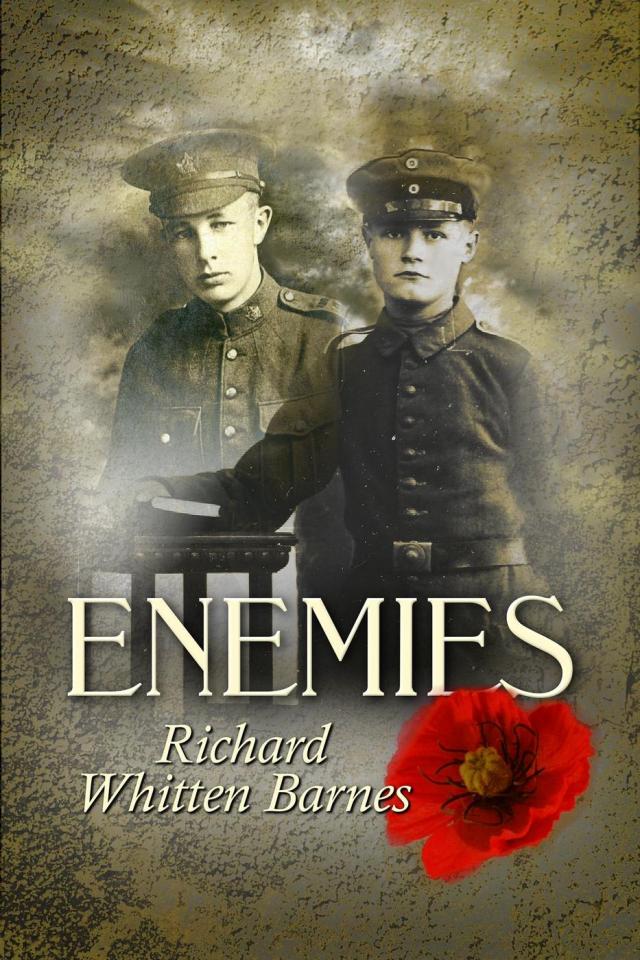


ENEMIES
Richard Whitten Barnes
A Wings ePress, Inc.
Historical Novel
Edited by: Jeanne Smith
Copy Edited by: Camille Netherton
Senior Editor: Jeannie Smith
Executive Editor: Marilyn Kapp
Cover Artist: Trisha FitzGerald
All rights reserved
Names, characters and incidents depicted in this book are products of the author’s imagination or are used fictitiously. Any resemblance to actual events, locales, organizations, or persons, living or dead, is entirely coincidental and beyond the intent of the author or the publisher.
No part of this book may be reproduced or transmitted in any form or by any means, electronic or mechanical, including photocopying, recording, or by any information storage and retrieval system, without permission in writing from the publisher.
Wings ePress Books
http://www.wings-press.com
Copyright © 2015 by Richard Whitten Barnes
ISBN 978-1-61309-822-6
Published In the United States Of America
Wings ePress Inc.
3000 N. Rock Road
Newton, KS 67114
Also by Richard Whitten Barnes
Andy Blake Mystery
Bad Medicine
A Scent of Almond
Cult
The Inheritance
Standalone
Brink
Enemies
Table of Contents
Title Page
Copyright Page
Also By Richard Whitten Barnes
Enemies
In Memory Of
In Flanders Fields
One
Two
Three
Four
Five
Six
Seven
Eight
Nine
Ten
Eleven
Twelve
Thirteen
Fourteen
Fifteen
Sixteen
Seventeen
Eighteen
Nineteen
Twenty
Twenty-one
Twenty-two
Twenty-three
Twenty-four
Twenty-five
Twenty-six
Twenty-seven
Sign up for Richard Whitten Barnes's Mailing List
Also By Richard Whitten Barnes
About the Publisher
Dedication
To the brave men of the Canadian Expeditionary Forces and the over four thousand from the Algoma, Ontario region who served.
In Memory Of
George H. Luehmann,
463d Regiment, 238th Infantry Division,
Imperial German Army
Robert W. Barnes
151st Artillery, 42d (Rainbow) Division
American Expeditionary Force
Acknowledgements
Two sources for researching ENEMIES were invaluable:
History of German WWI Divisions
U.S. Army War Office
1920
Canadian Expeditionary Force
1914-1919
Colonel G.W.L. Nicholson, CD
THE ABOVE SOURCES KEPT me true to the actual facts of the war, but it is through personal accounts that life is breathed into a story. I want to especially thank Jackileen Raines, Jeanne Basteris, and Holly Pook Sachdev for contributing background, documents and letters from their families. Carrie Uusitalo of the St. Joseph Island Museum was helpful as well.
Author’s Note
November 11, 2018 will mark the hundredth anniversary of the end of World War One; “The War to End All Wars.”
Yet, twenty years after the armistice Europe and Asia were on the threshold of another war exemplifying the treachery and hubris of man. The human species seems to have learned little since.
The “Great War” caused the deaths of ten million young men before they had a chance at life. A similar number were wounded under conditions unspeakable by today’s standards of hygiene and medicine. Few readers of this generation have a clear idea of the hardships endured in that conflict. It is for that reason and the approaching anniversary that I set this as the era for Enemies.
I have chosen to tell the stories of two boys, both from similar backgrounds but separate allegiances to emphasize the blamelessness of all those young men sent so easily into peril by generals and politicians.
While Enemies is in no sense biographical and entirely fiction, I have done my best to adhere to the actual events and time line of the war on the western front. Dialogue and situations attributed to non-fictional characters are purely imaginary.
RWB
In Flanders Fields
In Flanders fields the poppies blow
Between the crosses, row on row,
That mark our place; and in the sky
The larks, still bravely singing, fly
Scarce heard amid the guns below.
We are the Dead. Short days ago
We lived, felt dawn, saw sunset glow,
Loved and were loved, and now we lie
In Flanders fields.
Take up our quarrel with the foe:
To you from failing hands we throw
The torch; be yours to hold it high.
If ye break faith with us who die
We shall not sleep, though poppies grow
In Flanders fields.
Lt. Colonel John McCrae
1872-1918
Principal Locations
One
November 11, 1968
Ottawa, Canada
Jürgen Stern had a clear view of the man from his breakfast table, and was fascinated. Possibly it was the red poppy on the gentleman’s camel topcoat. It might have been because he looked to be close to Stern’s own age of seventy. The man sat alone in the lobby of the Chateau Laurier Hotel, white hair under his fedora, a cane by his side, glancing repeatedly at his watch.
The flower wasn’t unique on this eleventh day of November. The Canadians were even more patriotic than the Brits about the armistice of 1918. Remembrance Day poppies were on jackets and coats everywhere in the hotel and on the street this morning. It was the fiftieth anniversary of the signing.
“...and some more coffee, sir?” The waiter held a full pot at the ready.
“Please.”
The act blocked his view of the lobby for mere seconds. When the cup was poured, the man in the lobby had left, probably to meet his appointment.
Stern was disappointed for some reason, and wasn’t sure why. He continued to watch the vacated seat as he finished his coffee and signed his room number for the bill.
“DAD! OVER HERE!” A black Volvo sedan was double-parked just past the taxi stand. A stylishly dressed woman in her forties waved from the open driver’s door. “Where are your bags?”
“Just there, Melanie.” The man in the fedora motioned to a bellman’s cart.
Brian MacLennan loved his hard-charging lawyer daughter, but she could sometimes be a pain in the ass, and he knew he’d get a scolding for not being there waiting as she pulled up. It would be a long week, he thought, with her acting as the family matriarch at his son’s wedding.
The bags were loaded and they were soon headed north out of the city. At once, Melanie was into relating the myriad of obstacles in the way of planning a rehearsal dinner at the bride’s family summer home on Lac Saint Pierre, where it stood an hour north of the city, and from anywhere else. “What the hell were they thinking, having a November wedding at a summer cottage?”
“It’s more of an estate than a cottage, I hear,” Brian said. “Besides, you have four days to get it right.”
Melanie had found a job in the government for her younger brother two years earlier. In the meantime he had met, and fallen in love with the daughter of a politically prominent Quebec family.
Brian let her go on while his mind drifted. He’d stayed overnight at the Laurier after flying up from Toronto to meet his daughter. She had suggested the sketches he made while serving with the Canadian Expeditionary Force in the First War as a wedding gift for his son. Colin had always loved looking at them.
Actually, it was a fine idea. They would mean a lot to Colin, so that was good. It had been years since Brian had looked at the drawings, and last night he’d stayed up late in the hotel room arranging them by date. Now, he wished he’d placed them in an album, or something more suitable as a gift than the battered old portfolio where he’d always kept them.
THEY’D BEEN ON THE road for almost an hour before Melanie mentioned the drawings. “You did bring them, didn’t you?”
“Of course.” He glanced at the rear seat where his top coat and cane lay. Not there. In the trunk with his bags? He began to worry. Melanie in her own annoying way had begun chiding him about not paying attention to details since his wife’s passing three years ago. He’d be damned if he was going to say anything about the drawings until he was sure. She’d insist on stopping to check the trunk. And then what if they weren’t there? She’d make a fuss and be all over him for his carelessness. If they’re not in the trunk, the hotel will have them.
“DOCTOR STERN.” THE man at the desk remembered his name from checking him in the previous day.
“Ah...yes,” Stern smiled at the recognition. He placed a brown, time-worn portfolio on the counter. “It seems this was left in the lobby by a gentleman, but I don’t see him. Perhaps if you keep it, he will return for it.”
“There’s no identification?”
“Not on the outside.”
The deskman hunched his shoulders. “Well, then...”
Stern hesitated, but undid the string closure. Sure enough, inside the flap was an adhesive label bearing the address of a Toronto Company: MacLennan, Esposito, and Assoc.
“Let me check,” the clerk said. “Yes. A Mr. Brian MacLennan checked out this morning. Would you like us to keep this?”
Stern hesitated, then declined; possibly due to the way he’d felt intrigued by the man—drawn to him. “I may have time to try contacting Mr. MacLennan after all.”
Actually, he didn’t. A week ago he’d received a call in his Bonn apartment from German Chancellor Kiesinger himself, requesting Stern to fly to Ottawa, and use his personal friendship with Canada’s new Prime Minister, Pierre Trudeau, to pave the way for next January’s trade talks between the two countries. He was due at Trudeau’s chambers in an hour. The forgotten parcel would have to wait.
THE FALL COLORS HAD left the maples, and the leaves were falling in earnest. The Volvo entered the long driveway. Melanie tapped the Volvo’s horn, and they came to a stop on the circular drive. A touch football game of half a dozen men and young boys was in progress on the lawn. Brian stepped out of the car, feeling his stiff leg complain from the trip. He took a moment to stretch it out while Melanie popped the trunk.
The drawings. He walked around to look inside the trunk. Not there. Damn!
“Dad!” Colin MacLennan strode away from the game, flashing his patented smile. He gave his sister a brotherly embrace and shook his father’s hand. “Let me have your bags. I’ll show you your room.”
They chatted on the way; mostly Colin asking about the older man’s health, and the trip up from Toronto.
Brian watched his athletic son effortlessly scale the stairs with a bag in each hand. He followed, feeling his own stiffness, convincing himself it was the damn knee, and not his seventy-two years that made him so goddam tired.
They arrived at a guest room overlooking the rear of the house and the lake.
“Quite fancy,” he said. “Hardly a cottage.”
“No,” Colin said, and left it there.
Brian appraised his son for a few seconds, amazed how he reminded him of his brother Owen as a young man. “Your mother and I weren’t sure you’d ever find the right girl.”
“Thirty-six isn’t that old. You were that age when I was born.”
“Point taken. I’m looking forward to meeting Pamela’s family.” They stood there in awkward silence. “Well...look, I need to make a call.” Brian pointed to an ornate-looking telephone. “Does that thing work?”
“Sure. Why don’t you unpack and get comfortable? There are drinks on the rear patio in an hour...casual. You can meet the clan.” Colin closed the door as he left.
Brian retrieved the hotel check-out receipt from his jacket and dialed the toll-free number.
“Front desk, please.” He waited, wondering why it should take so long.
“Desk. This is Warren. How may I be of assistance?”
Brian explained having left a brown portfolio in the lobby at 7:30 this morning.
“I wasn’t on duty until eight, sir, but let me check.”
More waiting.
“I have nothing turned in, sir. Perhaps someone from the earlier shift will remember something. We have your address on file if we learn anything.”
Brian replaced the phone, imagining how unlikely that would be. His first concern was not having the drawings to give to Colin and the flack he’d take from Melanie. The sketches had no monetary value, he was sure. But now that they were lost, he realized how precious they were to him.
STERN WAS EXHAUSTED. The meeting had turned out to be much more than two old friends talking. Trudeau had his Trade Minister and two deputies in tow. They had been tipped off about Opel’s interest in building a plant in Canada. Canada had grain and energy to sell, but wasn’t sure if West Germany had the buying power or markets to compensate for the dollars that would be flowing back into Europe from the new plant. They had held his feet to the fire all afternoon.
Besides that, he was still fatigued by the trip from Bonn. He’d arrived in Montreal expecting a limo for the drive to Ottawa, but through a fluke, the car didn’t show. Instead he caught the train, expecting to arrive at Union Station, a short walk to the hotel’s lobby. But the city had decommissioned the building and erected a new Tremblay Road Station an annoying cab ride away.
Following the meeting, it was past 4 PM when he arrived in his room with the prospect of another session in the morning. Scheisse! He was too old for this! He’d tried to retire two years ago when Ludwig Erhard left office, but Kiesinger prevailed on him to stay on until he could find a suitable replacement in the Trade Commission.
The portfolio on his room desk reminded him he’d expected to trace the address of the owner this afternoon, but Trudeau’s protracted meeting scotched that. Possibly there was more inside that would be a hint to the owner’s destination this morning. Once more he unwound the string fastening.
Inside were drawings, dozens of them. Some were in ink, but most were pencil sketches, all spectacular in their realism and detail. One or two of them had been colorized. There were interiors, portraits, landscapes, and building exteriors. Many of the sketches were on standard, stiff writing paper, but also on small card stock, half as big.
The next thing Stern noticed were the dated initials BDM and title of each drawing in neat script. The drawings were in chronological order, ranging from June 1915 to October three years later. The first few were portraits. One of a man and a woman titled Jocelyn Farm 6/1915; he, with an axe at a chopping block. She was clutching something in her apron...hen’s eggs? They faced each other, rather than the artist. A portion of a wooden farmhouse lurked in the background. Another sketch of a stocky young man, Owen 4/1915; another portrait of a young dark-complexioned boy in army uniform titled, H. Gardinier 3/1916. There was an April 1916 drawing of a building with the title, Gouin St. Arena. Here was a portrait of another boy in uniform, his light colored hair showing under his cap. Stern was drawn to the face. The signature read: George K 5/1916. Like the one of the Arena, and a number of others, it was done on good quality writing paper that carried an embossed CRC over a block-shaped cross. Canadian Red Cross?
Next in the chronology was a panoramic view of a field dotted with hundreds of tents. It was from a perspective of height, allowing detail of the nearest objects and the vastness of the expanse at the same time. It was brilliant. This one was dated 7/1916, entitled Niagara Camp.
He was impressed with the quality of the work. The portraits gave more than a sense of what the subject looked like; they seemed to look inside the person. He seemed to capture the subject’s character, his worth as a human being. The landscapes and buildings were realistic to be sure, but they also told a story: a filthy doll left on the stoop of a gutted house, the pall of war haze over what once must have been a tranquil field. Then there were the depictions of the dead, so gruesome in their realism, yet no hint of voyeurism. These were poignant memorials to wasted youth.
There was no doubt. The drawings were a soldier’s memoir of the Great War. They struck a chord that resonated with his own experiences of the time. He continued to peruse the collection until he came upon one that seemed somehow familiar. He reached to remove it from the others when it flipped over, revealing its opposite side. What he saw caused him to audibly gasp.
“GOOD DAY, Bonjour, MacLennan, Esposito.”
Stern was about to state his business when the recording continued, “If you know your party’s extension, press one. Otherwise press ‘O.’ Si vous connaissez l'extension de votre partie , appuyez sur l'une. Sinon, appuyez...”
He punched the zero.
“Good afternoon, MacLennan, Esposito. How may I direct your call?”
“Is Mr. MacLennan available, or perhaps one of his associates?”