The end of always, p.1
The End of Always, page 1


Library and Archives Canada Cataloguing in Publication
Title: The end of always / Rebecca Phillips.
Names: Phillips, Rebecca (Young adult author), author.
Identifiers: Canadiana (print) 20230515983 | Canadiana (ebook) 20230515991 | ISBN 9781772603712 (softcover) | ISBN 9781772603798 (EPUB)
Subjects: LCGFT: Novels.
Classification: LCC PS8631.H558 E53 2024 | DDC jC813/.6—dc23
Copyright © 2024 by Rebecca Phillips
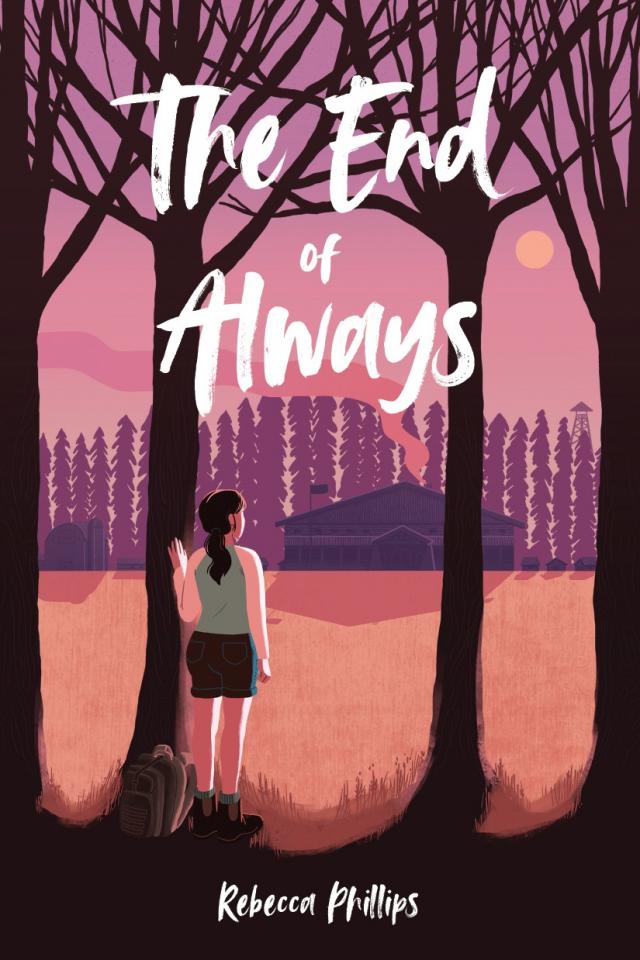
Cover illustration by Erin McCluskey
Edited by Erin Della Mattia
Designed by Laura Atherton
Printed and bound in Canada
Second Story Press gratefully acknowledges the support of the Ontario Arts Council and the Canada Council for the Arts for our publishing program. We acknowledge the financial support of the Government of Canada through the Canada Book Fund.
Published by
Second Story Press
20 Maud Street, Suite 401
Toronto, ON
M5V 2M5
www.secondstorypress.ca
“A fast-paced portrait of grief and growth, The End of Always illustrates the complexities of what happens to a family when a parent’s societal fears shadow their children’s lives. Thoughtful and moving, Phillips’s narrative touches on themes of first love, sisterly bonds, and what it means to come of age.”
—Joan F. Smith, author of The Other Side of Infinity
In loving memory of my dad, who is always with me
Chapter One
“Isobel.”
The needle slips and pierces my skin. With a surprised yelp, I drop everything and stick my injured finger in my mouth, soothing the sting.
“Oh, crap, sorry,” my father says from behind me. “I didn’t mean to sneak up on you.”
Finger still in my mouth, I turn to see him standing in the doorway to the kitchen, his black shirt covered in wood shavings. For a big guy, he moves around the house with the stealth and grace of a ninja.
“It’s okay.” I squint at the tiny red hole. “Not the first time I’ve stabbed myself with a beading needle.”
My father, ever prepared, strides over to the first aid drawer for a Band-Aid and a tube of antibiotic cream. He places both beside me on the kitchen table, then peers at my latest project. “That’s looking nice.”
I shrug and pick up the half-finished crystal and pearl ladder wrap bracelet. The intricate design is tough, but I had a good rhythm going before Dad sprung up behind me. “Claire asked for a new one. Hopefully, the leather cord will hold this time.” My best friend has broken or lost every piece of jewelry I’ve ever made her. Probably because she forgets to take stuff off before her games. At least three other bracelets are buried in the soccer field behind our high school.
Dad stands there for a moment, absently stroking his beard. There’s a red mark on the bridge of his nose from his dust mask. He was woodworking in the garage—probably making more shelves for the basement—before he came to find me.
“Did you need me for something?” I ask, dotting some antibiotic cream on my fingertip. I do this for his sake. Unlike him, I’m not worried about infections or blood poisoning or any other condition that probably won’t happen from a harmless little needlestick.
Dad blinks twice, like he’s struggling to remember why he’s standing in the kitchen with me. “Oh,” he says. “Yes. I need you to watch April this afternoon. I have a meeting.”
I wrap the Band-Aid around my finger, even though it’s fine now. “On a Sunday?” My dad is an estimator for a real estate company that develops apartment buildings in the city, so he has meetings with construction people all the time. But not usually on the weekends. Saturdays and Sundays have always been for us—my sister April and me, and our mom when she was still alive.
Dad goes to the sink to wash his hands. “Not a work meeting,” he says, his back to me. “There’s a workshop at the community center. Intro to portable solar power.”
I press my lips together and pick up my bracelet again. Portable solar power. Last year, he attached solar panels to the roof of the house, but even that’s not enough for him anymore. Now he needs to know how to harness the sun everywhere. “I guess I can stick around,” I say.
“Great.” He dries his hands with a dish towel. “She’s in the backyard with Rana. I’m gonna go grab a shower. Keep an eye on her, okay?”
“Okay,” I say, even though I’m not worried about her playing in our fenced backyard. The kitchen window is open, so I can hear her giggling.
After he leaves, I go back to my bracelet. I’m almost finished by the time April bursts into the house, the screen door slamming shut behind her.
“Rana had to go home for dinner,” she announces. Rana is her best friend…on our street. She has a dozen more best friends at school. “When are we eating? I’m hungry.”
I look her over. She’s red-cheeked and sweaty from running around beneath the warm May sun, her hair a tangled mess. I sigh. I’ll be the one combing out those knots before her bath later because she hates the way Dad does it. She doesn’t particularly like the way I do it either—Mom always had the magic touch with tangles. Probably because she had the same hair as April—thick and curly. Beautiful. I remember the day it started falling out during her chemo treatments. It was the first time I’d seen her cry over her cancer diagnosis, looking at that blond clump of hair in her hand.
I push away the memory and check my phone. It’s almost five. Dad should be home soon.
“Well, then,” I say, wiping a smudge of dirt off April’s chin. “Let’s start dinner.”
Weekends are frozen food days in the McCarthy house. On weekdays, I usually throw together something involving some kind of vegetable, but on weekends, it’s pizza or burgers or, when April gets her way, chicken nuggets. Today she gets her way.
“What do you want on the side?” I ask once the nuggets are in the oven.
She thinks about it for a minute. “Canned corn,” she says. Her face lights up. “Can I get it by myself?”
“Sure.”
She darts for the basement door. For some reason, she loves going down into Dad’s storeroom, an eight-by-ten-foot space lined with custom shelves he built himself in the garage. One of Dad’s hobbies is stocking up on whatever nonperishables are on sale. Three of the shelving units are stacked with food—cans and boxes and bags, enough to feed us for at least a year. The other shelf is for things like matches, lanterns, candles, and first aid items. The basement supplies aren’t meant to be used, but Dad replaces whatever we take anyway.
The nuggets are half-done by the time she returns, canned corn in hand. “There are thirty-six cans of tomato soup,” she tells me.
No wonder she took so long. “Wow. That’s almost enough to fill up your pool.”
She giggles, which turns into a cough. I frown. The basement dust isn’t good for her allergies. “Are the chicken nuggets ready yet?”
“Almost.”
I give her the job of gathering condiments and drinks while I take care of the corn. Dad gets home just as we sit down at the table.
“Hi, Daddy,” April says as she dumps about half a cup of ketchup over her food. “We have thirty-six cans of tomato soup.”
Dad goes over to the stove and plops a few chicken nuggets onto a plate. “Is that so? I’d better go shopping then.”
April laughs: it doesn’t take much to entertain a six-year-old.
“Sorry I’m late, girls,” Dad says, sitting across from me. “I got talking to the guy who ran the workshop. He knows everything there is to know about solar power. There’s this portable lithium power station that can keep all your devices and appliances charged for days.”
“Why do we need that?” April asks. “We have power.”
Dad’s eyes gleam like they do whenever he’s learned something new. I look away. “We have power right now, Sunshine, but there might come a day when we don’t.”
His nickname for her is so fitting. With her glossy hair and bright smile, she’s like sunshine in little-girl form.
“Like when we had the hurricane?”
I raise my eyebrows, surprised she remembers. Two autumns ago, a couple of months after Mom died, we were hit with a Category Two hurricane that downed dozens of trees and knocked out power for days. Dad went a little bonkers securing the house beforehand, boarding up windows and hoarding packs of bottled water. During the worst of the storm, we hid out in the basement and played board games until the wind stopped shaking the house. In the end, the only damage we suffered was a broken lawn chair. For me, Dad’s wild-eyed intensity was more memo-rable than the storm itself.
“Right, like the hurricane,” he says. “Or something worse. You know, with climate change, extreme weather events are becoming more frequent and—”
“Dad,” I cut in, “do you want some more corn?”
“You can eat as much as you want,” April adds. “We have seventeen cans downstairs.”
He looks at her, and I wonder if he’s actually seeing her or imagining something else entirely. “We need to be ready,” he says. It’s like he didn’t even hear us.
After dinner, Dad goes back to the garage while April and I make instant chocolate pudding for dessert. We take turns using the mixer, then I pour the finished pudding into dishesâ€
“Should we do whipped cream on top?” I ask.
April nods solemnly, like this is serious business, so I dig around for Mom’s recipe book. She used to jot down recipes into a blue coil notebook, and I know there’s one in there for a decadent, peanut butter–flavored whipped cream. We made it together once, for a chocolate pie.
I finally find the notebook in the cupboard above the fridge. My heart clenches a bit when I see Mom’s neat printing. Almond tarts, tomato sauce, taco soup, lemon cake…. I flip through the pages, past all the meals and treats she made or thought about making, until I get to a page that’s not a recipe at all. Or her handwriting. I recognize Dad’s distinct, slanted cursive.
He’s written lists. Rows upon rows of items, each with a different header. Food. Utensils. Clothing. Tools. Medicine. Weapons.
My mind scrambles to make sense of what I’m looking at. When did Dad write these? And why in Mom’s recipe book?
I glance toward the door to make sure he’s not about to walk in and flip to another page, expecting to see more lists. Instead there’s some sort of rectangular diagram, like a blueprint, neatly sketched and labeled in pencil. It looks like a room or very small apartment, complete with a couch, a tiny kitchen, two bunk beds, and a little squared-off space for a bathroom. I squint at the cramped printing. Food/supplies, storage, shelving, stairs, entrance—each word accompanied by a little arrow pointing to its designated spot in this…what is this?
Outside the rectangle are the words Air filtration system. But why would this room need an air filtration system?
Then it hits me. It’s because it would be underground.
My father has drawn up plans for an underground bunker.
Chapter Two
I stay up until after midnight finishing Claire’s bracelet. Focusing on the intricate knotting pattern is the only thing I can do to keep my mind off of the recipe book.
Until I go to bed, where there’s nothing to do but think. My body feels tired, but my brain is wide awake with images of canned goods and respirator masks and tactical knives. All the things on my father’s lists. Sweat gathers on my skin, and I kick off the blanket. He’s cataloged exactly what we would need to survive a real apocalypse.
I finally drift off around two a.m., lulled by the patter of rain on my window. The next morning, it’s pouring and my limbs are heavy with exhaustion. Claire’s car appears in the gloom and I sprint, trying not to get soaked as I throw myself into her messy landfill of a front seat. I shake out my hair, dripping water all over her dashboard. Oops.
“So, I’m freaking out,” she says as we pull away. Our rides to school are routine at this point, and she’s not one to bother with small talk. “Ms. Grandy posted the grades for that precalc unit test we had last week. You know, the one I thought went pretty well?”
I lift my head and try to look alert. “And did it?”
“No.” Claire flicks the wipers to the highest speed. “I got a seventy-six, Iz. A seventy-six. It brought my grade down like five points. And we have the final exam coming up, which is worth thirty per cent.”
“You’ll do fine,” I say calmly. The tightness in my stomach releases a little. Listening to my best friend spiral over school feels normal and familiar, and comforting her is making me feel better, too. “It’s next year that really matters anyway. Colleges don’t care about your junior year grades unless you’re applying early. So it’s not worth worrying about.”
She glances at me, eyes wide. “I am applying early. Aren’t you?”
“I mean, yeah. Probably. But art school focuses more on the portfolio. I don’t really need to worry about precalc.” I shrug.
Sometimes I wonder how Claire and I ever got to be friends. She takes advanced sciences and math and gym; I take art and design and the bare minimum of everything else. She wants to go to a good college and study civil engineering; I’m not even entirely sure what that is. I want to go to art school and study jewelry design and metalsmithing. She’s athletic and slim with thick auburn hair; I inherited my mom’s wide hips and incoordination and my dad’s dull brown hair and slightly-too-big nose. If the proximity of our lockers hadn’t thrown us together daily in ninth grade, we probably never would have gotten close.
“You amaze me, Isobel,” Claire says with a shake of her head. “How do you do it? How do you not worry about the future?”
“Because the future is unpredictable,” I reply. “Things change. Plans go awry. Forty-one-year-old moms die of cancer. The way I see it, worrying about what may or may not happen is pointless.”
Claire nods. “Good point.”
She parks the car as close as possible to the school, but we’re still dripping by the time we get inside. Her first class is right across from my locker, so we head there.
“Are you okay?” Claire asks as we shoulder our way through the hallway crowd.
“Yeah, why?”
“Because your concealer isn’t enough to hide those dark circles and you didn’t even notice Miguel walking by.”
I blink and glance behind me, but Miguel—Claire’s friend and the focus of a tiny unrequited crush I’ve been harboring for weeks—has been absorbed into the crowd. “Oh, I almost forgot,” I say, sidestepping her concern. “I have something for you.”
I wait until we’re at my locker, then I unhook my backpack from my shoulder and unzip the front pocket. Inside, wrapped in several pieces of tissue paper, is the ladder wrap bracelet.
Claire’s face lights up. “Oh my God, it’s gorgeous. Thank you.” She carefully slips the bracelet onto her narrow wrist. “You’re so talented, Iz.”
I smile. “Just try not to lose it on the soccer field.”
The bell rings, and I have only three minutes to get to English on the opposite side of the school. I fling open my locker to stow my jacket and gather my things, an action that’s usually automatic for me. But today, I just stand there, frozen and staring.
The long rectangular shape seems to contort into neat lines and sharp corners, carefully drawn in pencil. Suddenly, I’m overcome by a strange suffocating feeling as I stare into the small space. My dented locker fades away, and I see a room—four walls, a low concrete ceiling, metal bed frames, a tiny kitchen. A bunker.
My lungs constrict as if I’m in that room right now, the air getting thinner until there’s barely enough left to draw a breath. The damp earth surrounds me, pressing me deeper underground, so strong I’ll never break free from the weight of it. Trapped.
Last fall, Dad “gifted” April and me with bug-out bags. Maybe I should’ve known then that my father had turned a corner in his quest for preparedness. For months, half my closet has been taken up by an extra-large tan backpack, its sides bulging with enough emergency survival supplies to keep me going for seventy-two hours after disaster strikes. Until now, I’ve mostly ignored its hulking presence in my room, hiding it when Claire comes over because I don’t want her to know how excessive my dad can be. But after yesterday, I can’t help wondering how far he’ll go to protect us from some hypothetical apocalypse.
As far as drawing up plans for a bunker, apparently.
Would he actually build that thing? In our backyard? And what does he think is going to happen to us that we’d need a hidden, underground fortress?
“Iz? You okay?”
I look over at Claire, shoving the strange feeling down as fast as it came up. I could talk to her about Dad—she was there for me two years ago during the horrible months Mom was sick, and the even more horrible months after she died—but how would I even explain it to her? I don’t want people to think of my father as some weirdo in a tinfoil hat.
“I’m fine,” I say. When I look at my locker again, it’s back to being just a dented old locker.
Chapter Three
I’m packing up my supplies after art class when Ms. Sheridan appears beside me. “Isobel,” she says with her usual lively enthusiasm. My art teacher radiates pep, the kind that comes from way too much caffeine. “Your final project is coming along great.”
I smile. “Thanks.”
The theme of our final project is mixed media art. Mine is a silhouette of a bird, cut from a piece of newspaper and surrounded by color-pencil sketches of feathers and old-fashioned cages. I still need to add in a tree branch for its perch—which I’ll do in acrylic paint—but so far I’m pleased with how it’s shaping up.