I disappeared them, p.1
I Disappeared Them, page 1


More Critical Praise for Preston L. Allen
for Jesus Boy
“Heartfelt and occasionally hilarious, Jesus Boy is a tender masterpiece.”
—Dennis Lehane, author of Small Mercies
“Generations of illicit sex run through this clever and wide-ranging book in which the flesh always triumphs … Surely no one does church sexy like Allen … Allen’s writing by turns is solemn and funny … It would be easy for Jesus Boy to become fluffy satire but Allen keeps his characters real.”
—New York Times Book Review
“Allen has created a consummate tragicomedy of African American family secrets and sorrows, and of faith under duress and wide open to interpretation. Perfect timing and crackling dialogue, as well as heartrending pain balanced by uproarious predicaments, make for a shout-hallelujah tale of transgression and grace, a gospel of lusty and everlasting love.”
—Booklist
“Jesus Boy is one of those books that makes you sit up and go … WHAT? No novel should be this enthralling. With a mesmerizing style, Preston L. Allen offers sentences that you reread because of their sheer enchantment and sense of wonder they invoke … in magical prose that lights up the pages. This is a novel unlike any I’ve ever read and among the very best of the decade. What a joy to read a book you can truly call a contemporary classic.”
—Ken Bruen, author of The Guards
“Ten More Titles to Read Now: Think African American Romeo and Juliet, as played out in a devout Christian community.”
—O, The Oprah Magazine
“This latest from Allen is hilarious … Scenes of preaching and singing in the church convey the boisterous fervor of African American gospel music and religious practice in a soulful, vibrant style … This is a very enjoyable and well-done novel; highly recommended.”
—Library Journal
“A riveting story of star-crossed love, Jesus Boy plumbs the hypocrisies and impossible stringencies of evangelical America with humor and no small amount of pathos. This novel is definitely a guilty pleasure.”
—Cristina García, author of Dreaming in Cuban
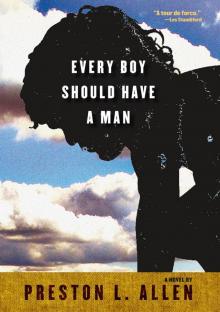
for Every Boy Should Have a Man
“Allen … throws caution to the wind with his bizarre but exquisitely composed fable that uses transhumanism as the prism to reflect on the nature of humanity … Much like Pierre Boulle’s 1963 novel Planet of the Apes, this novel is a sardonic parable on the nature and destiny of the species. A nimble fable whose bold narrative experiment is elevated by its near-biblical language and affectionate embrace of our inherent flaws.”
—Kirkus Reviews
“Imaginative, versatile, and daring, Allen raids the realms of myth and fairy tales in this topsy-turvy speculative fable … With canny improvisations on ‘Jack and the Beanstalk,’ ‘The Epic of Gilgamesh,’ and Alice in Wonderland, Allen sharpens our perceptions of class divides, racism, enslavement, and abrupt and devastating climate change to create a delectably adventurous, wily, funny, and wise cautionary parable.”
—Booklist
“Allen’s concise book’s power lies within its understated irony, never more heavy-handed than a preacher’s admonition that ‘a world without mans is a world without us all.’ The plain narrative and relationship between boy and female man, rounded out with humor and occasional (sometimes literal) bite, promises to be a sleeper favorite among speculative audiences.”
—Publishers Weekly
“An imaginative and honest epic, weaving together biblical stories, fantasy, poetry, and fairy tales with a touch of realism … Allen asks us to question the assumptions, -isms, and contradictions of the modern world … Recalling the humanitarian concerns of Octavia Butler’s Fledgling and the poetry of Ovid’s Metamorphosis, this book will appeal to readers of literary fiction and fantasy.”
—Library Journal
“Allen has crafted a highly imaginative, unsettling work of social satire that … utilizes a speculative fable as a way to muse on race, slavery, civil rights, and even climate change … Every Boy Should Have a Man is James Baldwin meets Aldous Huxley, a twisted contortion of a weird fairy-tale future gone wrong, all told from high atop the mountain in a sort of New Testament prose. As the mixologist of this mad and unpredictable genre tableau, Allen has navigated into wholly uncharted territory. He comments on everything from slave ownership to pet ownership to the way we treat our planet and ourselves. His novel is ambitious yet understated, cautionary while rarely politically preachy. Every Boy Should Have a Man is that rare novel that is derived from such a disparate scope of literary influences that it waxes entirely original.”
—Chicago Tribune
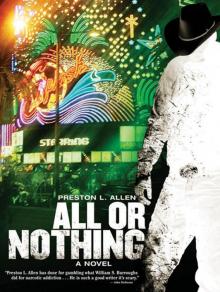
for All or Nothing
“As with Frederick and Steven Barthelme’s disarming gambling memoir, Double Down, the chief virtue of All or Nothing is its facility in enlightening nonbelievers, showing how this addiction follows recognizable patterns of rush and crash, but with a twist—the buzz is in the process, not the result … As a cartographer of autodegradation, Allen takes his place on a continuum that begins, perhaps, with Dostoyevsky’s Gambler, courses through Malcolm Lowry’s Under the Volcano, William S. Burroughs’s Junky, the collected works of Charles Bukowski and Hubert Selby Jr., and persists in countless novels and (occasionally fabricated) memoirs of our puritanical, therapized present. Like Dostoyevsky, Allen colorfully evokes the gambling milieu—the chained (mis)fortunes of the players, their vanities and grotesqueries, their quasi-philosophical ruminations on chance. Like Burroughs, he is a dispassionate chronicler of the addict’s daily ritual, neither glorifying nor vilifying the matter at hand.”
—New York Times Book Review
“Dark and insightful … The well-written novel takes the reader on a chaotic ride as … Allen reveals how addiction annihilates its victims and shows that winning isn’t always so different from losing.”
—Publishers Weekly
“A gambler’s hands and heart perpetually tremble in this raw story of addiction. ‘We gamble to gamble. We play to play. We don’t play to win.’ Right there, P, desperado narrator of this crash-’n’-burn novel, sums up the madness … Allen’s brilliant at conveying the hothouse atmosphere of hell-bent gaming. Fun time in the Inferno.”
—Kirkus Reviews
“Allen has done for gambling what William S. Burroughs did for narcotic addiction. He’s gotten into the heart of the darkness and shown us what it feels like to be trapped, to be haunted, to live without choice. Allen is relentless and unsparing in his depiction of the life of a gambling addict, from the magical thinking to the visceral thrill of risking it all. And now the world will know what we in Miami have known for a long time: Preston L. Allen is so good a writer it’s scary.”
—John Dufresne, author of Johnny Too Bad
“By turns harrowing, illuminating, and endearing, Preston L. Allen’s All or Nothing is more than a gut punch, it’s a damn good book.”
—Maggie Estep, author of Alice Fantastic
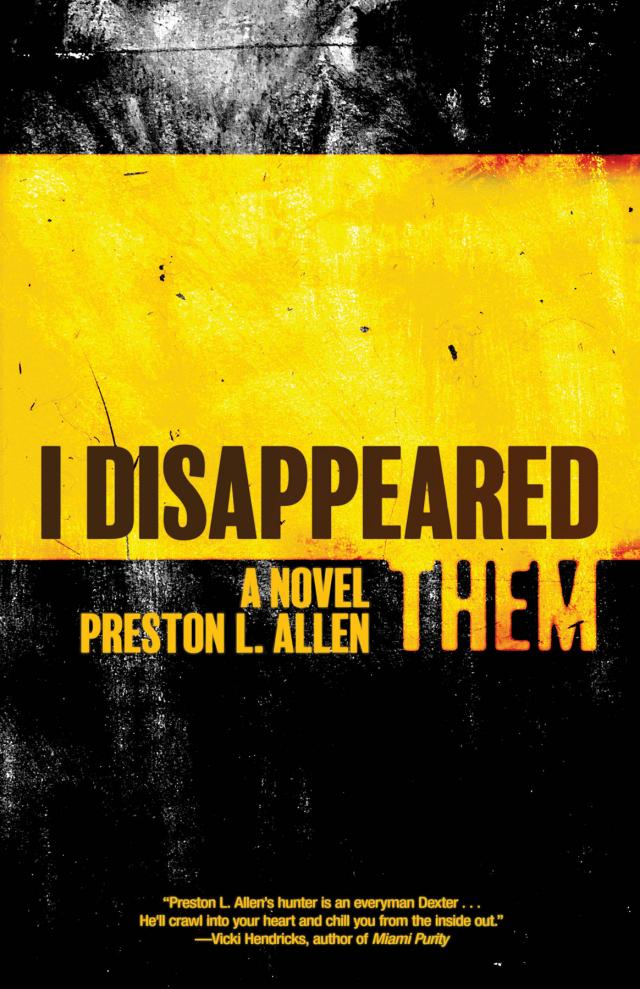
I DISAPPEARED
THEM
BY PRESTON L. ALLEN
This is a work of fiction. All names, characters, places, and incidents are the product of the author’s imagination. Any resemblance to real events or persons, living or dead, is entirely coincidental.
Published by Akashic Books
©2024 Preston L. Allen
All rights reserved
ISBN: 978-1-63614-161-9
EISBN: 978-1-63614-169-5
Library of Congress Control Number: 2023946523
First printing
Akashic Books
Brooklyn, New York
Instagram, Twitter, Facebook: AkashicBooks
info@akashicbooks.com
www.akashicbooks.com
To Dawn,
my first reader, my final proofreader,
my life partner, my love
I kill whores mostly,
and friends who sleep with my wife.
—Edgar L. Jackson
THE HUNTER
Eduardo
July 5, 2001
The dead man is Eduardo, and he drives an American car.
It is a Ford, a roomy car, though Eduardo is not tall, standing exactly 5'7" from toe to head. He weighs 198 pounds, which is heavy for his height. In his charcoal-gray bespoke suit, you cannot tell, but Eduardo the bank officer is obese according to the charts.
Seconds after Eduardo exits his car, the hunter emerges from the alley.
—Eduardo lives in an apartment building on Aragon Avenue in Brickell just south of downtown Miami. In the 1920s, the apartment building was the mansion of a millionaire who made his money in steel. The lobby they enter was once a ballroom. It boasted polished black-and-white-tiled floors, a magnificent curved staircase, and a resplendent crystal chandelier that still hangs from its high cathedral ceiling. Eighty years later, there are still no security cameras in the lobby of the converted mansion.
Suddenly Eduardo turns. The hunter looks down, looks up, looks away, adjusts his cap. Eduardo walks on.
—Slow and joyless are the footfalls of Eduardo. For him, it is the end of a tedious workday. He is in familiar surroundings, and his mind is elsewhere. His mind is on his troubles with his ex who seems happier without him. Why should he care? She’s his ex. It should not matter that she is better off without him, but it does.
Last night Eduardo appeared in the hunter’s dream. Eduardo had no hands or feet in the hunter’s dream.
—The hunter follows Eduardo into a fancy jazz age elevator framed in bronze leaf frills. Edua rdo carries a briefcase, his favorite. It is the last gift she gave him before she left. The hunter is a pizza man. He carries a pizza-warmer bag on one shoulder, his left. He wears a black T-shirt and matching cap, cheap, no-name-brand jeans, and surgical gloves. Eduardo nods at the hunter, noting the cheap jeans, missing the surgical gloves. The hunter nods back, his face a blank. They get off on the second floor and Eduardo opens his door with a key.
The hunter drops the warmer bag and shoves him inside.
—There is a snarl and a flash of white teeth.
The hunter grabs Eduardo and holds him around the neck. There is a noiseless flailing of arms by Eduardo as he fights back. The cap is knocked from the hunter’s head. He gets a hand in the eye and for a moment sees stars. Eduardo clutches desperately at the hunter’s hands around his neck.
“Get off me! Help—!”
The hunter slaps a hand over Eduardo’s mouth and sinks the needle in his neck. A little blood spurts. He notes where it falls. Later, he’ll have to clean that up.
Eduardo collapses. His head has become groggy, his voice weak. “Is it about Jenny?” he says.
The hunter does not answer. He picks up his warmer bag and matching cap, and shuts the door for privacy.
—Though Eduardo has been divorced for a year and three days, the apartment still has the woman’s touch. The peaches-and-cream couch that still carries her smell. The matching wall art she chose. The framed photographs of her beautiful face that Eduardo found too precious to part with. The angelic smile. The eyes, green and gemlike. He was with her yesterday at the Fourth of July barbecue, though he was told to stay away. She looked even more beautiful in real life.
The hunter knows how it is. The hunter has been there.
He understands love’s great power to hold, a hold so strong that you’d humiliate yourself by going to her family’s backyard party on the Fourth of July. You would endure the subtle rebukes of her mother, the giggling insinuations of her teen sister, the threatening looks from her father. You would shake her new lover’s hand, pat him on the back. Smile. Say nice things about the weather, which is cool for July because of the rain. Oh, but yesterday it was a hot one.
They find your fawning transparent, your presence offensive. The stern father tells you to leave or you’ll get a beating you won’t forget. In the car on the way home you shed tears knowing they still hate you, but it was worth it. Anything to be near her again. You love her, Eduardo. Always have. Always will. That’s why you put her in the hospital half a dozen times before she finally got fed up and left you.
Beneath the green of her gemlike eyes, there is red from the strain of living with you.
She lost the baby.
The hunter will not punish you for that crime, Eduardo. That crime is between a husband and a wife. The divorce has already punished you for that crime.
The hunter has come bearing gifts. In the van, there is a mattress to lay you on, straps to bind you with, and tools to hack your limbs and separate them from your body with. And flowers.
Periwinkles.
“Is it about Jenny?” Eduardo says again when the hunter comes back to him. His breathing is shallow. The hallucinations have set in. Jenny stands next to the pizza man, holding his hand, smiling. Without warning, Jenny turns into a green-eyed balloon and floats away, still smiling. “Is it about money?”
The hunter does not answer.
He watches for two and a half minutes until Eduardo’s eyelids close. Then he stands him gently, like supporting a friend who has drunk too much at a party, leans him on his shoulder, and walks him out of the apartment.
They exit the building through the service door at the rear and enter the alley where the van awaits. The sun lingers low in the summer sky. The shadows in the alley stretch long, shading the face of a staggering Eduardo. He tries to speak, but he can’t fight the drug. When he passes out, he becomes suddenly heavy on the hunter’s shoulder and almost hits the ground.
The hunter hefts Eduardo into the van, flops him onto the mattress in the back, stuffs the towel in his mouth, and binds his hands together with the leather straps.
—Back at the restaurant, he parks across the street and watches the other drivers enter and exit their cars, going on deliveries, returning from deliveries.
There is a moment of indecision. Will he be able to go through with it? Well, it must be done.
In the back of the van where it is cool and dark, Eduardo stirs, blinking back to consciousness. There is a towel stuffed in his mouth. His arms and legs strain against leather straps. Who did this?
He lifts his face to the black T-shirt, the matching cap, and he remembers. The pizza man did this.
That baffled but comical look on Eduardo’s face, the look of someone at a surprise birthday party about to laugh when the lights are switched on—that look vanishes when he spies the pizza man’s handsaw and the set of polished and well-sharpened knives.
The hunter selects the carving knife.
The towel muffles the dead man’s scream.
When it is all over, he gives the dead man his flowers.
Periwinkles.
“Just like this,” the hunter says. “Bob is gonna get it just like this.”
—The hunter arrives home to his small apartment, and his wife, who holds the phone to her ear, sees him and sets it in its cradle.
“Who?” the hunter says.
“No one special,” his wife says.
He knows she’s lying. At best it’s one of her trash sisters. At worst it’s Bob. It’s probably Bob. He says, “Is Junior in bed?”
“Is it one of those nights?”
“It’s one of those nights.”
His nervous shakes are gone, and his hands are steady again. When he reaches for her, she pats her distended stomach.
“Remember, I’m eight months pregnant.”
“I’ll be careful.”
“Don’t be careful,” his wife says. “Be good.”
While their natures are separate and apart on most things, on this they agree: love, for a moment, makes the pain go away. In spite of all that’s happened, they do love each other. An injury to pride, however, is not easily healed. The hunter lifts his wife from the settee and heads in the direction of their bedroom.
There are only two rooms in the small apartment, plus the living room and a small kitchen that doubles as a laundry room because of the rickety washing machine next to the ancient stove. He kisses his wife on the mouth and tickles her as they enter their bedroom. She tries not to laugh, but she does.
They are good in their bedroom, though not so good it would wake Junior.
Afterward, he asks her to marry him. Once again, his wife says no.
The washing machine makes the rickety sound as it spins.
And except for the murder of Eduardo Gomez, who is the hunter’s first kill, it is a normal day.
The Baby
“The baby’s name when it is born,” says the hunter, “shall be Zander.”
“Zoe,” says his wife, “if it’s a girl. Or maybe Bobbi Sue.”
“You’re kidding, right? Don’t kid around like that.”
She closes her mouth and turns away from him on the bed.
“You should be careful what you say,” he says.
And well she should because Bob is gonna get it. His wife, if she’s not careful, might get it too.
The Call
It is two days later. It is 10:00 p.m.
Raindrops pummel the top of the black van as it approaches the phone booth outside a porn shop on 163rd Street in North Miami. The hunter steps out and a curtain of rain closes over his eyes. In the phone booth, he makes a call to the Miami-Dade PD.
“I killed a man.”
“Who? What?” the officer says.
“Be silent and listen,” the hunter says in an artificial voice, a kind of farcical snarl. “He was a wife beater. He won’t be missed.”
The officer is silent and the hunter proceeds to tell them where in the Everglades the dead man can be found.
“And who are you?” the officer says. “What should we call you?”
Lightning from the torrent brightens the night sky and thunder rolls.