A bicycle built for brew, p.1
A Bicycle Built for Brew, page 1
part #1 of The Collected Short Works of Poul Anderson Series


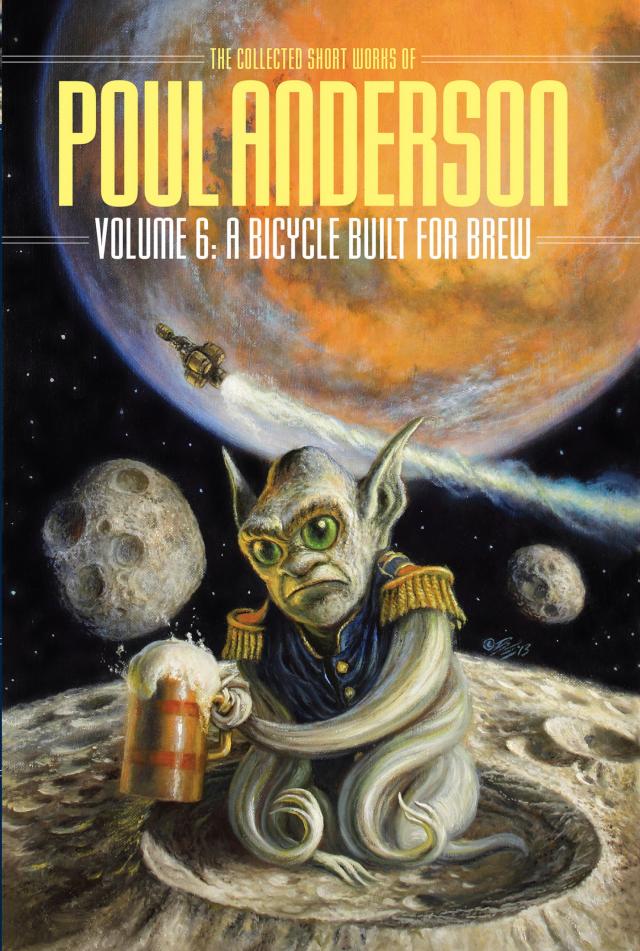
A Bicycle Built for Brew
Volume Six
The Collected Short Works of
Poul Anderson
Edited by Rick Katze & Michael Kerpan
© 2014 by the Trigonier Trust
“My Father, Poul Anderson” © 2014 by Astrid Anderson Bear
Dust jacket illustration © 2014 by Bob Eggleton
Dust jacket design © 2014 by Alice N. S. Lewis
All rights reserved.
No part of this book may be reproduced in any form or by
any electronic, magical or mechanical means, including
information storage and retrieval, without permission
in writing from the publisher, except by a reviewer,
who may quote brief passages in a review.
First Hardcover Edition, February 2014
ISBN: 978-1-61037-306-7 (hardcover)
ISBN: 978-1-61037-332-6 (epub), December 2021
ISBN: 978-1-61037-013-4 (mobi), December 2021
NESFA Press is an imprint of, and NESFA® is a registered trademark of, the New England Science Fiction Association, Inc.
NESFA Press
Post Office Box 809
Framingham, MA 01701
www.nesfapress.org
info@nesfapress.org
Contents
Cover
Title Page
Copyrights
Contents
Editors' Introduction
“My Father, Poul Anderson” by Astrid Anderson Bear
A Bicycle Built for Brew
Three Hearts and Three Lions
The Snows of Ganymede
Territory
The Sensitive Man
Silent Victory
The Three-Cornered Wheel
A Plague of Masters
Acknowledgments
Sources
A Bicycle Built for Brew
Editors’ Introduction
This is the sixth volume in a series collecting Poul Anderson’s short fiction. It is slightly different from the previous volumes where the bulk of the stories were novelette length or shorter. When Poul Anderson was writing, there were many magazines still publishing science fiction. Many of them published “complete novels” in one issue. In fact, many of them were less than 40,000 words and thus were novellas. Even Astounding published “novels” in two issues which barely reached the 40,000 word minimum. This volume is primarily a selection of those works and some novella-length material.
The title story, “A Bicycle Built for Brew”, is a stand-alone story. It was republished as The Makeshift Rocket as part of an Ace Double. We have kept the title used in the original magazine version. The actual title proposed by Poul Anderson was “Bicycle.” We considered using it as the title but decided not to, fearful that the book would be catalogued under “bicycles” or some other weird location. We leave it to the reader to decide which is the best title.
“Three Hearts and Three Lions” is the original magazine serial from F&SF. While the rewritten longer version is still available, this version has not been readily available unless you owned the magazines. We considered making it the title story but we felt that would again be confusing to both the cataloguer and the reader.
“The Snows of Ganymede” makes reference to the terraforming of both Venus and Mars, and to the proposed terraforming of Ganymede. While none of these events are very likely now, when it was published in 1953 the possibility still existed, even if it was not very probable. That should not detract from the story itself.
“Territory” is a Nicholas van Rijn story showing his generous side since he was prepared to only accept 15% interest instead of the customary 20%.
“The Sensitive Man” is somewhat similar and yet, significantly different from “Un-Man” which appeared in volume five. The positive slant to the Psychotechnic Institute in both “The Sensitive Man” and “Un-Man” contrasts with its description in “The Snows of Ganymede.”
“Silent Victory” was reprinted as “The War of Two Worlds.” Despite the body count in this story, while we question some of the choices made, we don’t find that any of the combatants in the story to be morally objectionable.
“The Three-Cornered Wheel” portrays a young David Falkayn at the beginning of his career, demonstrating the skill that would eventually cause his rise to Master Trader. Note that the original magazine version did not have a hyphen between “Three” and “Cornered” while later publications do have the hyphen.
“A Plague of Masters” has been reprinted under the titles of “Earthman, Go Home” and “The Plague of Masters,” and portrays Captain Sir Dominic Flandry in his never-ending pursuit to delay “The Long Night,” while making some money in the bargain.
NESFA Editors
November 2021
My Father, Poul Anderson
by Astrid Anderson Bear
Rick Katze, editor of this fine series of reprint volumes of shorter Poul Anderson works, has asked me to write about my father as “Anderson the man”, rather than “Anderson’s works”. But if you’ve read the works, you’ve encountered shades of the man. If there’s a man enjoying a cold beer and some Limfjord oysters, that’s him. A man somewhat of an outsider from mainstream American culture, that’s him. A lover of fine art and music, that’s him.
Born in the US to a Danish immigrant mother, Astrid Hertz Anderson, and a father, William Anton Anderson, whose parents were Danes, my father was raised bilingually, and remained fluent in spoken and written Danish all his life. He maintained close ties with his mother’s family in Denmark his whole life, and visited many times, so “the old country” was very much a part of him.
He was born in Pennsylvania, but the family soon moved to Port Arthur, Texas, where his father worked as an engineer for The Texas Company, now Texaco. His brother John was born there, and there were some years of happiness for the family until his father died in an automobile accident in 1937. The next spring his mother took the two boys to Denmark, considering the possibility of moving there to be close to her family, but she could see war looming on the horizon and eventually settled in Northfield, Minnesota, where her brother Jack lived. She bought a small farm there and they all tried to make a go of it, but the realities of small-scale farming in Minnesota defeated them. My father never regarded chickens with good humor after that. My grandmother took a job as a librarian at Carleton College, and the family transitioned into the academic milieu.
Being raised partly in Texas, with deep Scandinavian roots, then transplanted to Minnesota and spending time in both rural and academic settings, as well as enjoying extensive European travel before it became as common as it is now, I think my father often felt a little apart from his setting. He considered himself to have had somewhat of a southern upbringing, yet lived in the north and west (California) the majority of his life. This perspective, of an outsider finding his way into a culture, is seen in several of his characters.
His father was the son of a sailing ship captain who transported cargo between Denmark, Greenland, and the US; and he built a sailboat for the family in Texas. My father loved sailing and the sea for the rest of his life. He and Jerry Pournelle tried to sail Jerry’s small racing boat from Seattle to Jerry’s new home in southern California, but stormy weather forced them to abandon the effort at Neah Bay, Washington, an experience that prompted Jerry to say, “I love my country, but not when she’s a lee shore.” My dad’s enjoyment of “messing about in boats” also got him involved in a houseboat building project with Jack Vance and Frank Herbert, which is recounted in Jack’s excellent autobiography, This is Me, Jack Vance! We spent many Saturdays at the Point Richmond marina during the building phase, me poking around the beach doing kid stuff, while Jack, Frank, and Dad did the carpentry, wiring, etc. to bring the boxy houseboat to life. Lunch time usually took us to Fritzi’s Café for burgers, accompanied by a root beer for me and a Miller High Life for the adults.
In addition to multiple childhood ear infections that left him rather deaf, Dad was physically handicapped for a time as a young boy, due to Sydenham’s Chorea, sometimes known as St.Vitus’ dance. It caused palsied movements until it abated, and he always was a gangling sort of man, so there may have been some lingering minor lack of limb coordination from that. He would jokingly call himself a disciple of St. Ineptus, the patron saint of klutzes. This didn’t keep him from having some adventures, though. He took a bicycle tour of England and the Continent with his brother, John, in 1951, and a couple of years later they traveled through Europe with their mother, all on a motorcycle and sidecar rig. A photo from the journey shows my grandmother grinning with delight from the sidecar, goggles jauntily perched on top of her helmet. When the Society for Creative Anachronism got started in nearby Berkeley in 1966, he took up rattan sword and plywood shield, and fought well enough in the SCA’s form of medieval combat to earn the title of knight.
He enjoyed hiking, and did a few backpacking trips in the High Sierras of California. We also did a lot of family car camping, visiting many of the National Parks of the Western US, including Yosemite, Death Valley, Yellowstone, the Grand Canyon, and Devil’s Tower. Shortly after college, he had a job at Mesa Verde National Park, and he always had a special love for the southwest after that.
Dad enjoyed woodworking and puttering around with tools. He had a corner of the garage that was a well-organized workshop, and he repurposed an old roller skate of mine into a wood en-decked skateboard for me in the mid-1960s. He also did his “stoutness exercises” out there, various calisthenics such as pushups and jogging in place, that helped him maintain a relatively slim figure all his life. The term “stoutness exercises” came from the Winnie-the-Pooh books, a great family favorite. Since he was born in 1926, the same year that Winnie-the-Pooh was published, I imagine that his mother first read him the books at a very early age, and various Pooh-based lore and habits were incorporated into our lives, such as playing Pooh sticks at appropriate bridges, enjoying a smackerel of honey, and searching for Heffalumps. In fact, when he was selling so many stories to John W. Campbell at Astounding (later Analog) that sometimes two stories would appear in a single issue of the magazine, he needed to devise a pseudonym to use for one of them. He picked Winston P. Sanders, the name on the signpost that Pooh lived under. When stories by Winston P. Sanders started coming out, Randall Garrett, who often used pseudonyms and was also a Pooh fan, felt that it must be a pseudonym, and pulled out the Scrabble tiles to see if it was an anagram. Astoundingly enough, it came out as “P. Anderson’s twin”!
He often brought sly and not-so-sly wit into his writing. “A Bicycle Built for Brew,” in this volume, features broad political satire of the English/Irish relationship. It is light in overall tone, yet the gimmick of the story, the beer-fueled spaceship, is solidly grounded in the rules of physics. He majored in physics (with a minor in math) at the University of Minnesota, and he brought that scientific rigor into his fiction, whether designing planets, or describing orbital mechanics. As one does in science fiction circles, when there would be a discussion of orbits or acceleration he would stare off into the middle distance and mentally calculate the exact solution to the situation being bandied about.
His love of humor started early. I have a scrapbook that he kept in his youth, with jokes written out in the sprawling cursive of a grade-schooler. He retained the habit of writing down jokes all his life, and would pull out a small pad of paper to jot one down when he heard a particularly good one. And he loved telling jokes, from quick puns and limericks to long, involved shaggy dog stories. He was also very fond of the drawings of Rube Goldberg and his Danish equivalent, Robert Storm Petersen (known as Storm P.), the comic strip “Popeye” in its classic Segar years, and the movies of Charlie Chaplin and Buster Keaton.
In addition to lighter fare, Dad also had deep love for the Dutch Masters, the Impressionists, Bach, and Mozart. Archeology and astronomy always held fascinations for him, and he enjoyed the intellectual and scientific cornucopia of AAAS meetings, NASA launches, and JPL planet encounters when he had opportunity to attend them. I recall him saying once that he was happy with the amount of fame he had—not enough to be a bother or burden, but enough to be able to get him through doorways into gatherings to meet interesting and accomplished people. The most fun, of course, was in the after-hours informal gatherings at such events as well as at SF conventions, where he could be found, beer in hand, in the best conversation in the room.
“He was a man, take him for all in all,
I shall not look upon his like again.”
Astrid Anderson Bear
Lynnwood, Washington
A Bicycle Built for Brew
“Mercury Girl, Black Sphere Line of Anguklukkakok City, Venusian Imperium, requesting permission to land and discharge cargo.”
“Ah. Yiss,” said the large red-haired man in the visiscreen. “Venusian ownership, et? An’ fwhat moight your registhry be?”
Captain Dhan Ghopal Radhakrishnan blinked mild brown eyes in some astonishment and said: “Panamanian, of course.”
“Was that your last port iv call?”
“No, we came via Venus. But I say, what has this to do with—”
“Let me see, let me see.” The man in the screen rubbed a gigantic paw across a freckled snub nose. He was young and cheerful of appearance; but since when had the portmaster of Grendel—of any asteroid in the Anglian Cluster—worn a uniform of such blazing green?
“An’ moight Oi hear fwhat cargo ye have consoigned locally?” he asked. It was definitely not a Grendelian accent he had. York? Scotia? No. Possibly New Belfast. Having maintained his Earthside home for years in Victoria, B.C., Captain Radhakrishnan fancied himself a student of English dialects. However—
“A thousand cases of Nashornbräu Beer and six ten-ton barrels of same, miscellaneous boxes of pretzels and popcorn, all for the Alt Heidelberg Rath-skeller,” he answered. “Plus goods for other ports, of course, notably a shipment of exogenetic cattle embryos for Alamo. Those have all been cleared for passage through intermediate territories.”
“Indayd. Indayd.” The young man nodded with a sharpness that bespoke decision. “ ’Tis all roight, thin. Give us a location signal an’ folly the GCA beam into Berth Ten.”
Captain Radhakrishnan acknowledged and signed off, adjusting his monocle nervously the while. Something was not all right. Definitely not. He turned the console over to the mate and switched the ship’s intercom to Engine Room. “Bridge speaking,” he intoned. “I say, Mr. Syrup, have you any notion what’s going on here?”
Knud Axel Syrup, chief and only engineer of the Mercury Girl, started and looked over his shoulder. He had been cheating at solitaire. “Not’ing, skipper, yust not’ing,” he mumbled, tucking a beer bottle under a heap of cotton waste. His pet crow Claus leered cynically from a perch on a fuel line but for a wonder remained silent.
“You weren’t tuned into my talk with the portmaster chap?”
Herr Syrup rose indignantly to his feet. He even sucked in his paunch. “I ban tending to my own yob,” he said. “Ban busier dan a Martian in rutting season. Ven are de owners going to install a new Number Four spinor? Every vatch I got to repair ours again vit’ shewing gum and baling vire.”
“When this old bucket of rust earns enough to justify it,” sighed Radhakrishnan’s voice. “You know as well as I do, she’s barely paying her own way. But what I meant to say is, this portmaster chap. Got a brogue you could put soles on, y’ know, and wearing some kind of uniform I never saw before.”
“Hm-m-m.” Herr Syrup rubbed his shining bald pate and scratched the fringe of brownish hair beneath it. He blew out his blond walrus mustache, blinked watery blue eyes, and ventured: “Maybe he is from de Erse Cluster. I don’t t’ink you ever ban dere; I vas vunce. It’s approashing conyunction vit’ Anglia now. Maybe he come here and got a yob.”
“But his uniform—”
“So dey shanged de uniform again. Who can keep track of all dese little nations in de Belt, ha?”
“Hm-m-m…well, perhaps. Perhaps. Though I wonder…something dashed odd, don’t y’ know… Well, no matter, as you say, no matter, no matter. Got to carry on. Stand by for approach and landing, maneuver to commence in ten minutes.”
“Ja, ja, ja,” grumbled Herr Syrup. He fetched out his bottle, finished it, and tossed it into the waste chute which spunged it into space. Before he rang for his deckhand assistant, Mr. Shubbish, he put a blue jacket over his tee shirt and an officer’s cap on his head. The uniform was as faded and weary as the ship: more so, perhaps, for he made an effort to keep the vessel patched, painted, and scrubbed.
A long blunt-nosed cylinder, meteor-pocked, patchplated, and rust-streaked from many atmospheres, the Mercury Girl departed free-fall orbit and spiraled toward the asteroid. The first thing she lost was an impressive collection of beer bottle satellites. Next she lost her crew’s temper, for the aged compensator developed a sudden flutter under deceleration and the men and Martians found their internal gyrogravitic field varying sinusoidally between 0.5 and 1.7 Earth gees.
That was uncomfortable enough to make them forget the actual hazard it added. Landing on a terraformed worldlet is tricky enough under the best conditions. The gyrogravitic generators at its center of mass are not able to increase the potential energy of the entire universe, but must content themselves with holding a reasonable atmospheric envelope. Accordingly, their field is so heterodyned that the force is an almost level one gee for some two thousand kilometers up from the surface; then, within the space of a single kilometer, the artificial attraction drops to zero and the acceleration experienced is merely that due to the asteroid’s mass. Crossing such a boundary is no simple task. It is made worse by the further heterodyning as the spaceship’s negative force interacts with the terraformer’s positive pull. When the crew are, in addition, plagued with unexpected rhythmic variations in their weight, a smooth transition becomes downright impossible.