

Twice lost, p.1
Twice Lost, page 1


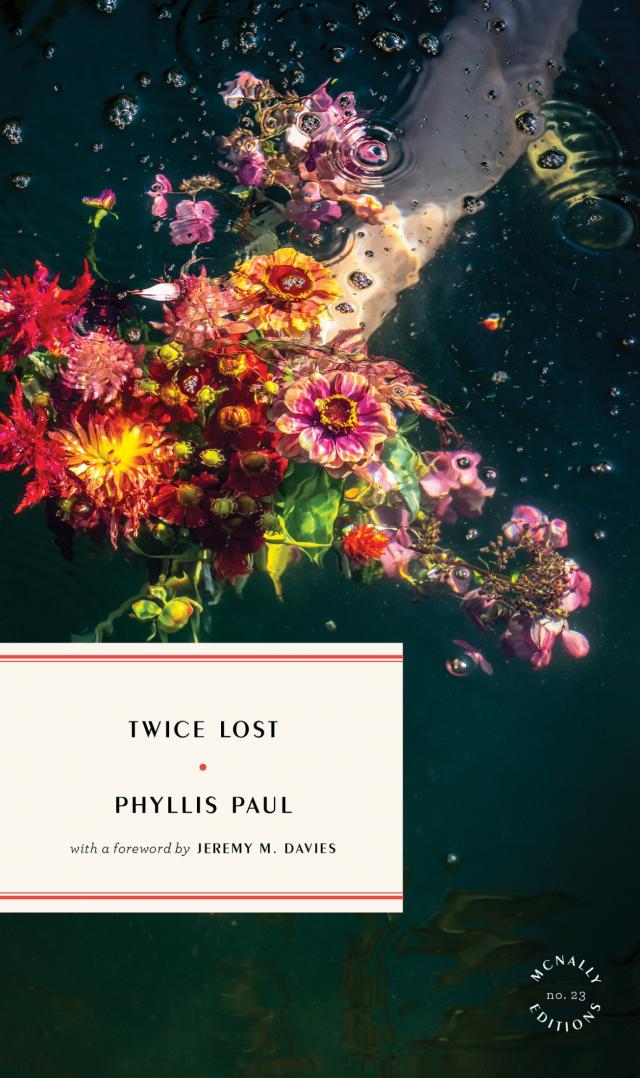
“Miss Paul writes with an icicle, in a fine and distinguished way that is quite her own… the effect is sombre, impressive, moving.”
—Times Literary Supplement
“Phyllis Paul was that rare creature, a puritan with a passionate and colourful imagination… [Her] quintessential novel, and arguably her finest, is Twice Lost (1960). Here she is writing at the height of her powers, combining even more successfully than elsewhere a mystery story with a metaphysical fable… Twice Lost is an unforgettable portrayal of the human capacity for self-deception, and of the vulnerability of the innocent to the inroads of scrupulosity. It is a novel of a uniquely unsettling kind, the definitive achievement of the possessor of such a fascinating… and disturbing gift.”
—Glen Cavaliero, Wormwood
“An almost medieval sense of good and ill. One enters a different world—compelling, fearful, mysterious. The characters live, the place has frightening reality… a kind of violent beauty.”
—Elizabeth Jane Howard
FOREWORD
Everyone gets forgotten. Writers more than most. They send their names into the world, names they by and large didn’t choose, and then with those names try to sell us a few thousand or hundred thousand words, words that are already public property. Their faces, voices, behaviors, transgressions… these might survive them a while, as they would any nonentity who’s cast a shadow, cooked a meal, bred a few kids. But, for writers, these are meant to be secondary matters. Marketing material at best. At worst, indictments. What a writer worth her salt cares most about is what’s most perishable. It’s what goes away first. For a writer to be remembered, and so briefly, as nothing more than another human being who had the misfortune to live and breathe is the most abject of all literary failures. Also the most common.
The majority of writers are forgotten before they have the sense to die. The rest melt away within a few years of their final byline. The radiant constellations of a mere twenty years past are full of dark patches today, where we can see—or, rather, not see—the entropy of fashion at work.
That said, even in a firmament this gloomy, there are singularities so dense that nary a sigh of resignation can escape them. There’s obscure and then there’s obscure.
For a novelist who published eleven novels over three decades, whose books were widely reviewed and reprinted within living memory, the novelist Phyllis Paul has become the blackest of black holes. She’s vanished about as completely as anybody can. She is, and is likely to remain, an enigma that no search engine, no university’s special collection, no clandestine archive will ever illuminate.
* * *
How much those eleven books of hers, published between 1933 and 1967, might have borrowed from her life story is impossible to know. In the words of British publisher R. B. Russell, these “dark and unhappy books often feature murder, disappearance, suicide and insanity… It makes it all the more tempting for critics to look for autobiographical material in [Paul’s] writing, but all that can be said with any certainty was that she was preoccupied in her imaginative life with dysfunctional and morbid relationships.”1
We do happen to know how Paul died: in a traffic accident, struck by a motorcycle as she was crossing the road. According to the late Glen Cavaliero of Cambridge University, the world’s first and (to date) final Pauline scholar2:
Phyllis Paul died on 30 Aug. 1973, in Hastings [England]… The account at the inquests suggests that she was not known locally as a writer, being only identified by the… nametag on her handkerchief. A neighbour commented that ‘Miss Paul kept herself to herself. When she walked she had a habit of looking quickly to one side and then the other, and then she would look down again.’ A witness to the accident was more graphic still, remarking that what he saw was ‘an old lady going across the road like a sheet of newspaper.’ The phrase might have been coined by Paul herself (see Hastings Observer, 8 and 15 Sept. 1973).3
The phrase might have been coined by Paul herself, as might the detail of the handkerchief. By the time of her death, she seems to have scrubbed the record of her existence, leaving only the barest facts. To wit: She was born in Kent to Alfred Ernest Paul and Edith Jane Hartley. She was the youngest of three; an older brother died in childhood the year she was born. Paul’s father worked as a commercial and mercantile clerk. In her twenties, Paul may have done work as an illustrator of children’s books. She published her first novel, We Are Spoiled, in 1933, when she was thirty years old. This and its follow-up, The Children Triumphant (1934), were published by the London house of Martin Secker, in the company of such celebrities as D. H. Lawrence, Thomas Mann, and George Orwell. Then there was silence for fifteen years—a rehearsal? an interruption? a crisis of faith?—after which Paul published nine more novels, now with William Heinemann, home to Henry James, Joseph Conrad, Graham Greene, and, in time, the justly lauded African and Caribbean Writers Series, respectively. Paul’s oeuvre continued, and ended, with Camilla (1949), The Lion of Cooling Bay (1953), Rox Hall Illuminated (1956), A Cage for the Nightingale (1957), Constancy (1959), Twice Lost (1960), A Little Treachery (1962), Pulled Down (1964), and An Invisible Darkness (1967). According to Cavaliero, who interviewed Paul’s solicitor, she left behind a substantial donation to the League Against Cruel Sports, as well the manuscript of an unpublished novel, “Hedera,” rejected by both Heinemann and Chatto and Windus. These pages were sent by the solicitor to the friend who was Paul’s primary legatee, but has since been lost.4
Paul never married, lived quietly, and—according, as always, to Cavaliero—she “resolutely maintained her privacy, believing strongly that a writer should be known only by [her] work.”5 She avoided literary circles; indeed, her novels won her famous fans whom Paul did her best to spurn. Among these admirers was John Cooper Powys, who proselytized about Paul to his friends, including the American novelist James Purdy: “Do try and get from some library this Book—Rox Hall Illuminated by Phyllis Paul and published by Heinemann. Like your own writing it shows some subtle demonic-angelic influence emanating from Edgar Allan Poe.”6
Paul “is a puzzle to me,” Powys went on, some weeks later,
I wrote to her once and she answered to my letter politely but by some psychometric spirit emanating from her letter (if that is the right word) I got the feeling she doesn’t want to be praised by anyone. She writes to write and she must until we are all turned to dust. I’d give a lot to know whether she is Roman Catholic… Phyllis Paul might I feel (like the angels and devils) easily take the form of either St. Augustine or, or someone else! She is deadly subtle.”7
Subtle to the point of total occultation. Paul’s great subject, on the page and off, was darkness—darkness both mundane and metaphysical. To survive, her characters cling to the dark, as much to hide their sins as to keep the truth at a safe distance. What is or isn’t “happening” in a typically plotty, mystery-driven Paul novel—whodunnit, whydunnit, wuz it even ever dun?—tends to be as difficult to distinguish as your fumbled housekeys on a moonless autumn night. Not because of any overt postmodernist trickery, but because her characters flee, en masse, from the very secrets they yearn to penetrate, chiding themselves all the while for their weakness. To quote Cavaliero once again: Paul “has a chilling gift for showing how careless laziness, or willful blindness to the truth, provide the soil in which more purposeful malevolence can flourish.”8
* * *
Four of Paul’s novels were picked up for hardcover editions in the United States. Two of these, Twice Lost and Pulled Down—the latter retitled Echo of Guilt—were then reprinted in 1966 as the inaugural novels in the “Lancer Gilt-Edged Gothic” paperback series. These were emphatically pulp editions. Nowadays, even the less pedigreed Lancers—Don’t Look Behind You!, The Devil’s Church, Evil Became Them, et al.—are treasured for their lurid, painted covers of women in flowing dresses, or else torn shifts, fleeing across cliffs or marshes in the shadows of rambling, Gormenghast-like estates. Might this be the key to Paul’s peculiarities, her relentless secrecy, her novels about secrets never quite coming to light? Was Phyllis Paul a “gothic writer”? Gothic like a twelfth-century basilica, gothic like The Monk or Dracula or Melmoth the Wanderer, gothic like the skinny fellow with stringy hair throwing shapes at a Legendary Pink Dots concert in ’99?
Of course, anything and everything can be termed gothic if it aspires to horrify in a less-than-blatant manner. But Daphne du Maurier, as a preeminent latter-day popularizer of the mode, makes for an instructive comparison with Paul. The gothic has never really been out of style, but it seems likely that whatever measure of success Paul’s novels enjoyed on the American market, in their pulp incarnations, owed something to the enduring popularity of Rebecca and its many daughters. But a Rebecca flirts with the abyss only to return its narrator, and the reader, to the drab everyday of consequences and regrets. If Paul is gothic, she is not gothic like that du Maurier, but like the du Maurier of “Don’t Look Now,” which ends, famously, with a moment of terror, insolubly absurd.
* * *
Which is not to say that you’ll find any homicidal dwarves in these pages, nor that Paul was “against the world, against life,” as Michel Houellebecq has characterized H. P. Lovecraft’s fiction. But there is a misanthropy here that runs deep, which must have undermined contemporaneous readers’ desire to take Twice Lost for a simple romp over the moors.
Paul’s books aren’t just gothic. They aren’t just pulp. In her sentences you will find the filigree of a Henry James at war with the heaving bodices and adverbs of the drugstore spin-r ack. But it takes as much squinting to fit Paul into the context of literary fiction as it does to exile her as a writer of potboilers. Paul’s work shrinks from labels as it does from the light. Part of the fascination it exerts is precisely in leaving us wondering which of Paul’s effects were intended and which dictated by commerce, a very bleak sense of humor, or a streak of irrepressible neurosis. Until the last lines of Twice Lost you may find yourself doubting that Paul was in control of her materials—wondering whether this book is above or beneath you. The question is settled with a final cruel fillip. It’s difficult to think of many other final sentences in “serious” fiction that hit with such an authoritative, undermining effect. It is subversive. Even malicious. And, for that, delicious.
* * *
Paul was rather more successful in erasing herself than fellow recusants like Kafka or Rosemary Tonks. Were it not for the spell she’s still able to cast, it might be the polite thing to let her spend eternity in the oblivion she chose, without the hiccup of a revival.
But cast a spell she does, and no author so able to beguile should be allowed to rest easy. Besides which, this is a different world—bleaker, weirder, ruder—than the one Paul left behind. Where once she came across as eccentric, a bit troubling, she now reads as alien. In its unique amalgamation of guilty pleasure and inscrutable modernist paradox, Twice Lost is utterly out of place in the fiction of our moment, where obviousness is king. To me, that makes it a tonic.
Surely we’ve had too much of authors who must telegraph their every valorous opinion. Let us read Twice Lost, and be led back out of the light.
Jeremy M. Davies
New York, 2023
1 R. B. Russell, Past Lives of Old Books, Tartarus Press, 2020, 93–94.
2 Cavaliero (1927–2019) was President of the Powys Society for thirty-four years, an organization that was founded to celebrate and study the writing of the Powys family, “particularly John Cowper, Theodore, and Llewelyn.” It was John Cowper Powys’s enthusiasm for Paul that first intrigued Cavaliero and sent him looking for Paul’s work, which even then was by no means easy to acquire. Cavaliero’s continual drumbeating for Paul’s books—his insistence that she was “a writer who deserves to be taken with total seriousness”—carried the conversation about Paul’s work into the digital age when by all rights it ought to have disappeared.
3 Glen Cavaliero, The Supernatural and English Fiction, Oxford University Press, 1995, 259.
4 Mark Valentine, “The Last, Lost Novel of Phyllis Paul,” Wormwoodiana (blog), January 15, 2019, http://wormwoodiana.blogspot.com/2019/01/the-last-lost-novel-of-phyllis-paul.html
5 Glen Cavaliero, “The Novels of Phyllis Paul,” The Powys Review 14, 6–10, https://www.powys-society.org/1PDF/PR_14.pdf
6 Michael Ballin and Charles Lock, “The Correspondence of James Purdy and John Cowper Powys, 1956–63,” The Powys Journal, Vol. 23 (2013): 23.
7 Ballin and Lock, 24.
8 Glen Cavaliero, “Mysteries of the Thirteenth Hour: The Enigmatic World of Phyllis Paul,” Wormwood no. 9 (Autumn 2007): 1–15.
ONE
They had separated and were creeping about the grass, bowed over, with their eyes on the ground. But it was too near nightfall. Through the gateway with the flanking piers topped by urns, whose pale, classic shapes were enveloped in savage tufts of ivy, the rest of the tennis-party had already drifted, and out in the lane voices rose boldly above the din of bicycle bells and hooters, and the stuttering of a motor-cycle on the point of moving off. Only the three of them remained in the big, wild garden. Christine Gray and a friend of her own age, Penelope, had good-naturedly stayed behind to help the little girl in her search for a lost treasure.
‘A charm of some sort?’ Christine questioned her. ‘A shiny thing? Goldy? Silvery?’ But the child was upset, did not seem able to describe the object she had lost, and could only say it was ‘a thing to hang on a necklace’. ‘Well, a sort of pendant,’ Christine decided.
But having come to the verge of the cleared ground surrounding the courts, she paused, straightened her back and remained gazing dubiously over the great spread of knee-high, feather-headed grass which stretched away to a confused region of thickets where the flower-garden had once been, or was swallowed up under the pyramids of the horse-chestnuts whose shadow was so dense. This outlying domain was extensive enough to be called a park and had long been out of any sort of cultivation. Forest trees had room there; they spread at ease and freely brandished their great limbs in windy weather. But neglect preyed on them. Ivy embraced them in its deadly clasp. An innumerable progeny of saplings had struck root at their feet and were thrusting up lankly to the light. Even the garden itself, in which the courts were situated, was a wilderness. Paths had long ago been obliterated by weeds which had forced their way through every crack in stone-work, and trails of climbing roses, unpruned for years, sprawled on the ground and mingled with the long grass, forming entanglements as effective as barbed wire. In short, the only quarter open enough to allow of any sort of search at this gloaming hour was that of the two rather rough and indifferently levelled courts which the young tennis players themselves had cut and patched and rolled so enthusiastically in the spring. They had hired the ground for the season from the agents of the empty house.
Vivian Lambert, the little girl, bored by the tennis, had been running all over the garden the whole afternoon. Somewhere, at some unguessable point in her solitary play, the string on which she had threaded the pendant and had knotted inexpertly herself, had slipped unnoticed from her neck. So that her helpers should not be discouraged, she had at first pretended to know in what part it had fallen; but Christine and Penelope now realised how entirely fanciful the pretension was. While they did their best to comfort her, therefore, the search was becoming more and more perfunctory. Christine, at least, saw that it was hopeless.
The voices were dying off down the lane, the courts themselves were engulfed in shades, the air pinged with insects. The last of the sun, still on the upper parts of the house, produced a somewhat sensational display of gleaming windows. She looked round and saw Penelope across the courts, still groping energetically over the shadowy ground, with the child trailing behind her at a slack, uncompanionable distance of many yards. Penelope’s optimism reproached her.
So she went on a little way into the wild part, moving irresolutely; pushing aside the large weeds on which the flecks of cuckoo-spit, beginning to show like cotton-wool, touched her exploring hands with sudden, cold dabs. Moths, clouds of moths, minute or big and whirring, were shaken out of the disturbed grasses. They sometimes blundered into her face, startlingly, before reeling off into the dusk. Some night-breathing weed exhaled a harsh scent. She began to find it all discomforting. And she was about to call out, ‘Look, Pen, how odd those little bushes look in this light,’ when, through the thin shrieking of the cruising swifts, she fancied she heard a wail or screech of another kind, distant, seeming to her to come from a particular far corner of the garden. At that, she stopped dead.
Then, moving abruptly out of the wild part and drawing near to Penelope, she began saying in a nervous tone, with a sort of annoyance, ‘There’s that old gate again——’ But her friend, calling out at the same moment, did not hear her. ‘Shall we look in the well-house corner?’ cried Penelope. ‘I saw her playing around there—at least, I saw her hanging over the fence under the chestnuts.’
‘Oh, no!’ Christine exclaimed, the words bursting from her spontaneously. Then she added, feeling that so flat and decisive a refusal required explanation, ‘It’s much too dark now.’
‘Well, I suppose it is.’
‘Besides… someone has just gone through there.’
‘What—the iron gate? Go on. Now you are imagining! I didn’t hear anything. Perhaps it was cats. Hi, Vivian!’
‘Where is she?’
‘Behind you.’ No, she had not known that the child was anywhere near her, and she looked round sharply; to see the small figure hovering at a little distance with a kind of craven, dodging air which somehow expressed itself in spite of the darkness. As the two girls faced round on her, Vivian spoke in a hoarse half-whisper. ‘I don’t ever go near the well-house,’ she said quickly, in a denying tone, in the manner of one who expects to be accused of something, or to be disbelieved. And she stood there, keeping a wary distance.






