

The islanders daughter, p.1
The Islander’s Daughter, page 1
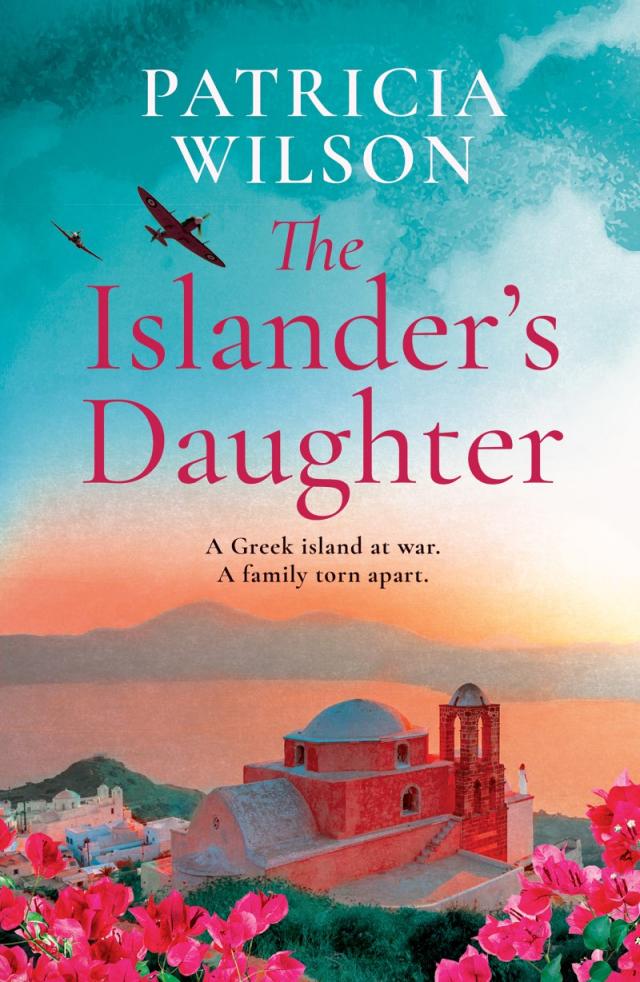


THE ISLANDER’S DAUGHTER
PATRICIA WILSON
For my nephew, Steven Cooper.
One is not truly dead until one’s name is forgotten.
TALMUD
CONTENTS
The Ballad of Firopotamos Farm
A Word on Names
Prologue
Chapter 1
Chapter 2
Chapter 3
Chapter 4
Chapter 5
Chapter 6
Chapter 7
Chapter 8
Chapter 9
Chapter 10
Chapter 11
Chapter 12
Chapter 13
Chapter 14
Chapter 15
Chapter 16
Chapter 17
Chapter 18
Chapter 19
Chapter 20
Chapter 21
Chapter 22
Chapter 23
Chapter 24
Chapter 25
Chapter 26
Chapter 27
Chapter 28
Chapter 29
Epilogue
Thank you!
More from Patricia Wilson
Author Note
Book Club Questions
Acknowledgements
About the Author
Letters From the Past
About Boldwood Books
THE BALLAD OF FIROPOTAMOS FARM
In a Greek island valley, where wild winds roam,
A troubled stud farmer sets up his home.
He’s a man with a temper, always enraged.
While the mares run free, his stallion is caged.
Dora’s spirit is wilder than spume on the sea.
She dreams of horizons, where souls can be free.
“Let’s ride far beyond Firopotamos farm!”
She pleads with a lover her father would harm.
But her father insists, “You’ll stay by my side!
I’ll decide where my daughter is bound to reside.”
So she plots by night, beneath the moon’s glow,
To run with the horses – to tear off and go.
One dawn she awakes, her resolve is on fire,
To leave with the love that’s her heart’s desire.
As sun kisses sky, she mounts her great steed,
Bolts for that horizon – at last, she is freed!
A WORD ON NAMES
In this book, some of the men’s names appear both with and without an -s at the end, depending on usage. In Greek, a man’s name usually ends with -s in the nominative (formal) form, but drops the -s in the vocative – the form used when speaking to or calling someone. For example: Κώστας (Costas) becomes Κώστα (Costa.)
PROLOGUE
THE GREEK ISLAND OF MILOS, MARCH 1943
Dawn bleeds across the harbour of Adamas, streaking the whitewashed buildings with crimson so they appear bruised or wounded. The air fills with a terrible silence that waits to be broken. When it comes, the crack of boots against the cobbles echoes like gunshots, omens of the violence to follow.
German soldiers move through the narrow streets in their usual formation, worn field-grey uniforms dull against the pristine walls. The first door caves easily under the butt of a Mauser rifle. The wood splinters with a crack that startles sleeping birds from their roosts.
‘Get up! Now!’ The command, half German – half broken Greek, rips through the quiet home of the fisherman Stavros. He fumbles for his trousers, eyes still clouded with sleep, embarrassed that his hairy buttocks should be on show. His wife clutches their bedsheet to her chest, her mouth a perfect O of terror.
‘Please—’ she begins, but the soldier’s gloved hand strikes her face, sending her sprawling back onto the thin mattress. Stavros lunges forward only to meet the barrel of a rifle pressed against his forehead.
‘Outside,’ the soldier orders, breath sour with schnapps and hate. ‘Now.’
Three doors down, old Markos, the baker’s father, hears the commotion and reaches for his cane. He’s halfway to his front door when it bursts open, sending splinters skittering across the floor like frightened insects. The German who enters is barely more than a boy, cheeks still smooth, but his eyes are hard as he jabs his rifle towards the street.
‘Move, old man,’ he yells, but there’s a tremor in his voice that makes him more dangerous, not less.
Across the harbour, the butcher Dimitri is dragged by his nightshirt, feet bare and bloodied on the cobblestones, his protests silenced by a swift punch under the ribs that leaves him gasping like a landed fish. His boy Nikos tries to follow, only to be shoved back by a soldier who barks, ‘Not you. Only men.’
Morning light shifts and strengthens, indifferent to the terror as more men are pulled from their homes. The schoolmaster with his wire-rimmed glasses askew, the young priest clutching his ivory cross so tightly the edges bite into his palm. The taverna keeper, hands shaking from fear. Some struggle, earning rifle butts slammed into soft bellies or kidneys. Others go quietly, eyes downcast, knowing resistance could mean death for those they leave behind too.
Marched to the town square, boots and bare feet stumbling over the cracked flagstones. The soldiers arrange them in a ragged line, shoving those who move too slowly, striking those who stand too proudly. Fourteen men, fourteen lives suddenly pushed into the only two prison cells on the island.
Behind them, the harbour water laps the stone quay, indifferent. Above, seagulls wheel and cry, oblivious to the human drama unfolding below. A child’s distant wail is quickly muffled by a mother’s desperate hand.
‘Stand straight!’ A sergeant paces before them, his jackboots polished to a shine that seems obscene against the dusty square. ‘Eyes forward!’
Whispers begin, passed from man to man like contraband. ‘What is happening?’ ‘Why us?’ ‘What have we done?’ The questions travel down the line until they reach Yannis, whose brother works as a translator for the occupying forces.
‘Reprisals,’ he murmurs, the word bitter on his tongue. ‘They’re saying reprisals.’
The word ripples back, gathering weight and meaning as it goes. Reprisals. The terrible math of occupation. The currency of blood and grief.
1
LIVERPOOL, JANUARY 2003
The kettle whistles, a thin, continuous scream. Trisha Hardcastle allows it to continue until the neighbour’s dog sets up a howling chorus. She stands, kills the flame, pours the water. The mug she selects is tall, white-glazed with hairline cracks from a thousand knocks.
She feels an affinity.
On the table, a pristine envelope. Trisha recognises the insignia, Army Veterans Benevolent Association. She turns the letter over, then back, thumb tracing the embossed seal. There is no return address, just a set of numbers that mean nothing.
She slits the envelope cleanly, not tearing the edge. Inside: a single sheet, laser-printed, formal, addressed to her mother. Trisha skims the page, halting on certain phrases. ‘Annual gathering. 60 year Commemoration. Honouring the fallen. Guest speaker to pay tribute to those lost on Milos, Greece, 1943… The Lord Mayor of Chester and the Chairman of Chester Council will together raise the Armed Forces Day flag outside Chester Town Hall on the afternoon of 12 March 2003 in the presence of military and cadet force personnel, local veteran organisations and local civic dignitaries.’
The name ‘Milos’ hangs in the air. Her grandmother told and retold stories of the war on that island, rehearsed, dissected – always finding their way back to the war, the men in grey. Now, as she sits in the lemony square of light from the window, Trisha can almost hear her mother. Tina’s voice whispers the words ‘bravery’, ‘duty’, and ‘sacrifice’ so often that they lost their weight.
Trisha reads the letter again. They ask her mother to speak at the memorial. ‘It would be our highest honour.’ The typeface is bold, and the signature: William A. Reynolds, Secretary. There is a date, a location, and a list of prominent attendees.
The sunlight shifts. Trisha’s finger rests on ‘Milos executions’. She closes her eyes, lets the facts unspool: March 1943. Fifteen men lined up in the town square. Executed. Reprisals.
She feels a mild irritation. That this duty now falls to her mother. The letter is not a request; it is a summons. There is no room for refusal.
She rises, paces the length of the kitchen, hating the wallpaper her husband chose before he died. It does not suit her, yet tearing it down seems disrespectful. Perhaps next year, when she is more herself. She longs for a vintage Laura Ashley, small pink roses, something pretty and fresh.
Trisha sets her mug next to the letter, watches steam rise in a thin spiral, considers the logistics: train to Chester, what to wear, what to say. She has no fear of crowds.
Still, something catches in her throat. The knowledge that these rituals now belong to her. She will answer the letter, eventually.
Trisha recalls sitting on Granny’s living room sofa when she was young. The sofa plastic-wrapped for protection, sweating against the backs of her knees. The story already a myth by the time her mother told it straight.
‘There wasn’t much bread,’ Granny always said, staring at the space just above the door. ‘The story is… and I’m not sure if this is true, the Germans got Grandpa when he went out that morning to Panos, the baker. Panos was head of the village, more important than the mayor because he had flour. Everyone depended on flour.’
Granny, in her pale blue housecoat, sat in the wingback armchair. Her eyes darted between her daughter and granddaughter, never resting. She twisted the hem of her sleeve until the fabric warped. ‘The Nazis came to get me,’ she said. ‘To stand witness. But I was in hospital, so they took Ma Bella instead.’ Her eyes widened with horror. ‘They said, if she closed her eyes they’d shoot her too.
‘An awful business. Fifteen martyrs, local men. The captain said something in German, and then there was a sound. Like…’ Her grandmother’s hands made a gesture, a clap, as if she brushed flour from her palms. ‘The bodies fell forward. Fast. Efficient. All gone.’
Young Trisha found herself staring at Granny’s restless hands – fingers thin and elegant, nails filed to soft ovals. They looked nothing like her own, always ink-stained. The thing she remembers most clearly from those visits is the old woman’s fingers, shivering, even in sleep, weeping for their partners. She imagined, one day Grandy would come, take her waiting hands in his and lead her into heaven.
‘Did you see it?’ Trisha asked once, quietly. Not sure who she’s asking.
Her mother answered, ‘It’s a long story, darling. When you’re older, I’ll tell you everything. Promise.’
‘But was Grandy really shot to death?’
Granny sobbed, her hand flew over her mouth but she shook her head as if to say ‘no’. ‘That man loved me so much, you see. Loved me more than his own life,’ Granny whispered. ‘Such love is a rare and precious thing, child.’
Young Trisha simply didn’t understand, and an explanation never came.
The story concluded, as it always did, with silence. With words too big to speak. With Granny in tears.
When the time came to leave, her mother guided her towards the door with gentle, absent-minded pressure on her shoulder. In the hall, Trisha would glance back. Granny remained in her chair, hands open, palms up, waiting for Grandy.
On the bus home, her mother fell silent, watching the city pass by. Trisha leaned her forehead against the glass and, in the reflection, she saw trembling hands superimposed over her own.
She felt nothing. The story, told and retold, consisted of facts, nothing more.
Trisha reads the veteran’s letter again now, tracing the lines with her fingernail. ‘Honouring the fallen.’
In the hall mirror, she checks her hair, tugs at her blouse, makes sure she looks appropriate. She wonders, briefly, what her grandfather would make of all this. The speeches, the memorials, the endless repeating of his name by people who never knew him. She suspects he would hate it. Men like him, her mother always said, did not die for words. They died because it was easier than living with the enemy.
At four in the afternoon, six in Greece, Trisha stands with the letter in hand and watches the second hand on the wall clock drag itself around. She doesn’t want to make the call but dials anyway.
The ring tone is sharp, metallic. After six rings, the line connects. Her mother’s voice arrives with the classic Greek phone response: ‘Go ahead.’
‘Hi, Mam, it’s me,’ Trisha says. There’s a pause, filled by the soft crunch of a biscuit being broken on the other end.
‘You sound tired,’ her mother says, always opening with a judgement.
‘I got a letter from the Army Veterans Benevolent Association.’
A small, brittle laugh. ‘They still remember us?’
‘They want you to talk about the Milos executions. Chester Town Hall, next month. There’s an annual commemoration and all that. They said it would be an honour to have you.’
She holds the letter tight against the receiver, as if the paper can speak for itself. The line crackles, the silence heavy. Trisha counts to eight in her head before her mother replies.
‘Don’t see why they need me,’ her mother says. ‘You’ve heard the story a hundred times. You could do it in your sleep.’
‘They want you,’ Trisha repeats. She hears her own voice, flat as a plank, notices her hand is trembling. Remembers Granny.
Her mother sighs, the sound high and weary. ‘I’m not up to the trip, Trisha. You know that. My legs—’
‘I can arrange a flight. You can wear those special stockings, you know.’
‘You go in my place. They’ll listen to you. They always do.’
This last bit is meant as a compliment.
‘Fine,’ Trisha says. ‘I’ll tell them I accept in your place, write the speech, do the “any questions” bit after.’
‘That’s my girl,’ her mother murmurs, voice suddenly tender, and then hangs up without a goodbye.
Trisha watches the steam from her mug, thinning into nothing. That’s life, she thinks.
On her way to Liverpool Central Library, Trisha pauses outside a shop window. Her fingers twitch at her side and her heart rate flicks up a notch. A display of scarves arranged in neat, colourful rows beckons her. It would be so easy – a quick movement, a fold of fabric into her coat pocket, the rush of heat to her face as she walks out, heart thundering against her ribs.
But no. Not today. The memory of the security guard’s narrowed eyes last month still burns in her mind. She turns away, adjusting her camel coat collar, and continues down the street, her slight limp more pronounced when she’s nervous. Liverpool Central Library looms ahead, grey and stolid against the afternoon sky. A safer harbour for her restlessness.
‘Just keep walking,’ she whispers, the words forming a small cloud in the cool air. The urge to steal something small, something insignificant, pulses through her like the old addiction. Since Thomas died, these impulses have become her unwelcome companions – minor rebellions against the tidiness of widowhood.
She quickens her pace, wincing slightly as her bad ankle protests. The injury from twenty years ago serves as a constant reminder of a time when her body, and life, had seemed more vital, more worth claiming. Now, at forty-five, she cultivates invisibility. Her mouse-brown hair, tied back in a practical ponytail, her clothes chosen for their ability to blend. She can feel herself fading away like stars in the morning.
What she needs is a friend, she knows, and she has tried. But they all seem to have a yappy little dog, or a moulting cat that leaves her sneezing. She joined a knitting group, a bridge club, and a quilting class, but found them too boring. When she wanted to punch the fool who ran the Bible class, she knew she needed a completely different pursuit.
Shoplifting does it for her, excitement fierce as an orgasm. Danger spiking her heart rate like she imagines leaping out of a plane at ten thousand feet, or the terrifying thrill of a death-defying roller-coaster ride.
The library steps rise before her, offering sanctuary. She climbs them with care, aware of how her limp creates an asymmetry in her gait that draws occasional glances. The heavy door yields to her push, and the familiar smell envelops her – paper, dust, the faint mustiness of old bindings, and the chemical undertone of cleaning products.
Inside, the librarian at the front desk is an older woman with silver-rimmed glasses hanging from a chain around her neck. She nods in recognition. They know her here, this quiet, dull woman who comes in several times a week, who never causes trouble, who sometimes spends hours in the reading room without checking anything out. They don’t know about the shoplifting, about how she sometimes slides a lipstick or a pack of gum into her pocket just to feel something, anything, except the failure of her lifelong ambition. Dr Trisha Hardcastle dreams of being a historian with purpose… with a proper job delving into an exciting, mysterious past; of uncovering something – anything – vitally important.






