

My hummingbird father, p.1
My Hummingbird Father, page 1
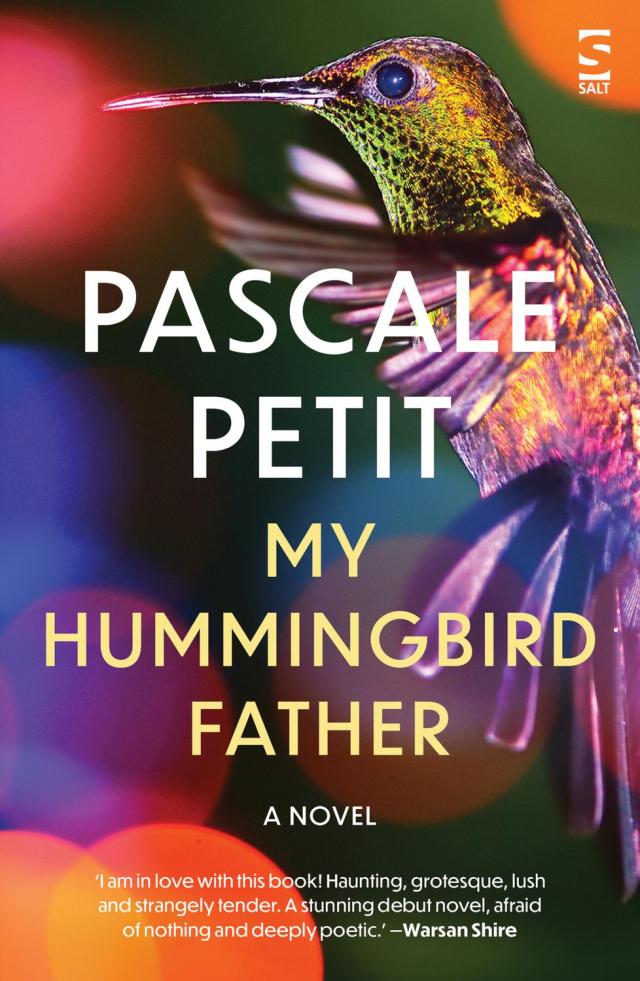


PASCALE PETIT
MY
HUMMINGBIRD
FATHER
CONTENTS
Title Page
Prologue
PART ONE
1: The Face in the Falls
2: The Letter
3: Giant Anteater Father
4: Stick Insect Father
5: Taste
6: Lungs
7: Hummingbird Father
8: The Hummingbird Album
9: In the Forest of Childhood
10: Veronique
11: His Wardrobe
12: Hide and Seek
13: Father’s Shoes
14: Kavac Cave
15: Truth and Tell
16: Tigre Mariposa
17: On Auyán-tepui
18: The King Vulture Bride
19: Black Jaguar
20: Were-Jaguar
21: The Notre-Dame Sparrows
22: After Visiting the Musée de l’Homme
PART TWO
23: The Lady and the Unicorn
24: An Announcement
25: The Black Trunk
26: King Vulture Daughter
27: Sight
28: A Wasps’ Nest
29: Two Dominiques
30: A Phone call
31: Boulevard de Grenelle
32: King Vulture Daughter
33: Sight
34: Rue Ortolan
35: Smell
36: Sainte-Chapelle
37: Square de la Place Dupleix
PART THREE
38: Rue Abel
39: Hummingbird Hearts
40: Thiais
41: Hôtel Notre-Dame
42: Gallery of Chimeras
43: René-Viviani Square
44: The Letter
45: The Notre-Dame Angel
46: Return to Thiais
47: Père Lachaise
48: Touch
49: À Mon Seul Désir
50: Howler Chimera
51: Breath
52: Black Jaguar
53: A Mountain Gate
54: Angel Falls
55: The Face in the Falls
56: Bullet Ants
57: The Ant Shield
PART FOUR
58: Taste
59: Sight
60: Emmanuel
61: Rue Clovis
62: Touch
63: Blue-and-Gold Macaw Feather
64: Hummingbirds
65: À Mon Seul Désir
Epilogue
Acknowledgements
About the Author
Also By Pascale Petit
Copyright
Prologue
I rise out of myself and hover above my body on the kitchen table so I can watch what the doctor is doing. I am the hummingbird of colours no one should see, new colours painted on snow-soft feathers. Now I can watch the rolls of cotton wool the doctor keeps dabbing at my body, how they are smeared with sunrise.
It is dawn and I am escaping into the red mist my six-year-old self sees when she opens her eyes, the shimmer of dots, the walls of tree-doors that keep opening and closing, that bang and creak in the breeze. I can fly so fast that my wings blur. I can fly backwards, sideways, and on the spot. The doctor swats at me but cannot catch me. I can drink the nectar of my child-self’s body. She thinks she is a flower that someone has plucked, petal by petal, until all that’s left is the pistil.
She thinks the whole Amazon basin is a childhood. In the beginning, in the darkest part of the forest, Papa came up to her bed and forced his tongue between her teeth. She clenched her jaw and her front tooth cracked, the sides of her mouth split.
Later, the hummingbird will stitch her wounds with cobwebs, weave a nest in her mouth and in the secret places between her legs. She will mend every tear with moss and eagle down feathers, with leaf veins and hairs of the sleep sloth.
‘Tukui,’ she whispers, and her hummingbird listens.
I call the black jaguar with his coat of exploding stars – my new night, velvet-furred and smelling of moonlight through leaves. I call my white jaguar smelling of morning steam from the earth floor. I call my owl monkeys and they hoot an alarm. The pygmy marmoset crawls out from my hair. The ceiling echoes with scarlet macaws, their tails streaming behind them like fresh blood.
My parents’ kitchen disappears when they come. Papa vanishes like morning mist wiped by sunrays. The doctor closes the door after him. He wonders if I am dead, this child he’s wrapped in gauze like a bride, this girl with a face like a smashed mirror. The one who will never be able to bear children. He’s stitched her with spider silk and orchid roots. He’s used all his animal helpers. There is nothing left in his rattlebag, so he says a prayer and leaves.
Now I am in the forest of perpetual childhood. Now I can start painting my animals, animals no human has seen before. Their names are pain and beauty, hunger and camouflage. They hunt each other through the understorey. They climb the minds of trees.
I am releasing them into the canopy of my canvas.
PART ONE
1
The Face in the Falls
1997
The giant face that appears in the waterfall is her father’s; Dominique knows this even though she has not seen him since she was a child. He turns from one side to the other, showing her each profile buffeted by gusts from the world’s highest torrent. The scattershot spray around him is his sheet. He must be ill – his eyes are closed.
She is sitting on a high stool in a rough church, the wall behind the altar is missing, and it’s here that she can see the tumbling veils of Angel Falls. Though they do not tumble, they hover in a white mist of micro-bullets. They spit like a white tigre, as glacial eyes open to meet hers. She realises that the falls are silent, because after the drop of almost one mile, all water has evaporated. She watches the meteors of spray rise back up and explode.
Two years have passed since she first saw Angel Falls. She has even canoed to the base. But this dream, she realises as she wakes, tells her she longs to return, and the dream will recur, but never show her her father again. Instead, she will climb Devil’s Mountain, the tabletop tepui they drop from, that the Pemón people call Auyántepui – the House of the Devil. And she will dream of the summit, a vast fissured sandstone moonscape with its own life forms. She will dream of a school in one of the valleys, and she’ll wake homesick for this uninhabitable place.
But what she has to paint is that face. It is not a human face and yet it is electrifying as that tigre, her mythical white jaguar, and terrifying as an angel. Yet how can that be? Is her father dead?
What she has to paint is how a week later, a letter will arrive from a father she has not heard from for thirty years. When she goes to meet him, he will tell her that a week before she received that letter, he lay in bed and could not sleep, tormented, having made one of his rare sorties from his apartment, to the hospital that day, where the consultant had given him the prognosis that he would live for only two more years at the most.
‘As soon as my lawyer’s office opened, I phoned him and had him come to see me, to send you the letter, letting you know where I live, asking you to come. You don’t mind?’ he will ask her. ‘Are you angry with me? I had to have peace of mind, to make up for the lost years.’
The lost years.
Her dream of his face after years of not allowing herself to think of her lost father. He appears in the wildest place on earth, and even before the lawyer writes that her father is ill, Dominique knows, because she’s seen it in her dream. She saw the face in torment, and its thoughts spat at her. She woke with intense longing, like being in love. But she cannot be in love because this man is her father. But that’s what it will feel like – this summoning out of the blank.
2
The Letter
The letter trembles in Dominique’s hand as if she’s holding Angel Falls – a kilometre-long cataract shrunk to the size of a page. She folds the letter and it’s like trying to hold an archangel’s wing in her palm. She unfolds it and it fills the room. She’s creased it so many times that one line of Father’s address is faint. What if her tears blur his phone number?
Now she’s dressing, no time for breakfast. She’s running for the tube to the French Consulate, which closes for emergencies at noon. They must renew her passport; she’ll make them do it.
Now she has her passport and she’s running back home, to the phone, to let him know she’s coming.
A week ago, she dreamt of him: she was back in Venezuela, at the base of Angel Falls. His face appeared titanic in the tumbling comets. She looked into the vapour as his face dissolved and reformed. First, she saw the lace of a wedding-veil, shreds of skin behind a veil, then his face turned towards her, and she saw her father.
Dominique dials the number and listens to his phone ringing, and in the pause as she waits for him to answer there is this sound – far away and very near, as if she’s also got the Amazon on the line. A series of low grunts inside her ear, then an icy roar – deeper and longer than a jaguar’s. Howler monkeys swing through the space between them while time drops in light-year-long arrows. And she can wait. She has already waited thirty years. She is not afraid. Then a voice – French, formal, familiar, from the slash-and-burn past:
‘I have thought of you every day,’ he says. It’s in French, so she has to check she’s heard right.
He repeats, ‘I have thought of you every day, chérie.’
Dominique tries to absorb this word as he asks, ‘What time will you arrive?’
‘I’m catching the Eurostar tomorrow at ten,’ she says.
‘Can’t you come this evening?’ he asks.
‘I have to pack!’ she explains. And she has to tint her hair and wash and dry her best clothes. And there is a mask she has to conjure, to hide her hunting-face.
When Dominique first arrived at the foot of Angel Falls, she was feverish. She camped in a tent on Raton Island. Before dawn she was up and out, in time for the first rays to pierce the saddle between Sun and Moon Mountains and hit the falls so they shone like fire. She stared at them transfixed as mist tumbled slowly, then rose back up and vibrated in the morning steam rising from the treetops, before it disintegrated and fell in forests of foam. If the falls look supernatural in ordinary light, they were now god-like, imprinted on her retina.
She will visit him with that letter lighting up her face – the world’s wonder as her bridal veil. She will wear this Amazonian armour and it will be frozen at first, even though she’s at the equator of her life. After a few hours sitting opposite Father – after he has answered some of her questions – her angel-veil will start to thaw. Behind it will be her rose-quartz face, blinding in the dawn light, like a mirror where he will catch glimpses of himself behind the shreds of glitter. The ice will heat up under the morning rays. The released vapour from her bride-visor will sting him. Gradually, he will see small black words in the falling haze, a life he must translate.
When Dominique reaches the Gare-du-Nord she rushes to the toilet and makes herself up, as if she’s painting the cliff behind Angel Falls with foundation, highlighter, concealer, blusher, copper eye shadow. The full works. She wants him to regret not having known her. What time did she tell him she’d arrive? She can’t rush. She must look her best. The light is so bright there are spots in front of her eyes, but it’s a harsh light; she’s not slept. Her eyes are puffy. How she wishes he could have seen her when she was younger.
The taxi stalls. She’s going to be late. Let him wait! She keeps folding and unfolding the lawyer’s letter as they cross the Seine by Notre-Dame into the Boulevard Saint-Michel:
Yesterday I went to meet your father, Abel Emmanuel Grandin, in his home. Despite the many years of his disappearance, he asked me to come to Paris urgently to see him so he can make contact with you.
Your father understands perfectly that your first reaction might be surprise and anger but he wants to put his life in order. He is dying.
He wants you to visit him. He has asked me to give you his address. Here is his phone number. He would be so happy to hear from you.
As they enter the Quartier Latin, the taxi driver asks if she’s visiting Paris for the first time. She explains she was born here and is coming back to meet her father who she hasn’t seen since she was seven. He catches her face in his mirror as he says, ‘Your father must be well off – this is a smart area.’
They draw to a halt at 7, rue Clovis.
Dominique glances up at the windows in case he can already see her. She pictures him looking out for her from his elegant apartment and can’t believe she will soon be up there. She tries to look composed. It’s hard to pay, as her whole body is shaking.
She pulls out the instructions Father has given her for entering his apartment block – the code to the courtyard gate, the number of his flat, the code she must key in at the outer door. But his name isn’t on the panel. She rings other names. It’s 3:15, siesta time and maybe no-one’s home. She tries the concierge as Father had suggested, but there’s no answer. Has she got the right address? She tries the second building and rereads Father’s instructions, but they still don’t make sense. Then she realises there’s a fourth building at the far back of the courtyard. And there, in a bank of buttons next to the glass outer door, is his flat number, with his name. She presses it.
His voice!
She answers, ‘It’s me – Dominique!’ She keys in the new code he gives her. The door clicks open and she hesitates. There’s a frantic shadow at the top, attached to a lead, and she can hear whimpering, but he darts back in without realising she’s seen him. She leaps up the short flight of stairs.
His apartment door is ajar and there he is – small, thin, in silk pyjamas and a bronze paisley dressing gown. She shakes his hand. He hugs her, pressing himself against her body. It gives her an electric shock. It’s too soon for hugging. She notices the plastic tubes dangling from his nostrils, and how breathless he is. He is taking short desperate gasps before he can speak.
‘Come in. It’s a jungle!’ he grins, waving around his room.
There is nowhere for her to sit. The room is tiny and chock-full of furniture and heaped boxes. She takes a narrow pathway through the clutter, as she has taken jungle paths. She is wearing her angelveil and through it everything looks misty.
Dominique pulls out a hard-backed chair from under a pile of old newspapers and sits facing him. He hauls himself into his red armchair; a pink pillow propped behind his back. Between them there’s a small table piled with cooking appliances and medicines. To her right is his narrow bed by the corridor wall.
‘Let’s eat,’ he says. ‘I didn’t have lunch because I was waiting for you and I’m about to faint! You’re very late.’
She glances at her watch and realises she forgot about Paris being one hour ahead. He obviously needs to eat. She’s hungry too, but not yet ready to eat with him. She wants to sit and talk. But all he says as he serves the microwaved meal is, ‘Wait …’ and tries to catch his breath. This is what he will always say when she asks a question, but she does not yet know this. For now, she thinks he is going to talk until everything comes right.
While he is panting for air, she becomes aware of a pumping noise, she can’t yet tell where from, it vibrates through her chair and up her spine. Later, she will locate the oxygen recycler – a machine inside his door-less toilet just by the front door.
He offers her vintage pink champagne and tells her he has had three crates delivered to celebrate her arrival. His eyes sparkle as he leans back to say, ‘I didn’t know if you’d come or not. I thought you might be cross with me. Are you angry?’
‘Yes. But it doesn’t matter now,’ she reassures him. ‘I’ve always wanted to have a father.’
He struggles with the cork, stopping every few seconds to pant, but won’t let her help him. She waits patiently then asks what his days are like. Can he go out? He looks so alone, like a wolf in a forgotten corner of a zoo. It’s hard to hear him say he hasn’t left his flat for two years. She could have been visiting him all along! Every three months an ambulance takes him to hospital to see his consultant. These are his only outings. ‘I can see the trees through the ambulance window. If it’s spring, there’s blossom. If it’s winter, there’s sometimes snow on the branches of the Bois de Boulogne,’ he says, stopping to cough, ‘… though they look the same to me … my only glimpse of the outside world, apart from this window here.’
Dominique glances out. ‘At least there’s a fir,’ she says.
‘All I can see from here is this tree and those buildings and this section of the old Paris wall. Look – ’
Dominique takes in his only view bleached by the late September sunlight. She’s relieved to hear a home help comes every weekday to wash up and do his shopping, and asks, ‘Do any friends visit?’
‘No,’ he replies. ‘Not anymore. I lost touch with them little by little. I’m too proud. I didn’t want them to feel sorry for me. Even my old pal, Pierre Oudin, whom I’ve known since the brasserie days, he was the last to come and I told him not to bother again. That was two years ago.’
He reaches across the small table and gives her his hand.
Because the angel mask guards her, she can touch him. She can let him hold her hand and she can let their hands lie there on the table while he looks into her, trying to glimpse beyond the tumbling falls of her face.
When a huntress first encounters someone else in the forest, she hears twigs snapping. The sound echoes from trunk to trunk. Time slows to a standstill. Beams slant in through leaves, splash her shoulders. Then fear comes, like a pump in the corner of a room. The huntress realises she is not in the forest of her father – she is in her father. He has swallowed her.






