

Endgame, p.1
Endgame, page 1


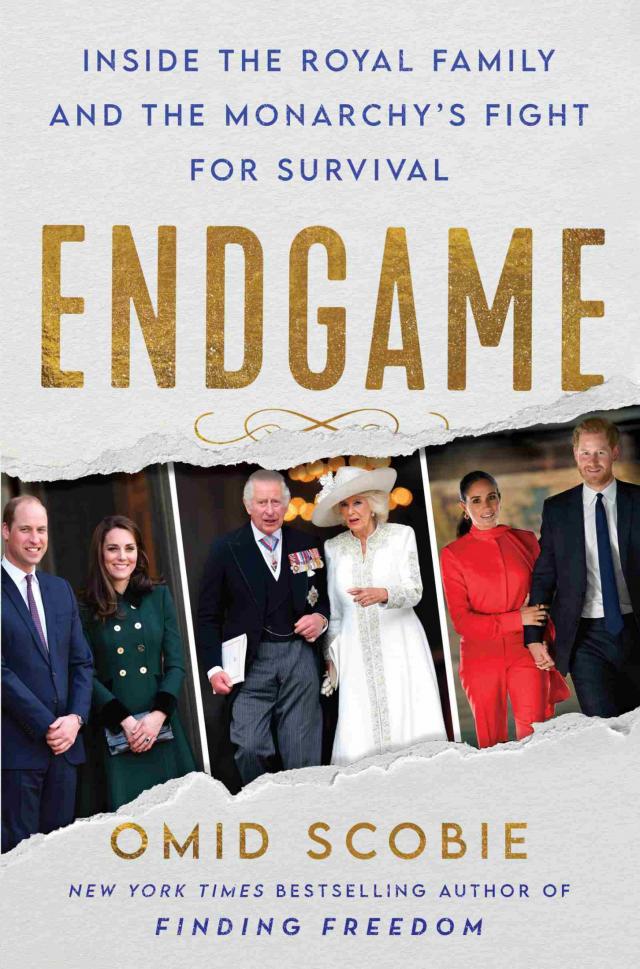
Omid Scobie
Dedication
To everyone who clicks on, reads, or watches my work—
your support means the world. Thank you!
endgame (noun)
ĕndgām
the final stages of a chess game after most of the pieces have been removed from the board
also: the final stages of an extended process or course of events
Contents
Cover
Title Page
Dedication
Prologue
1: The Queen and Her Piper: Elizabeth II’s Final Days
2: Shaky Ground: The Queen Is Dead, the Monarchy Faces Trouble
3: “Oh God, I Hate This”: King Charles’s Premiere
4: Remembrance of Things Past: The Ongoing Campaign to Make the Royals Great Again
5: Baggage: The Lingering Trials of King Charles
6: The Fall of Prince Andrew: Scandal, Shame, and Silencing Jane Doe
7: Race and the Royals: Institutional Bigotry and Denial
8: Gloves On: Prince William, Heir to the Throne
9: Gloves Off: Prince Harry, Man on a Mission
10: The Men (and Women) in Gray: Royal Courtiers and the Struggle for Power
11: Ghost at the Feast: Princess Diana and Revisionist History
12: Skilled Survivors: Camilla and Kate, Windsor Women
Part I: Camilla—The Transformation of a Mistress
Part II: Kate—Suddenly Front and Center
13: A Dangerous Game: Royals and the Media
14: The Decay of Years: The Fading Glory of the Crown
15: Endgame
Acknowledgments
Notes
Photo Section
About the Author
Copyright
About the Publisher
Prologue
When Queen Elizabeth II was in her nineties, there was an element of covering the royals that those around me found a little morbid. Wherever I went, whether it was on a road trip with mates to Wales or a royal visit to Morocco, I always packed a black suit and tie. To friends and family outside the royal bubble, the presence of that ominous suit bag was, to say the least, somewhat gloomy, and a grim reminder that Queen Elizabeth II was nearing the end of her life.
As a journalist who joined the royal beat in 2011, I knew this was a vital piece of the reporting tool kit—an appropriate outfit at the ready so I could spring into action the moment Buckingham Palace shared the news of the Queen’s death. While I was at home in London, the suit (a practical polyester blend, because who has time to steam out creases during breaking news?) mostly lived in the trunk of my car.
On September 8, 2022, however, that car and its contents were twenty-odd miles away getting serviced when I was summoned to ABC News’ London bureau for what we worried might become the long-feared announcement. I was in the middle of running errands when rumors started to flood through via sources and colleagues, so I didn’t have time to race home to grab a backup suit. Feeling the pressure and lack of time, I grabbed a simple black sweater from a nearby Marks & Spencer and took the fastest route, via London Underground, to the Hammersmith studio.
The Queen had been bedbound at Balmoral Castle in Scotland for the forty-eight hours prior, after conducting what later became her final engagements on September 6—seeing out the controversial prime minister Boris Johnson and welcoming in his exceedingly short-lived replacement, Liz Truss. Palace aides announced the day after the monarch’s royal duties that she had accepted doctors’ advice to rest. The next morning, after a further Palace update warned that her doctors were “concerned for Her Majesty’s health and have recommended she remain under medical supervision,” an insider messaged me to say, “It’s not looking good.” For a multitude of reasons, I hoped the warning would turn out to be a false alarm.
Arriving at ABC News’ offices that Thursday afternoon, I received a text from someone very close to the family. As I caught my breath in the elevator of the Disney-owned building, “A Spoonful of Sugar” was playing quietly in the background, making a surreal moment even more so. “Please don’t say anything yet but I think it’s happened,” they wrote. I responded with a follow-up, checking that I understood their message correctly. No doubt trying to get confirmation of their own, the source—someone whose word I had come to trust over recent years—didn’t reply.
Fifteen minutes later, as I sat in front of the camera and put on my earpiece and mic, my calm in the storm, the network’s royal producer Zoe Magee, called across the newsroom: “We’ve had confirmation.” Messages started pouring into my phone within seconds. The statement from the Palace had yet to land, but my heart was already thumping. Though I had been at briefings that described what would happen the moment “London Bridge” (the code name for the monarch’s death and the operation that kicked into action straight afterward) went down, nothing could have truly prepared anyone for the news. Not even the two-hundred-page research bible Magee had created in the recent months. The death of Britain’s longest-reigning monarch, a woman much loved and revered around the world, had a bigger impact on me in the moment than I expected. The Queen had been a presence in my life for as long as I could remember, a fact shared by most Brits. Whether you cared about the royal family or not, she had evolved into the nation’s grandmother—a comforting presence during destabilizing times and easily more popular than the monarchy itself. “New York is going to come to you shortly, Omid!” my producer prompted.
This is it.
* * *
An astounding amount of royal history happened during the writing of Endgame. The world was introduced to King Charles III and Queen Camilla; Prince Andrew was stripped of his titles. Prince Harry released an explosive memoir and a revealing Netflix series, and, of course, Her Majesty Queen Elizabeth II passed away. All these events, along with a litany of startling headlines, greatly impacted this book, including the structure and shape of the narrative and its cast of characters. What should have been a banner year for the royal family, one spent celebrating the Queen and her seventy years of service, was instead a year of more upheaval and strife. The Queen’s Platinum Jubilee in the first half of 2022 is but a footnote now because her death followed so quickly in September—a summer of flag-waving celebrations quickly met an autumn of profound change and depth charge revelations. All this proved trying for a staid institution not exactly used to, or adept at managing, such rapid-fire disruptions or change. The royal establishment has now assiduously installed an elderly new king while fending off unyielding accusations and misgivings from an exiled prince.
I started this book in the summer of 2022, so the Queen’s passing happened well into the writing process. This meant going back and figuring out how to reframe key chapters while looking through the twin prisms of the late monarch’s death and the ascension of her eldest son. Where significant parts of Endgame initially theorized about the future of the Firm, I suddenly found myself watching and reporting on that future as it happened in real time. Overnight we were in it: the royal family’s new chapter—a moment I couldn’t have imagined during my first royal engagement with Prince William and a then Kate Middleton over eleven years earlier. The months following the Queen’s death gave me the necessary time to process such a seismic event and an opportunity to peer into the new era before contextualizing it. And that time provided me with a chance to speak with those currently at the center of it as well as the many individuals who had been part of the journey leading up to it. Think of it this way: I started writing the book in the New Elizabethan age and finished in the Carolean era—a dynastic sea change happened in a matter of days. And with it, so did many of my perceptions.
The full reality of Queen Elizabeth II’s death hit me ten days later, when I joined a small group of journalists to observe the scene of the former monarch lying in state at Westminster Hall. Members of the public had queued for up to ten miles and over twenty-four hours to pay their respects. For those of us in the press working eighteen-hour shifts, reporting to millions of others around the world, British Parliament’s “Operation Marquee” team had arranged prebooked one-hour time slots in Westminster so we could capture this moment in history.
I’d been to the Houses of Parliament before, for other assignments and events, but with all political activity suspended during the ten-day national mourning period, the usually buzzing alley through the length of the Palace of Westminster was eerily silent as we walked toward New Palace Yard. Deep in conversation with one of the staff members guiding us, I wasn’t at all prepared for the moment we arrived at the doors of Westminster Hall. Suddenly, there it was: the Queen’s coffin resting on a raised ornamental catafalque.
You couldn’t hear much else beyond our footsteps and the rustle of coats and bags carried by mourners as we entered the hall’s vaulted silence. A solemn usher, obviously weary from his work, calmly directed us up a narrow spiral staircase at the back of the room. We climbed a makeshift riser painted to blend in with the thick magnesian limestone walls of the eleventh-century room—an inconspicuous observation tower for the press.
From this position, about fifteen feet off the ground, my eyes were almost at the same level as the Imperial State Crown resting atop the coffin. As I’m sure it did for so many of the people who quietly walked in and out to pay their respects, the juxtaposition of the crown and the coffin emphasized the finality of it all. Like many journalists covering this story, I had been operating in a suspended state of disconnect up until that moment.
Lying next to the pillowed crown were t he orb and scepter. I’d seen them in person before, many times, but being so close to the two symbols in this setting gave me goosebumps. There was the weight of history and tradition, yes, but also the aura of mystery and myth. Ordinary things in and of themselves, really, but an accruement of time, the narratives of power and divine lineage dictated over centuries, and the human desire for meaning and order all alchemized, transmuting those things into powerful ideas. It was a strange, commanding magic that I felt that day in Westminster. But the woman, the human form of all that regal authority and mysterious poetry, was lying in a coffin underneath. For so long, she stood for the Crown, and the Crown for her. Without her presence, these ornaments and symbols seemed exposed, naked somehow, as if they had been caught unawares.
King Charles III. Even after all this time, it still doesn’t always look quite right on the page. The same can be said of Queen Camilla—those promises of her taking on only the titles Princess Consort, and then Queen Consort, were just white lies the Palace is now keen for people to forget. But here we are. Despite their flaws and many mistakes, it’s difficult not to sympathize with the new king and queen. Filling such enormous shoes is almost an impossible task, especially considering that when Her Majesty died, unfortunately so did much of the legend, mystique, and secrecy that enshrouded the monarchy. It’s safe to say that very few outside a strict inner circle knew much of anything about Queen Elizabeth II. She inhabited her stately role completely. Her personal life was her own and she fiercely guarded it, knowing full well that to share it was to lose it. She also appreciated and respected the demands of the Crown: service over personal gain, and duty over individual happiness. In public, her resolute composure expressed this in spades, no explanations necessary.
With Charles and Camilla, it’s the opposite. The King has lived a full life out in the public as an outspoken environmental activist, an occasional meddler in politics, a successful businessman, a flawed father, and a philandering husband who destroyed the life of Princess Diana—an ignominious legacy he’s eager to put behind him now that he is on the throne. He’s known to us warts and all. His litany of personal failings and missteps is front-page fodder, and much of the British public will never fully forgive him for his role in Diana’s tragic demise. And Queen Camilla, a woman who is finally tolerated by the public but is still not universally accepted, remains to many as “the other woman,” the third person in Charles and Diana’s marriage and someone who caused much pain and chaos within the royal family. Now, no veil of arcane secrecy falls between the new King and Queen and their subjects, providing cover and inscrutable power. Everyone already knows that King Charles might have preferred a life as Queen Camilla’s tampon.
Though off to a steady start, the ongoing efforts to boost Charles’s popularity will never come easy for the institution of the monarchy, regardless of his new station. As prepared for thronedom as he may have felt, behind palace walls, and in the minds of the public, the question remains: Is he up for the job? Immediately after the Queen passed away and ordinary citizens were still shedding tears, the new King Charles made headlines after cameras caught him throwing a tantrum over a faulty pen. A stubborn eccentric who has spent most of his life waiting and planning for his ascension, even at the cost of his relationships with his own sons, the former Prince of Wales is not only far less popular than his predecessor and his successor, he has also been a thorn in the side of the institution. Despite the fact he’s well-liked by world leaders and global power figures, during the life of his mother, he was never fully embraced by power brokers within the system, the Palace operators and partisans with links to the British establishment, including the government. When he was Prince of Wales, some senior Buckingham Palace aides had expressed to me and others that they felt the then next in line didn’t quite have the moxie or vision for the family’s next chapter. Perhaps they were right. Just weeks before becoming the new monarch, he was knee-deep in controversy involving bags of money, cash-for-honors allegations, and a police investigation into donations accepted by his Prince’s Foundation charity.
Or perhaps he was just never allowed to demonstrate his readiness. Many in the Firm’s old guard, including the Queen’s most senior courtiers—those shadowy men, and now women, “in gray,” as Diana famously called them—distrusted and disliked Charles. Personally, I’ve always admired Charles’s efforts in the environmental space, but it’s telling that he is also a man who—over fifty-five years into his life as a working royal—failed to truly capture the imagination and interest of those outside the monarchist bubble. His quirks and entitled behavior have, at times, alienated him from the institutional hidden forces that could change that popularity overnight, leaving him to take matters into his own hands, often with disastrous results. His failure to initiate a substantive dialogue with Prince Harry, despite how clearly his son detailed their fracture in interviews and public statements, is yet another sign of his inability to effectively address family matters head-on or navigate constitutional crises.
To add insult to injury, Charles knows his reign will be a transitional one, an intervening sovereignty that must happen before his elder son, William, the Prince of Wales, takes over at a far younger age and attempts to breathe new life into a desiccated monarchical system. Over the years I’ve watched as, behind the scenes, senior courtiers and other establishment figures groom Prince William for the throne. As a long-serving member of the Queen’s most trusted staff put it to me before the monarch’s death, Charles may be the next king, but William is “the future.”
This brewing power struggle between the favored prince and the unpopular king is Shakespearean—a familial tug-of-war waged both onstage and off that still has the potential to unravel the monarchical tapestry. Scheming and backstabbing began long ago. Jealous of Harry’s popularity with the media and William’s preferred status in the Firm, King Charles has been known to turn a blind eye while aides leak details about his sons to the press. Camilla, also guilty of the same practices, caused further damage to the family during her long-running campaign to rehabilitate her own image. A tactical masterstroke, a well-timed leak, can pave the way for a beneficial back-scratching relationship with media confidantes in exchange for favorable treatment while also cutting down competition for the spotlight a rung or two. Long before the release of Spare, it was well known within the tight circle of royal correspondents that Charles eagerly piggybacked on reports of Prince Harry’s teenage drug use by allowing the leak of personal details about his own son to construct a “great dad” narrative that many within the press gladly printed in return.
They say never mix family with business and, though the brothers had in the past put on a good show when needed, William and Harry are the perfect example of why this particular family business often teeters on the brink. Though they were remarkably close as they grew up, Harry’s decision to “defect” to America (William’s choice of word, according to a source, not mine) widened an already growing rift between the pair. Disappointed in Harry’s life decisions and rooted in his ignited, newfound dedication to the Crown, William now considers his brother an outsider, especially since the release of Harry’s memoir, which not only gave further details surrounding the Sussexes’ decision to step back from their royal roles but also William’s part in it. The heir doesn’t really “need” the spare any longer anyway, one source admitted to me shortly after the Duke of Sussex left Britain in March 2020.
No longer useful as a helpful distraction or collateral damage, William had been wanting to distance himself from his brother ever since Harry’s marriage to Meghan—whom the then Duke of Cambridge took a disliking to from the start. Now firmly established within their own household, William and Kate have become a committed, driven team, focused on their roles in the family and in royal history. Harry’s dramas are no longer of any concern to them. Or so they say.
Some might argue that it’s unnecessary to bring the Duke and Duchess of Sussex into conversations about the future of the monarchy since they started their separate life in California three years ago. As royal family members now living autonomously and completely disconnected from the institution, they currently play no part in where the Firm goes from here. But their role in the bigger royal story remains as important as ever. The issues raised by the couple, including allegations of bullying, misogyny, racism (or, in Harry’s description, “unconscious bias”), and image manipulation, alongside the institutional cruelty they experienced, remain largely ignored and unexamined by the Palace. And any promises made after their departure, including a focus on diversity within the royal households, have proved little more than PR-friendly gloss-overs. Not a great look for an institution whose monarch is sovereign to interracial Britain and the head of the predominantly non-white Commonwealth. Discrediting Harry and Meghan through negative press briefings (no matter how many times Palace sources deny doing so) may have damaged the Sussexes’ legitimacy to many, but for the members of the public still horrified by the family’s treatment of its first mixed-race royal, it remains a thorny issue.






