

Dakshin, p.1
Dakshin, page 1
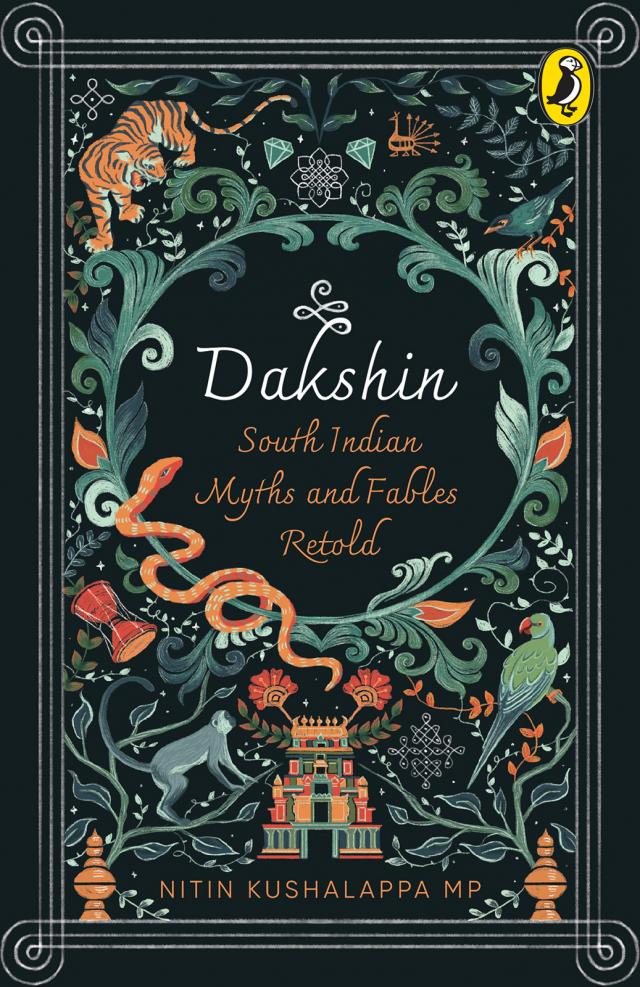


NITIN KUSHALAPPA MP
Dakshin
South Indian Myths and Fables Retold
Illustrations by Pari Satarkar
PUFFIN BOOKS
Contents
Author’s Note
1. The Tale of the Mynah Who Never Gave Up
2. The Tale of Bala Nagamma and the Evil Sorcerer
3. The Giant Red Kangaroo, the Queen and the Hunter
4. The Tale of the Singing Drum
5. The Blessings of Vishnu
6. The Cat and the Fly’s Delicious Congee
7. The Cow and the Tiger
8. The Seven Fairy Princesses
9. The Tale of the Last Sun
10. The Tale of the Miser
11. The Tale of the Jungle River
12. The Tale of the Boy Champion
13. The Tale of the Good Boy
14. The Moon Prince
15. The Sage and the River
Short Bibliography
Acknowledgements
Follow Penguin
Copyright
PUFFIN BOOKS
DAKSHIN: SOUTH INDIAN MYTHS AND FABLES RETOLD
Nitin Kushalappa MP, by profession, is a software developer who has been responsible for twenty-two iPhone apps that have been released so far. Over the past decade, he has worked as a team lead, entrepreneur, and senior consultant for numerous companies. In his free time, he can be found either coding or digging up history—something he’s very passionate about.
Born Mookonda Poonacha Nitin Kushalappa and hailing from Coorg, a region rich in oral lore, Nitin devours myths and folk tales. He has authored seven books so far: four on local history, one biography about an army officer, one translation and a modern-day retelling of the Ramayana. A researcher for the Kodava Virtual Museum, Nitin has worked on an old temple script, and has also written several articles for news dailies. Currently, he lives in Bengaluru with his family.
To the children of the world— you are the future; make the best of what you have.
To Amoghamandana (we named you after gods, kings, saints and elders)—
I hope you enjoy this book.
Author‘s Note
‘Live and be well, O God, Great God,
Also, be well O Sun,
Together, be well O Moon,
Earth be well, our place of birth.
O friend, what do you want to listen to?
We will sing about nothing other than this—
In the middle of this earth is India, the land of the Jamun tree.’
—Pattole Palame, N. Chinnappa
Dear reader,
In this collection of folk tales, you will find fascinating fables from South India. Most are translations of folk songs from regional languages and converted from verse into prose. Some are retellings of the originals—oral folk tales passed down from one generation to the next in the form of anecdotes.
I gathered these stories from various people and books, some of which were written in regional languages. To write this book, I had to consult a lot of sources. Alongside age-old books, I looked up movies and comic books!
Several Dravidian languages are spoken in the Deccan, or the south Indian part of our country. Did you know the word Deccan comes from the Sanskrit word dakshina, meaning ‘south’? Four languages spoken across five states have the most number of speakers in South India. Telugu is spoken mostly in Telangana and Andhra Pradesh. It is the Dravidian language that is spoken by the largest number of people. Karnataka, Tamil Nadu and Kerala majorly speak Kannada, Tamil and Malayalam respectively.
There’s another language—called Tulu—that has speakers native to the coastal districts of southern Karnataka (Dakshina Kannada and Udupi) and northern Kerala (Kasaragod). Some other spoken languages are without a script. These have fewer speakers and each of them is confined to a district or two.
Kodava is spoken mostly in the Kodagu district of Karnataka. Badaga, Toda and Kota are spoken in the Nilgiris of Tamil Nadu. These are also the names of the people who live in these hills.
There are several other Dravidian languages—nearly seventy of them! These are spoken across parts of South Asia—from Baluchistan (Pakistan) in the west to North-Eastern India in the east, and from Bihar and Madhya Pradesh in the north to Sri Lanka in the south. Dravidian speakers are found in parts of Nepal, Bhutan and Bangladesh as well.
Coming to the actual stories, at least four of the tales were originally written in Kodava, an endangered Dravidian language used in the Kodagu district of Karnataka. There’s one tale in Kannada. So five tales are from Karnataka itself. There is one tale translated from the Tamil language and one from the Badaga language of the Nilgiri region. Therefore, two stories are from the state of Tamil Nadu. The book also has one Malayalam tale from Kerala and one Telugu story from Andhra Pradesh and Telangana.
One story is an exception since it is actually neither Dravidian nor from South India. This tale is from Odisha (which borders Telangana and Andhra Pradesh) and of Mundari (Munda) origin. Mundari is one of the many Austro-Asiatic languages spoken across central and eastern India.
The district of Kodagu, or Coorg in the south Indian state of Karnataka is a land rich in folklore. As a result, it invariably finds its way into this book several times. The people of this region spoke the Kodava (Coorg) language and shared a common culture. They considered the river Kaveri to be their patron deity, and you will find a story on this as well. The Kaveri legend is partly of Tulu origin, even though the Tulu language is spoken in the coastal region and away from the river basin.
The Kaveri River flows through the two states of Karnataka and Tamil Nadu in the Deccan Plateau. As one would move from the west coast, reach the river and travel to the east coast along the Kaveri, one would meet people who speak different languages and dialects. These speakers are found in and around the Kaveri River basin in the two states.
The life of Sage Agastya, husband of Kaveri, is narrated in the Sanskrit epics of India: the Ramayana and the Mahabharata. There are oral traditions at local temples like Irpu Rameshwara and Male Thambaran that mention that the heroes of these two classical epics (Rama and the Pandavas) came to Kodagu.
Do you know about the compilation of folk songs called Pattole Palame? It is a famous collection of Kodava songs that was published in 1924. ‘The Tale of the Mynah Who Never Gave Up’, ‘The Tale of the Singing Drum’, ‘The Tale of the Boy Champion’ and ‘The Seven Fairy Princesses’ are retold from here. The last two can also be found in other sources, which I’ve mentioned in my notes at the end.
Several movies were made on the popular tale of Bala Nagamma and the evil sorcerer. For this book, I watched a couple of Telugu and Kannada movies and read the Amar Chitra Katha comic book titled The Prince and the Magician.
‘The Blessings of Vishnu’ is another tale that was developed from multiple sources, such as the works of Dr Brenda Beck, Tamil movies and texts and even social media. These are but a few examples.
In this collection, there are at least three stories which have never been put to writing in the past—‘The Giant Red Kangaroo, the Queen and the Hunter’, ‘The Tale of the Miser’ and ‘The Tale of the Jungle River’. I grew up listening to family elders and school teachers narrating these stories.
I hope as you read through the stories, you will notice the vibrancy of the folklore, myths and legends of the Deccan region of India.
Nitin Kushalappa MP
October 2022
Bengaluru
1
The Tale of
the Mynah Who
Never Gave Up
Do you know the story of the little hill mynah who wreaked havoc? This is a story that is told by the Kodava people during Puththari, the harvest festival in the Kodagu district. The Kodagu district of Karnataka is also known as Coorg. The tale has been recorded in the famous Pattole Palame, a compilation of Kodava folk songs that came out almost 100 years ago! This is a cumulative tale, a story where one event leads into another and results in a chain of events.
* * *
There was once a spotted turtle dove and a hill mynah (a kind of a starling) who were friends. The two birds had made their nests next to each other in a carpenter’s attic. Both laid their eggs in their respective nests. But the dove’s eggs hatched first, and once the young ones grew, they learnt to fly quickly and left the nest early.
Days later, the mynah’s eggs hatched, and the young ones came out. But just as they were about to learn to fly, the carpenter shut his attic!
‘Oh, carpenter, please open the attic window so that my young ones may fly out,’ requested the mynah.
But the carpenter refused to listen. ‘I am too busy now,’ he replied curtly. ‘I cannot open the attic window.’
The distraught mother mynah then went to a wild hog and told him about her woes. After she completed the tale, the mother bird chirped, ‘Oh, hog, please, please help me. Can you dig out the betel and banana plants in the carpenter’s garden? That way the carpenter will open the attic door as he will need the tools to clean his garden!’
But the hog didn’t oblige. ‘Sorry, bird! I won’t be able to do that today or tomorrow, I’m afraid,’ he grunted. ‘I’d rather go and search for some farm crops to eat instead.’
The mynah became very sad, but she didn’t give up. She then approached the village drummer. In his spare time, the drummer made mats, umbrellas and other handiwork for the villagers. She requested him to go and beat his drums in the jungle home of the hog. She explained that by doing so, the hog would be disturbed from its cozy lair. He would then run to make a mess of the carpenter’s garden. But the drummer refused as well. ‘I have a lot of work to do, little mynah. I must search for reeds to weave mats with,’ he said.
Not willing to be discouraged, the mynah went to a rat next. ‘Oh, rat! Can you chew the drummer’s drum skin?’
But the rat was not inclined to help the mynah either. He wanted to search for rice grains stored in some granaries instead.
Still determined, the mynah went to a male rat snake and asked him to chase the rat she had met earlier. But the rat snake refused too. ‘I am busy, bird,’ he hissed. ‘I am just going out to ask a female rat snake to marry me.’
Next, the mynah met a group of cowherds. ‘Dear cowherds,’ she cried out, ‘could you please hit the rat snake for me? He may become agitated and hunt the rat this way.’
But the cowherds laughed. They only had time to climb up jack trees and bring down jackfruits.
The little bird kept going, as she had to get the carpenter to open the attic somehow.
Very soon, the mynah came across a bull. ‘Bull, could you chase the cowherds for me?’ she pleaded.
But the bull didn’t heed. ‘I have to go meet my wife, the cow, so I cannot help you,’ he bellowed gruffly.
The mynah sighed and went along, now in search of a wasp. Upon finding it, she asked the insect to prick the bull. But the wasp ignored her and buzzed about his business of seeking flowers.
Tired and saddened that no one would help her, the mynah kept going. She didn’t have the heart to stop looking for help. Soon, the mynah spotted an eagle. She meekly asked the great bird, ‘Oh, eagle! King of the birds! Please go and destroy the wasp’s dwelling!’
The eagle kept quiet for a while, perched by a window sill. Then he asked the little bird, ‘Why should I help you? What will I get in return?’
The mynah saw that the eagle was eyeing the chicken coop beyond the low wall. The eagle was hungry, it seemed. That was when the mynah realized she had to change her approach—everyone has their own needs, and maybe she could use this fact to help her children.
‘I will pay you for your services,’ she answered confidently. ‘I will get you trinket bells to decorate your feet and a coat to adorn your back.’
The eagle was taken aback. He had not expected this pleasant surprise. Now his mind was no longer on the coop. He wanted to listen to the mynah instead for the goodies he would get. ‘You are smart, indeed!’ he replied. ‘Okay! I will do the task for you.’
The eagle got off the window sill, flew straight into the wasp’s nest and damaged it. The wasp, who was inside at that time, buzzed out immediately to see the cause of the commotion. He quickly realized what had occurred. Feeling guilty for not helping the mother bird earlier, he now stung the bull, who was wandering around the cowshed. The enraged bull then blamed the cowherds for the pain caused. He bellowed and chased the herdsmen with his horns held low in the air, ready to gore anybody who got in the way.
The frightened cowherds in turn realized the cause of this. They ran into the woods and chased the rat snake with sticks. The snake fled for his life, wishing that the cowherds would stop hurting him. He went in search of the rat. When the rat noticed the snake slithering behind him with its mouth wide open, he ran as fast as his feet could. He jumped onto the drummer’s drum and chewed up the middle of its skin.
The drummer understood that this wouldn’t have happened if he had helped the mynah free her children. He felt guilty now. No drummer would want their drum’s skin torn. He took up his spare drum and went into the jungle. He went around the jungle, beating the drum. All the jungle creatures were startled, and they fled as the drummer approached.
Meanwhile, the wild hog had been napping after a heavy meal. He woke up from his slumber, alarmed at the noise of the drumbeats. He came out of his hideout, a nest made of long, dry grass on the forest floor with a hole to rest in. The drummer saw him and chased him closely, all the while beating the drum. Unable to bear the noise, the wild pig rushed into the carpenter’s garden. He knew what was expected of him.
That evening, when the carpenter came back home, he inspected the damage done to his vegetable garden plot. He figured out that the mynah had exacted her revenge. He sighed. Feeling sorry for how he had acted towards her and her children, he now resolved to help anyone who asked for his assistance the next time. He went up to the attic and opened the window. The mynah flew in and prodded its young ones to fly into the sky. One by one, they followed the mother bird and fluttered away into the blue sky.
So what do the bards say about this story? Patience is a virtue. And all creatures, big and small, have a lesson of wisdom to teach us.
2
The Tale of Bala
Nagamma and
the Evil Sorcerer
This well-loved folk tale of Telugu origin hails from Guntur and other parts of Andhra Pradesh. It is a part of the rich Burra Katha oral tradition of storytelling in which tales are narrated by wandering storytellers known as ‘Jangams’. Jangams were Shaivite monks (devotees of Lord Siva) who played a stringed instrument called the tambura and sang the tale. In Andhra Pradesh and Telangana, this story is popularly known as the ‘Bala Nagamma Katha’ or the ‘Bala Raju Katha’. Do you also know that this story is so well-known and loved that many movies have been based on it?
* * *
Once upon a time, there was a king and a queen. The king, Nava Bhoja Raju and his queen, Bhoo Laxmi, didn’t have any children.
Longing for a baby, they prayed to their family deity, Lord Siva, for many years, asking him to bless them with a child. They even performed many penances to please Siva. Finally, the god appeared before them in the form of an ascetic called Jatangi Muni.
The sage blessed them and pronounced a boon upon them. ‘You will have seven daughters. It is destined that you will be survived by the female line. Your daughters will bring you fame and glory, especially the youngest one,’ said the deity. ‘But first, you must go into the forest and pluck seven fruits from a particular tree. If you eat these fruits, you will have seven children in the future.’ After saying this, Jatangi Muni disappeared.
And so Bhoo Laxmi went into the forest and stood under the designated tree. When she looked up, she was amazed! There were several beautiful, succulent fruits hanging from the tree. She clambered up the uneven ground in her excitement to reach for the fruits.
What she had not noticed in her hurry was that the ground underneath was an abandoned termite mound. In this mound lived the king of all cobras, Nagendra. When he heard all this commotion overhead, he grew angry and came out of his hole. It was only when the queen saw the fuming, hissing snake emerge from the hole that she realized her mistake.
‘How dare you stomp on the holy mound?’ Nagendra the cobra king yelled.
The queen tried to apologize profusely, but to no avail. ‘I will kill you for this sin!’ he declared furiously.
‘No, no,’ cried Bhoo Laxmi. ‘Not now! I am going to bear children. Let me live until my youngest child is about a year old,’ she pleaded.
The cobra king didn’t agree. But after much crying and requesting, he went quiet and pondered. After a long while, he agreed. ‘Fine, I won’t kill you . . . now! Go have your children. But I have a condition—name your last child after me! Remember your promise . . . When the time arrives, I will myself come and take your life away for your sin of destroying my home today. Be prepared to sacrifice yourself!’ Saying this, the cobra king slithered into one of the holes in the mound and disappeared.
The queen was now highly disturbed by all this. She quickly gathered the seven fruits that she had plucked and rushed out of the forest. The moment she reached the palace, she ate these fruits.
Time flew by.
Queen Bhoo Laxmi gave birth to seven daughters. Keeping her word given to Nagendra, the cobra king, she called her youngest daughter Bala Nagamma, whose name meant ‘the young cobra mother’.
When Bala Nagamma was nearly a year old, the cobra came back as promised. One day, he slithered into the palace unnoticed and made quick work of his task. When the queen was busy with the palace work, he stealthily came up to her and bit her. As the venomous fangs pierced her skin, the queen gave out a blood-curdling scream.






