Bard city b sides, p.1
Bard City B-Sides, page 1


BARD CITY B-SIDES
NATHANIEL WEBB
INTERIOR ILLUSTRATIONS CRIS PUGA
MAP MIKAEL ASIKAINEN
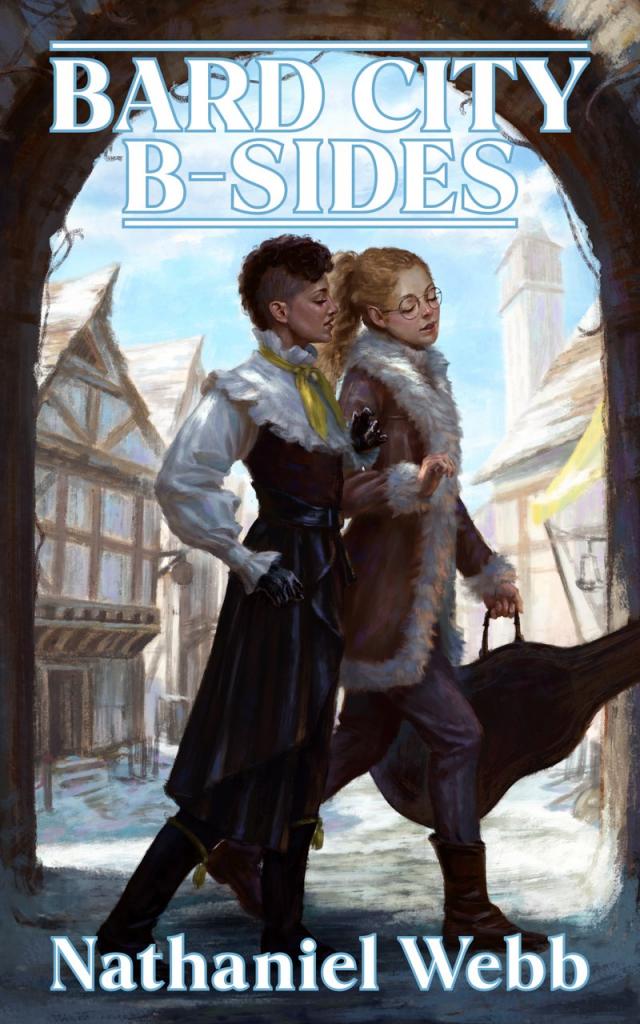
COVER PAINTING LUCAS MARQUES OLIVEIRA
Copyright © 2023 Nathaniel Webb
Wyngraf copyright © 2023 Young Needles Press
All rights reserved. No part of this book may be reproduced in any form or by any electronic or mechanical means, including information storage and retrieval systems, without written permission from the author, except for the use of brief quotations in a book review.
Cover by Lucas Marques Oliveira
Interior art by Cris Puga
Map by Mikael Asikainen (www.orbigraphia.com)
CONTENTS
A Gift to Suit
The Underbender
Kid Gloves
The Sea King’s Eyes
Bard City Blues Official Playlist
About the Author
Kickstarter Backers
This one’s for all the writers, reviewers, and (most of all) readers who have supported Wyngraf. Thank you for sharing my cozy dream.
A GIFT TO SUIT
May Featherlight wiped her hands on her apron, gazed around the shop, and nodded with satisfaction. She had named it Immaculate Miscellany when it opened two years ago, and today it really did look immaculate. Just like a soap shop should.
The teak floors shone from a fresh mopping, the heartwood columns and rafters showed not a speck of dust, and the four tables that ran the length of the room were pin-straight. The tables were the perfect height for a halfling like May, which meant her customers from the taller folk had to stoop a little, but that was fine by her. A double row of wooden bowls marched down each table—May had just finished dusting and nudging them into tidy lines—each holding a different aromatic ingredient for soapmaking. Vanilla and lavender, chocolate and coffee, cut grass and jasmine… they all mingled together in the air of Immaculate Miscellany’s smellroom, making a warm and welcoming blend, but May’s discriminating nose picked out every note.
She nodded again, making her auburn curls bounce. Everything was perfect.
“Maylily Dogblossom Featherlight!” howled a voice from the closet near the back of the smellroom. The door was only slightly ajar, but that voice had a way of carrying. “What is all this junk?”
May sighed, her good humor dissolving swiftly. “What junk, Mum?”
She pulled a kerchief from an apron pocket and tied her hair up as she crossed the smellroom. Of course her mother would find something to criticize. Mum had come to Lackmore from the Reeve—“upriver all the way, and with winter coming on, no less!”—to help with May’s seasonal cleaning, and to Pansy Featherlight, helping and criticizing were one and the same.
“All those boxes and bags and things!” The closet door swung open and out rolled Mum, brushing dust from her best blue travelling dress. “I was nearly buried under all that.”
“Buried?” May stopped short. “Did the pile topple over?”
Mum raised her chin. Her own curls, though more gray now than auburn, had lost none of their springiness and bounced proudly around her face. “No, but it could have.”
“But it didn’t?”
“You know,” said Mum, “if you had someone tall around here to lend a hand—a man, maybe—they’ve got all sorts in the big city…”
“Mum!”
Her mother shrugged, the picture of maternal innocence. “I’m not criticizing. Running a shop on Coin Hill’s an awful lot for one halfling girl to handle all on her own, that’s all. It’s only an observation.”
“We’ll just leave those things where they are, then,” May said. “It’s nothing I need for the shop.”
“If not, we should toss them.”
“No—”
“Then what is all that? I raised six good halfling children, Maylily, and I know none of them’s a hoarder.”
May sighed. Mum had a way of wearing you down. “They’re gifts.”
“Maylily Dogblossom, the manners on you! You’ve not even opened them!”
“I opened some of them,” May said miserably. She edged around her mother toward the closet. “Those are the ones I haven’t. There’s too many, Mum. At first I thought I’d just store them as they came in, and open everything once a week or so, but they just kept coming, and I kept stowing them away, and before I knew it…” She shut the closet door with a clunk. “Well, you saw.”
“Oh, May.” Mum stepped forward and took her hand. “You should have told me.”
May blinked. “I should have?”
“The same thing happened to me at your age. It’s the hair, you know. Boys are enchanted.” Mum smiled, dimpling her cheeks, and May had to admit she could imagine the halfling lads of the Reeve lining up for a chance at young Pansy’s hand. “Girls, too. Everyone really. Well, I had so many suitors I simply froze. Spent the longest spring of my life tossing pebbles in the Weeping River, wondering whomever to choose. Half of them had married other girls before I made up my mind. I swear, sometimes I think your father won on sheer dogged patience alone.”
“Mum, that’s not the problem,” May said. “I don’t want to marry—”
“The wrong one, yes, I understand, darling.”
“No—”
“Luckily, your mum has just the solution.”
May let go of her mother’s hand. She had planned to keep arguing, had steeled herself for Mum’s next emotional assault, but she found herself so curious what in the world her mother was thinking that she felt a perverse and overwhelming urge to go along with it simply to find out what it was.
“And that is?” May asked cautiously.
“Why, it’s simple, love.” Mum smiled. “Somewhere in that closet is a present that’ll win your heart. Surely one of these suitors of yours has actually bothered to get to know you. We only need to find his gift.”
“But Mum, that would mean—”
“No quailing, Maylily. We’ll have to open them all.”
And so they did. Box by box and bag by bag, May and Mum tore paper, untied ribbon, snipped string, and opened envelopes until May’s hands stung from paper cuts and she prayed she would never celebrate a birthday or Winterfair ever again, simply to avoid the presence of presents.
The single most common gift was perfume. Every one of them was awful. Why so many men thought they were better judges of scent than a woman who made people smell good for a living, May couldn’t begin to guess, nor did Mum have a pithy answer when she asked the question out loud.
The second most common gift was food, which, having all spoiled, admittedly smelled worse than the perfume—though they made many jokes to the contrary.
Then there was the clothing. So much clothing. Some of it fit and some didn’t, some was tasteful and some wasn’t. But considering May worked seven days a week and rotated through the same set of simple dresses and aprons, it was hard to argue that any man who sent her clothing really knew her, even if he knew her measurements.
Four and a half hours later, the sun had long since gone down, and May and her mother sat like two lonely dinghies in an ocean of ribbon, string, and paper.
“Well,” said Mum. “Whom do you like best?”
May picked up a block of blue-veined cheese—they hadn’t decided if it was supposed to be that way or not—and dropped it back into a pile of white waxed paper.
“Don’t sulk, Maylily,” Mum said. “You’ve got to pick someone.”
“I certainly don’t!” May gestured at the wreckage around them. “Look at this place. You came here to help me clean my shop for the season and instead we destroyed it, because you’ve got a bee in your bonnet that I need a ring on my finger and a man in my life. Well, I don’t. I built a successful business on Coin Hill, I have loads of friends, and I’m happy, Mum. I’m happy! Doesn’t that count for something?”
Mum leaned over, picked up the veiny cheese, and began wrapping it up. “It counts for everything, May,” she said softly. “I’ll start tidying this mess. You take a break.”
“Forget it. We’ll tackle it tomorrow.” May stood and reached out a hand to help Mum up. “Good thing I closed for the week. Come on, I’ll put a kettle on for tea.”
Mum took her hand and hauled herself to her feet, and together they headed for the door to May’s workroom, shuffling through the remnants of their afternoon’s efforts. As she neared the edge of the debris, May aimed a sarcastic kick at a stack of crumpled wrappers in various candy colors. Having removed her shoes hours earlier, she yelped when her toe clanged against something hard.
“What was that, darling?” asked Mum.
“I don’t know,” May said. “The one that got away, I guess.”
“A perfume bottle, I expect.” Mum sighed. “Just leave it, we’ll sweep it up with the others tomorrow.”
“That’s all right.” May leaned down and began shuffling through the papers. “I’d rather get it now.”
But rather than a perfume bottle, she found a package the size of her hand, plainly wrapped in brown paper, with no card or marking other than the name “May Featherlight” written in pencil. It was strangely light for its size, as though whatever was inside was hollow, and… warm.
“Well?” said Mum.
“I don’t know.” May tugged at the paper, which fell away easily. Inside was a glass jar of the sort used for pickling. But rather than food, it held—
“Maylily Dogblossom, some boy sent you a fire elemental!”
Within the jar, a ribbon of blue flam e jerked and sparked like a living thing. May was no archmage, nor did she know much of city magic—the spells she worked for her special-order soaps were ones she’d learned far from the crowded streets of Lackmore—but she understood that most urban enchantments were powered by bound elemental spirits like this one. It was a tidier form of sorcery than the wild magic of the highlands, or the humble rustic spells she’d learned in the Reeve, but it suited the orderly chaos of life in the big city.
May beamed at her mother. “Do you have any idea how much this could help me with my work? Just making the quicklime—the amount of wood I burn to get the fire hot enough—this elemental will save me… I don’t know, a lot of gold!”
“May, that’s an expensive gift.” Mum’s voice was soft. “Who sent it?”
Catching her mother’s tone, May tamped down her excitement. “I don’t know. It didn’t say.” She stared at the wreckage around them. “Even if there was a card, we’ll never find it now.”
“Well, if you ever do sort out who sent it, you could do worse than to marry a rich fellow with a knack for the sensible.”
May looked back at the elemental, watching it dance in its jar. “I’m not getting married, Mum.”
“I’m not criticizing, darling. It’s only an observation.” Mum put a hand gently on May’s back. “Now, I believe you mentioned tea? Your gift can heat it up for us.”
THE UNDERBENDER
On a lonely stretch of the King’s Road, somewhere south of Lackmore and north of the Reeve, rain pattered on the thicket. A rabbit huddled under one particularly dense bush, nibbling at a tuber and contemplating his good fortune in finding such a sensible place to wait out the weather.
His head came up, nose twitching, at a sound as yet inaudible to the other creatures holed up along the roadway. He wasted only a moment in contemplation—and rabbit moments are quicker than most—then, with hardly any remorse at the loss of his supper and refuge, bolted.
Soon the sound grew loud enough to be heard over the rain: hoofbeats, shaking the King’s Road with their approach. A pair of thrushes took flight to find somewhere they could sing undisturbed. A moment later a horse came thundering around a bend in the road, hooves churning the earth, spraying mud in a great arc.
The horse was a compact but powerful stallion, built for speed, its flowing muscles and glossy coat unmistakeable even under the layer of filth it wore. A rider bent low over its withers, reins looped around her right hand and a rapier in her left. In her battered leathers she was the same color as her mount, except for the bright yellow bandana around her face, which seemed to have escaped the evening’s rain and muck.
“Go, Brigand!” she shouted, snapping the reins, and the horse cleared the bend and took to the straightaway with a fresh burst of speed. Soon they were gone, lost behind a curtain of rain.
A few moments passed, slow human moments, before a curious fox poked its nose from the underbrush. He sniffed the air in the hopes that horse and rider were truly gone—then yelped and ducked back into the thicket just as the rabbit had.
Two horses much larger than Brigand, bearing men much larger than the rider in the yellow bandana, galloped around the curve. Their crimson tabards were as patchy and mud-caked as their mounts, but on both of them the image of a gauntleted fist clutching a lightning bolt could be discerned.
One was helpless against the rain, but the other wore a battered black hat on his head and a chain shirt under his tabard. “Ride on, you dog!” he shouted. “She can’t run forever!”
Alix seemed unwilling to let go of her rapier, and used her right hand to tug at her bandana as they rode. She gulped down the steamy summer air with such desperation that for a moment, Brigand worried she would inhale the thickening rain with it.
“Lords Below, Brig,” she said, “you’d think I stole the whole pie!”
Brigand, focused on keeping his mistress away from the bad soldiers and rather enjoying the chase, didn’t reply.
“Not to mention,” Alix went on, “if Lord Pinchpenny back there had actually paid up, I could’ve just bought the slice.”
Brigand chuffed in agreement at that. They’d ridden all night to deliver an urgent letter to this Lord Pinchpenny (Brigand had never caught his real name) only to be, as humans put it, stiffed. Alix had returned to the stables fuming and cursing, but with enough presence of mind to steal Brigand’s supper before her own. Nor had she gotten caught doing it, which he appreciated.
Alix, who for all Brigand loved her didn’t seem to speak a lick of horse, replied, “You’re right, old boy. This rain’s looking worse by the minute and while I’d bet the house on you on turf, I can’t say for certain you’ll win a swimming contest.”
Brigand snorted and piled on the speed. He was a fine swimmer.
“Nor’s it getting lighter,” Alix said, “what with the sun going down. Best we find somewhere to hole up ’til dawn.”
Some wet and desperate minutes later, Alix slid from Brigand’s saddle, laid a hand on his heaving flank, and said, “All things considered, Brig, one could do worse.”
The rain had indeed worsened, becoming a proper storm. But that had been a stroke of luck, after a fashion: the first flash of lightning made Brigand shy, but the second had revealed the bones of a tumbledown old farmhouse a hundred yards off the King’s Road. Knowing she’d find no better, Alix had turned Brigand for it at once, walking him through tall, weedy grass with teeth-gritting slowness and listening for the hooves of her pursuers all the while.
The third lightning flash came when they reached the house, and then it really set to raining.
Alix sheathed her rapier with some reluctance and squinted into the gloom. Brigand and she stood beneath the ragged stub of half a ceiling, what had once been the second story of the farmhouse. To judge by the footprint of the place, someone had been rich once, long ago. But there was no telling what had become of the land, nor did Alix much care to guess. Horses she knew, and cattle on her mother’s side, but farming held no interest.
She peeled off her riding gloves with two wet pops and stuffed them in a saddlebag. Deeper in it she found a bundle wrapped in cheesecloth, which she pulled out and unwrapped to expose a few soggy crusts of bread and half an apple. Alix crammed two of the crusts in her mouth and held out the apple to Brigand, who took it in a single bite.
“My thoughts exactly, old boy,” she said around a mouthful of damp bread. “Well, we may be hungry, wet, dirty, tired, broke, and recently on the receivers’ end of a good old-fashioned cheating, but we’re safe. And if Alix Bon Vallu is one thing in this world, it’s fashionable.” She looked down at the mud caking her boots nearly to the knee, ran a hand through her wilted hair. “Excepting tonight, one supposes. But if I’m two things, Brig, it’s fashionable and lucky. The chance those red-shirted buggers even spot this skip is good as nil, and even allowing that they might, would they really bother coming over for a sniff?”
High above, thunder boomed. The lightning came instantly, a great sheet that lit the farmhouse with fugitive daylight, and Alix saw two sodden men in red tabards looming in the arch of a fallen doorway. The larger of them was soaked through and dripped noisily on the half-buried flagstone floor. The smaller—slightly smaller—one was shielded from the weather by a wide-brimmed black hat and a ragged mail shirt, but his face was dark with fury.
“Gents,” Alix said. “I appreciate your boss forgot to pay me, but you didn’t have to come all this way in the rain.”
“You owe Lord Flensy two silver for that pie you nicked.” A raindrop plopped off the shorter guard’s hat.
“And he owes me a gold and six for the urgent overnight delivery, so what say we call it square?”
“Just let’s have the silvers, miss, or you could come along back with us,” said the other guard. He had a broad, open face and hands like dinner plates, which he raised as though to demonstrate his capacity for grabbing. “We don’t want a tussle.”