Silent siren, p.1
Silent Siren, page 1
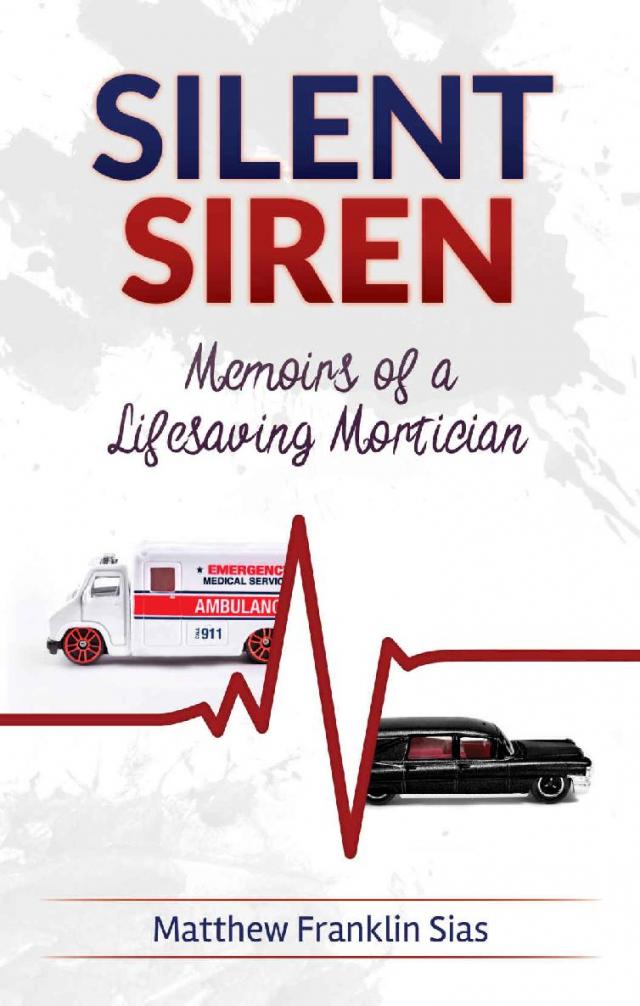


Silent Siren
Memoirs of a Lifesaving Mortician
Matthew Franklin Sias
Copyright © Matthew Franklin Sias 2018
All rights reserved. No part of this publication may be reproduced, stored in or introduced into a retrieval system or transmitted in any form or by any means, electronic, mechanical, photocopying, recording or otherwise without prior written permission from the publisher.
This book is a work of non-fiction. All events have been reproduced as accurately as possible. At times, to protect those who could suffer embarrassment, names and/or certain details have been changed.
Originally self-published by Matthew Franklin Sias in 2012
Published by Vulpine Press in the United Kingdom in 2018
ISBN 978-1-910780-55-8
Cover by Claire Wood
Cover photo credit
www.vulpine-press.com
This book is dedicated to my late grandmother, Doris Druschel, who encouraged me to write.
A note from the author
The “silent siren” refers to a purple flashing light that was commonly found on the front of hearses in the 1930s and 1940s. It indicated that a funeral procession was in progress. Much as cars now pull over for ambulances, police cars, and fire engines now, they pulled over for funeral processions out of respect for the dead and their families.
I have tried to lay out chronologically some of the more interesting experiences I have had in my vocation and avocations in the public service sector, focusing mainly on my chosen career in EMS. I never took notes on calls in the last twenty years, so my recall of more recent events is more accurate. This is the reason for relatively more detail included in my Skagit County and funeral home accounts. I have, however, attempted to recreate even past events to the best of my recollection.
This book is also dedicated to the memory of Randy Oliver, Art Dick, and Terry Bowen, three comrades in EMS who left us too soon.
Matthew Sias, April 19, 2010
Contents
I. EMT
Alta
First Days
Medical Terminology
Explorer Firefighter
Trial by Fire
Ancient Mammaries
Bleach
Shocked
Daddy’s Sick
Station Rats
The Dukes of Bainbridge
Pieces of a Man
Coitus Interruptus
Rats!
Aircraft Down
Stinker
Sleeping Beauty
Guts in the Street
Up a Creek without a BVM
Stairway
The Blue Dog
Just a Tune-Up
Taking Granny Home
I’m Worried
II. Paramedic
Paramedic Training
Cough CPR
Queens
Gear Geeks
Ethel gets an Airway
AMR Northwest
If Thy Hand Offends Thee
Skinny Dip
Adventures in Lawn Mowing
EMS Superstition and the Heisenberg Uncertainty Principle
Back to School
History of Medic One
Training
Seniors
Shunt
Evaluations
See Me
Smock Burning
An Impossible Airway
Hot Dog
The Split
Shoreline Fire
Sick Kid
Time to Retool
III. Transitions
Re-Evaluation
The Cooler
Autopsy
Suicide
A Multitude of Maggots
Homicide
Decomp
In Shades of Ordinary
Gross
Rough Riders
Another Transition
The Removalist
Heavy Duty
The Mummy
Academy
IV. Skagit County
Skagit County
A Substantial Woman
Fly Paper
Cardiac Arrest
Mushroom
Darryl the Nearly Indestructible
One Confirmed
Two Humans
Tones
Health Care is Broken
Silent MI
Monkeys with Needles
Blocked
Problem Patients
A Car, a Dead Man, and Some Cows
Pablo
Comfortably Numb
Medics Say the Darnedest Things
Code Save
Off Duty
The End of the Road
V. The Business
Death
Different Missions
My Other Car is a Hearse
Embalming Mrs. Ramirez
Double Duty
Every Sparrow’s Fall
Ditched
All in the Family
VI. Reflections
One of Our Own
Grandma
Success
Looking to the Future
A Calling
I. EMT
“Being a volunteer is like peeing in a dark suit. It gives you a nice warm feeling and nobody notices.”
- Unknown
Alta
Alta slumps in her wheelchair, still and silent, in the middle of the nursing home hallway. Her waxen face passively regards the fluorescent ceiling lights. A toothless mouth gapes in a perfect “O” and her eyes remain half-open behind her ever-present tinted glasses.
At fifteen years old, I became a volunteer at a local nursing home—something I had taken up for Lent, when I was more religious than I am now. My mother stands beside me in her purple coat, hair still blown from the late December wind. She had just walked in the door to pick me up and was trying to adjust to the tropical environment of a skilled nursing facility.
“Is she dead?” I ask Mom. She nods, reverently I thought. “I think so.”
My mouth goes dry and I can’t speak for a minute. This is the first dead body I have ever seen. I have the sense that I had witnessed something I shouldn’t have, that the passing of one life into the next was intensely private—something that should only be experienced behind closed doors.
Earlier in the day, I had seen Alta energetically maneuvering her wheelchair through the hallways. She had always seemed to be in a hurry, propelling her chair, using one leg as a motor. Yet there she sat, still and pale, her chunky orthopedic shoes perched on silver footrests, her crisp khaki skirt reaching just past her support-hose clad knees.
A nurse approaches the still body with a cup of water and a handful of pills, seemingly unaware of her demise.
“Alta! Alta!” She nudges her shoulder.
The nurse looks panicked and beckons to another woman at the desk, who presses two fingers to Alta’s neck and then, wordlessly, wheels her backwards into her room.
“Alta’s gone,” whispers a white-coated nurse.
“No!” says another, hand clapped to her mouth.
Though I hadn’t been prepared for what I had seen when I had rounded the corner at the nurse’s desk, Alta’s passing was a gentle introduction to death, and I had no responsibility to take action. I was merely an observer.
With a sense that somehow I had been changed, I jam my slightly sweaty hands into the pockets of my jeans, and Mom and I make our way down the wide hallway towards the double doors that lead to the outside world—a world of fresh air, trees, life.
The Responder
A tepid breeze blows through the anemic air conditioning unit of our Plymouth minivan, providing little comfort against an unseasonably warm August day on Bainbridge Island. Dad sits beside me, lost in his work, scribbling notes on a wrinkled, coffee-stained piece of paper entitled “First Call.” I roll down the driver’s side window and make the left turn down a long, steep driveway. As we descend, the salty kelp smell of the beach grows stronger. I’ve always found the breezes wafting from the Puget Sound comforting and the van needs airing out anyway.
Our destination amounts to a mansion, three stories of magnificence presiding over acres of manicured lawns that lead to a glimmering shoreline. Something about the residence is vaguely familiar. Standing at the doorway is an elegantly dressed woman who watches our approach impassively. She stoops to move aside planters of brightly colored flowers as we pull our van parallel to the front door.
I glance at myself in the rearview mirror before I exit. Necktie centered and pulled tight. Hair combed and shellacked to the point of immobility. A few gray whiskers are visible in my beard. Otherwise all is good. As I step out of the van, the sun strikes my head and I notice that it seems a little more intense at the crown, where, almost imperceptibly, my hair has begun to thin.
The elegant woman opens the front door for us and steps aside as Dad and I roll our equipment in.
“He’s on the top floor,” she says. “We’ll be out in the garden if you need us.” She walks into the adjoining kitchen and joins a middle-aged man and woman who sip coffee and mull over paperwork spread on top of a large oak table.
Dad gazes up the steep stairway. “I think a backboard would be the best idea here,” he says. Eleven years as an EMT have conditioned his problem-solving ability. When viewing an elaborate spiral staircase, his first thought is probably not, “My, what an elegant piece of architecture.” Instead he thinks, “Hope nobody dies up there. We’d have a hell of a time getting him down.”
After fetching the backboard
Lying on the bed is a tall, thin man, his bony, aged feet jutting out from underneath silk pajama bottoms like pieces of driftwood. Downy white hair thinly covers his alabaster scalp. It’s patchy in places, as if he’s had recent radiation treatment.
Dad clips a small orange tag to the man’s left ankle before spreading a plastic sheet on the bed. I grab hold of a limp arm and turn the man to his side as Dad moves the sheet underneath. The familiar sounds of crinkling plastic and clicking seat belts break the silence as the man in the silk pajamas disappears inside his plastic enclosure and is secured to the backboard with three fluid-impervious straps.
My heart rate accelerates slightly as I lift the laden backboard and realize the man’s slender physique belies his considerable weight. One step at a time, Dad and I convey the man down the steep staircase to the wheeled stretcher waiting at the base of the stairs. After laying the backboard on the thin burgundy gurney mattress, we place a gray shroud over the body, raise the stretcher to load position, and wheel it into the August sunshine.
Dad slides the gurney into the metal retaining cups and slams the back hatch. Climbing into the driver’s seat, I slap a gob of alcohol disinfectant on my hands and fasten my seat belt. I gaze down at the First Call sheet Dad has left on the center console and note the name printed at the top—Herbert Morris, Sr., born April 20, 1923, died August 8, 2008.
Not more than two months ago, I had wheeled Mr. Morris out the front door of his house, sick, tired, but very much alive, to an idling ambulance. I had placed oxygen in his nostrils to ease his labored breathing and a blood pressure cuff around his left arm to assess his chances of survival in the coming hours. At Harrison Hospital, he was given his prognosis—a month, maybe six at the most. Pain medication had eased his transition and Mr. Morris went to go home to pass away on his terms, surrounded by his loving family, gazing at the fishing boats leaving the harbor and slowly fading into the distance.
Now the lungs that had labored for breath are silent, the hands that had so recently gripped the rails of the ambulance gurney lie still atop a pajama-clad chest. Mr. Morris now makes his penultimate journey, this time to a small room with tiled walls and bright lights, to be dressed in his finest suit, rosary beads interlaced between his fingers, the pallor of sickness replaced by the subtle hues of mortuary cosmetics. His mortal remains will be framed in cloth and embraced by the fine wood or steel of a medium-grade casket, creating what, in funeral parlance, is referred to as a “memory picture.”
Like a well-rehearsed play, the obsequies of Mr. Morris’s Catholic faith will be recited, his casket will be closed for eternity, and he will take his place at rest beside his beloved wife, beneath the bright green sod of Seabold Cemetery, well-loved, well-mourned, and at peace.
***
As a practitioner of both the healing and the mortuary arts, I am in the unique position of both participating in the struggle to stave off death and later carrying out the final wishes of the deceased in death’s aftermath. In the years since I first picked up a stethoscope, and later, a casket key, I have come to regard my two seemingly divergent vocations not as contradictory in purpose but as instead all service to my fellow man, different expressions of the same desire to bear witness and provide comfort to those I have been called to serve.
From the rural self-reliance of Clackamas County, Oregon, to the fast-paced and often violent streets of Seattle, I have witnessed the best and the worst of humanity. I have seen babies born on bare floors in one-room apartments and lives end on rain-slick roads, inside opulent condominiums, and in cold, dark alleys. I have lived most of my life in the relatively small community of Bainbridge Island, Washington, surrounded by the inky saline water of the Puget Sound.
A bedroom community of Seattle, it is a half-hour ferry ride away from the arts and culture of the greater King County core. I graduated from Bainbridge High School in 1991 and now own a home here on the island. Though I have lived elsewhere for a time—New York and Portland, Oregon, I have always come back to the place I called home. My family is very close, both in terms of proximity and dedication to one another. My parents, semi-retired, live five minutes away. My brother and his wife live seven minutes away. From the time I was a little guy, I can remember being fascinated with the hidden world of emergency services—mesmerized and a little frightened at times by the flashing lights and sirens. I was probably the only kid in my neighborhood to have a fully staffed Lego fire department, complete with dual paramedic ambulance and dispatch center. My parents, God bless them, tried to get me involved with sports. During a tee-ball game, I was assigned to the outfield and lost all concentration when a fire engine went roaring by. I couldn’t figure out why coaches and fellow players then began yelling and gesturing in my direction. Apparently everyone was displeased with my athletic performance. I guess the allure of EMS and fire was already in my blood.
First Days
My journey into emergency medical services began in 1989, when I was fifteen years old. A sophomore in high school, I had always been interested in EMS but wondered if I had the stomach for it. I was a scrawny kid and the sight of my own blood was enough to make me queasy. At my high school, I had overheard a classmate of mine, Fred Schneider, mention to a friend that he was starting the Explorer program at Bainbridge Island Fire Department. A branch of Boy Scouts, it provided high school kids the opportunity to learn the professions of firefighting and emergency medical services while actively participating in training and emergency calls.
I mentioned this information offhandedly to my mother that evening, never thinking that I would be one to participate myself. However, Mom had other ideas. She encouraged me to complete an application for the department—actually, I believe threats were involved—and within a week, I was sitting in my informal interview with Garrett Kimzey, student captain of the Explorers.
My first meeting at Bainbridge Island Fire Department was on a Tuesday evening in March of 1989. Upon walking (with great trepidation) through the double glass doors, I immediately became lost. Many who know me well would argue that not much has changed since then.
A speaker blared: “All recruits to the multi-purpose room!”
Was I a recruit? Where was the multi-purpose room?
Eventually a passing volunteer took pity on the skinny, wide-eyed, clearly bewildered kid, and pointed me in the general direction of the other skinny, wide-eyed, bewildered kids gathered in the day room or “beanery” as it was known. In the next two hours, I met many I would come to look up to professionally in the following months and years. I got a tour of the paramedic unit, given by resident firefighter Jim Walkowski.
The medic unit reeked of cleanliness and order. Fluorescent lights illuminated unfamiliar equipment, some translucent and rubbery, others with multicolored buttons and display screens. I was in awe. Assistant Chief Callaham, with forty years of service to the department under his belt, and the gray hair to prove it, gave us a briefing on radio procedures and told us that our primary responsibility from now on was to the fire department. Many would argue that family or school came first, but I took his advice to heart. Nearly every day after school and on the weekends, I sat in the day room waiting for calls or poked around in the apparatus bay learning the ins and outs of every fire engine, rescue, and medic unit in the fleet.
The following months introduced me to the rudiments of firefighting, paramedicine, and the culture of the fire service. I sat in on the boisterous firefighter’s club meetings, spent hour upon hour in the back of the medic unit, learning the contents of every drawer and the workings of the heart monitor, bag-valve mask resuscitator, and intravenous line set-up. I spent Tuesday evenings clad in heavy school-bus yellow firefighting gear, yanking a heavy water supply hose off the back of the fire engine and hooking it into hydrants. I didn’t enjoy ladders in the least. Still, it was part of the training, and I did it without complaining. I never considered myself to be terribly mechanically inclined, but, in time, I learned the basics of operating chainsaws, portable fire pumps, and, perhaps most importantly, the powerful pumps that provided high-pressure water from a fire engine to attack hoses. And I do mean the basics. I still consider myself a hazard around anything that has more than two moving parts. Many long-suffering fire officers can attest to my lack of mechanical acumen.