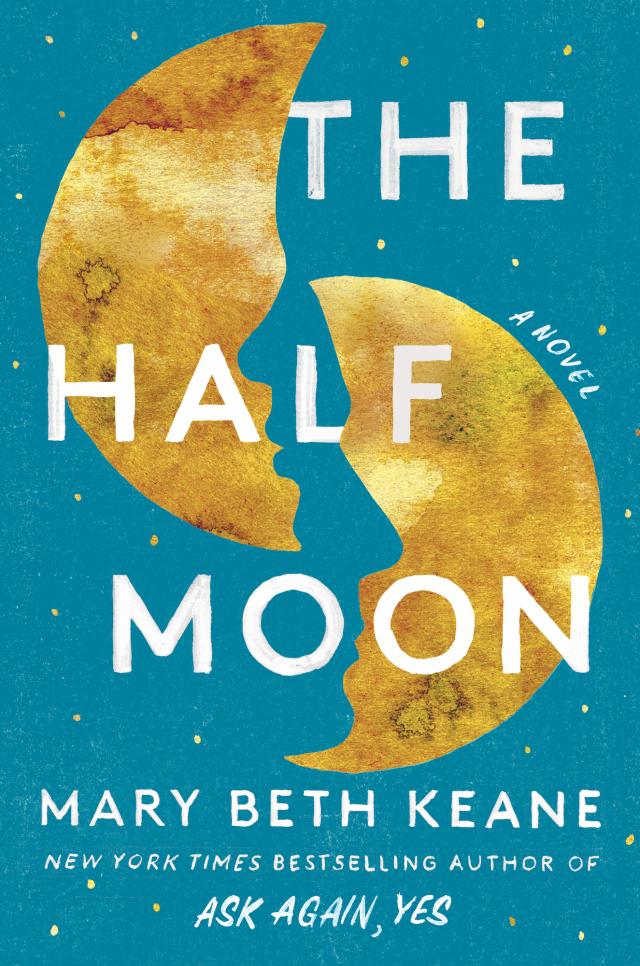
The half moon a novel, p.1
The Half Moon: a Novel, page 1


SELECT PRAISE FOR MARY BETH KEANE’S ASK AGAIN, YES
Named a best book of the year by People, Vogue, Parade, NPR, and Elle
* * *
“An epic of intertwined families redeemed by their enduring compassion for one another.”
—O, The Oprah Magazine
“A rare example of propulsive storytelling infused with profound insights about blame, forgiveness, and abiding love.”
—People
“A beautiful novel, bursting at the seams with empathy.”
—Elle
“Keane’s gracefully restrained prose gives her characters dignity…. Shows how difficult forgiveness can be—and how it amounts to a kind of hard-won grace.”
—Vogue
“Keane writes with acute sensitivity and her characters are consistently, authentically lived-in…. Smartly told.”
—Entertainment Weekly
“Tender and patient, the novel avoids excessive sweetness while planting itself deep in the soil of commitment and attachment. Graceful and mature.”
—Kirkus Reviews (starred review)
“A gem of a book.”
—Taylor Jenkins Reid
“I absolutely adored Ask Again, Yes…. I’ll read everything she writes.”
—Liane Moriarty
“Mary Beth Keane is a writer of extraordinary depth, feeling, and wit.”
—Meg Wolitzer
“I devoured this astonishing tale of two families linked by chance, love, and tragedy…. A must-read.”
—J. Courtney Sullivan
“Stunning! An absolutely brilliant, gorgeously written novel by a fearless writer.”
—Lisa Taddeo
Thank you for downloading this Simon & Schuster ebook.
Get a FREE ebook when you join our mailing list. Plus, get updates on new releases, deals, recommended reads, and more from Simon & Schuster. Click below to sign up and see terms and conditions.
CLICK HERE TO SIGN UP
Already a subscriber? Provide your email again so we can register this ebook and send you more of what you like to read. You will continue to receive exclusive offers in your inbox.
To my first loves, Annette and Catherine
Right and wrong were shades of meaning, not sides of a coin.
Louise Erdrich, Love Medicine
one
Malcolm Gephardt could tell the bar was busy even from a block away, even from behind the filthy windshield of his Honda. The night was damp, the sidewalks along the center of town laced with dirty snow that had been refusing to melt for near a week. Most businesses had heeded the weather forecast and closed in advance of the coming storm, but when Malcolm approached the traffic light and saw his own squat, brown-shingled building at the bottom of the hill, something lifted in his chest and he leaned over the steering wheel.
“Oh,” he said aloud to his empty car. Something was different about the place tonight. He felt a pull of energy, that singular happy chaos that can only be found inside a crowded bar when the music is good, people are running into friends, and the whole place is cozy despite the bone-cold world outside. He tried to imagine himself a stranger, tried to see his place as a stranger would. His place. His. Did it look welcoming? Was it just his imagination or did the light spilling onto the street give the whole façade a faint glow? Yes, he decided as he slid neatly into his parking spot and felt a thrill of hope, of faith, shoot through him for the first time in weeks: in himself, in his town, in these people, in life, in destiny, in following one’s intuition. It was a good town, a good bar, and he was okay, he said to himself silently, like a prayer. Half Moon the old wooden sign above the door read, punctuated by a carving of a crescent moon (people loved pointing out the mistake) that had gone black and moldy over the years, and which Malcolm had scrubbed and then retouched with bright white paint the day after the deal went through.
Tonight, there were two people outside, smoking, and another woman just standing there, shivering. A positive sign. But it meant he couldn’t go around to the side entrance because they’d spotted him, were already lifting their chins to him, and now as he approached he had to say all the things: how’s it goin how you feelin looking good yeah more snow coming what a winter I guess nobody’s goin nowhere for the weekend hope to god we don’t lose power what’ll we do without the TV ha ha ha. He had to shake hands, kiss the women hello, pretend he didn’t know what they were talking about when they asked how he was doing, and made serious faces. And when he told them he was good, he was fine, as if he didn’t know what they could be referring to, he had to do a better job pretending when they asked him again not ten seconds later.
All of this was far more difficult without a two-foot-wide bar sitting between him and the person asking. It was more difficult than it used to be, that was for sure. But why? Because he believed he knew himself, he supposed. Because he believed he knew Jess. He held fast to the good feeling from a moment earlier and told himself to keep going, to get through the night, and then maybe there’d be another one just like it. Lately, he’d been having thoughts. While at the stoplight on Wappinger a week ago, the sunset a purple bruise above Tallman Mountain and the wide Hudson hidden beyond, he thought, I could keep driving. I could turn right and head for Mexico. Turn left and make for Canada. All he had to do was keep filling the gas tank. He was handsome and charming and people liked him instantly. This was a fact he’d known about himself his entire life, and it would give him an advantage if he were to turn up in some Québécois village looking for work. His mind glanced at how much money was in the safe, how much room was left on the credit cards. He itemized everything in his house that he considered dear, but what was there that he truly loved? The coffeepot? His leather chair? Then the light turned, the thought evaporated without taking root, and he arrived at the bar feeling off-kilter, like he’d been on the verge of saying something important, but he couldn’t remember what.
As he chatted with the people standing outside, he allowed himself to hope for twenty people inside. Twenty would be a decent night, and if there were twenty people in there, he told himself to not immediately wish there were forty. He refused to look through the window as if it might bring bad luck. Thirty maybe. There might be thirty. It was the coming snowstorm. Gallagher’s and The Parlor hadn’t even bothered to open. Primavera, next door, seated their last table at seven sharp. He wasn’t sure about Tia Anna’s or the new Thai place. If he had to close, he’d close, but until then he’d pull pints.
“He’s here,” Roddy said as soon as Malcolm stepped inside, and he felt his optimism wobble for a moment. As always, there was a note of urgency in Roddy’s voice, something in the timbre finding a frequency above all the conversations and reaching Malcolm like a tug on his sleeve. Forty people. More. His friend Patrick was there. Siobhán, too, and God love her she was bouncing a hip to the beat of whatever was coming out of the jukebox. His friends had been calling and dropping by his house a lot more often since Jess left, and even if their cheeriness was a performance, he appreciated it so much that one recent Saturday, when he woke up to Patrick and their friend Toby banging around his kitchen looking for coffee filters, he sat up in bed and felt pressure in his throat like he might cry. He and Patrick had been gently making fun of Toby for almost forty years, but there he was, sniffing the creamer he found in Malcolm’s fridge and searching for an expiration date. Were they calling Jess, too? Siobhán was, probably. Maybe some of the others. But no one raised the subject, no one wanted to talk about anything explicitly. If there were sides to be taken, they let him know in small ways which one they were on.
“Malcolm!” Roddy called over. “Hey!”
Malcolm nodded at Patrick and Siobhán and held up a finger to let them know he’d be just a minute. Roddy had been getting on Malcolm’s nerves from almost the first minute he started working at the Half Moon, but he seemed honest, his uncle had vouched for him, and Malcolm reminded himself that honesty was what he needed most after the disaster of the previous year, when he found out that John had been stealing money since probably the very first day Malcolm took over, just folding stacks of bills and shoving them into his pocket, running only the credit card tabs through the register. This, after all the times Malcolm had covered for him when they both answered to Hugh Lydon. All the coke John shoveled into his nose. His wife on the landline wondering where he was, though she already knew, and then turning her rage on Malcolm because he was stupid enough to have answered the phone. He hadn’t thought twice about keeping John on when it went from Hugh’s place to his place, and stealing was how John had thanked him.
Emma, his best bartender, was the one who told Malcolm. It was eleven in the morning, and they had a hundred balloons to inflate for a private party. She took him by the arm and pulled him into the women’s bathroom. For a second, when she put her warm hand on his tricep and locked the door, all his synapses fired. He didn’t want to think about what his expression told her when she stood close to him, because whatever she saw there prompted her to raise her hands as if to tell him to relax, as if to tell him in his dreams, maybe, to get over himself, that she would shelve that conversation for another time, that first she needed to tell him something. She held a finger to her lips and listened, to make sure no one was passing in the hall, but the servers were busy with the helium tank, André was cutting long strands of ribbon, and the chairs were still upturned on the tables like a forest of mahogany legs.
She told Malcolm that she didn’t want to be a narc, b ut she started watching John because he wasn’t putting his tips in the jar, and look at André working two jobs, and Scotty with a whole slew of kids, she could never remember how many. She certainly wasn’t giving up every weekend of her youth just so this joker could take money out of her pocket. She told Malcolm that when she called John out, he offered her three hundred dollars on the spot.
“Was he pulling this when Hugh was here?” Malcolm asked.
“I doubt it!” Emma said. No one would have messed with Hugh Lydon. With Malcolm, however, the bad seeds saw an opening.
John left without a fight, a sign of guilt, and Malcolm needed to fill his shifts. Roddy’s uncle was a regular, a union boss, Cement and Concrete Workers. Huge guy, with a face the color of a raw porterhouse. Jess used to cross paths with him once in a while when she was newly out of law school and working for Laborers’ International. Every time he saw her, he pointed finger guns and shouted, “Malcolm’s girl!” Jess forgave him for never bothering to learn her name because she so enjoyed when the other attorneys looked at her as if to say, We can’t believe you actually know this guy. Roddy was a good boy, the uncle told Malcolm, very smart when he applied himself, but he’d dropped out of college after two semesters. He wasn’t a drinker, the uncle said. He wasn’t into drugs as far as the uncle knew. Get him away from the computer and he was fine! His dad had split years ago and he needed more male role models in his life. Would Malcolm do him a favor?
“Malcolm!” Roddy called again. What Roddy’s uncle failed to mention when he was talking the kid up was that Roddy was annoying. His whole vibe was nervous, and that feeling was contagious, coming from a bartender. It could infect the entire place. Malcolm thought he’d lose that nervous energy once he learned his way around, but he hadn’t, and lately it was worse than ever. That night, he was behind the stick wearing a ratty T-shirt that said “Byte Me” and had a picture of an old 1980s floppy disk underneath. There was a dress code, Malcolm told him when he hired him. Wear dark colors. Shave. Comb your hair. Jesus.
Malcolm wasn’t ready to deal with Roddy yet, though he wondered for a moment if whatever Roddy wanted had to do with Jess. Maybe she’d called the landline. Maybe she was still on the phone, holding until he showed up. But who called the landline anymore except Malcolm’s mother, who had the number memorized since he started working there twenty-six years ago, or around the Super Bowl, the old-timers who were laid up after hip surgery but wanted to buy a box. Would Malcolm cover them? Of course he would. Of course. But try getting money out of them after they lost.
Maybe she was there somewhere. He glanced around.
No Jess at the bar. No Jess at the high-top she liked best. No Jess bullying people by the jukebox. She’d memorized the codes for the songs she hated, and in the old days, before the updated system, she would sit there and make sure no one pressed the combination of numbers that would serve up “Piano Man.”
But one look at Roddy’s face and Malcolm could see it was a problem with a customer. He took a quick glance around at the various clusters of people. Most were laughing. There was a group playing darts. “Gephardt!” someone called over, and he turned to find two of his buddies from the gym. He saw an old neighbor from his mother’s block. A guy from the barbershop. He saw his friend from the deli with a new girlfriend. Cute. Everything seemed fine. Seemed better than fine, actually. He clapped a few backs on his way through the room, and felt his own back clapped in return. There was joy in the air. People making themselves at home. Did the group by the window seem too rowdy? He watched for a moment. They’d hold for a few minutes while he collected himself.
And then he saw Hugh’s guy, Billy, sitting alone at a two-top, sipping a whiskey. They made eye contact, and Billy raised his glass as if to say cheers. Cheers to the crowd. To the money the night would no doubt bring in. Malcolm’s stomach heaved. Ignore him, he told himself. Just keep going.
He nodded hello to Emma as he tossed his keys in the usual drawer. Her hair was up in a high ponytail, and he really tried not to keep track of these things, but she had a beautiful neck, and in the one second he allowed himself to look, he followed a tendril of hair that had slipped loose.
“How long has—?” Malcolm lifted his chin toward Billy’s table.
“A while,” Emma said. “Waiting for you to show up, I think.”
He pulled on his tight shoulder to stretch it and then remembered Jess saying that was what he always did when he was worried. He hated getting to the bar so late, but his mother had come by with a meat loaf. She’d looked in his fridge like he was twenty-two again, living in his first apartment. After they ate, as she wrapped the leftovers for him, Malcolm had a vision of Jess rolling her eyes. “I gotta go, Ma,” he said eventually. “You okay to get home?”
“What the heck are you talking about am I okay to get home?” she asked.
In the old days, on Fridays, the construction workers would have started arriving by four. By six they’d have moved on and the commuters getting off the train would take their places. Around seven he used to start looking for Jess, in case she wanted to have a beer and a sandwich at the bar before she kissed him good night and said she’d see him later. Jess had warned him about making changes, but how could he have guessed the depth of love people had for broken-down, sticky barstools? Who would have believed they’d want to keep listening to the same songs on the jukebox over and over and over, as if music stopped being made in 1996? And he didn’t do even a fraction of what he dreamed of doing. He stuck to things that were relatively cheap and quick. But it turned out people didn’t want things to be nice, they wanted them to be familiar.
The only demographic that got stronger once Malcolm took ownership was the underage crowd. The moment he took over, they started trying to get in after ten o’clock with their New York State dupes and their good friends from Ohio and Florida. But a bar full of kids didn’t help the bottom line because they ordered straight sodas for a dollar and then brought their drinks to the bathroom, where they pulled nips out of their pockets and mixed their own. They worked on animal instinct, these kids. It was like a call went out the very hour the bar changed hands, and next thing they started showing up with little bottles clanking in their purses.
“I’m sure every generation thinks they invented that move,” Jess said, when he brought that detail home.
Where is she right this second? Every time he thought about it and realized he didn’t have the answer, he felt as if he’d taken a flying leap off a ledge without having a clue where he’d land. Up until that week she’d been staying with her friend Cobie, who lived on West Twenty-Third Street with her wife and their two sons. Cobie made sense as a person to go to: a college friend, one of the few close friends who was entirely Jess’s, without any connection to their hometown. But a few days earlier, he called Cobie because Jess wasn’t answering his calls or responding to his texts, and Cobie told him that Jess was, in fact, back in Gillam.
Look at that, Malcolm thought, she was inching her way home.
To Malcolm’s ear, Cobie pronounced Gillam like she was holding her nose. The one time aside from their wedding that she’d come to Gillam was to meet Malcolm, fifteen years earlier, and she kept pointing out things that she found interesting. That there were seven Catholic churches within five miles was interesting to Cobie, and that so many business names were Irish. She found it interesting that so many cars had a union local displayed on the bumper, and as they walked through town she called out each one they passed—carpenters, sandhogs, scaffolders, ironworkers, steamfitters—as if she never knew these jobs existed. How much do jobs like that pay? she wanted to know. What were the benefits? How long could a person do a job like that?
“Why?” Malcolm asked. “You gonna start digging tunnels?” Jess gave him a look that said, Watch it. He was sick of Cobie’s observations. He thought she was a snob.
But it was interesting that Jess was back in Gillam. She probably wanted to meet up, but she was so stubborn. Well, he had a few things to say now that he’d had space to think. He wouldn’t let her back in without a conversation, that was for sure. He had a memory of her in her twenties, just as they were getting together, how she used to stand with her friends but keep her eyes on him while he worked. How he felt electrified by that, astonished, really, given how brightly she shined and how proud everyone was of her going to that good school, her hair gleaming down her back, the breathtaking perfection of her profile when she turned to talk to the person next to her. Everything he did—mixing, reaching, leaning over the bar—he felt more acutely knowing she might glance over at him for a moment.