

Rye royal, p.1
Rye Royal, page 1


Contents
Foreword
The Lone Pine Club
1. Royal's Visitors
2. Penny to Jon
3. Rye Fawkes
4. Enter Lone Piners
5. The Message
6. Mary's Mistake
7. Holford Court
8. The Widow Vanishes
9. The Widow Disturbed
10. The Pencil Dot Clue
11. The Widow Courageous
12. Dickie Gets His Story
13. Lone Pine Party
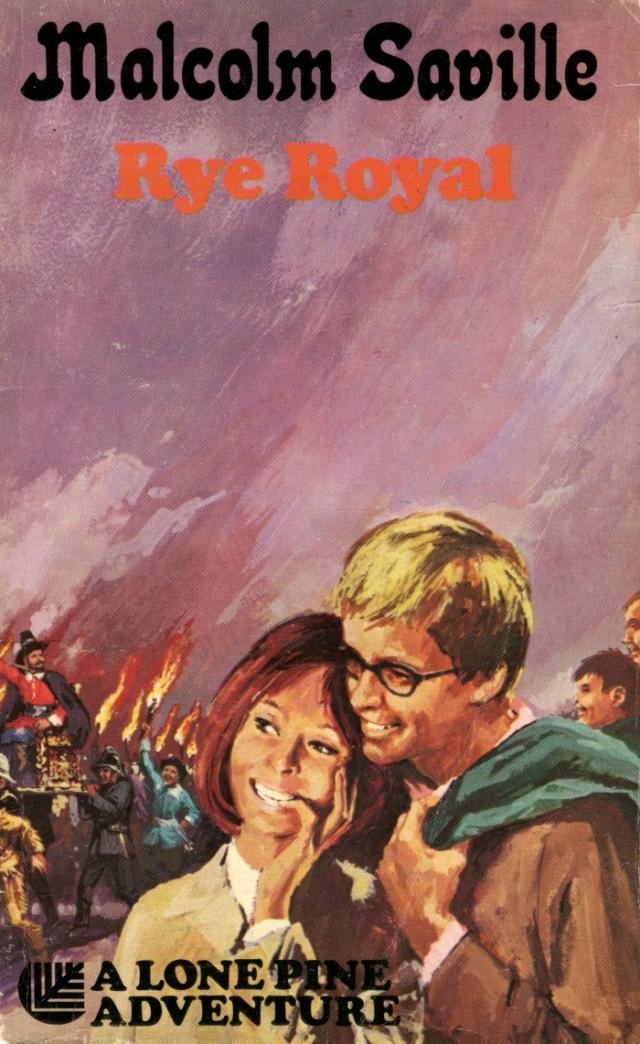
Rye Royal
Malcolm Saville
Armada
First published in 1969 by William Collins Sons & Co. Ltd., London and Glasgow. First published 1973 in Armada by William Collins Sons & Co. Ltd., 14 St. James's Place, London S.W.1.
© Malcolm Saville
Printed in Great Britain by Love & Malcomson Ltd., Brighton Road, Redhill, Surrey.
CONDITIONS OF SALE:
This book is sold subject to the condition that it shall not, by way of trade or otherwise, be lent, re-sold, hired out or otherwise circulated without the publisher's prior consent in any form of binding or cover other than that in which it is published and without a similar condition including this condition being imposed on the subsequent purchaser.
I acknowledge, with thanks, help given to me by Mr. Jim Foster of Adams of Rye, Ltd., the author of a local Guide Book which he has also called 'Rye Royal.' I am also grateful to the County Archivist of the East Sussex Record Office at Lewes, who has shown me several documents written in Rye during the reign of Queen Elizabeth I.
Foreword
Even if you have never read any of the other adventures of the boys and girls who founded the Lone Pine Club, and who are now known in many parts of the world as the Lone Piners, you will find this story complete in itself.
All the Lone Piners' adventures are set in parts of Britain which you can visit yourself. The setting of this story is the Sussex town of Rye on the edge of Romney Marsh and the time is now. I have known Rye all my life, and those who come to it for the first time are at once aware that there is no other town like it in Britain. Rye is indeed curiously un-English and this may be because it is one of the ancient Cinque Ports which in the Middle Ages were responsible for our sea defence and were the cradle of the British Navy. Rye was frequently attacked by the French and quick to defend itself and retaliate. It was certainly used a great deal by the smuggling gangs particularly in the 17th and 18th centuries when brandy and lace were brought in from France and wool from the Marsh sheep was smuggled out.
Today, you can explore the narrow streets and winding courts and alleys of this ancient town which was dubbed 'Rye Royal' by the first Queen Elizabeth when she visited the town in 1573. Hundreds of years before this royal visit, the marshes, now so peaceful and fertile, were once covered by the sea which washed the town's walls. Nowadays Rye is crowded with tourists and artists in the spring and summer months. But it becomes its true self again when they have gone and the seasonal south-westerly gales roar up the Channel and the waves thunder on the shingle beach and sea wall a mile or more away.
Because I am writing about a real place, I must explain that everyone in the story is imaginary and has no reference to any living person. There is no hotel called The Gay Dolphin and certainly no secondhand bookshop called Rye Royal. There are no streets called Trader's Street or Landgate Street and no Holford Court. But if you go to Rye on the Saturday nearest to November 5th you will certainly see the famous 'Rye Fawkes Pageant' with its torchlight procession which winds through the narrow streets and under the old Landgate down to the town Salts where a boat is burned according to ancient custom. As to the 'treasure' and its hiding place, there is no doubt that both are possible in a town like Rye Royal.
Readers who are acquainted with the earlier adventures will find in this story that, with the exception of the Morton twins, the Lone Piners have grown a little older. They are old enough now to behave with courage, integrity and a sense of duty, and realize how much they mean to each other. I hope you will enjoy their latest adventure at Rye.
M.S.
The Lone Pine Club
The Lone Pine Club was founded as a secret society at a lonely house called Witchend in a hidden valley of the Long Mynd in Shropshire. The first headquarters of the Club was a clearing, marked by a solitary pine tree, on the slopes of this valley. The original rules of the Club are very simple and are set out in full in 'Mystery at Witchend', which is the first story about the Lone Piners and was written over twenty years ago.
There are now nine members of the Lone Pine Club, but it is not usual for them all to appear in one story. The following appear in this one: -
JONATHAN (JON) WARRENDER - Age 18, only son of Mrs. Warrender who owns the Gay Dolphin. Is in his first year at Sussex University.
PENELOPE (PENNY) WARRENDER Age 17. Jon's cousin. Has just left school and is now attending Domestic Science College at Hastings. She lives at the Gay Dolphin as her parents are abroad. She is devoted to Jon.
DAVID MORTON - Nearly 18. Has also just left school and lives and works in London. He is the captain and co-founder of the Lone Pine Club.
RICHARD (DICKIE) AND MARY MORTON - David's ten-year-old twin brother and sister.
PETRONELLA (PETER) STERLING - Age 17. Now works in a Shropshire riding stable. Was really the founder of the Lone Pine Club. She first met the Mortons when they bought a house called Witchend close to where she was then living. Has no mother but lives now with her father at Witchend. Nobody in her life like David.
MACBETH - The Morton's Scottie dog.
The other members are: -
TOM INGLES & JENNY HARMAN - who live in Shropshire.
HARRIET SPARROW - a special friend of the twins, who lives in London.
1. Royal's Visitors
This adventure begins, as so many do, with the arrival of an unexpected visitor. The scene is the narrow, cobbled street named after the ancient Landgate in the town of Rye in Sussex, Crowning the hill to which the town clings is a noble church with an unusual sixteenth-century clock set in the north tower. During the tourist season there are invariably a few people watching this clock because it is flanked by two gilded figures five feet high and carved from Sussex oak. At each quarter of each hour, except the hour itself, these "quarter boys" strike their bells as they have been doing for nearly four hundred years.
On a September evening, when the sun was gilding the weather-vane on the pinnacle surmounting the tower, the two cherubic figures struck the last quarter before six. As the last notes died, a man stepped from the shadows of the narrow doorway of a half-timbered house in Landgate Street, not far away. Above the leaded window of the shop behind him was inscribed in old English lettering:
Rye Royal for Books and Prints
And beneath, even more discreetly:
Proprietor Roy Royal
Mr. Royal, aged about forty-five, was thin and balding with a small goatee beard, and behind his steel-rimmed spectacles his eyes were bright and intelligent. He was neatly dressed in a grey tweed suit and a white-spotted red tie. He had come to Rye only six months ago and lived alone in the rooms above the shop which was already becoming quite well known. The woman who worked for him a few hours daily was well paid and had nothing but praise for his quiet and gentlemanly ways, and had let it be known that he could cook for himself and worked hard packing and unpacking parcels of books and banging away on the typewriter in his little office at the back of the shop. So Rye had more or less accepted him, although his one daring innovation was a big surprise and had caused some criticism. The town was used to strangers trying to make a living out of tourists, but the idea of opening the cellars beneath the shop as a coffee bar primarily for young people who wanted a quiet place to meet and talk was regarded as ridiculous. Royal called this the Book Cellar and it had a side entrance at the bottom of some stone steps in an alley for use when the shop itself was closed. After a difficult start, the Cellar began to be appreciated, and although it showed no signs of being a financial success, Royal evidently considered it a worthwhile advertisement. It certainly brought some young people into the shop as well and there was no doubt that in his quiet, eccentric way, he was an agreeable and knowledgeable man with a gift for getting on with other people.
Royal employed nobody else in the shop and opened and closed it as he liked. His regular customers realized that he often had to travel to inspect other people's libraries and so sometimes was forced to close the shop and the Cellar.
And so, on this beautiful evening, after a satisfactory day, he stepped out into the pale sunshine. Landgate Street was narrow and never busy with traffic. None of the old houses had garages and Royal had to keep his Mini-van in a car park at the foot of the hill. This did not worry him. The people who came for expert advice and to buy beautiful books and old pictures and prints were usually in no hurry and did not fuss if they could not park directly outside Rye Royal.
A black cat minced across the cobbles and rubbed its head against his legs. Royal, who was wondering whether he would now close up and go to the Gay Dolphin for his evening meal, stooped to stroke it as an enormous car slid round the corner at the end of the street and glided towards him. He lifted the cat and stepped back into his doorway. The car was undoubtedly American, and as Royal had for long realized that American tourists usually had far more to spend than any others, he wondered whether this was a chance to tempt the occupants of the outsize and rather vulgar vehicle to step into Rye Royal.
So, sti ll holding the cat in his arms, he smiled a welcome at the man behind the steering wheel who had his window down and was looking at him enquiringly. Royal's guess was correct. There was no doubt of this man's nationality even before he spoke. He was wearing a cream linen suit and blue silk shirt and a garish bow tie. He was clean shaven, and as he stopped the car and smiled with a flash of very white teeth, Royal caught a whiff of his shaving lotion. Big, dark sun-spectacles hid his eyes.
"Say, friend!" he drawled. "I'm looking for a guy called Royal who runs a bookshop and I reckon I've just struck lucky. The name is over your head, mister, and I've a notion you're the feller I've come a long way to see. Is your name Royal and if that's so are you ready to talk business?"
"You are correct, sir. My name is Royal, this is my shop and I am invariably ready to discuss business. If you are interested in old books and the like I shall be happy to show you some of my treasures if you can spare the time. I was about to lock the shop door, but I live here and am at your service. May I ask if this is your first visit to Rye? It is at its best at this time of year when our streets are not too crowded."
The large man beamed at him and extended his hand. "Shake, Mr. Royal. I'm right glad to make your acquaintance. Harry K. Purvis is the name... Purvis of Chicago. And you've guessed right, Mr. Royal. This is my vurry first visit to your famous Rye and I would like some words with you."
Royal put down the cat and suggested tactfully that the car, now blocking Landgate Street, must be parked elsewhere while they talked. He was invited to get into what seemed to him to be a luxurious drawing-room on wheels and to pilot them to the safety of a public car park. As they strolled back together Royal felt optimistic. He knew that his shop was now talked about. He neither bought nor sold rubbish, and knew that rich Americans with money to burn were always ready to buy genuine antiques, old books, documents of historical interest as well as old silver and, particularly just at present, Victorian jewellery. This man might well be of value to him but Royal, who had met flamboyant Americans before, was sure that he would strike a hard bargain. He must play his cards carefully.
When they got back to the shop a woman was waiting on the doorstep. Under her arm was a badly tied parcel, and there was an anxious look in her eyes that confirmed Royal's suspicions that she had come to sell a few worthless books. Mr. Purvis swept off his hat, but before Royal could explain that his shop was now closed the old lady broke into nervous speech.
"Good evening! I do trust that if one of you is Mr. Royal you will spare me a few moments. I tried the door but fear it is locked... You are Mr. Royal? Yes, of course. You must forgive me for not knowing you although we are fellow citizens. I come out now only rarely, but I have here a few books which I think may interest you. Not from my dear husband's library, of course. That is exceptional. Very exceptional. Dr. Flowerdew is a historian, Mr. Royal, and he has many, many treasures... What I have brought you this evening however is a selection from my own collection. I no longer have room for my own books. I must dispose of some and I was told that you sometimes purchase books which are surplus to the owner's present requirements. Is that so, Mr. Royal? Would you be kind enough to relieve me of this parcel as I find it beyond my strength? Trader's Street is not very far but I confess that I found the journey quite arduous... Thank you very much. Will your friend excuse us for just a few moments because I must hurry back to my husband? He is not at all well. That is why I want to give him a surprise with what you are going to pay me for these books, Mr. Royal."
Royal was annoyed but there was not much he could do about it, because Mr. Purvis genially suggested that if he would unlock the shop door he could browse around while he attended to the "little lady".
"Don't mind me, Mr. Royal, I've got all night and I'm much looking forward to a chat with you later, I was never the man to stand in the way of somebody else's business. 'Business is what makes the world go round' is my motto."
So Royal unlocked the door and warned his two companions that there were two stairs down into the shop. He led the way and it was then that the string of Mrs. Flowerdew's parcel broke and a dozen books fell to the stone floor. He kept his temper and picked them up because he remembered that somebody had told him about the eccentric couple with the odd name who lived in Trader's Street. This beautiful old street was one of the attractions of Rye. At the far end was the famous Gay Dolphin hotel and it was said that this, and virtually every other house in the street, had been used by smugglers. He also remembered that Dr, Flowerdew was ill and that the old couple who could have sold the house very well were now said to be exceedingly poor. He switched on the light and looked again at the neat little woman standing hopefully before him. Her clothes were unfashionable, her shoes, although polished, were old and cracked, and as she lifted her hand nervously to her greying hair he noticed that her fingers were worn with work. These were people who were feeling the pinch. It might be wise to cultivate Mrs. Flowerdew because her husband's library - and perhaps some other accumulated treasures - would be worth investigating. And as they were undoubtedly poor, the old man might be easily persuaded to sell. There might well be books in a historian's library which a man like Mr. Harry K. Purvis would be glad to buy.
So Royal smiled at Mrs. Flowerdew and brought forward a chair for her.
"Of course I understand the situation, Mrs. Flowerdew. Certainly I will make you an offer for these books, although they are not quite the sort of literature that is in demand just now... Let me see now... Ah, yes. A complete Victorian edition of Tennyson's verse. Interesting but not rare. Bunyan's Pilgrim's Progress, Black Beauty. Quite so... But what is this? A calf-bound edition of Lamb's Essays of Elia."
"I do so hope they will be of value, Mr. Royal. I don't want to press the point and am reluctant to mention any specific sum, but my husband is alone - truth to tell he was enjoying a little nap when I left - and I must get back to him now. He did not know that I was going out you see..."
Royal looked at her gravely. Was it possible that she really believed that these old books were of value? Was she really living so out of the world?
He took out his wallet and passed her a note. "I am sorry to disappoint you, but your books are not of much value, Mrs. Flowerdew. Nevertheless, this is an agreeable little edition of Lamb's Essays. I will take it and the others for one pound. I am sorry I cannot offer you more."
"Thank you very much, Mr. Royal. I had no idea they would be worth so much. Now I must be on my way... Good evening."
He escorted her up the two steps and as she was putting the money in her shabby handbag he said: "I am sure I should find your husband's library of great interest, Mrs. Flowerdew. I know something of his reputation, of course, and when he is better I should esteem it an honour to inspect it. Would you be kind enough to mention it to him? And of course he would always be welcome here. I have a few treasures which I think he would appreciate."
She snapped her bag shut.
"That would not be possible, Mr. Royal. My husband is not well enough to see anybody or to go out and he would never allow any stranger to see his library nor are any of his books for sale. Only this morning he repeated this so please do not mention it again."
Mr. Royal shrugged his displeasure.
"As you please, Mrs. Flowerdew. Should your husband ever change his mind please let me know. Have I your address? Of course, it will be in the Telephone Directory. Forgive me."
"I did not give you my address and my husband does not approve of the telephone. We are not connected to it. You are a newcomer to Rye, I believe, and so you would not know that Dr. Flowerdew has lived for over forty years at thirty-nine Trader's Street, next to the Gay Dolphin hotel. Good evening."
When Royal turned round, Mr. Purvis was standing in the doorway. He must have overheard this conversation and there was a glint of amusement in the dark eyes behind the heavy horn-rimmed spectacles which he had substituted for his sun-glasses.
"Say, Mr. Royal, from what I heard that was not a vurry profitable transaction. A very odd little lady. Reckon you would think me impertinent if I asked you how you can make a living from such customers? You've got some good books here and I like the look of the little place. I've got dollars to spend, mister, but I guess I like value for them. Show me what you have got to sell."






