Osprey, p.1
Osprey, page 1
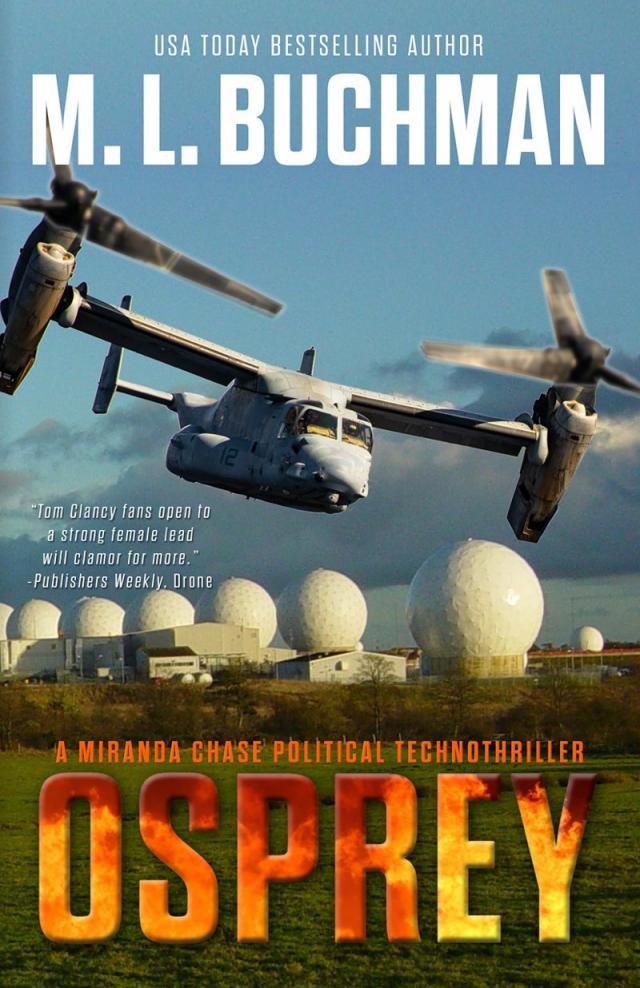


OSPREY
A MIRANDA CHASE ACTION-ADVENTURE TECHNOTHRILLER
M. L. BUCHMAN
SIGN UP FOR M. L. BUCHMAN’S NEWSLETTER TODAY
and receive:
Release News
Free Short Stories
a Free Book
Get your free book today. Do it now.
free-book.mlbuchman.com
ABOUT THIS BOOK
Russia teeters on the brink of collapse, spoiling for a battle to end all wars. All it needs? One thin excuse.
World War I began with the assassination of Archduke Ferdinand. World War II launched with the invasion of Poland. Russia’s invasion of Ukraine didn’t do it—yet.
A Russian flyby of an American CMV-22 Osprey tiltrotor goes desperately wrong over the North Sea. Will the tipping point for World War III break the moment a favored daughter of the Oligarchy goes down in flames?
When the NSA’s secret military base at Menwith Hill in the UK can’t handle it, they call in Miranda Chase. She and her elite team of air-crash investigators must avert a crisis like none before. A crisis that unravels her past, batters at her autism, and threatens to crush her team in the ultimate grinder of East vs. West.
A list of characters and aircraft may be found at:
https://mlbuchman.com/people-places-planes
NOTES
The opening prologue is as accurate as possible based upon the 341-page NTSB report #AAR-00/03 adopted August 23, 2000. (And for you total geeks, like me, read the second part of the prologue before pinning down a key error in the first part.)
The plane crash mentioned as occurring July 16, 1996, the day before the crash of the opening prologue, was moved 34 days earlier for the purposes of the story, but is otherwise accurate.
The other incidents are fictitious but, the author fears, only too possible.
PROLOGUE
July 17, 1996
8:17 p.m.
The sun hung low among the towers of New York City casting final shadows across JFK International Airport.
At 2017:18 Eastern Daylight Time, Trans World Airlines Flight 800 from New York to Paris was instructed to hold short of JFK’s Runway 22R. A landing 757 had kicked up some heavy wake turbulence that would take half a minute to subside. The 747-100, with two hundred and ten passengers and eighteen crew members aboard, held their position for a minute and three seconds.
While idling at the edge of the runway, the cockpit flight crew remained focused on completing the pre-takeoff checklist. The flight hadn’t gotten off to a good start and the four men were all glad to finally be on the move.
The 747 had landed from Athens on schedule at 1631 hours. For cabin comfort, the APU—Auxiliary Power Unit, a small engine used as a generator to power the plane’s systems—was kept powered up to run two of its three air conditioners to mitigate the heavy heat of the July sun beating down from the partly cloudy skies over New York.
Three of the crew had over sixty thousand hours combined flight experience, much of it in the 747. The fourth was relatively new to the 747, a trainee flight engineer. At twenty-four years old, he had over two thousand hours of flight time as an engineer, but only thirty of those were in a 747. His trainer on this flight was two years from retirement and did his best not to think how much he’d miss the big plane that had dominated his forty-year career.
Over the previous two and a half hours, the plane had been emptied, serviced, and reloaded with passengers and their luggage.
Rather than departing for Charles de Gaulle at 1900 hours as scheduled, there had been multiple delays.
First, a service vehicle had broken down, blocking the plane at Gate 27 until it could be towed clear.
Once it was clear, there was a further delay as gate personnel insisted that a piece of luggage had to be pulled from the hold because the passenger hadn’t boarded. Eventually the luggage and its owner were both located. The owner sat already aboard the plane, seriously considering several scotches once they were aloft. The overexcited high school French class looking forward to their first trip to France were boisterously annoying. It was going to be a long damn flight and scotch was definitely in order. Despite the delays, he’d still be in time for his lunch meeting. The French would just have to take him in whatever state he was in.
The bag was returned to the hold.
Of only slightly more concern, the captain’s weather radar wasn’t working properly. Maintenance marked it as inoperative and, per regulation, ordered service at the next opportunity within ten days. The copilot’s radar was operative, so the flight was finally cleared for departure.
At 2018:21, the tower transmitted final wind conditions and cleared TWA 800 for departure. They rolled down Runway 22R and lifted into the air well before midfield as they carried only two-thirds capacity. The final fuel load had been adjusted downward to avoid carrying any extra weight across the Atlantic. As a result, the large central wing tank sat mostly empty.
Over the next eleven minutes, as air traffic control routed the flight east to higher flight levels through the typical clutter of jet traffic, there was only one unusual comment captured by the Cockpit Voice Recorder.
At 2029:15, the captain remarked, “Look at that crazy fuel flow indicator on Number Four…see that?”
There was no follow-up comment captured by the CVR.
A minute and fifty-seven seconds subsequent to that remark, at 2031:12 after the flight was cleared to climb to fifteen thousand feet, the CVR abruptly ceased operation. For just over a tenth of a second before it did, a very loud sound was recorded.
It stopped recording because a frayed fuel gauge wire, probably chafed by a sagging air duct, sparked. The spark occurred inside the nearly empty central wing tank, now primarily filled with a highly combustible fuel/air mixture. The mixture had been further heated and concentrated during the overlong wait on the tarmac by the heat exchangers for the air conditioning units—mounted directly below the tank.
When the fuel/air mixture ignited, an intense explosion sliced the airplane in two, immediately ahead of the wings. This severed the wiring to the flight recorders as well as killing many of the passengers instantly—mostly by snapping their necks. Those who survived in the main body of the aircraft died from inhaling the burning air rolling through the cabin like a roiling wall of death.
Approximately five seconds later, the nose of the plane—including the flight deck and first-class passenger section—broke free and began its long, eighty-three-second fall to the ocean. Based on ocean water found in their lungs, some of these passengers may have survived long enough to attempt a breath after the impact with the Atlantic off East Moriches, Long Island, New York.
The main fuselage and wings of the 747, abruptly lighter in the nose, tipped steeply upward. With the engines still driving ahead at climb thrust, it ascended an additional three thousand feet over the next thirty-eight seconds before the wings broke free from the shattered central wing box that had enclosed the fuel tank. No one aboard remained alive as it too began its long tumble toward the ocean.
During the next four years, the largest investigation in the history of the National Transportation Safety Board recovered over ninety-five percent of the debris and all the bodies from the Atlantic. The plane was reassembled in a hangar piece by piece to determine the causes. Over forty recommendations were sent to the FAA by the NTSB, including several changes to all 747 wiring harnesses.
The most important? All future jets—civilian, military, by every nation—would eventually be redesigned to pump inert nitrogen into their fuel tanks as they empty to prevent the accumulation of a highly explosive fuel/air mixture. With that single design change recommendation, it is estimated that the National Transportation Safety Board has saved tens of thousands of lives globally.
July 17, 1996
8:55 p.m.
CIA Headquarters
Langley, Virginia
“Turn on the news.”
Ron Klemens looked up from the file that was causing him such misery to glare at his assistant as he hustled into Ron’s office.
Bert ignored the glare and hurried over to the television.
Ron must be losing his touch.
The set came alive with a bright red Breaking News banner. Some passenger jet had crashed into the ocean less than thirty minutes ago.
What the hell was it with planes going down all of a sudden? His two top agents, he resisted the urge to look down at the file spread before him, had gone down yesterday under conditions that could never be revealed. How was he supposed to explain their deaths?
Even as the Director of the Russia Desk for the CIA, one didn’t stroll into the Director’s office and announce such a thing without having a solution already in place. The bastard was too busy declassifying the Cold War and damaging the CIA in all sorts of creative ways. Ron couldn’t fight back, but he couldn’t let this get out. No, he wasn’t going to the Director until this one was locked down and fully in the bag.
Wait. Did he have to explain it?
He flipped to the front of the file. Damn it. They had a kid, insurance policies, property, any number of loose threads that could never be allowed to be questioned.
The real tragedy? Nothing could be done to plug the massive intelligence hole that their deaths created. They were irreplaceable.
He stared at the screen as dribs and drabs of information were gathered about the air crash.
Explosion.
A dead 747 plunged into the water off Long Island.
A French class field trip on its way from JFK to Pa ris.
“Survivors?” the news anchor asked.
After an explosion high over the ocean? Ron thought the man should be shot for offering false hopes. Nothing but death and confusion would result.
If only he could hide his agents’ deaths there, then—
“Bert!” he shouted so loudly that the man less than five feet away jumped.
“Sir?”
“Was the flight full?”
“What flight?”
Ron jabbed a finger toward the screen.
Bert twisted his head like that green Muppet frog-thing, first to the screen, then back. Then he glanced down at the file on Ron’s desk that had been giving them both headaches all day.
He bolted for his desk.
He was back less than five minutes later, and he was smiling. “The flight wasn’t full. Two hundred and ten people and about three hundred and sixty seats.”
Ron felt like a bit of a ghoul as he returned the smile—just another day at the CIA. “Make it two hundred and twelve. Get them confirmed aboard. Alter paperwork, flight manifests, all of it. Fast, before they can absolutely confirm the number.”
“Assign seats. First class, I think. Fabricate some luggage and sink it in the recovery area…” Bert kept talking to himself as he hurried away. It was the kind of deep cover that the CIA had a whole department dedicated to creating.
TWA Flight 800 would now have two hundred and twelve passenger deaths, not two-ten. The agent’s bodies should be repatriated within twenty-four hours. Divers from a Special Activities Division team could quietly insert them into the wreckage, even snap their seatbelts.
He could always wait for the next director before reporting it so that it stayed hidden; the current idiot couldn’t last much longer. If he was careful, that director might well be him. Then he could add their stars to the Memorial Wall with no one in the wider world any wiser.
Ron flipped to the first page of Sam and Olivia’s file. The emergency contact was some live-in nanny. Close enough.
He dialed the number and listened while it rang in the hell-and-gone Pacific Northwest.
As the call was answered, Ron glanced down to find the surviving kid’s name: Miranda.
1
2,349’ (716m)
High on Great Shunner Fell
North Yorkshire, England
Today
“Just look at that.”
Miranda Chase did. Again. She still failed to feel the excitement in Andi’s voice.
She did feel the cold of the quartering headwind that had been lashing her face all morning. Was her right cheek tingling from incipient frostbite due to windchill on a sunny day—or simply from being battered for the last four hours?
They had spent the whole morning climbing the rocky path up the south face of Great Shunner Fell in England’s Yorkshire Dales National Park. Nothing here grew higher than her knees. No bushes or trees. Only scrub grass, brown bracken not yet recovered from winter, sandstone rock (most of it converted to tall walls to border sheep pastures), and the beaten-down footpath often thick with mud.
Many of the stretches were worn calf-deep, which made the grass thigh high rather than knee high. Other stretches were paved with sandstone or limestone blocks, she couldn’t tell which, a meter square and ten centimeters thick. She’d measured several and found little variation.
She pulled out a notebook and added Hydrochloric Acid to her list—after she’d turned her back to the wind to stop the panicked flapping of the pages. If she ever came back, she’d be sure to bring a dropper bottle of it. Even a few drops of HCl would fizz on limestone but not on sandstone offering a definitive identification.
Miranda then attempted to calculate how many people must have walked these paths to wear the trench she trudged along. An average human weight would be easy enough to assume, courtesy of the FAA. They provided average combined weight for passengers and carry-on luggage based on gender and seasonality (five pounds more clothes in winter) for aircraft loading estimates.
Should she downgrade the FAA’s allocation? Only the more fit people would attempt this hike. Though hikers would be carrying packs: lighter day packs like their own or heavier packs for those hiking self-contained around the four-day circuit of the Herriot Way. No, she’d use the FAA standards: males at a hundred and ninety pounds and women at one-seventy-four. That was inclusive of clothing and typical carry-on weights.
Ratio of males to females? Based on their own group, one-to-three. Mike and Holly were already at the top of the peak. She and Andi were yet a hundred meters from the top. But were they typical? Perhaps a one-to-one ratio would be better. Or were men more likely to set out on the fifty-two-mile walk? She’d have to ask Mike, he understood people better.
Without soil density measurements, calculating the impact of each step upon soil compaction or erosion would be—
“Is something wrong?” Andi had come back down the trail to stand in front of her.
Her hiking pants had a pocket for her phone along the outside of her thigh. That looked very convenient. If she did that, then she’d be able to carry additional items in her vest. “I need pants like yours.”
Andi looked down at them, then back at her.
“That’s what’s wrong?”
“Oh, no.” After Miranda had explained the problem with soil erosion and trail-wear mathematics, Andi offered one of her understanding smiles.
“It’s been worn down as much as it has by people enjoying themselves as they walk along. Maybe that’s all we really need to know?”
Miranda always marveled at Andi’s clear view of the world. She herself was far too likely to overcomplicate things. She never remembered to tell her autism to calm down when in the midst of overthinking something. Andi now did that for her.
Hands clasped, they walked up to join Holly and Mike, their boots shushing along together through the taller grass that carpeted the top and blurred the final part of the trail into invisibility.
The top of Great Shunner Fell was marked by a crossed pair of stone walls, high enough to block the wind and let her assess that she wasn’t suffering from incipient frostbite. That appeared to be the one great constant of the Yorkshire Dales, a powerful wind. It had measured fifteen to twenty knots, gusting to thirty, since they’d climbed out of the ancient town of Hawes. During each major gust catching her along the steep path, all she’d been able to do was brace in position and wait it out. To lift a foot was to be sent staggering aside.
The air reminded her of home in the Pacific Northwest. Most places she’d been, the air had distinct scents. Of course, at plane crash investigation sites, it was typically the sharp tang of spilled kerosene-based fuels or the char of the fire that had followed. Thankfully, the roasted meat smell of corpses in post-crash fire typically dissipated by the time her investigation team arrived.
In Washington, DC, at NTSB Headquarters, the wind felt as if it had been breathed and rebreathed by every person from the outermost Caribbean islands and up the whole East Coast, starting at the Florida beaches. Humidity and a greasiness like too much sunscreen hung on the air—she never felt clean in DC. At home, the wind off the Pacific Ocean tasted as if it had never been breathed by anyone, scrubbed clean and born anew before sweeping down from the Gulf of Alaska.
The Dales air had that same quality, fresh and clean. No scent of ocean or grass or the sheep they had walked past. That was the other great constant aside from the wind: sheep. Thousands of them. There were no sheep here atop Great Shunner Fell, but she could see whole hillsides dotted white ranging off in every direction.
Walking around the crossed stone walls, Miranda looked in each direction to assess the countryside. Above hung a blue sky peppered with small clusters of scudding clouds, several of which had dispensed a few raindrops on them before hurrying away to the east.
At ground level to the southwest, there was a small clump of trees in a deep valley—dale she corrected herself. Around here they were called dales. Just as a hill was a fell. To her ear they sounded backwards. A dale sounded high and a fell low, but the ancient bards of Old Norse had never asked for her opinion.