

Beyond year zero, p.1
Beyond Year Zero, page 1


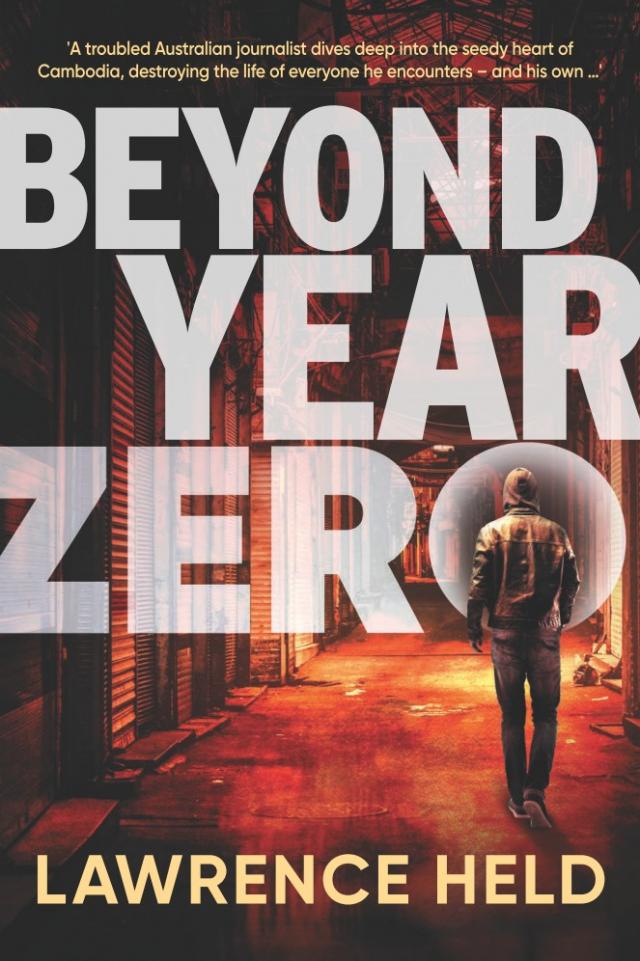
BEYOND
YEAR
ZERO
Copyright © Lawrence Held
First published 2022
This book is copyright. Apart from any fair dealing for the purposes of private study, research, criticism or review as permitted under the Copyright Act, no part may be reproduced, stored in a retrieval system or transmitted in any form or by any means, electronic, mechanical, photocopying, recording or otherwise, without written permission.
All inquiries should be made to the publishers.
Big Sky Publishing Pty Ltd
PO Box 303, Newport, NSW 2106, Australia
Phone: 1300 364 611
Fax: (61 2) 9918 2396
Email: info@bigskypublishing.com.au
Web: www.bigskypublishing.com.au
Cover design and typesetting: Think Productions
Title: Beyond Year Zero
ISBN: 978-1-922765-46-8
BEYOND
YEAR
ZERO
LAWRENCE HELD
Carl Meissner
I’m thirty-two years old. A Cancerian, if you have any interest in that sort of thing. I don’t. I studied journalism at university, worked on a couple of newspapers, covered the courts, police rounds, moved to investigations, specialising in politicians and other public and not-so-public officials who didn’t have enough money of their own and couldn’t resist the temptation to get more of it in brown paper bags when no-one was looking. Ran for parliament as an independent on an anti-corruption ticket. Lost. Got married and divorced. Meaning I lost again. Most recent employment was on what became known as the Grafton Affair. That’s journalese for sex scandal. A judge is accused of being a paedophile but before the jury can reach a verdict, he commits suicide. End of story. I’m presently writing a book which doesn’t include any corruption. Not yet anyway. But you never know. It seems to get in everywhere.
Contents
One
Two
Three
Four
Five
Six
Seven
Eight
Nine
Ten
Eleven
Twelve
Thirteen
Fourteen
Fifteen
Sixteen
Seventeen
ONE
It was a little after five when the taxi dropped me outside a couple of tall sandstone pillars with a pair of big black wrought iron gates between them and big brooding lions on top of them. Next to the pillars was a postern gate and beyond them a flagstone path ran a hundred metres to a big old sandstone house set in a couple of acres of garden. There were frangipani and jacaranda trees, a forest of eucalypts, elms, sycamores and a couple of giant Moreton Bay figs with roots the size and shape of dinosaur’s tails. Everything about the place was big.
I pressed the buzzer beside the postern. A man’s voice asked me who I was.
‘Meissner,’ I said. ‘Carl Meissner. I’m a friend of Eliza Meissner. Or I was.’
‘What was that?’ the voice asked me.
I repeated my name but left out the rest. A short delay followed, then a buzzer and the postern creaked back. The lions on the pillars might more appropriately have been a couple of big three-headed dogs called Cerberus.
Along the path were security cameras. Coloured party lights and revellers drinking and smoking cigarettes hung around the porch of the house, and there was a lingering scent of late summer mixed with a tasteful Latin beat on the still air.
The house itself was three storeys high. Outside it was a wide sweep of bright green grass and a gravel horseshoe drive. A knotty wisteria grew around the porch and beyond that was an open front door and the sound of a party.
The hall was crowded and noisy with people coming and going. Hanging from the two-storey high ceiling was a chandelier no bigger than a small car and on the left a polished oak staircase swept gracefully up to a three-sided balcony, off which was a row of doors. It would be a nice place to live all right, heavy with the smell of old money and the dry creak of genuflecting knees.
The drawing room was through a high arch, flanked by two louvred doors. On the way in I caught sight of myself in a decorative wall mirror mounted in an antique gilt frame. What I saw was a sturdy, dark-haired man of thirty-two with even features and a look in his eye to suggest that he’d rather be at home reading a book than answering a call by his former wife to a job interview.
The room was as big as a small church nave and contained the usual society crowd. At the back was a bar. Behind that were French windows and beyond them another expanse of grass and a view of the Pacific Ocean.
A dozen bartenders in white jackets were serving the crowd, and here and there waiters were dishing out champagne and canapés.
I ordered a whisky sour at the bar, then looked around for Eliza. A couple of smoothies in designer hand-me-downs were selling each other pieces of real estate with the energy it would take any normal man to get up in the morning, while looking at their mobile phones. It didn’t distract them. I had the feeling that nothing would distract them, not even a naked woman running through the room whistling Beethoven’s Fifth.
The smokers outside had given me a taste for nicotine, but I hadn’t had a cigarette in six months and I wasn’t about to start again now. I sipped my whisky and thought about all the things lung cancer could do to me, which just about did it.
I felt a tug at my arm. It was Eliza. She had on a pink and black outfit that emphasised the womanly shape of her body without giving too much away. I told her she hadn’t looked so good in years. She smiled.
‘Nice suit. Haven’t I seen it before?’
‘Only at our wedding.’
‘Seven years! Has it really been that long?’
‘Seems like yesterday.’
‘Mm, what’s the smell?’
‘Mothballs.’
‘Fetching. What kept you?’
‘Work.’
‘Work? You call writing work?’
‘Sure. What do you call it?’
‘I call it something that doesn’t make you any money. That’s what I call it. Come and meet the hostess.’
She dragged me across the floor to a small group who seemed to be getting along quite well without me.
‘This is Carl,’ Eliza told them.
They turned their best smiles on me. There was a woman of about thirty with a torrent of flaming red hair, a short fat man of about fifty and a rangy blonde with hot green eyes. She was the hostess. The host wasn’t there.
‘What do you do, Carl?’ the fat man asked me.
‘I write,’ I told him.
‘What do you write?’ the redhead asked me.
‘I’m working on a novel.’
‘Really?’ the fat man said. ‘That must be hard.’
I shrugged.
‘Carl used to be an investigative reporter,’ Eliza said as if she was my mother.
‘Used to be?’ the fat man asked me.
‘Yeah. I got fired.’
‘Oh, I’m sorry,’ the redhead said. ‘What’s the book about?’
‘I’d rather not say. It tends to destroy the creative process to talk about it.’
‘Joe’s sister writes,’ the blonde said. ‘She’s had a book of poetry published.’
‘Really? Does it rhyme?’
Everyone pretended to think that was funny. I felt a heavy pressure on my right foot. It was Eliza telling me to be quiet.
‘What’s her name?’ I asked the blonde. ‘Perhaps I know her.’
‘Sue,’ the blonde said. ‘Sue Goldman.’
‘Nice name.’
‘Do you know her?’
‘Afraid not. But there’s always a first time.’
• • •
I was back at the bar, doodling with my thoughts and nursing another whisky sour. Eliza hadn’t told me any more than I already knew about why I was there, which was nothing. I considered going home to get on with my book, but I wasn’t in the mood. I hadn’t been in the mood for days.
I took my whisky into the back garden. It was a two-tiered job, the upper tier consisting of an expanse of ornamental lawn the size of an ocean liner’s sun deck, in the middle of which was a rocky pool from where a frog was putting up a hopeful stutter. The smokers and serious drinkers were out there also. As usual on such occasions the most fun was being had outdoors.
I stood there, breathing in the salt air and looking seaward. On the tier below a swimming pool glittered playfully in the last rays of the sun, and far beyond that, almost all the way to the horizon, a set of white sails leaned on the wide sweep of emerald and the fiery sparkle of water.
Sue Goldman was about twenty-five years old and well-built in the way Eliza used to be. She was wearing a short black cocktail dress and walked like a dancer, with her toes a little out. Her brown hair was cut short, her eyes were blue, and her small, round face was freckled over the nose and tanned from the sun. She wore no jewellery or make-up that I could see, and in her left cheek was a dimple that made a hole when she smiled.
She was smiling as she came across the lawn towards me.
‘Hello, Carl,’ she said. ‘I’m Sue Goldman. I hear you’re a writer.’
‘Only on weekdays. Weekends I practise yoga.’
She laughed. She had a nice, easy laugh.
I finished my whisky. ‘Do you mind if we go inside? There’s only so much nature I can stand without a drink in my hand.’
‘I hope you’re not one of those drunken writers
We went inside. The party was getting noisy. I ordered another whisky sour and asked Sue what she wanted.
‘Absinthe,’ she said.
‘Like Hemingway.’
‘And Rimbaud.’
I grinned at her. ‘What do you do when you’re not writing poetry?’
‘Oh, you know about that?’ She lowered her eyes demurely. ‘I was going to be a lawyer but I dropped out of university to write.’
‘Wise choice. Lawyers make money. Writers, if they’re good, make sense.’
‘Is that what you do?’
‘I try.’
We got our drinks and found a couple of empty chairs by a bay window at the front.
‘What do you think of Joe?’ Sue asked me.
‘I don’t think anything of him. I haven’t met him yet,’ I said.
‘Joe’s a fine man, but you must be careful. He likes money the way a cat likes pigeons.’
That struck me as a strange thing to say, but I let it pass. ‘Is that the inside scoop?’
She gave me one of those cute, challenging looks. ‘You’re a journalist. You should know.’
‘Used to be.’
‘Are you always so tight-lipped, or is it me?’
‘I was an investigative reporter. That’s shorthand for doing what the government should be doing but isn’t.’
‘Sounds exciting.’
‘It has its moments.’
‘I bet. Why’d you stop?’
‘A difference of opinion with my employer.’
I drank some whisky to wash away the bad taste. I felt like a cigarette again. ‘How come you’re interested in my opinion of your brother?’
‘Because I know why you’re here.’
‘Oh, yeah? And why’s that?’
‘Sorry. I can’t tell you.’
‘Don’t be. I like the excitement. And it’s not you. You get a little tight-lipped in my job.’
She smiled at me. We looked at each other. It didn’t go anywhere that mattered.
‘Why not try the police?’ I suggested.
‘What makes you say that?’ she asked me.
‘Well, with this much intrigue it’s either a police job or you need a good lawyer. You should know a couple.’
‘Joe doesn’t want the publicity. We’re an old family. We have strict morals.’ Her tone was ironic.
‘What family isn’t – old, I mean?’
‘Every family is old – I guess. Only most of them don’t have anything to show for it.’
‘Except their children. Tell me about your morals.’
‘Oh, you know. Don’t kill. Don’t commit adultery unless you’ve got a good alibi.’
‘How about don’t hang out with strange men on a Sunday evening unless you know they’ve got clean fingernails?’
She eyed me over her glass. ‘You’re not so strange. I bet you don’t even go to church.’
‘Not since I was caught looking up my Sunday school teacher’s dress.’
She laughed abruptly. ‘Did you really?’
‘No. I was afraid God wouldn’t approve.’
‘Oh – do you believe in God?’ That same cute smile.
‘Depends what you mean by believe.’
‘Well, let me see.’ She crossed one leg over the other a little provocatively at the knee, rested her right elbow on it and her chin in her hand, and looked me squarely in the eye. ‘From a non-legal point of view, I would say to have faith in the truth or existence of a supreme being. Wouldn’t you?’
‘And from a legal point of view?’
‘There isn’t one. The law is concerned only with facts.’
‘Sounds reasonable.’ I sipped my drink. ‘My concept of God is pure energy transmuted into mass when multiplied by the velocity of light squared – the mass being us.’
‘Einstein?’
‘Uh-huh.’
‘E equals M C squared.’
‘Very good.’
‘Meaning we’re all God?’
‘You got it.’
‘You’re a rationalist.’
‘Used to be.’
‘What are you now?’
‘Unemployed.’
Her eyebrows shot up interestedly, then she settled back and gave me a long, hard look. ‘That bugs you, doesn’t it?’
I grinned at her again. ‘You were telling me how moral your family is.’
She shook her head. ‘I think I’ll leave that to Joe.’
‘Did he put you up to this?’
She laughed a little nervously this time. ‘I don’t know what you mean.’
‘What I mean is ...’ I put a hand to my mouth. ‘Nothing.’
‘No. Go on. Say it.’
‘Well, my ex-wife invited me here because she thought there’d be something in it for me. I’m a struggling writer. You know the story. Living alone in a drafty garret, drinking cheap red, not eating, sleeping all day, writing at night, no-one to love except the girl downstairs who works in a bar and sells her body to strangers for a few sous an hour. If you don’t, read the lives of the great writers. You’ll find me under L for learner. Anyway, so far I’ve met your brother’s wife and some friends of theirs but nothing else has happened. Then you come along and engage me in playful conversation and tell me you know what’s going on, but you won’t tell me what, when you could be hanging out with your friends and—’
‘They’re all bores. All they can talk about is money.’
‘What’s wrong with money?’
‘Nothing – if you don’t have it.’
‘And if you do?’
‘Nothing. I suppose.’ She frowned.
‘Okay. I’m thinking you’re to find out if I’m suitable for whatever Joe has in mind.’
‘This isn’t a conspiracy, Carl. Not everything’s the way it is in fiction. It’s Joe’s party. He’ll do it the way he wants to. He always does.’
‘Well, I hope it’s before Christmas. Otherwise, I might get a job as Santa Claus.’
She smiled, took a sip of her absinthe and studied me under her fine brown lashes. ‘I bet you’d look just peachy in red and white.’ Her eyes looked a little glassy.
‘Yeah, like a Coke commercial. How’s the absinthe?’
Her mouth fell open and her eyes flared. ‘I’m not drunk, if that’s what you mean.’ She frowned, then let go of the creases in her face and looked at me frankly. ‘Joe wants you to help him find Danny.’
‘Who’s he?’
‘His twin. Our brother,’ she said hesitantly.
‘And why would he want me to help him find him?’
‘Because he’s gone missing.’
‘Well, that would make sense. But why me?’
‘I don’t know. Joe must have liked the sound of you.’
I nodded and looked around. ‘My ex thinks she’s my mother. We’ve been divorced for three years but she still thinks she knows what’s good for me.’
‘Some people might call that love,’ Sue remarked with a serious smile.
‘Sure, but I grew out of nappies years ago. They didn’t have my size.’
She gave me a searching look. ‘Do you mind if I ask you something?’
‘Depends what it is. According to the Geneva Convention I’ve only got to give you my name, rank and serial number and you know part of that already.’
‘Do you always wisecrack?’ she asked me.
‘Is that your question?’
‘Yes.’
‘Only on Halloween.’
‘It’s not Halloween.’
‘Then I wasn’t wisecracking.’
• • •
Sue had been called away to do the party circuit, leaving me to nurse my fourth whisky by myself. I was mulling over our conversation when a young man in a tuxedo bent down and said, ‘Mr Goldman would like to have a word with you, sir, if that’s all right.’ He had a long, thin face and seemed very polite.
I got up and followed him into the hall and up the stairs to the balcony. The party was beginning to thin out, it being a Sunday night and with all that lovely dough to be made in the morning. Behind one of the doors a man wearing a brown herringbone jacket over a pale green shirt was sitting behind a big old banker’s desk, smoking a cigar and talking on a landline. His face was smooth and fresh and looked far too young to be behind such a big desk.









