Point of impact a nuclea.., p.1
Point of Impact: A Nuclear Apocalypse Survival Thriller (Nuclear Dawn Book 1), page 1
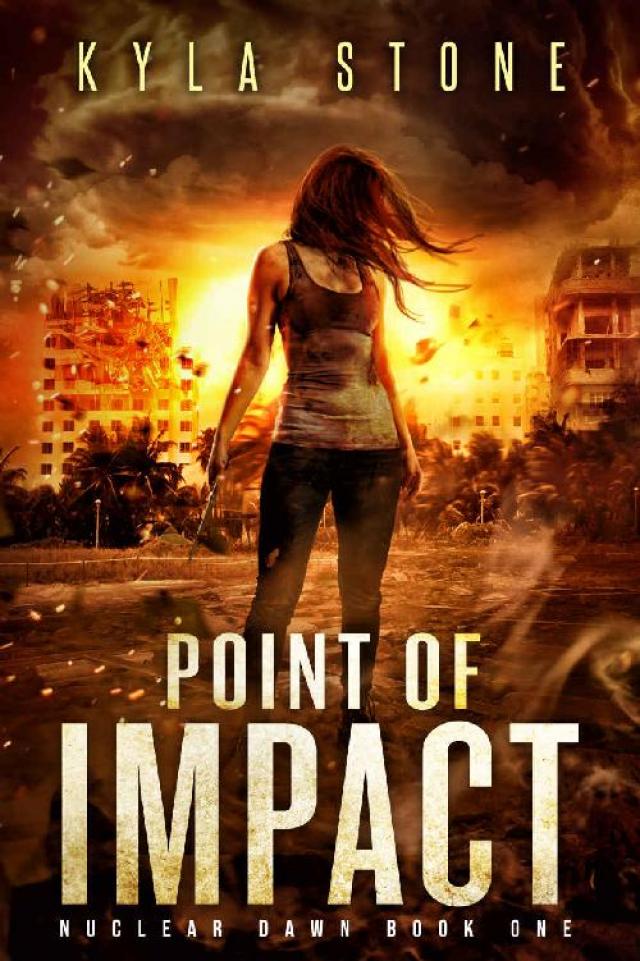


Point of Impact
Nuclear Dawn Book One
Kyla Stone
Paper Moon Press
Point of Impact
Copyright © 2018 by Kyla Stone All rights reserved. This book or any portion thereof may not be reproduced or used in any manner whatsoever without the express written permission of the publisher except for the use of brief quotations in a book review.
This book is a work of fiction. Any references to historical events, real people, or real places are used fictitiously. Other names, characters, places, and events are products of the author’s imagination, and any resemblances to actual events or places or persons, living or dead, is entirely coincidental.
Printed in the United States of America
Cover design by Christian Bentulan
Book formatting by Vellum
First Printed in 2018
Created with Vellum
To Jeremy, for holding down the fort while I made up imaginary people in imaginary worlds.
Contents
1. Washington, D.C.
2. Dakota
3. Dakota
4. Logan
5. Logan
6. Eden
7. Maddox
8. Dakota
9. Dakota
10. Logan
11. Dakota
12. Dakota
13. Dakota
14. Dakota
15. Logan
16. Logan
17. Logan
18. Eden
19. Logan
20. Dakota
21. Dakota
22. Maddox
23. Dakota
24. Dakota
25. Logan
26. Logan
27. Logan
28. Maddox
29. Dakota
30. Dakota
31. Dakota
32. Eden
33. Dakota
34. Maddox
35. Dakota
36. Dakota
37. Logan
38. Logan
39. Logan
Also by Kyla Stone
Author’s Note
Acknowledgments
About the Author
I. No Safe Haven Bonus Chapter
1
Washington, D.C.
Zero Hour Minus Thirty-four Minutes…
At 12:03 p.m., the metallic sea-green 2013 Honda Odyssey pulled up to the curb in front of the Smithsonian National Museum in Washington, D.C., just a few blocks from both the Capitol Building and the White House.
A fading stick-figure family sticker was affixed to the rear lefthand window. A “proud parent of an Albertson Elementary Honors Student” sign peeled from the bumper.
The front passenger’s seat held a woman’s black leather purse. A bulging diaper bag sat on the floor amid several wadded Taco Bell wrappers and a Paw Patrol sippy cup. A baggie of Cheerios spilled onto the middle console.
The mid and rear windows were tinted black so that no one walking by could casually glance inside. Someone would have to take the time to peer carefully into the minivan, to press their face against the glass to really see.
Behind the driver and passenger seats, the rear and mid-seats were recessed. A large, bulky object took up the entire rear of the vehicle: a rectangular cardboard box. Probably just housing a compact fridge or shiny new front-loading washing machine.
Probably.
But no one bothered to give the minivan anything beyond a cursory glance. It looked like a thousand family minivans they’d seen before. Worn, well lived-in, innocuous.
Above all, harmless.
Even the man who exited the vehicle—a middle-aged white guy wearing jeans and a wrinkled Star Wars T-shirt, a Washington Redskins cap shoved low over his forehead—aroused no suspicion.
After he paid the parking meter, the man strolled along the sidewalk, diaper bag over one shoulder, a selfie-stick in one hand.
Just another tourist enjoying the fine, sunny day in the bustling Capitol of the United States of America.
No one noticed the second car—dark blue Ford Taurus, nondescript—slide up next to him and open the door as he slipped inside. No one noticed as the car pulled into traffic and drove away, just under the speed limit, toward the Anacostia River.
Twenty-five minutes after the minivan first parked, the man in the Redskins cap shifted in the passenger seat of the Ford Taurus and checked the GPS.
He punched in a saved number on a pre-paid, disposable phone.
“The time was moved up,” said the deep voice on the other end. “Did you receive the message?”
“We did. We’re in position,” said the passenger. “Everything is ready.”
The man on the other end grunted in approval.
“There is a time for everything under the sun,” the passenger said.
“God be with us,” said the other man.
The driver said nothing. He did not honk at a jaywalking pedestrian as he pulled onto a less congested side street and parked in Giesboro Park off MacDill Blvd, almost six miles from Capitol Hill.
With one hand still on the wheel, he pulled a specialized pair of sunglasses over his eyes. The passenger did the same. He glanced at the clock on the dashboard. 12:37.
He pressed the button of the small device he held in his hand.
A hundredth of a second later, the bomb exploded.
In the instant of detonation, the core of the bomb scorched a blistering 300,000 degrees Celsius, fifty times hotter than the surface of the sun itself.
In less than a second, tens of thousands of people were cremated, instantly carbonized into charred, smoking ash. They were vaporized where they slept, stood, walked, sat, drove—simply gone.
The intensity of the thermal blast ignited birds in midair. Clothing, trees, dogs and cats, and cars spontaneously combusted. Steel liquefied, melting like wax.
Internal organs evaporated. Flesh, muscle, and bone were consumed so swiftly that nothing remained. The shadows of human bodies were burned into concrete walls.
Everything within the seven-hundred-foot fireball’s radius was utterly incinerated.
The enormous fireball shot above the city, rising and rising, expanding until it blotted out everything. A colossal, blazing monster of fury and fire ripped open the sky.
The fireball blasted upward in a great flash of extraordinary brilliance, bright and searing. The light blast was witnessed over one hundred miles away in all directions.
The visceral, violent heat decimated everything within its path. A thousand fires sprang up simultaneously.
It was as if the sun had fallen to earth.
The immense light flashed electric green and blue and red, vivid colors burned into the retinas of anyone who looked, if they hadn’t already been blinded.
Flash blindness occurred up to eight miles distant, all the way to the beltway. After the flash, a deafening boom crashed—explosive, thunderous, with a sound like mountains colliding.
With it came the shockwave, a towering wall of tremendous pressure five times stronger than a category-five hurricane.
The shockwave blast obliterated houses, offices, churches, condos, restaurants, factories, schools, hospitals, and hotels, animals and people.
People as far as a hundred and twenty miles away registered the shock.
It slammed through the National Mall and ravaged Capitol Hill. It crushed monuments and museums: the Smithsonian, the Capitol building, the Library of Congress, the Supreme Court building, the Washington Monument, the White House.
The powerful shockwave sucked out almost all the air behind it. The extreme underpressure in its wake had such force that people’s eyes were vacuumed out of their eye sockets.
Within a half mile of ground zero, every building was demolished or rendered uninhabitable.
Within a mile, the immediate radiation dose would prove to be almost universally lethal.
Over two and a half square miles, thermal radiation boiled skin, causing extensive third-degree burns for tens of thousands of victims.
But the horror was just beginning.
Swelling upward, the cloud sucked up thousands of tons of ash, dirt, concrete, plastic, glass, paper, and dust. The mammoth radioactive tornado punched through the clouds toward the upper atmosphere at five thousand feet a minute.
The mushroom cloud reached a height of over five miles, with a diameter of almost two and a half miles as it spewed more than two hundred radioactive isotopes into the atmosphere.
The Ford Taurus pulled away from the park and entered traffic already pouring out of the city. There was still room to maneuver around the crashed vehicles and escape, though there wouldn’t be for long.
Dozens of crashes littered the highway from those shocked by the blast. Others had dared to look into their rearview mirror at the initial flash; temporarily blinded, they’d smashed into the vehicles ahead of them.
As the Taurus fled the city, the passenger twisted in his seat, staring back at the burning ruins of Washington D.C.—not in horror, but with an awestruck thrill of vindication.
In ten seconds, more than fifty thousand men, women, and children were wiped off the face of the earth. Over eighty thousand more were grievously wounded.
Within ten minutes, the highly radioactive dust broiling within the mushroom cloud began i
It would poison another hundred thousand people as the nuclear chain reaction released a flood of gamma rays that penetrated skin and damaged organs and bone marrow.
It was only the third time in history a nuclear bomb had ever been used against civilians.
It wouldn’t be the last.
2
Dakota
Zero hour minus fifteen minutes…
Dakota Sloane was no stranger to hardship. A born survivor, she’d spent her life waiting for the next calamity, the next disappointment, the next strike from a world intent on breaking her.
But Dakota didn’t break.
She felt close now, though. Her chest tightened as she scanned the street outside the window of the Beer Shack Bar.
Bussing tables, she froze, bent over a yellow table strewn with crumpled napkins and a greasy, half-eaten lunch of twist fries, burgers, and sloppy dribbles of ketchup. The empty glass of Coke nearly slipped from her fingers.
Her gaze locked on a familiar figure striding through the lunchtime crowd strolling along Front Street in Overtown along the outskirts of downtown Miami.
She knew that confident, purposeful walk, the lean, lanky shape of him, sharp as a knife blade. She’d recognize that thin, angular face anywhere, those grim, fevered eyes—the eyes that haunted her nightmares.
He wasn’t supposed to be there.
Dakota didn’t believe in coincidences.
If Maddox Cage was in Miami—in this part of Miami—it was for one reason.
He was here for her. For her and Eden.
She’d made it two years and thirteen days. She wasn’t ready yet, hadn’t saved enough. Six more months, and her plan would be in place, ready for execution.
Twenty grand and her little sister. That was all she needed to start a brand-new life a thousand miles away.
Miami was loud and colorful and always moving, made up of a jumble of Cubans, Haitians, Asians, South Americans, and Anglos, an exuberant smorgasbord of cultures, music, food, and art.
Miami was an easy city to get lost in.
But she hadn’t gotten lost enough.
Sweat prickled along her hairline. She took a step back from the window, hoping the sunlight’s glare on the glass would shield her presence.
If he was still searching, if he didn’t already know exactly where she was…
But maybe he wasn’t coming for her first. The thought sent a cold fission of dread through her gut.
He was going after Eden.
She held her breath until he passed—never turning his head to the left or right, eyes fixed straight ahead as he weaved between the pedestrians thronging the sidewalk.
He always had been single-minded, like a dog with a bone.
She should’ve known he wouldn’t let go. Would never let go.
“Excuse me, Miss,” said a heavy, middle-aged Indian guy at the next booth.
She didn’t know him. The usual regulars haunted their favorite bar stools, but this close to downtown and Miami International, the bar always served a steady stream of tourists and traveling business types.
People liked the Beer Shack’s funky vibe. The bright bar glowed, lined with kitschy shiny yellow tables and elephant palms in huge ceramic planters adorned with fairy lights. Famous locations throughout Miami—South Beach, Freedom Tower, the Coral Castle Museum—were immortalized in bottle cap art hung on the faux brick walls.
The radio was always playing a vibrant mix of rumba, salsa, timba. The mix of authentic Cuban fare and classic American selections was damn good, too.
With his sweating mug of Sam Adams, the man gestured toward the flat-screen against the far wall. He was in his fifties and nearly bald, a neatly combed circle of white hair ringing his shiny brown scalp. “Can you turn that up?”
“Sure thing.” She forced herself to move, to go through the motions, even as her mind spun with jostling, frantic thoughts.
She put the Coke glass down on the dirty table she’d been cleaning, leaving the plastic tub and rag behind. She pulled the remote from her moss-green apron and punched up the volume.
The Marlins’ loss recap had been interrupted. The screen showed an aerial shot of Michigan Avenue in Chicago, completely cleared but for a minivan parked on the street.
Several police cars and SWAT vehicles were stationed a safe distance away, three helicopters hovering overhead.
A breathless, wide-eyed news reporter gesticulated wildly about something. She couldn’t make sense of the woman’s jumble of words.
A low, frantic buzz filled her head.
“I live near the west side of Chi-Town. Heading back tomorrow. Crazy, huh?” the guy said.
Fear was already forming like ice around her heart.
“What’s all the excitement about?” Dakota asked distractedly, forcing herself to be polite.
She couldn’t just leave in the middle of her shift. She couldn’t afford to lose another job, but she had to contact Eden, had to figure out what to do.
“Some kind of bomb. Terrorist wackos, looks like. Probably ISIS. But Chicago PD caught it in time. Disarming it now, thank God.”
“Good thing,” she said.
He held his mug toward her. “Fill ‘er up, would you?”
She grabbed the mug, refilled it at the bar, and returned it to the customer. He didn’t acknowledge her. His eyes were glued to the screen.
Her nerves were stretched taut. Anxiety squeezed her lungs. She needed a break. She needed to reach Eden.
She strode across the room and paused, keeping her back to the empty bar-height table behind her, the glass front door on her left, the bar counter several feet to her right.
The bar wasn’t busy yet. A handful of regulars hunched over their drinks, staring glassily at the second screen hung over the bar, showing the same view of the van in Chicago.
The steady buzz of their conversations was a constant hum in the background: Walter Monroe whining about his ex-wife; Jesse Peretti’s grass kept dying from the increased water restrictions due to the drought; Tamara Santos complaining about more forced overtime.
Mendo Del Rio always brought up politics, especially when he was itching for a fight. The Beer Shack owner and current bartender, Julio de la Pena, had been forced to kick him out several times.
Most of the time, the regulars discussed sports and deep-sea fishing plans, crappy boss problems, and the latest indomitable heat wave.
They were all regular people with regular problems. No one was hunting them.
None of them paid any attention to her.
She jerked her cell out of her cargo pocket—an old model Samsung that barely qualified as a smart phone. It was all she could afford, since she put every extra penny toward her bugout fund.
As she tapped the contacts icon, she kept one anxious eye on the street outside, in case Maddox decided to double back. He was cunning like that.
Wanda Simpson, her sister’s social worker, picked up on the fourth ring.
Dakota didn’t waste time on greetings. “I need to see my sister. Now. Today.”
“Well,” the woman huffed. “I don’t have time for this nonsense today, Ms. Sloane. You know as well as I do that you have court-appointed, supervised visits once a month and no more. Your next visit isn’t for a week—”
“I can’t wait that long.”
“Ms. Sloane, your sister is medically fragile. She needs consistency. The judge, the psychologists, and I all agree that disrupting her carefully maintained routine would be detrimental to her well-being.”
“Which is just shrink-speak for trying to keep me from my sister so you can adopt her out—”