

A prince among men, p.1
A Prince Among Men, page 1
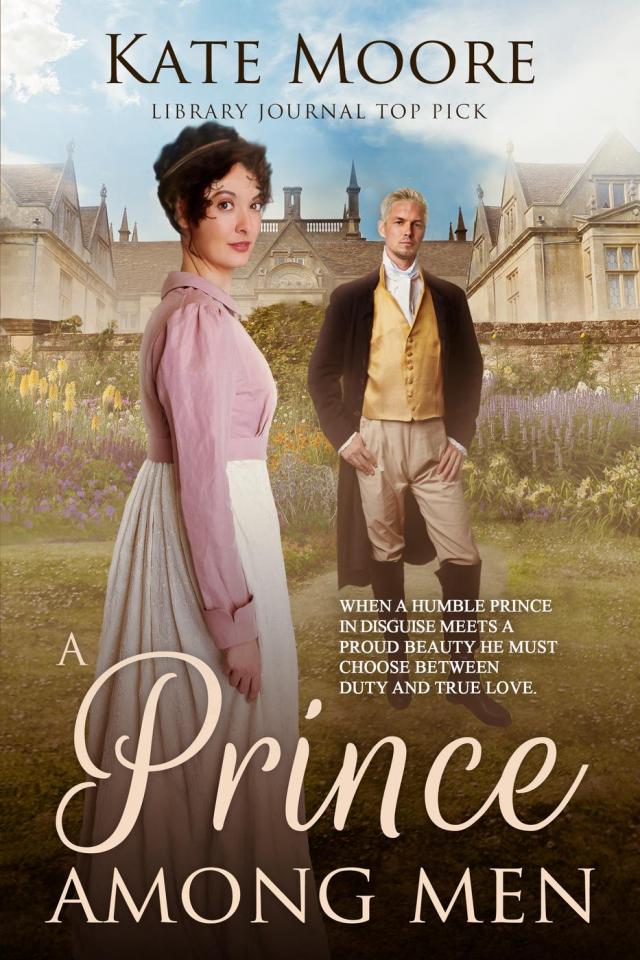


A Prince Among Men
Historical Romance
Kate Moore
This is a work of fiction. Names, characters, places, and incidents are the product of the author’s imagination or are used fictitiously. Any resemblance to actual events, locales, organizations, or persons, living or dead, is entirely coincidental and beyond the intent of the author.
Copyright 1997 by Kate Moore.
Second e-book edition.
eBook cover design by BookBrush.com and Leslie V Knowles @leslievknowles.com
First Avon Books Printing: November 1997 Library Journal Top Pick in Romance, 1997
ISBN: 978-0-9848971-5-5
Library of Congress Catalog Card Number: 97-93178
Table of Contents
Title Page
Copyright Page
A Prince Among Men
Prologue
Chapter 1
Chapter 2
Chapter 3
Chapter 4
Chapter 5
Chapter 6
Chapter 7
Chapter 8
Chapter 9
Chapter 10
Chapter 11
Chapter 12
Chapter 13
Chapter 14
Chapter 15
Chapter 16
Chapter 17
Chapter 18
Chapter 19
Chapter 20
Chapter 21
Chapter 22
Epilogue
Chapter One
About the Author
For Kevin and Allison, my best works.
Prologue
1796
With Napoleon’s defeat of the Piedmontese and Austrians, King Lorenzo di Piovasco Mirandola of Trevigna thought it prudent to assess the strength of his tiny kingdom. What he saw sobered him. Everywhere the arts of war had been neglected. Peace, which Lorenzo had striven to preserve, had made the nobles prodigal and the bandits voracious, and divided the cities into factions. His mild rule appeared a failure, but he wasted no time in self-reproach. Though the power of France might crush Trevigna as easily as the press crushed the olive harvest, he boldly began a campaign to restore the vigor of Trevigna’s institutions. He made only one concession to prudence, which was to send his ten-year-old son and heir to England to be educated in safety, far from the reach of Bonaparte.
Alexander and Lucca were to be punished. All the boys said so, but the arrival of Donna Francesca made their punishment a certainty. They sat on a hard bench in the dim cloister opposite a gothic door. The heavy door, darkened with age and crossed with antique iron bands, suggested the entrance to a castle dungeon rather than the office of the headmaster of a modern English school for young men of birth and fortune. Yet if their classmates were to be believed, behind that door lay indignities worthy of the Inquisition.
The October morning was frosty, and the fresh scrubbed faces of the two boys smarted. Their collars, damp from contact with still-wet slicked-down hair, sent involuntary shivers down their spines.
The taller of the two boys, a lad with huge dark eyes and the nose of a Roman senator, betrayed a certain miserable anxiety by scuffing the toes of his shoes across the stone floor, until his companion spoke.
“Hush, Lucca, I can’t hear a word if you scrape the floor that way.”
Lucca immediately stilled, giving a heavy sigh, his breath a fleecy puff in the frigid air.
The shorter of the two boys, Alexander, whose fair looks suggested Eros outgrowing babyhood, leaned forward on the bench, listening intently, his cherub’s mouth pursed, his remarkable blue eyes fixed on the door. Though the heavy door muted the voices on the other side, Alexander recognized the value of this rare opportunity to hear what the adults were saying. He realized now, as he had not a few months earlier, that these solemn conversations affected his future directly.
At the moment, he could think of two punishments he most wished to avoid—being sent away from school, and being separated from Lucca. A flogging was nothing. He’d had one or two already and discovered he could bear them very well if he concentrated on some future pleasure, like the promise of a good horse to ride at Christmas.
He inched forward on the bench. While he judged it wise to listen closely, it was beneath his dignity to cross the corridor and press his ear to the door. There were four voices on the other side, all fairly easy to distinguish. The first was the headmaster’s, with a smooth, placating cadence to it that he never used when addressing the boys. The second voice, Aunt Francesca’s, embarrassingly loud and shrill, could be heard clearly. The other two were Mr. Keane’s and Mr. Nevil’s.
“Have you dared to lay hands upon the Prince of Trevigna?” Aunt Francesca asked.
“Regrettably, we are facing that step,” the headmaster answered. “Unless his majesty can be prevailed upon, perhaps through your influence, to moderate his behavior. Here the masters must govern. The nature of boys, royal birth not withstanding, is such that we must be permitted to apply the necessary discipline for unruly behavior.”
“To lay hands on a prince who will one day rule a kingdom older than England is an unpardonable offense.”
Alexander could see Aunt Francesca saying this. She was as tall as the mast of his first boat, and she could give a fellow the malocchio, the evil eye.
“I regret to inform you, Donna Francesca, that his majesty has had some difficulty adjusting to the rules of school life.”
“The Prince of Trevigna does not misbehave.”
“Mr. Keane,” said the headmaster. “Your report.”
A high, thin voice spoke. “I’m sorry to say, madame, but his majesty made faces at the food and comments in Italian for the benefit of his servant. There was no mistaking his disparagement of our very healthful and substantial fare. Furthermore, his remarks precipitated an unseemly display among the third formers. Throwing peas.”
Alexander heard Aunt Francesca snort, like a horse smelling bad hay.
“Mr. Nevil, your report,” said the headmaster.
Mr. Nevil’s booming voice made Lucca start and look up. Alexander put his finger to his lips. “In the classroom his majesty looks down his ... grand nose at his masters. In the midst of the Greek lesson, he rent his gown in a fit of temper over a correction, an absolute breach of necessary authority.”
There was a silence behind the door, and Alexander guessed Aunt Francesca was unimpressed.
The headmaster’s voice came again. “These acts of rebellion might have been overlooked, had his majesty not engaged in a brawl with his classmates.”
“A brawl?” Aunt Francesca’s voice was slow and gathering power like a wave about to pound the shore. “The Prince of Trevigna does not brawl like some wharf rat. He is a sweet-tempered, biddable young man, conscious of his duty to his station.”
“Madame, are we speaking of the same child? Perhaps his new surroundings have brought out hitherto hidden aspects of his character.”
“Impossible.”
“I assure you, Donna Francesca, that his majesty has bloodied the noses and blackened the eyes of several boys, and even threatened the servants. With his size and strength, he could seriously injure someone.”
“His size and strength?” Aunt Francesca’s tone had changed to one of surprised suspicion. Alexander’s grip on the edge of the bench tightened.
“Madame, he is a full head above his classmates.”
Aunt Francesca spoke briefly and pungently in Italian. Lucca’s eyes widened appreciatively as she called the headmaster an ass with shoes and a coat.
“Are you blockheads not able to see the difference between a prince and a serving boy?”
By straining, Alexander could hear the faint reply.
“Madame must explain.”
“You idiots have mistaken Lucca Gavinana, the son of a sailmaker from Laruggia for Alexander di Piovasco Mirandola, a prince with a six-hundred-year-old name.”
Alexander could not help the slight slump in his shoulders. Aunt Francesca’s announcement put an end to his disguise. It had been a lark while it had lasted, his time as an ordinary boy. He tried to picture the faces of his masters. He knew Mr. Nevil must be looking particularly green, as he was the one who had flogged Alexander for the episode in the Greek class.
“An understandable confusion.” The smooth voice of the headmaster came again. “Master Lucca is the taller of the two and of a proud demeanor. It was he, of course, who seemed to have more difficulty adjusting to the discipline of school life, so naturally we assumed—”
“Surely you noted the difference in their work, their English.”
Mr. Keane entered the conversation again. “If madame will examine the two copy books, she will see that both boys perform extraordinarily well.”
There was a little pause during which Alexander held his breath.
Then Aunt Francesca’s voice came again, distinctly. “I recommend that you gentlemen examine the books carefully yourselves. Any fool can see that they are written by the same hand, Alexander’s hand.”
There was a silence of an awkward duration.
“Are you in the habit of mistaking fireflies for lanterns? You cannot tell the difference between a serving boy and a prince of the blood?”
“With all due respect, madame, it is your brother’s opinion we must consider. He has entrusted the boy to us. Now that we know the true prince, we require only that you remove Master Gavinana, and we will proceed with our business, which we know very well, instructing the minds of the future leaders of society.”
“Remove Gavinana?”
“If he is not to be a pupil, he may not remain. We practice equality. The only deference here is due not to rank, but to learning. All our students are scholars under the guidance of masters. To have a boy among the others with a personal attendant is against the principles of the school.”
“But the prince must have Gavinana. He must speak his language daily, the tongue of Petrarch, Boccaccio, Dante. And he must govern at least one subject to remind him that he is a prince and will one day be king.”
“Madame, these are our rules. If your brother is not satisfied with this form of education for the prince, he is free to take the boy elsewhere.”
Alexander stiffened, instantly alert, drawing Lucca’s glance. The discussion from behind the door was beyond Lucca’s minimal comprehension of English. He knew only that they had caused trouble for the adults of the school. Lucca, Alexander thought, was lucky not to be aware of this most dreadful possibility.
Alexander prayed his aunt would not let her pride speak. He did not know which he feared more, being separated from Lucca, or being cast out of the school. He held his breath. It would be like her, to turn on her heel and tell these paltry Englishmen that the Mirandola did not need their school.
The silence this time was awful, and when it ended, Alexander was sweating.
Then Francesca spoke in her more feminine voice. “Well, gentlemen, you must keep Master Gavinana enrolled. You have no objection to two purses from my brother, I trust?”
Alexander grinned at his friend. Thus, unfortunately, both boys were smiling broadly when the heavy door swung open and Aunt Francesca’s tall form appeared. Her stern eye fell first on Lucca, with the swift intensity of an eagle’s swoop. Lucca froze.
“You impudent, ungrateful dolt,” she said in blistering Italian. “Nothing is worse than a foolish servant. Your pride has brought this embarrassment to the prince. It is your duty, your privilege, to serve him in all things. You will be respectful to the masters and students, take any punishment intended for the prince, and study until your brains turn to mush in your thick noggin.”
Francesca turned to Alexander. He was shaking with relief, but he kept everything inside. “And you, sir, do not deceive me. You speak English perfectly well, and yet you did not correct the misapprehension of your masters.”
Alexander refused to hang his head. He was guilty, and he must take whatever punishment Aunt Francesca meted out.
“Never forget,” she went on, “your station or your dignity. Your father depends on you. He sends this book to remind you.” She thrust a small leather volume at him. “You are Mirandola, the shepherd of the people, bred to rule, to put Trevigna ahead of all else, to serve her in every action of your life. The petty concerns of schoolboys are not for you. When Trevigna calls, you go, consenting, even to death. Remember.”
She made him a curt bow, as a man would, and strode off down the hall, the stone echoing with her sharp footsteps. There was no embrace, no touch.
Alexander stood stock still, clutching the book from his father, not daring to look at Lucca until she was truly gone.
At the other end of the hall, she paused, glancing back over her shoulder. “If your marks are high enough, Alexander, there will be a horse to ride at Christmas,” she said in English.
The door at the end of the hall closed behind her, and Alexander grinned. Whatever the masters did to them, he had it all now—school, and his friend, and the promise of a horse.
1816
“I can’t do it,” whispered Lucca.
Alexander did not look up from the papers on the desk. “You must.”
“Majesty, it is your best evening coat, wool as fine and soft as silk, the cut a work of Michelangelo.” Lucca’s voice was pleading.
Alexander pushed back from the desk and looked up at his servant. “We have no money,” he said patiently.
Lucca shrugged. “The English king does not pay his bills. Why should we? I will send the man away.”
“Lucca,” Alexander said. “We agreed to sell the coats a fortnight ago. I had your promise at that time.”
“But that was before anyone came to buy them.” Lucca wrinkled his nose. “Madre della Virgine, the man has no shoulders!”
Alexander turned back to the letter he was writing. “Then the coat will improve his appearance.”
He managed a few more lines before he realized Lucca remained standing in the doorway.
“To sell your coats in a common shop!” Lucca shook his head. “It is beneath you.”
“We’ve slept in barns and fields, and worn the boots of dead men.”
“In war. In London you must preserve the dignity of your state.”
Alexander put down his pen, the point he was trying to make in the letter had escaped. “Unpack the royal plate, then.”
“Majesty, could we not remove to a hotel?”
“No.” Alexander rolled the cuffs of his sleeves over his wrists and fastened them properly. “The plan depends on secrecy.” He stood and lifted the coat off the back of his chair. “If the foreign secretary finds me before I refill the treasury of Trevigna, I’m powerless.” If he let them, the English would put him in a toy soldier’s uniform and prop him on a dying throne, so that the royal navy would have a handy port from which to fight the Turks.
Lucca hung his head. “All this I know, but what will Donna Francesca say? What will she do?”
Alexander’s glance sharpened. “You haven’t told her where we are?”
Lucca’s great dark eyes had a wounded look. “I had to tell her you were hiding. How could I lie and say we were still at Windsor? She already knew you’d sold the horses. Like Christopher Columbus, she discovers everything,” he concluded bitterly.
Alexander donned his coat. “You’ve heard from her, then?”
“She is going to find you a wife.”
“A wife?” Alexander felt himself go very still. “Why?”
“So that when you are crowned, you will have the nobles’ support.”
Alexander stared at the papers on the desk, letters inviting free men of Trevigna to give up being subjects, to regard themselves as citizens, to come together to draft a constitution for a new republic.
“Majesty?”
“Sell the black coat. Charge the man a king’s ransom, if he’ll pay it, but sell. You do want to eat, don’t you?”
“Yes, Majesty.” Lucca bowed, and retreated.
Alexander gripped the back of the chair, the papers a white blur on the desk. Bonaparte moved armies and changed the face of Europe. Alexander wrote letters to make one nation free and just.
He snatched a blank sheet, scrawled a message on it, and slipped out the door.
Chapter 1
For a moment as it rose, a dazzling morning sun gilded the rain-dampened rooftops of London. Lady Ophelia Brinsby slowed her steps to watch, and the shining deception vanished, leaving a vista of cold, gray slate and sooty chimney pots. With a shrug, Ophelia lengthened her stride, swinging her riding crop.
Two horses, her black mare, Shadow, and her brother Jasper’s new chestnut stallion, Raj, stood saddled in the stable yard. Ophelia halted. The stallion was a beauty, but no one had saddled him in a week. Her groom, William, wouldn’t dare. Raj had kicked a stall to pieces and proved once again that Jasper was no judge of horseflesh. This morning Raj, the terror of the stable boys, nosed the ground for bits of hay, his tail flicking lazily as if he were the tamest gelding.
Ophelia drew closer and peered under Shadow’s black belly at a pair of buckskin-clad legs and handsome boots. Someone was inspecting the mare’s right front foot, murmuring soft, indistinguishable phrases.
“William?” she asked.
The voice stopped. Shadow swung her head around to give Ophelia a belated whicker of greeting, and a man stepped into view. He was not William. He was nothing so ordinary and discreet as a groom waiting to accompany a lady on a Monday morning ride in the park. Ophelia could not check the upward sweep of her gaze from his boots to the curly-brimmed hat set on golden-brown curls.
The man looked back, his bold gaze a blue flash, in which surprise vanished into amusement without a trace of humility. Ophelia had the strangest impression of authority, perhaps in the way he held the two horses with a careless touch on the reins, as if he owned them.






