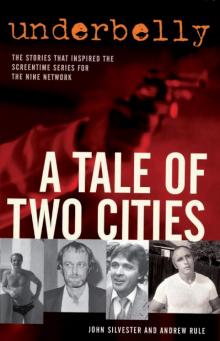
Underbelly 3, p.1
Underbelly 3, page 1


Allen & Unwin’s House of Books aims to bring Australia’s cultural and literary heritage to a broad audience by creating affordable print and ebook editions of the nation’s most significant and enduring writers and their work. The fiction, non-fiction, plays and poetry of generations of Australian writers that were published before the advent of ebooks will now be available to new readers, alongside a selection of more recently published books that had fallen out of circulation.
The House of Books is an eloquent collection of Australia’s finest literary achievements.
John Silvester has been a crime reporter in Melbourne since 1978. He has co-authored many crime books with Andrew Rule, including the Underbelly series, Leadbelly and Tough: 101 Australian Gangsters. In 2007 he was the Graham Perkin Journalist of the Year and Victorian Law Foundation Journalist of the Year. He is currently senior crime reporter for The Age.
Andrew Rule is a Walkley award-winning reporter who has worked in newspapers, television and radio since 1975. He wrote Cuckoo, the inside story of the ‘Mr Stinky’ case and has co-written, edited and published a number of crime novels, including the Underbelly series. Twice Australian journalist of the year, he is Associate Editor at Melbourne’s Herald Sun.
The authors’ work has been adapted into the top-rating Underbelly television series.
HOUSE of BOOKS
UNDERBELLY 3
John Silvester & Andrew Rule
This edition published by Allen & Unwin House of Books in 2012
First published by Floradale Productions and Sly Ink, Melbourne, in 1999
Copyright © Floradale Productions and Sly Ink 1999
All rights reserved. No part of this book may be reproduced or transmitted in any form or by any means, electronic or mechanical, including photocopying, recording or by any information storage and retrieval system, without prior permission in writing from the publisher. The Australian Copyright Act 1968 (the Act) allows a maximum of one chapter or 10 per cent of this book, whichever is the greater, to be photocopied by any educational institution for its educational purposes provided that the educational institution (or body that administers it) has given a remuneration notice to Copyright Agency Limited (CAL) under the Act.
Allen & Unwin
Sydney, Melbourne, Auckland, London
83 Alexander Street
Crows Nest NSW 2065
Australia
Phone: (61 2) 8425 0100
Fax: (61 2) 9906 2218
Email: info@allenandunwin.com
Web: www.allenandunwin.com
Cataloguing-in-Publication details are available from the National Library of Australia
www.trove.nla.gov.au
ISBN 9781742699332 (ebook)
‘The Only thing necessary for the triumph of evil is for good men to do nothing.’
EDMUND BURKE
CONTENTS
1 Dying on Easey Street
2 King of speed
3 The drug cabinet
4 Fallen angel
5 The bodies in the bush
6 Death in the afternoon
7 The wrong drill
8 A chain reaction
9 Evil that took an innocent
10 Presumed dead
11 The protection racket
12 Dealing with the devil
13 The suicide that wasn’t
14 The last of a dying breed
‘If anything in this life is certain, if history has taught us anything, it is that you can kill anyone.’
MICHAEL CORLEONE: GODFATHER 2
CHAPTER 1
Dying on Easey Street
In the 1970s the young and restless skated from job to job, bed to bed, across the thin ice of a suddenly permissive age
It had come to this. After twenty two years and countless false leads, the hunt for the answer to one of Australia’s most notorious unsolved sex killings had taken two Melbourne homicide detectives across the world. The murders had happened at the height of an Australian summer, in January, 1977, in a street whose name – Easey Street, Collingwood – was to echo down the years in Victoria. Now it was December, 1998, in the depths of an English winter, and the Australian pair shivered as they waited to play the last card in a game they hoped would trap a killer with a dreadful secret.
With the Australians were two Scotland Yard detectives, who’d narrowed the search to the building they were now watching: a drab office in a drab street in Margate, a shabby holiday town on the Kent coast smelling of fish and chip fat and poverty.
They didn’t know their quarry’s exact address, but computer checks showed he had been collecting his dole money from this particular office. It was pay day. He was a certainty to turn up.
Sure enough, the man collected his dole, and the detectives collected him. Detective Sergeant Steve Tragardh and his boss, Chief Inspector Rod Collins, had agreed to let the Scotland Yard men do the talking, so the nomadic Australian wouldn’t be alarmed by knowing immediately why he might be wanted a world away.
They took him to the local police station, the Yard men saying all they needed was a tiny blood sample – a routine precaution, they said soothingly, which would eliminate him from an inquiry. The suspect gave it willingly, so willingly that Tragardh and Collins wondered right then if it was a wild goose chase.
Tragardh pocketed the vial of blood, and they returned to London to extradite another murder suspect, which was the official reason for their flying visit. The detective kept the blood sample safely in his possession until he handed it over to the staff at the Victoria Police forensic science centre back in Melbourne.
Days later, a forensic expert compared the DNA code in the English blood sample with DNA from what was coyly called a ‘body fluid’ taken from the crime scene almost exactly twenty two years before. The fluid was semen, and it had been found underneath the blood-stained body of Suzanne Armstrong in January, 1977.
Suzanne, 27, had been stabbed twenty nine times, and raped. Her housemate, Susan Bartlett, had been stabbed more than fifty times, presumably after coming to her friend’s aid. With the same knife, police believe, although they never found it or the man who wielded it with such savagery.
The scientist checked the result. It was negative.
Four months before, the homicide squad had eight outstanding suspects on a short list for DNA testing against the semen sample, which had been found in 1997 with other Easey Street exhibits in a store-room. One by one they’d been eliminated, and each time the tension ratched another notch. But now there were no more. The investigation was back exactly to where it was when the bodies were found on a warm day in 1977, but the trail was colder than ever.
SUZANNE Armstrong turned twenty one in 1970, as Susan Bartlett had a few months before. The new decade belonged to their generation. A year after Woodstock and two before Whitlam, Australian baby boomers plunged into an era that spawned its own anthem, the Skyhooks song Living In the Seventies. It caught the mood of the time, an edgy mixture of alienation, self-gratification, sex, drugs and rock’n’roll. It was a time of full employment and changing social values, and the young and restless could skate from job to job and bed to bed, across the thin ice of a suddenly permissive age.
Some fell through.
The two Sues – Armstrong and Bartlett – had been friends from schooldays at Benalla High. When Suzanne was twenty, in 1969, Susan Bartlett’s mother, Elaine Bartlett, had written a reference which read, in part: ‘I have known Miss Suzanne Armstrong for five years. She has been a close friend of my daughter Susan since their school days. I know her to be a conscientious and capable young woman.’
Suzanne, oldest of Bill and Eileen Armstrong’s four children, raised at Strathbogie in the hills above Benalla, was intelligent and popular. She found friends and jobs easily, and had plenty of both. She had long brown hair, a good figure and a friendly smile. Men liked her, and she liked them.
Whereas Susan Bartlett went teaching, and saved up to travel, Suzanne Armstrong travelled constantly, picking up work and boyfriends as she went. First around Australia and, then, the world – in 1972, and again in 1974, working her way through exotic destinations from South America to South London.
After the second trip she came home with a baby boy, born in the Greek islands. His Greek father had wanted to marry her, but she had refused to be tied down to village life. Some say she named her son Gregory, after a television cameraman, Greg Molineaux, who had been a favorite boyfriend before she left, but she often wore a ring with her Greek lover’s name, Manolis, engraved inside it.
Susan Bartlett, who called Suzanne ‘little Sue’ and was taller and much heavier than her friend, was described by one boyfriend as ‘a large girl with a beautiful face.’ She had almost married a fellow teacher at Broadford High School, north of Melbourne, in 1973, but had gone overseas on sabbatical leave instead, before returning to teaching, this time in Collingwood.
After Suzanne returned from Greece in 1976 she moved to Collingwood, and picked up a little work minding the baby daughter of a barrister friend, Judith Peirce, whom she had known earlier when she had worked as a courier for Peirce’s husband. She rode a bicycle around Carlton and Collingwood, her toddler strapped on a seat behind her. In late October she and Susan Bartlett, who had been in a nearby flat, rented a house together.
It was a neat brick single-fronted Victorian ‘one of a pair’ of the type already popular with inner-suburban renovators. The address was 147 Easey Street, two doors from Hoddle Street. The former schoolfriends were happy, but not for long. Ten we
ON Tuesday, 11 January, their closest neighbors, Ilona Stevens and Janet Powell, who lived in number 149, found Suzanne Armstrong’s part-Labrador pup, Benjy, loose in the street. No-one answered when they knocked next door, so they left a note and took the dog home for safekeeping.
By Thursday morning, 13 January, the note was still in the door and Ilona and Janet’s curiosity had overcome their fear of being labelled stickybeaks. They heard little Gregory whimpering, and went down the lane on the other side of 147, through the open gate and the unlocked back door. Ilona went first.
‘I noticed that the kitchen and bathroom lights were on, but none of the others at the back of the house,’ she was to say. ‘In the passage, near the front door, I saw Susan’s body. She was lying on her stomach, face down …’
She yelled to her friend, who had paused to look at the note on the kitchen table, to ring the police. Susan was wearing a green nightie. There was blood down one side, on her legs and on the walls. In the front bedroom Suzanne’s body was on the floor. ‘She was lying on her back, legs apart and knees drawn up, and there was a lot of blood … She was naked except for what seemed to be a skivvy pushed up around her neck.’
In the middle bedroom was sixteen-months-old Gregory – pale, distressed and dirty, but alive.
The first job for police was to piece together the dead women’s last known movements, and a list of their friends and acquaintances. It was a long list, and it kept them busy. Most murder victims are killed by people who know them, and there were many potential suspects among the men the two women knew.
Within days, homicide detectives had gathered what facts they could. Almost twenty three years later, they don’t know much more.
It went like this. Suzanne Armstrong had got up early on Monday, 10 January, and shared breakfast with Susan Bartlett before Susan went shopping with her mother at Georges, then Melbourne’s elite establishment department store. Mother and daughter lunched together and, according to one account, Mrs Bartlett told her daughter it was time to end ‘old associations’ and concentrate on new ones – a heavy hint about what she probably saw as the young women’s increasingly bohemian lifestyle. After lunch Susan went back to Easey Street. It was the last time her mother saw her alive.
The two Sues spent the afternoon at home. Susan made a yellow frock to wear on a date with her latest boyfriend, a salesman she had met at the Argo Inn in South Yarra. Then she cooked dinner for themselves and her brother Martin Bartlett and his girlfriend, who often visited. After the meal, the women watched the long-running serial The Sullivans while Martin set up a stereo system he’d lent his sister. He and his girlfriend left not long after the show finished at 8.30pm. Later, Suzanne went to bed in the front room, which overlooked Easey Street, and Susan went to bed in the third bedroom, down the hall. Gregory was in his cot in the bedroom between. They had never changed their trusting country ways, leaving the back door open and the side gate into the cobbled lane unlatched.
Suzanne was reading a collection of Roald Dahl’s short stories, Switch Bitch. It seems that something or somebody interrupted her, because it was found, open at the middle pages, on the bed. It seems likely she put it down to open the front door because somebody she knew, or thought she knew, came knocking. Either that, or the killer came up the passage from the back door to get to her room. The story she was reading was called The Last Act. For her, it was.
FOR two full days, no-one knew. Amazingly, three men came into the house in that time but didn’t see the bodies at the front of the house and didn’t hear the thirsty baby. A fourth man stayed next door on the night of the murder. Each was let go after long interviews, but each was on the suspect list until the DNA tests finally cleared them beyond doubt half a lifetime later.
Barry Woodard, then thirty one, was and still is a shearer, an easygoing country boy who later grew heartily sick of having his name tossed up every time Easey Street was mentioned. But, at the time, he wasn’t shy about his tragically shortlived friendship with Suzanne Armstrong, whom he’d met on a ‘blind date’ just before Christmas, less than three weeks earlier. They’d had a couple of outings, and had dinner at his sister’s place in Northcote the night before she died.
Barry telephoned twice on Monday, evidently when the girls were out, and several times on the Tuesday and Wednesday. Puzzled because no-one answered, he and his younger brother, Henry, went to the house about 8.30pm on Wednesday, 12 January, came in the back door and left a note on the kitchen table. Henry wanted to have a look up the darkened hall, but Barry thought it bad manners to be so nosy, so they left.
When news broke next morning that two women had been found murdered in Collingwood, he rang Easey Street again, from his sister’s house. The telephone was engaged, so he assumed the women were safe. But when his sister called the same number five minutes later, a detective answered. Within minutes he, Henry and their sister were picked up, then split up for several hours of intense questioning.
Their stories tallied, but Barry Woodard felt that a question mark hung unjustly over his head for twenty one years. Until one afternoon in August 1998, when he came home from work to his house in a country town to find two detectives waiting for him. They asked for a blood sample. He was, like his brother and six other men, pleased to give it.
The other man who had been in the house without seeing the bodies was the tobacco salesman who had met Susan Bartlett the previous week. Like the shearer, the salesman was worried because no-one answered his calls, so he drove to Easey Street about 10.30 on Tuesday night – with a male friend, luckily, who was able to verify his story.
After knocking on the front door, he walked down the side lane, climbed through the unlocked window of Susan Bartlett’s empty bedroom and copied the house’s telephone number on a cigarette packet before climbing back out the window, all without seeing the bodies a few metres up the unlit hall.
The fourth man was a crime reporter, John Grant, known as ‘Grunter’ and one of the hardest of the hard cases working for the then popular tabloid scandal sheet, Truth. Tough, streetsmart, and with a reputation for wild living that could have got him a job in the armed robbery squad, Grant had ‘crashed’ for the night in the hallway of Ilona Stevens’s house, number 149, on that Monday.
The homicide squad spent a long, hard day questioning him but established only that he’d heard nothing through the double brick party wall. What intrigued detectives, and other reporters, was the ghastly coincidence that Grant had also been one of the last people to see Julie Garciacelay, a twenty-year-old American, apparently abducted from her North Melbourne flat in 1975, and almost certainly murdered.
He was cleared of any involvement in either case but he, too, had to live with innuendo until the DNA tests cleared him. Still wary, perhaps, after his earlier experiences with the law, he had a lawyer with him when he gave his blood sample in 1998.
There were other leads in 1977 – too many, probably – but they all came to nothing.
A knife was found at nearby Victoria Park railway station at 10.30pm on the night of the murders. A man with a history of sex offences was interviewed after stabbing a farmer in Tasmania; he had been living near Collingwood at the time of the murders, and had crossed Bass Strait days later, taking a car with a bloodstained knife, boots and shirt in the boot. And then, the dead women had known a lot of men who, in turn, knew other men.
The case frustrated the then head of the homicide squad, Detective Inspector Noel Jubb, who was to retire still tormented about what had really happened that night. It also fascinated Tom Prior, a veteran crime journalist and prolific author.
After retiring from daily newspapers in the early 1990s, Prior re-investigated the case to gather material for a definitive book. As it happened, he was diagnosed with a potentially terminal disease before he finished, and was forced to publish They Trusted Men in 1997 knowing it was a work in progress, not the book he’d planned.
But the old sleuth made friends with Greg Armstrong, by this time a young man, and helped find his natural father on the Greek island of Naxos, where the two were re-united.