The weird of hali, p.1
The Weird of Hali, page 1


· I ·
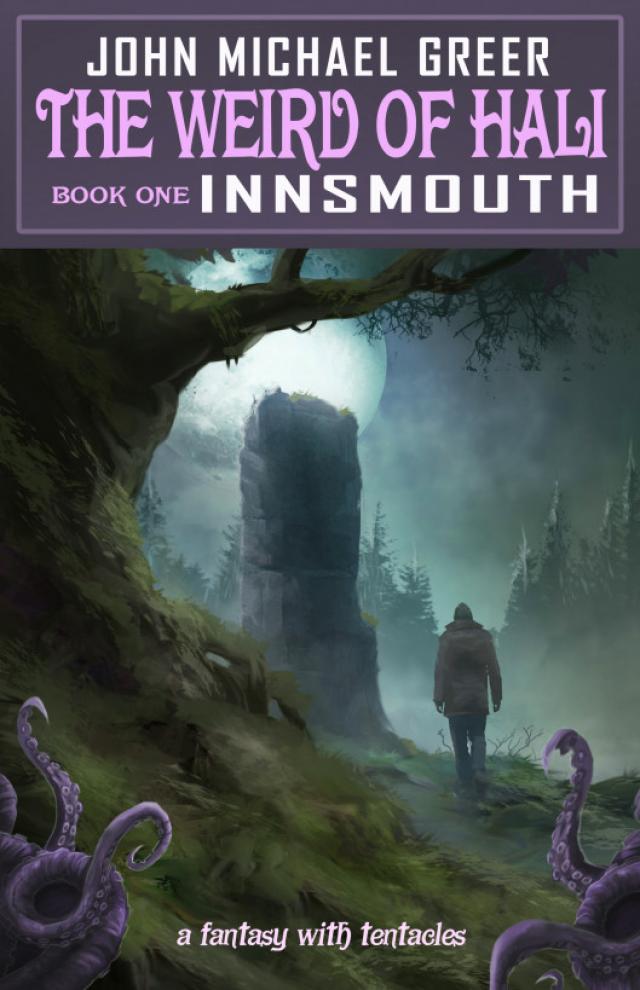
The Weird of Hali:
INNSMOUTH
A fantasy with tentacles
by John Michael Greer
CONTENTS
One: The House on Halsey Street
Two: The Devil at the Crossroads
Three: The Spires of Y’ha-nthlei
Four: The Parting of the Ways
Five: The Old Straight Track
Six: The Witch of Pickman’s Corners
Seven: The Children of the Old Ones
Eight: The Crawling Chaos
Nine: The Silence Between the Stars
Ten: The Six Thousand Steps
Eleven: The Yellow Sign
Twelve: The Guardian of the Gate
Thirteen: The Road to Dunwich
Acknowledgments
About the Author
Novels by John Michael Greer
Copyright Information
The prophet’s blood pools scarlet on the stone.
His eyes, that knew futurity and fate,
Stare blind and bleeding through a broken gate
Into a burning fane, where he alone
Once heard the inmost whispers of the Earth.
Did they forewarn him of the cold command,
The pounding hooves, the weapon in the hand
That struck him down, the laugh of brutal mirth?
Now muffled figures murmur in the night
His final words; now others gaze aghast
At fell shapes rising from the sleepless past.
The age that dawned there, in the flame’s red light,
Shall end in flame when, as he prophesied,
Four join their hands where gray rock meets gray tide.
—“Hali” by Justin Geoffrey
ONE
The House on Halsey Street
THE DOOR CLOSED with a bang, shutting out the raw September evening and the Arkham streetscape outside. Owen Merrill swung his backpack off one broad shoulder and plopped it on the floor of the entry, got his wet coat hung on a peg on the wall, then scooped up the pack again and went through the door into the living room.
One of his housemates, Jenny Parrish, was curled up on the battered old couch with a brown nineteenth-century volume open in front of her, her thin pale face just visible through a mop of mouse-colored hair. She gave him an owlish look. “Hi, Owen.”
“Hi.” Indistinct sounds came from the dining room, and a moment later voices followed them—one belonged to Barry Holzer, another housemate; the other to Kenji Takamura, Barry’s friend and perennial study partner. Owen dropped his pack on the overstuffed chair he liked best and went into the dining room, where Barry and Kenji were huddled over a couple of laptops, working on a class assignment.
“Hey, it’s our historian of ideas,” Barry said, looking at Owen over the top of his glasses. His blond hair and the brown beard on his chin both looked dyed, though Owen knew better. “Those ideas getting any more hysterical?”
The joke hadn’t improved any with age, Owen decided. “Laugh a minute,” he said. “That program you’re writing’s going to take your next two jobs away from you, you know.”
“I for one welcome our new cybernetic overlords,” Barry said, grinning. Kenji laughed and rolled his eyes.
Owen went on into the kitchen, got water heating in a saucepan and found a packet of dollar store ramen in his end of the cupboard. That went into the water as soon as it boiled, along with half a packet of mixed frozen vegetables and a vaguely grayish hot dog from a plastic bag in the fridge. Ten minutes, a pat of margarine, and a splash of cheap soy sauce later, dinner was ready. He poured it into a big bowl, fetched a fork, soaked the saucepan in the sink, and headed back through the dining room.
“Still chasing down stuff in the basement spooky section?” Barry asked.
“Of course,” said Owen.
“You gotta lay off the tentacles, man,” Barry told him. Kenji gave him a puzzled look and Barry turned to him. “Owen’s doing his thesis on Lovecraft.”
“Oh my God,” said Kenji. “Say it isn’t so.”
“‘Rhetorics of Otherness in the Horror Fiction of H.P. Lovecraft,’” Owen quoted himself. “Miskatonic’s got one of the two best Lovecraft archives in the country, and a couple of the best Lovecraft scholars anywhere, so why not?”
Kenji dropped his face into his hands in mock despair. “Why not, he says. Look, I know Lovecraft is Arkham’s one feeble claim to fame. I know the town would go belly up in fifteen minutes without the Lovecraft Museum, the festival, all that crap—but for the love of God, do you have to encourage them? And now there’s that new deejay on WMSK—”
“The one who calls himself the Fun Guy from Yuggoth?” Barry asked, with a wicked grin. “He’s pretty good. Have you listened to his show?”
Kenji shuddered. “No. I don’t want my brain to dribble out my ears.”
“I’m not actually much of a Lovecraft fan,” said Owen, “but from a history of ideas standpoint, the guy’s really interesting.”
“I’ll take your word for it,” said Kenji. “You want to spend your time with Cthulhu, Nyarlathotep, Yog-Sothoth, and the rest of that crew—”
“Iâ Shub-Niggurath!” Barry belted out with revival-meeting enthusiasm. “Black Goat of the Woods with a Thousand Young?”
“—see what I mean?” Kenji said. “They’ve already eaten Barry’s brain. Yours is next.”
Owen laughed and went back out into the living room, displaced his pack from the chair, slumped back into it and attacked the ramen. He was halfway through it when the door slammed again, and “Hey, all” sounded from the entry.
“Hi, Tish,” Jenny and Owen both said.
Tish Martin sailed into the living room and dumped a brightly colored shoulderbag of books on the end of the couch Jenny wasn’t occupying. She untied the red scarf around her head and shook loose a torrent of long braids with a sigh of relief. “Oh man,” she said. “I thought today wasn’t ever going to be over.” She headed for the kitchen, and her voice, Barry’s, and Kenji’s tumbled over each other.
Owen finished his ramen, ducked past the conversation into the kitchen to soak the bowl, came back out, grabbed his backpack and headed for the stair. Two flights up he turned down a mostly unlit hall, unlocked a door, stepped through. Inside was a cramped L-shaped room with cracked plaster on the walls, and five mismatched pieces of furniture—bed, dresser, bookcase, desk and desk chair—that had been handed down to him from decades of Miskatonic grad students and would doubtless be passed on to decades more. The landlord didn’t allow anything to be hung on the walls, so there weren’t many personal touches, just the books, a scattering of notebooks and papers on the desk, and a photo in a cheap standing frame on the dresser: half a dozen young men in desert fatigues, arms around each other’s shoulders, standing in front of the Air Force plane that was about to take them home. A younger Owen was on the left, sandy hair in an Army buzzcut, an uncommon grin across his square solemn face.
He went to the room’s one window. It faced north, looking down on the gambrel-roofed houses on that side of Halsey Street, a stretch of rain-soaked sidewalk that had seen many better days, and a narrow slice of street. Further off, a line of leafless trees clawed at the clouds, and beyond them the cyclopean masses of Miskatonic University’s main buildings rose stark and angular against a darkening gray sky. He had something like a thousand pages of reading to get through in the next week and a dozen pages to write to keep his thesis on schedule, but he stood at the window for a moment longer, staring down moodily at the sidewalk.
Kenji was right, he thought: there really was no getting away from H.P. Lovecraft in Arkham. Though the man himself spent most of his life down in Providence, and visited Arkham all of three times, he’d set so many of his most famous stories in and around the town that the local chamber of commerce started seeing dollar signs once his stories came back into fashion. They’d turned Lovecraft into the same sort of combination patron saint and cash cow that Salem made out of the old witch trials.
These days there was the Lovecraft Museum to bring in the tourists, and a Lovecraft Days festival every August, complete with vendors selling “What Part of Cthulhu Fhtagn Don’t You Understand?” bumper stickers and a costume parade for eldritch horrors of all ages. The park between Federal Street and Peabody Avenue, Washington Park until then, had been renamed Lovecraft Park, and had a bronze statue of the man himself in the middle of it, standing there looking off vaguely westwards while three bronze tentacles writhed around his feet and an eye on a stalk peered up at him from under the pedestal. You couldn’t walk three blocks anywhere north of the Miskatonic without seeing something Lovecraft-themed perched in a shop window or dangling from the rearview mirror of a passing car.
He shook his head, tried to focus. Crows circled over the Miskatonic campus, cars on Derby Street grumbled to themselves and moved on, the distant hills north of town rose up somber to rounded peaks marked here and there with circles of standing stones: a normal fall evening in Arkham. The day’s classes had been fine, and the next section of his thesis wasn’t going to be any kind of a problem, he knew. Still, something had his nerves on edge.
He opened the backpack and hauled out a stack of books with Orne Library call numbers on the spines, then popped his laptop open and clicked on the folder where he kept his music downloads. A tap on the mousepad brought the first chords of an old Muddy Waters blues piece belting out of the speakers. The sonic environment settled, he got to work on his thesis.
Below, a tall figure in a long black coat and a broad-brimmed black hat came striding along the sidewalk, glanced up at the window, walked on.
THE NEXT MORNING Owen was dressed in his usual sweatshirt and jeans and ready to head out the door while most of his housemates were puttering around in bathrobes and pajamas. Two sliced bagels and a cup of tea the color of road tar did for breakfast; he washed his dishes from the previous night, left them in the drying rack, scooped up his backpack and headed for campus. The last drops of another rainstorm came splashing down from a ragged sky as the door closed behind him. He dodged puddles on the sidewalk—his shoes were worn enough that stepping in one meant wet socks all day—up to Derby Street, trotted across it when the traffic gapped open, then waited for the light to get across Federal Street, which cut straight through campus on its way out of town to Innsmouth and Newburyport.
On the far side of the street was a big bronze statue of Cthulhu, the tentacle-faced Great Old One whose obscure legends Lovecraft made famous in his fiction, perched atop a pedestal with the words LOVECRAFT MUSEUM in faux-spooky letters below it. Behind it was a parking lot, and behind that was the museum itself, housed in the old gray Arkham Sanitarium building. Some prankster had stuffed a beer can into the Great Old One’s outstretched hand, which was mild by Miskatonic standards. Come winter break, if campus tradition was any guide, Cthulhu would be wearing a Santa Claus hat.
The light finally changed, and he and the dozen other students who’d piled up at the crosswalk surged across. Alongside the parking lot ran the huge brick mass of Orne Library, and beyond that was the Armitage Union, with the delirious angles of Wilmarth Hall just visible over its roof. Owen cut across the parking lot, started up the walk between the student union and the library, then veered over to the Armitage Union’s south entrance to check out the bulletin boards.
Somebody had stapled a solid line of flyers across the top of every one of the boards, with EXPERIMENTAL SUBJECTS WANTED across the top, a bunch of small print below that, and a ninth floor room number in Belbury Hall, the psychology building, on the bottom. Somebody else had plastered big posters about a lecture on Man’s Future in Space here and there over the top of everything else. Owen ignored them both. Further down, in among the rooms for rent, lost pets, things for sale, and housemates wanted, were the posters he was looking for, announcing music gigs. Mostly Arkham got local garage bands with names like Squidface and Hatheg-Kla, but every so often something better showed up.
That day Owen was in luck. A poster down toward the bottom of one board yelled ISAAC JAX AND HIS COTTONMOUTHS—DELTA STYLE BLUES, with the date and a few other details below it. The rest of the poster showed a crossroads under a crescent moon, with a tall figure in a broad-brimmed hat and a long coat standing there, backlit by the moonlight. Owen fished a pen and a little spiral notebook from his jacket pocket and noted down the details. He didn’t know the band, but a few minutes online would fix that, and if they were any good he’d want to try to make time to go see them.
From there he crossed the quad to Morgan Hall and found his way through mostly empty halls to his morning class, a critical-theory seminar. It was as bland as cold oatmeal and a good deal less substantial, but he took notes dutifully, tried not to watch the clock too obviously while the minutes ticked away. When it was over, he extracted himself from the classroom, took the stairs down to the entrance two at a time, and crossed the quad again to Orne Library.
He went in the big main entrance and turned immediately to the right, heading straight for an inconspicuous door over in an angle. Beyond the door was a bare concrete stair, dimly lit, leading down into the basement of the library. He trotted down the stair, came to an unmarked metal door at the bottom, opened it onto a bare corridor that led to another, identical door. Beyond that was a little office with a desk in it and another blank door beyond it. Nobody was in the office, so Owen went to the door and pushed the buzzer next to it.
A minute later the lock clicked, the door opened, and a wrinkled face framed in flyaway white hair peered out through it. “Owen? Yes, I thought that would be you. Come in, come in.”
The door opened the rest of the way to let Owen through, clicked shut behind him as the old man waved him through. Beyond was a bare windowless room with concrete walls and rows of steel bookshelves under the glare of long rows of fluorescent lamps. Another desk was just inside the door; further in were two steel tables with a scattering of chairs, and that was all.
Owen put his pack on the desk, pulled his laptop out of it, set it on one of the tables and fetched two cotton gloves from a box nearby.
“What will it be this time?” the old man asked him, regarding him with disconcertingly bright blue eyes. “Von Junzt again, I suppose.”
Owen nodded. “He’s not quick reading.”
The old man made a sound halfway between a laugh and cough. “No. You really do need to work on your German, you know. The Bridewell translation’s riddled with errors, and you miss far too much that’s in the original.”
“Oh, I know,” said Owen. “But then I’d also have to learn Arabic for Al Azif, Latin for Prinn and the Liber Ivonis, Greek koine for the Pnakotica—”
“Well, of course,” the old man said, as though that was the most obvious thing in the world. “But you’d also want a grounding in Old Lomarian for that last one, of course. The Greek text is by no means wholly reliable, you know, and the surviving Lomarian fragments really do need to be consulted if you want to be properly thorough about it.”
Owen laughed, said nothing, and followed the old man back into the stacks.
“Here you are,” said the old man. The book he handed Owen was a stout nineteenth-century volume with The Book of Nameless Cults in ornate script on the spine. Owen took it carefully in both hands, carried it back to the table. The old man went back to his desk, sat there with one eye on Owen and one on some project of his own. The sound of his pencil scratching over the paper and the ticking of the clock high on the wall were the only sounds in the room.
Owen didn’t mind any of it. Dr. Abelard Whipple was the restricted-collection librarian at Orne Library; his eccentricities were a reliable topic of Miskatonic gossip, but Owen had spent enough time in the restricted stacks to be comfortable with the old man’s habits. He booted up his laptop, then paged through the book until he got to the place he’d stopped reading two days before, and launched into another of von Junzt’s lurid accounts of lost continents, vanished civilizations, prehuman races, and forgotten beliefs. The chapter before him was an account of the dealings of the ancient prophet Hali with Nyarlathotep the Crawling Chaos, the messenger of the Great Old Ones, and Owen soon lost the thread of the story amid the tangled thickets of nineteenth-century prose.
All of it was thesis fodder, though. Lovecraft had borrowed heavily from von Junzt and half a dozen other volumes of occult literature from ancient and medieval times, taking colorful details and sometimes entire plots out of them for his stories. Showing how those borrowings had shaped Lovecraft’s sense of the Other was central to the argument Owen was making in his thesis. He spent most of three hours taking notes, before sitting back and closing the book.
At the sound, the old man looked up from his work. “Enough for the day?”
“I’ve got a class at one,” Owen said.
“Too many classes and not enough time for real scholarship, that’s the problem with today’s university,” said Dr. Whipple. “I grant you this, you apply yourself. I wish that could be said of others. Why, I had someone here yesterday afternoon who couldn’t be bothered to spend a quarter hour on anything. Get a book, page through it, scribble something down, and then it was on to the next book. How anyone can expect to learn anything that way, I’m sure I have no idea.”
Owen shut his laptop, stood up. “Don’t worry about the book,” the old man said to him. “I’ll get it put back in a moment.”
“Thanks. See you Sunday, Dr. Whipple.”
“Of course, of course. See you then, Owen.”