

Inferno and intrigue, p.1
Inferno & Intrigue, page 1
part #2 of Potion Voyages Series
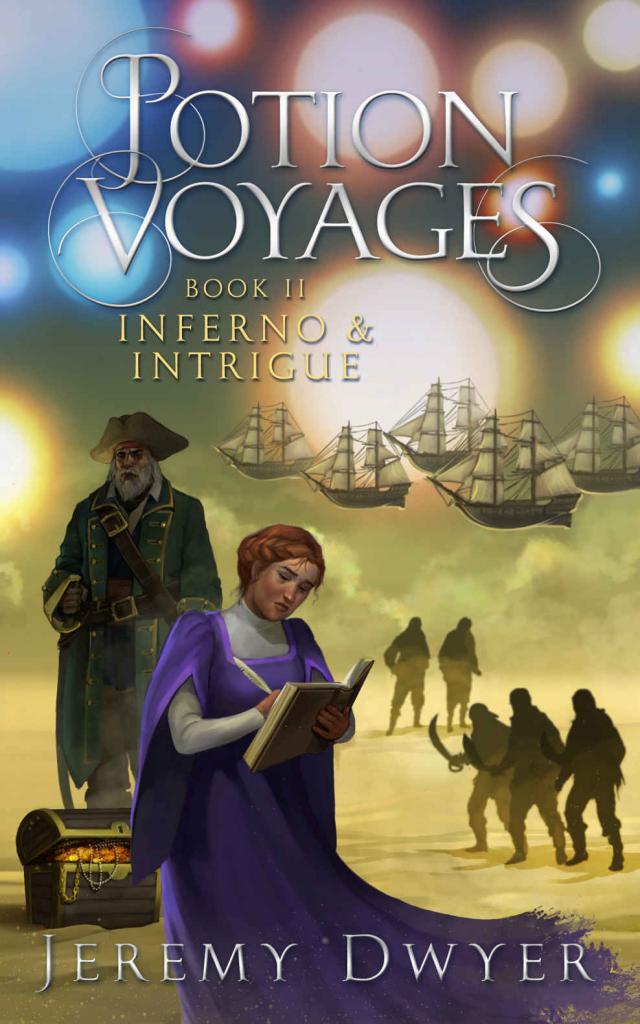


Potion Voyages®
Book 2: Inferno & Intrigue
By Jeremy Dwyer
Copyright 2016 Jeremy Dwyer
All Rights Reserved.
No part of this book may be reproduced in any form, except in the case of brief quotations for the purpose of articles or reviews, without express written permission from the author.
This is a work of fiction. Any similarity to real locations, objects, events or persons, living or dead, is purely coincidental, and not intended by the author.
Potion Voyages® is a registered trademark of Jeremy Dwyer.
(Last Revised Sunday, January 28, 2018)
ACKNOWLEDGMENTS
I’d like to thank my wife, Rachel, and our son, Ethan, for allowing me to work the long hours required to write this book.
Ebook Cover Design was done by http://www.ebooklaunch.com.
Visit the official website at http://www.potionvoyages.com for more information.
Table of Contents
CHAPTER 1: Farm, Faith and Fire
CHAPTER 2: Song, Star and Sickness
CHAPTER 3: Swords, Spirits, Spies and Ships
CHAPTER 4: Duke, Demon and Dragon
CHAPTER 5: Talents and Trials
CHAPTER 6: Rivals and Ruiners
CHAPTER 7: Architect and Alchemist
CHAPTER 8: Crisis and Crystal
CHAPTER 9: Compassion and Commerce
CHAPTER 10: Principle and Prayer
CHAPTER 11: Wall and Wisdom
CHAPTER 12: Puzzle, Pirate and Pattern
CHAPTER 13: Song and Spirit
CHAPTER 14: Fortune and Fear
CHAPTER 15: Doubt and Dining
CHAPTER 16: Violet and Victorious
CHAPTER 17: Jester and Judgment
CHAPTER 18: Structure and Spirit
CHAPTER 19: Fleet and Fury
CHAPTER 20: Anger and Avarice
CHAPTER 21: Discovery and Division
CHAPTER 22: Defeat and Delivery
CHAPTER 23: Tactics and Torpidity
CHAPTER 24: Undying and Unseen
CHAPTER 25: Haunt and Hymn
CHAPTER 26: Wager, War and Water Purity
CHAPTER 27: Strategy and Spirit
CHAPTER 28: Ghosts and Guard
CHAPTER 29: Past and Purpose
CHAPTER 30: Faith and Future
CHAPTER 31: Demons and Demands
CHAPTER 1: Farm, Faith and Fire
Romana drew the vial that hung on a chain around her neck, and took a deep drink of the waters of the Gradaken Ocean within it. She was now energized. The four (4) youth around her did the same for the first time in their lives: they were waterbound now.
Romana knew that this wasn't the Jenaldej way under which she was raised, since the youth were all under the age of twenty-three (23) and too young to take the trials, to see which water was best matched to their inborn potential. However, she wasn't living in the Jenaldej homeland on the continent of Revod, and the local communities here on the continent of Meridianus needed farmers. The Gradaken Ocean waters they drank would make them produce a better quality of yield than they otherwise would: that is, if they were willing to do the hard work. Romana was thirty-one (31) years old, and had been doing the work of farming here for two (2) years now, all while training various groups of adolescents: some were eager to work, some others were reluctant.
Romana walked the fields of the farm, slowly, planting seeds as she went, and the four (4) youth followed her.
There was Jengo, a sixteen (16) year old dark-skinned boy. He was strong and eager to plant seeds on the entire field, however long it took, never tiring. There was Sethunya, a nineteen (19) year old dark-skinned girl. She was very wise and kind and wanted to learn the wisdom of Romana's heart. There was Conrad – a twelve (12) year old boy – who only wanted to make sure there was enough food to eat and was doing this because his parents pressured him. Then, there was Theresa, a fourteen (14) year old girl who wanted to plant seeds more quickly, and she was worried that there wouldn't be enough to eat when people in the nearby towns needed it.
Romana said to them: "Healthy farming isn't about animals or machines doing the planting work. Each and every seed must be individually planted, with your personal attention, and touched by your own hands. When you drink the waters of the Gradaken Ocean, they change you, and then you change nature around you. You will have an energetic way about you, and project an aura. That aura will interact with nature – both with plants and animals – and they will respond. Animals will be subdued into useful service, and not strike at you or resist you. The seeds of plants will grow more richly, and sometimes more quickly. Those who eat their fruits will be healthier."
Romana's slow pace had a dual-purpose. She wanted to plant the seeds carefully and lovingly, of course, but she also wanted to teach these youth how to think about planting and farming, so that they would be just as careful and loving.
Romana could see that Theresa was growing impatient. Romana said to her: "There's little to gain if we rush things. Healthy farming cannot be done in haste."
Theresa looked like she was ready to cry, and said: "But how are we going to feed everyone in time?"
Romana smiled and spoke to her, and to all of the youths, saying: "They will eat. And the food will be very good. So good, in fact, that they will be healthier when they eat of it, and resist some diseases. It is definitely going to be worth the wait."
Romana continued, saying: "Personal attention to each and every seed, with love and patience, is like the personal attention and love and patience that God has for each and every one of you. These seeds will grow, because the gift of the Gradaken Ocean waters that flow through you now – and for the rest of your lives – is His Gift to you. There is much power in it, and you have been chosen to wield it to feed God's children."
Conrad dismissed this, saying: "It's just crystals and chemicals. And it's not even all that great if we have to walk these fields this slowly. We'll die out here from the heat and exhaustion."
Romana responded, saying: "Hard work is proof of sincerity and focus and, most of all, love. It's a measure of how committed that you are to helping others. Love gives of the self."
Conrad snapped back, saying: "I love myself, too. And I thought rest was necessary."
Romana had the answer and said: "You will have rest, and others will share the burden with you, and produce plenty. More of them would help you – and further lighten your burden – if only they could give up their love of mining for the crystals they treasure with all of their hearts and come to work in these fields."
Jengo was working hard, and did not complain, but felt the need to speak: “As long as I know the hard work we’re doing is helping to feed people, as long as there’s real evidence, then I’m happy to do it. I want the burden shared only so that there’s enough food.”
Romana answered him back, saying: “There is evidence. You are doing the right thing. They continue to eat and eat very well, indeed. But sharing the burden is something they will do only when their values change.”
Sethunya paid close attention to Romana, and wondered how more young people might be convinced to come to work in these fields. She asked: “If we show them the food we grow, and how good it is, then why isn’t that good enough? Do they really treasure their diamonds that much?”
Romana seemed annoyed, but not at Sethunya for asking; rather, she was annoyed at the townspeople for their greed.
“They really do prefer diamonds. Their hearts are hardened – until they’re hungry again – and then they wonder why there’s not enough food. Then, when they’re well fed and their health is robust, they put all of their energy back into mining, to get rich,” Romana said.
Judith had stayed with Romana these past two years, and chronicled the work that she did in the fields, and the names of the young people she taught, and how they were given the waters of the Gradaken Ocean. Judith also noted how much food went to each town, and how many tons of diamonds those townspeople mined.
Romana had kept her promise of two (2) years of service, yet she continued to work and teach beyond that period. Romana personally recorded all of the farming work she did – including which types of seeds were planted in which sections of the fields – into a log book so as to measure progress and to rotate crops over time in order to replenish the soil. Judith regularly asked to see this log book, and Romana shared it with her. The Chronicler then quickly copied Romana’s notes using a shorthand notation into her own book as part of the chronicles she kept.
Judith also noted that the suns did seem hotter, and the positions of the suns were different, and more concentrated. In the sky over this region were one (1) large, hot blue sun and two (2) medium, warm yellow suns along with five (5) of the small, cool red suns. Yet, their combined heat was anything but cool: it was getting somewhat uncomfortable, and the children could not work in the fields as many hours in recent days.
Romana noticed this as well, and she turned to the children and spoke to all of them: “You should go home now, and get rest from the suns.”
Judith turned to Romana and said: “I have documented the fulfillment of your oath to work on the farm here for two (2) years.”
Romana knew that this was a formality, but that the Chronicler was obligated to acknowledge it. Romana replied: “Thank you, trustworthy Judith. At this point, I will continue to work here as long as more pressing matters don’t call for my attention. These people still have a distorted value system. It’s one that values treasure above food, and demeans the importance of feeding the hungry, and the work of the farmer. These children have real potential, and are receiving their training correctly, and sometimes even eagerly. But even some of their value systems have to change, and that takes time and teaching.”
Judith agreed in her heart and soul that Romana was completely correct about the distorted value system held by these people. However, she couldn’t contribute or say anything that might constitute interference or judgment, as she was still bound under the Chronicler’s Oath. The two of them retired from the fields for that day.
Romana visited a nearby port city, awaiting a delivery of waters. Judith accompanied her, ostensibly to document the commercial transaction. However, Judith had another reason, as well: she was comforted by listening to Romana, and considered her to be wise, despite her young age. Of course, one thousand two hundred forty-one (1241) year old Chronicler considered just about everyone to be of a young age. While Judith never really had any belief in God or angels, she was still searching for answers, and thought that Romana’s words were worth hearing, and that Romana made compelling points in her arguments and by her generous actions in service to others.
~~~
Captain Pradrock and Torin arrived at the northern port of the continent of Meridianus and were ready to sell additional supplies of waters of the Gradaken Ocean that had been purified to a high level. They brought their water supply in a crate and carried it down the boarding ramp of the Meticulous to meet their customers at the pier.
Romana held a satchel in which she had several diamonds she received in payment from the local diamond miners in exchange for food. She was not against mining in general, or even diamond mining in particular, as diamonds and other crystals were used to collect energy from the suns to power airships and to build transparent structures and instruments for observation. Also, diamonds were used to cut other materials due to their hardness. Rather, she was against the proportions of things that the townspeople were doing: that is, the relative percentages of people employed in different occupations and, therefore, under different waterbindings: many chose the waters of the Kazofen Ocean for the ability it gave them to manipulate crystals and stones; few chose the waters of the Gradaken Ocean for the ability it gave them to control plants and animals. Yet, Romana believed that all things ought to be in the proper numerical proportion, and this point was made repeatedly during her youth by the Jenaldej mathematics instructors in Revod.
The Jenaldej Empire was insistent about one thing above all else: mathematics. They measured, and calculated, and proved, all the time, in every area of study. Despite being a farmer by her own innate potential and waterbinding to the waters of the Gradaken Ocean, Romana was a well-rounded scholar who traveled and taught and regularly studied in Emeth, so she had to know more than the usual person did about topics such as trigonometry, calculus, algebra and probability. She even had to be able to prove relations about angles and functions of angles, and their sums and differences. She had to be able to calculate areas between parabolic and other curves, and even calculate conditional probabilities. She was not an expert like some, and had to use writing implements to record her intermediate steps, rather than reasoning completely in her head, but she could do it very competently.
Romana’s usual studies in Emeth were put on hold for the past two (2) years so that she could work to rebuild the farms here, and thus enable the other industries – such as diamond mining – to continue more effectively. Since the Jenaldej Empire had business contracts with the diamond miners here, they accepted this temporary change of Romana’s scholarly schedule and assigned other scholars to carry out her former duties during this time.
“Greetings, Captain Pradrock, and Torin,” Romana said and smiled.
The captain and his apprentice were accurate, reliable and fair, even though neither one was raised in the Jenaldej Empire. Judith was observant of all of this.
Romana opened a satchel and handed five (5) of her diamonds over to Pradrock, who placed them into a satchel of his own. He then opened a crate containing one hundred ten (110) vials of the waters of the Gradaken Ocean and began handing them to Romana: some were for her, some for her apprentices. He also handed over several vials of waters of the Ursegan Ocean to Judith, free of charge. Although Judith always carried her own as the Chronicler’s Oath demanded that she be prepared, the Oath also demanded free transport of Chroniclers to Emeth and to other locations. This was widely understood to also imply transportation of their waters, which were often – though not always – the waters of the Ursegan Ocean. Few merchants ever charged Chroniclers for water deliveries, and those few who did charge asked a lower price of Chroniclers than they did of the general public. Still, Judith was appreciative for the supplemental delivery.
“I thank you, captain,” Judith said to Pradrock.
Judith carefully recorded the business transaction into her book, counting the diamonds and the water vials as they changed hands.
After handing over the last water vials, Torin stumbled and fell. The heat of the suns was too much for him. Pradrock turned quickly to grab him and even Romana rushed to his side.
Judith noted this into her book, and she was concerned. She inferred that the boy had too much sun exposure while out at sea, and was too young to resist its effects, as he was still in his growing years. She was right: he was only seventeen (17) now. Even though he and the captain would certainly use protective measures – a cloak over the body and a crystal lens over the eyes – whenever traveling as an airship because of the increased altitude, it was doubtful that they would use those same measures while sailing at sea level, which would be for most of any journey. Under the increasing heat of these suns, she supposed that those protective measures may be necessary at all altitudes now.
Still, Judith said nothing, bound by the Oath to not interfere. She wanted to speak up and demand something more. She was screaming inside to say more, but had learned over the centuries as a Chronicler to quiet that voice. The Chronicler’s Oath always took precedence, and, by its tenets, interference was still forbidden.
Judith had another way. She said: “Captain Pradrock, I request transport to Emeth, directly.”
Pradrock was obliged by law to support the Chronicler in keeping the Oath: travel to Emeth was a tenet of the Oath that was binding even to those who did not actually take it for themselves.
“I will provide you direct transport; we can depart immediately, if you wish. I just need to keep him out of the heat of the suns,” Pradrock said.
“I wish it immediately, Captain,” Judith said to him. The captain had already acknowledged the boy’s need to be kept out of the heat of the suns. Judith furthermore wanted to keep Torin from traveling on additional commercial ventures under these conditions. Instead of work, Torin would be taken to Emeth, where he could take rest and perhaps there would be some scholar there who had an answer to avoiding illness due to all of this heat, or at least the beginning of an answer. This was one form of interference with other people’s plans that the Oath did support. At this, they boarded the Meticulous and began the journey northeast across the Trerada Ocean.
~~~
Romana remained on Meridianus to continue her work rebuilding the farming community, for a little while longer.
CHAPTER 2: Song, Star and Sickness
Taesa was nineteen (19) years old, and had been studying at Emeth for two (2) years now. She was avidly researching history and art, most especially music in the Twelfth (12th) Hall. She was occasionally instructed by Lady Onora Elettra, a fifty-five (55) year old woman, who herself drank of the waters of the Pirovalen Ocean and had a high inborn potential for musical performance. Onora was an exalta – one who gives exaltation in song – and quite religious. Taesa’s mother, Caroline, did not approve of Onora’s influence on Taesa due to this, and wanted her daughter to be free of what she described as a debilitating thought pattern, which was how Caroline described belief in any deity.
Onora was among the finest musical instructors who was resident at Emeth, and was very familiar with songs both new and old, including the ancient and extremely ancient, some dating back over three hundred fifty (350) millennia. Onora spent much time in the archives, in the Twelfth (12th) Hall, where musical compositions were inscribed and many musical instruments could be found, including ancient music boxes which recreated melodies of the past. She herself authored many songs and their melodies, and frequently traveled the world to perform them for different religious ceremonies. However, she always vehemently refused to sing the songs of sun worshippers, such as Praise Every Sun Upon the Sea. To Taesa, it was just a work of art, as she herself had no belief in any deity, having been raised under Caroline’s influence her entire life. However, to Onora, singing this song was the highest sin, condemning one’s soul to the Maelstrom of Vengeance for betrayal of God. She admitted its existence, but trained no one in it, and warned Taesa away from it. Taesa never admitted to her to having already sung it when she was younger and living on the continent of Meridianus.






