Pasiphae, p.1
Pasiphae, page 1


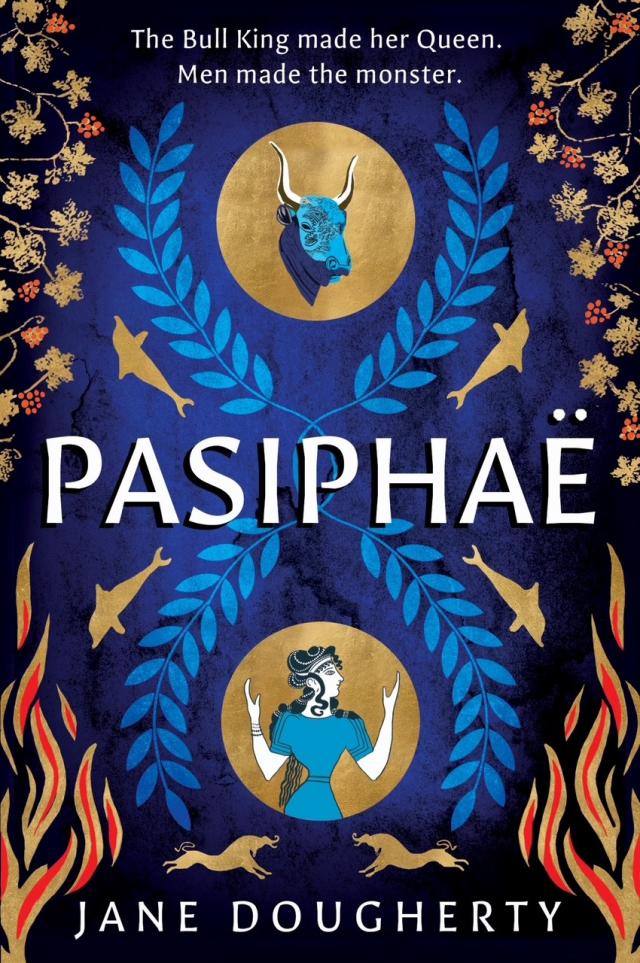
Pasiphaë
Jane Dougherty
Legend Press Ltd, 51 Gower Street, London, WC1E 6HJ
info@legendtimesgroup.co.uk | www.legendpress.co.uk
Contents © Jane Dougherty 2026
The right of the above author to be identified as the author of this work has been asserted in accordance with the Copyright, Designs and Patents Act 1988. British Library Cataloguing in Publication Data available.
Print ISBN 978-1-91716-329-3
Ebook ISBN 978-1-91716-330-9
Set in Times.
Cover design by Rose Cooper | www.rosecooper.com
All characters, other than those clearly in the public domain, and place names, other than those well-established such as towns and cities, are fictitious and any resemblance is purely coincidental.
All rights reserved. No part of this publication may be reproduced, stored in or introduced into a retrieval system, or transmitted, in any form, or by any means electronic, mechanical, photocopying, recording or otherwise, without the prior permission of the publisher. Any person who commits any unauthorised act in relation to this publication may be liable to criminal prosecution and civil claims for damages.
Jane Dougherty is of Irish origin, and was brought up in Yorkshire. She studied Early European Medieval History and Literature at Manchester University. Her first job with a London wine merchant, sent her to Paris where she settled down and worked until her fourth child was born and the family moved to Laon, a medieval town in the Aisne. She worked as a freelance translator and voice actress in Laon, where her fifth child was born, and began writing short stories and a YA series for her teenage children. She carried on translating and recording voice-overs for short films after the family moved south to Bordeaux. Her first novel was published by an American publisher Musa in 2014, then a YA series by Finch Books in 2016. Since moving to the countryside of the Lot-et-Garonne in 2017, Jane has written several novels. Her poetry and short stories have been published online and in anthologies and magazines. She has been nominated twice for the Pushcart Prize and has published three poetry pamphlets.
This book is dedicated to my parents, grandparents and all the grandparents before them, for giving me a history and teaching me its importance. They gave me both the passion for unravelling a story until I hold the threads of a truth, and the tools to create something new with them.
Part One
The far-shining girl
Pasiphaë, Moon Princess of Kolchis, was wife of one star and mother of another. Her story began, to all intents and purposes, at the first full moon after the spring equinox of her fifteenth year. It began as the story of the second daughter of the royal house of a not very important country, and it grew and swelled, like a child growing in its mother’s belly. It became the story of a woman who rose to the summit of the greatest power in the world. She was given two stars to hold, and when they fell, the world fell too.
1
Kolchis
The touch of a hand on her shoulder dragged Pasiphaë from the blinding blue of sea and sky, dissipated the scents of honey and thyme on hilltops baking in searing dry heat, the taste of roses. The roaring of lions faded. Wolves were howling their eerie songs on the mountain, and all that remained of the dream was a pang of longing and loneliness.
‘Princess, your mother wants you.’
The young pine marten curled up on the pillow woke too, opened amber eyes, unwound her supple body and stretched. With a sigh, Pasiphaë swung her legs out of bed. The servant didn’t bother to explain, and she didn’t ask. These midnight summonses happened often enough. She slipped her feet into her sandals, and the girl handed her a warm cloak. Together they pattered across stone pavements through the sleeping house. The marten followed.
The royal house of Aea was old, perched on a hill among tall trees, lush and evergreen. It was spring, it had been raining, and the night air was sweet, salty and flowery. Pasiphaë tried to recapture the dream, the taste of roses, but curiosity about what her mother wanted swept it away definitively. She followed the servant through the house, the empty central courtyard where the sacred basin lay still and silvery in the silence. This wasn’t an official ritual then, with fierce priestesses and the wild weaving of sacred dances. This was special, secret, and they left the courtyard and the house behind, taking the path through the night garden.
In a clearing among the dark trees was Perseis’s private stone basin, and Pasiphaë entered the grove of fig, plum and oak alone. The spot was sheltered by a dark flank of the hills, clad in a thick pelt of pine forest. Dawn broke late here, but evening lingered in the scented faces of roses, the pale blooms of rhododendrons. Through their wild vegetation, she saw the light of flames flickering on water.
Night spread stars overhead between the passing clouds, and below, fire blazed bright. In and out of the firelight, shadows moved – Perseis, her mother, and Circe, her older sister. Dark hair glittering with gemstones was caught up in golden fillets; dark eyes flashed in the flame light. Her mother and sister had dressed as carefully for this ritual as they would have done for a public one.
‘Mamá, what’s all this about?’ Excitement chopped the words small, nostrils quivered at the smell of herbs in the tripod over the fire, pine smoke, the sharp pinch of juniper. The moon sailed between the clouds, revealing the broad smile on her sister Circe’s face.
‘We’re going to find you a husband.’
Perseis hushed her. ‘We’re going to look and hope that we find.’
Circe shrugged. ‘Why wouldn’t we? The world’s full of men.’
Perseis shot Circe a reproachful look. ‘Exactly. Too full. The world’s getting smaller, louder. Even the sea creeps now with warships full of men looking for adventure, booty, people to enslave. Remember those brutes washed ashore this spring? Thinking they’d find golden sheep grazing in the fields with only a few girls to protect them?’ She sighed one of her theatrical sighs. ‘We will have to cast our nets wide to find a suitable husband for you, Pasiphaë.’
Perseis made it sound like a hardship, but Pasiphaë knew there was nothing her mother loved more than disappearing into the sea. She practised water magic, and some claimed she wasn’t a woman at all but a nymph. Sometimes she thought her mother was neither woman nor nymph, that her true nature was wave. When she talked about her countless sisters, Pasiphaë saw them as the rippling surface of the sea. She was never invited when Perseis took Circe to visit these famous aunts, to swim with dolphins and women as supple as seals. She had no sea blood, they said. She was the Moon Princess, a daughter of the sky and the air. Pasiphaë hated the sea.
‘Where? How far?’
Perseis sprinkled a pinch of something pungent into the bronze bowl from a jar placed on the parapet of the water basin, and sparks spat, green and blue. ‘Patience.’
Pasiphaë settled her skirts about her and perched on the edge of the basin. The marten sprang onto her lap, then her shoulder, and peered through the smoke into the pool from beneath her ear. From another jar, with a polished wooden spoon, Perseis took some of the thick, sticky potion that she called fruits of the earth, a mess of dried and ground leaves and berries, mushrooms and bark. There was blood in it too, and beetles’ wings. The mess was full of magic and visions, and Pasiphaë watched with a slight shudder as her mother’s teeth parted, her tongue darted, almost as red as her painted lips. The dark, heavy-smelling stuff disappeared and her jaw worked, chewing. With a gesture of studied indifference, Circe helped herself to a spoonful and drifted off, chewing abstractedly, to sit at the pool’s edge.
Perseis swallowed, licked her lips and looked down into the pool where petals floated, broad and pale in the moonlight – rhododendrons. The water was misty, but not with cloud reflections. Circe played a tune in honour of the Mistresses on a syrinx. The reeds fluttered softly like small birds, and Pasiphaë hummed then took up the words of the song, a song of life and love and death.
Her mother swept the surface of the basin with a bundle of oak leaves, her movements as graceful and fluid as waves, murmuring an incantation, too low for Pasiphaë to catch the words. Pasiphaë watched, singing and rocking to and fro, waiting for the water to clear. The water would clear for her mother; it always did. Circe would claim she saw the vision too. Maybe she would; her eyes were certainly sharp enough. Pasiphaë expected simply to be told what the vision showed.
Circe’s tune changed tempo and volume, loud now as the fluting of an owl, and she watched, almost as intently as Pasiphaë, the story that was beginning to unfold on the pool’s surface. Circe knew her destiny. As the elder, she would rule in Aea after Perseis, but beyond Kolchis, who knew how many peoples respected the ways of the Mistresses? Did anyone? Pasiphaë understood why Circe would be pleased to have a sister in a strong place to keep back the wave of bronze blades that was sweeping the world.
‘Stop fidgeting. It’s a bad habit.’ Circe frowned at her from beneath the dark cloud of her curls. ‘And that creature in your hair,’ she wrinkled her nose, ‘it’s disgusting.’
Pasiphaë placed a protective hand on the small animal peeping through her sleep-loosened tresses and glared at her sister. Perseis paid no attention. She rarely noticed fidgety or untidy behaviour. Her thoughts rolled with the tides, and she moved with them, in waves of graceful gestures, at one with the water, her thoughts woven into the unseen currents. Suddenly, her pose tensed. Circe’s mockery stopped abruptly, forgotten, as she to o peered into the pool.
‘Pasiphaë, shut up.’
‘I didn’t say anything!’
‘Mamá, is that Knossos?’
‘Such a big house, immense, gallery after gallery, tier upon tier…’ Perseis’s voice was distant, a song at the bottom of the pool. Pasiphaë listened. ‘Paintings, blue and red, golden dancers, lilies, bulls. Where else can it be?’
‘It seems empty. There’s something missing. I don’t feel any…’
‘In the dark room, do you see, Circe? On the bed? The girl in red, pale as death.’
‘Is she dead, Mamá? She looks it. Laid out all in red, like a blown poppy, and such a weight of gold at her neck…’
‘It’s a serpent. She was a High Priestess. Princess.’
Pasiphaë saw nothing, just water lilies and reflections of the stars. She glanced at her mother, waited for her glazed eyes to focus again, for her to explain.
‘Europa is dead, but I knew that, and she must have been forty when she died. This dead Princess isn’t Europa.’
‘So, who is she?’ Pasiphaë found some interest, if only morbid, in the fate of a girl who looked much the same age as herself.
‘I’d say it’s Kriti, the child Europa had with Asterius of Knossos. Her only daughter. She must be ten or eleven years old now, and they say she is sickly. This dead poppy girl looks rather older.’ Perseis glanced at Pasiphaë. ‘About fourteen, maybe fifteen. The seeing must be showing the future. Kriti might not be dead yet, but it looks as though she soon will be.’ Perseis frowned, considering the future and how she and hers fitted into it. ‘Of course, the seeing might be wrong, but if, when Kriti dies…’
‘If Kriti dies, one of those half-brothers of hers will demand the throne.’ Circe’s eyes had narrowed, staring into a bloody, violent future.
Perseis was barely listening, deep in thought, picking shreds of scrying potion from between her teeth. The bitter mixture sharpened her sight, she said. It certainly made her see some very funny things. Circe used it too. Pasiphaë had tried the foul-tasting stuff once and had had to go and lie down for the rest of the day, her head full of flashing lights, burning clouds, trees that grew limbs and leapt like dolphins into the sea. Perseis had not proposed it again.
‘So, suppose Kriti dies, who does that leave?’ Perseis asked herself thoughtfully.
‘Europa hasn’t got any nieces?’ Pasiphaë asked, more to show that she was following the conversation than out of any real interest.
‘Oh, pay attention, Pasiphaë,’ Circe snapped. ‘Haven’t you followed anything? Europa doesn’t count, she’s foreign, and not of the bloodline, so where do her nieces come into it?’
‘Why was she Queen then?’
It was true that Pasiphaë hadn’t ever followed talk about family histories. They were all so complicated. Her mother, possibly deciding it was time that Pasiphaë knew a little about the unlucky fortunes of the royal house of Knossos, took her hands and looked sternly into her eyes. A signal to Pasiphaë that she was to listen carefully.
‘Years ago, Knossos had a Queen named Keraso, and she chose Lycastus for her King. Well, her last King. She’d had several, but never any children. When Keraso died, it was decided to find the old King Lycastus another Queen, and the one the families of Knossos chose was Europa of Tyre.’
‘Tyre? Why—’
‘That’s another story. All that concerns us is that Europa produced only males for Lycastus, so when he died, they found her another husband from the same royal house as Keraso.’
‘Asterius?’
Perseis nodded and smiled. ‘Asterius. And she finally produced a daughter, Kriti, who will be Queen when she is old enough, and if she is still alive. Understand now?’
‘And apart from Kriti,’ Circe grinned, showing small white teeth, ‘there’s no one left of the old Queen Keraso’s bloodline, except Karpasia, of course.’
Perseis looked thoughtful. ‘I’d almost forgotten about her.’
‘Who’s Karpasia?’
‘A niece, grand-niece maybe,’ Perseis replied in a faraway voice.
‘Well then—’
‘Be quiet, Pasiphaë. Karpasia has a cleft lip and doesn’t want to be Queen. Mind you, they say Minos has been pushing her claim anyway.’
‘Who’s Minos?’ Pasiphaë asked, but her mother wasn’t listening.
Perseis frowned. ‘I heard he is even offering to organise the choice of her King. I wonder whose name the divination would come up with?’
‘At a guess, I’d say Minos. On the other hand, it could be Minos. Unless it was Minos of course,’ Circe said laconically. ‘And I don’t suppose he’s particularly interested in what her face looks like. He’d marry her if she had cow’s hooves and brayed like a donkey, to get his backside on the throne.’
‘That would be disastrous. I imagine Asterius feels the same way. I wonder what he’ll do?’
*
Pasiphaë let her mother and sister’s voices fade out, weighing the possibility of this, the unlikelihood of that. She had lost interest in the plot, the windings of a family tree of a distant royal house. Men didn’t rule; they didn’t decide anything. She dropped a flower petal in the water, blew on it. A tiny boat, drifting. She sighed heavily. As if remembering her second daughter was still there, Perseis turned and looked at her with the pride of a potter in a well-made jar.
‘This one was not named far-shining for nothing. She’ll keep the light of the Mistresses alive. Knossos will be safe with our little Pasiphaë on the throne.’
This time, it was a pebble Pasiphaë dropped in the water. ‘Me? You said yourself, this Princess Kriti isn’t dead yet, that the seeing only shows what might happen. If she doesn’t die, she’ll be Queen as soon as she’s old enough. What’s all this story of sons and cleft lips and thrones got to do with who I’m to marry?’
Perseis exchanged a quick glance with Circe and smiled indulgently at her younger daughter. ‘Of course, Pasiphaë, you’re quite right. Kriti is the heiress and will inherit the throne of Knossos. But Knossos needs a Queen now, a regent, if only for a few years, to keep the throne safe for her. It would be a shame if, because of some palace intrigue, she were to find someone else was sitting on her throne when she comes of age. So unfair.’
‘Until then, as the wife of Asterius, you’ll rule in her place,’ Circe said, and snapped her fingers. ‘Simple.’
‘Has anyone told Asterius? What if he doesn’t want to marry me?’
‘He will. There must be a Queen at Knossos, and you’ll do very nicely.’
Perseis beamed, but Pasiphaë could not rid herself of the image of a fearsome, vengeful woman with a cleft lip. ‘He should marry whatshername, whatever she looks like.’
‘Don’t be silly.’ Circe was already sweeping up her skirts as if everything was settled. ‘He can’t. He’s Karpasia’s uncle. Or perhaps she’s his aunt, I’d have to work it out. They’re far too close anyway.’
Pasiphaë was lost, but she had grasped the gist. The last of the female line of Knossos was Princess Kriti, who was a child and might or might not die young. If she did, Knossos would need a Queen quickly, before someone decided a King would be more appropriate. It was an extraordinary idea, and it only made Pasiphaë even more apprehensive.
‘Do the Mistresses not counsel them then? Don’t they listen to what custom tells them?’
Perseis read her daughter’s fear, and in a rare show of affection, put an arm around her and kissed her on the brow. She smiled. ‘Of course they do. Knossos holds the Mistresses in the highest esteem, and you, Pasiphaë, as Moon Princess and High Priestess of Potnia Theron, Mistress of Animals, will be especially beloved. As adept of Theron, you will make sure that custom is followed, and the throne is kept safe for the Queen.’
Pasiphaë flinched at the recitation of her titles. The burden weighed heavy sometimes, and she noticed Perseis didn’t say the throne was to be kept for Princess Kriti. The unseen image of the girl who would soon be dead, if the seeing was correct, floated behind her eyes, like a blood-red water lily on the pool.